What Is the Fixo in Futsal? Role, Positioning, and How the Game Starts from the Back
Published: 2025.03.29Updated: 2026.05.04
Have you ever wondered, "Does the fixo only need to defend?"
The fixo is certainly the center of the defense, but the real role in futsal is to be the court's key player on both sides of the ball. It would not be an exaggeration to say that the quality of the fixo determines how quickly a team can build its attacks.
In this article, I will break down the fixo's defensive responsibilities, how they feed the pivot, and how they manage the game with the alas. After reading, continue with the fixo-pivot duo to take the ideas further.
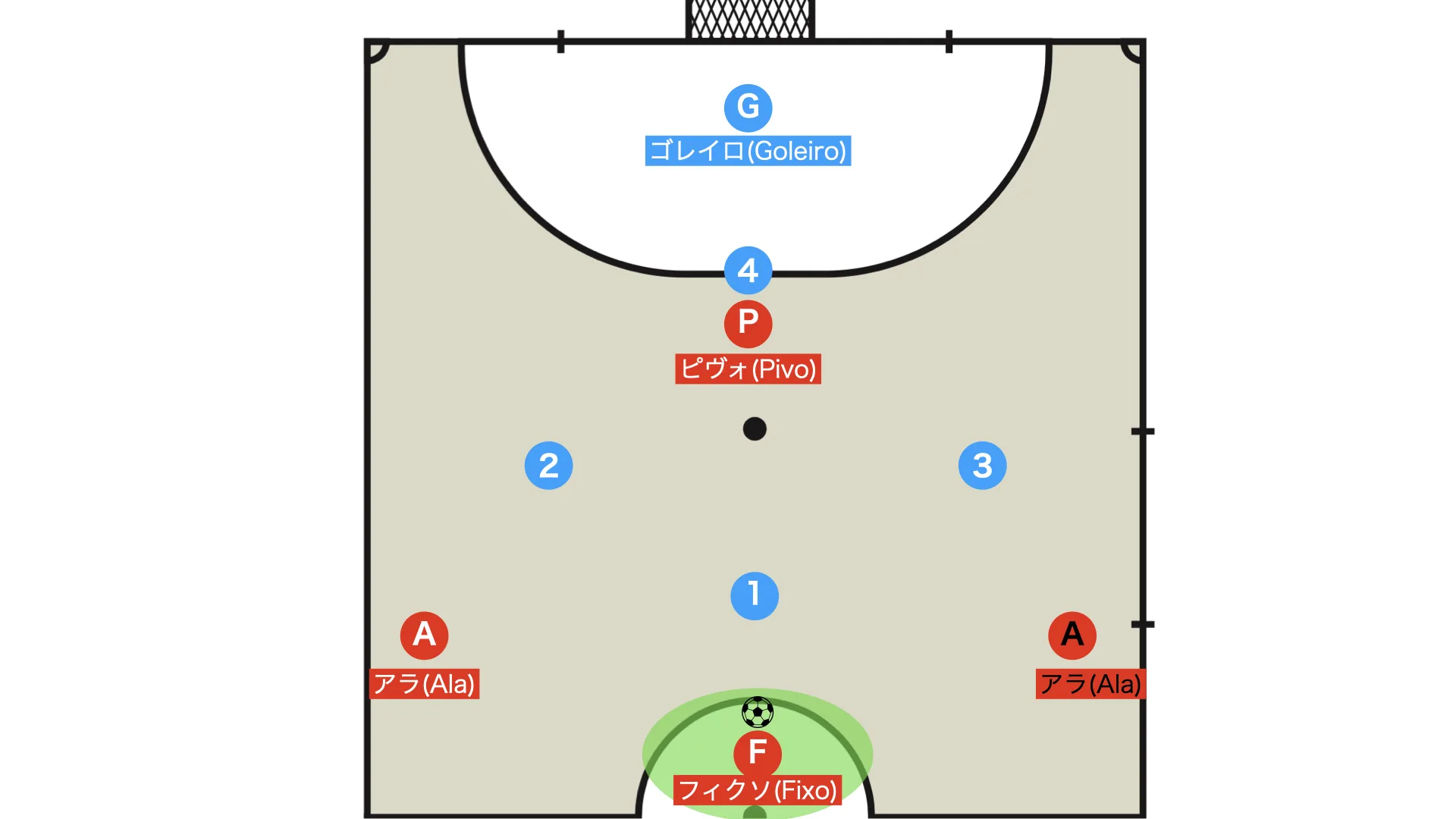
In futsal, the fixo is generally the player positioned in the middle of the back line in a diamond-shaped formation. Their most basic role is to stop the opponent's attack and start building their own team's attacks. Because of that central position, the fixo often sees the whole court and is regarded as the "key player on the court" who organizes the team. Some people simply call them a defender, but their role goes far beyond defending. The word "fijo/fixo" comes from Portuguese and means " fixed ," referring to the fact that they are usually positioned deeper on the court. In modern futsal, however, the fixo is not only the last line in front of the goalkeeper dealing with the opponent's pivot. They also play an essential role in attack.
The fixo's job is not just to protect their own goal. They also need to be very comfortable on the ball and stay calm under pressure. They are expected to read passes, intercept them, and launch quick counterattacks with dribbling or passing. In that sense, the fixo is a true central position that supports the team in both defense and attack.
The fixo's responsibilities are extremely broad. In addition to being the team's defensive stronghold, they also take on key tasks in build-up play and set plays.
The fixo's main responsibility is to protect their team's goal. They work to contain the opponent's forwards, especially the pivot, and prevent scoring chances. To do that, they must mark opponents strategically, win the ball, and keep danger away from critical areas. Disrupting the opponent's possession and cutting attacks off before they develop is also a major part of the role. A high level in 1v1 defending is required as well, since the fixo needs to stop dribble penetration and win the ball. Courage when blocking shots is another essential quality. Communication is also indispensable so they can organize the team and keep the defensive shape in order. On top of that, top fixos are expected to read the flow of the game and anticipate danger. By intercepting the ball and regaining possession quickly, they can break up the opponent's attack and create counterattacking chances. Since the fixo is often the deepest player, they can see the whole court, understand what is happening, and give instructions to teammates.
The fixo is not important only in defense. They also play a major role in attack. They are often the starting point of the team's possession, so they need calmness on the ball and the ability to execute accurately even under pressure. After anticipating a pass and making an interception, the ability to transition immediately into a counterattack is also crucial. Those counters may start with a carry forward or with an accurate pass. The fixo also needs the range to play many kinds of passes in sync with the pivot's movement. Deceptive passing techniques, such as no-look passes, delaying with the sole, and flicks, are important tools for building effective attacks. Even when being pressed, the fixo is expected to control the ball calmly and play accurate passes to become the base of the attack. The ability to beat the opponent's first line of pressure and then play a decisive pass matters a great deal. They also need spatial awareness to carry the ball forward from deep areas and create chances. At times, a surprise forward run can make the fixo extremely difficult for the opposing defense to handle.
The fixo's role on set plays varies depending on the team's strategy, but important contributions are expected in both defense and attack. Defensively, their positioning and willingness to block shots can make them a central figure in defending set plays. That may include marking a key opponent or intercepting by reading the passing or shooting lane. In attack, their close control and passing accuracy can help create chances, whether by shooting directly or delivering an accurate ball into the area. That said, the exact tactical responsibilities on set plays are determined by the team's overall strategy and the coach's instructions.
To succeed as a fixo, advanced technique, strong physical ability, and tactical intelligence are all essential.
The fixo needs a high technical level that can handle many different situations. In passing, they must be able to use accurate passes of many different types. Passing skill that deceives opponents is also important. Stable ball control under pressure is essential so they do not lose possession. Dribbling skill also matters, both to escape pressure and to find ways to start attacks. A proactive mentality in front of goal is valuable as well, and when the chance is there, the fixo should be willing to shoot. In recent years, there have been more goal-scoring fixos, and the role increasingly demands the ability to finish chances when needed.
The fixo needs the strength to handle intense physical contact in defense and the speed to move quickly into position. Agility to respond to attacks and endurance to maintain a high level on both sides of the ball are also indispensable. Courage to throw themselves into shot blocks and the energy to lift the team are physical qualities that matter for a fixo as well.
The fixo needs the ability to read the flow of the game and anticipate danger. A wide field of vision that takes in the entire court, together with proper positioning according to the situation, is also important. They must be able to judge situations instantly and choose the best action in both defense and attack. Leadership and the ability to organize the team are traits seen in many fixos. High concentration and sound decision-making on both sides of the ball are also indispensable. Tactical understanding and the discipline to follow the team's structure are required as well. The ability to evade pressure calmly is another important part of the role.
The fixo plays a hugely important role in a futsal team's tactical structure. Their presence affects not only the stability of the defense, but also the way the team builds attacks. It is no exaggeration to say that the quality of the fixo can shape the team's success. Much like a point guard in basketball, the fixo is expected to control the whole game and provide leadership that holds the team together. The fixo connects the team's overall strategy. While the pivot is the center of the attack, the fixo is the center of the defense. Clear instructions from deep positions and reliable defending give the whole team a sense of security. The ability to win the ball and quickly launch a counterattack also makes a major contribution to the team's scoring power. Communication to organize the team's defensive shape is another core responsibility of the fixo. Their movement affects both attack and defense, making them indispensable to the team's balance. In futsal, positional interchanges happen constantly, and when the fixo joins the attack aggressively, it can disrupt the opponent's defense. On experienced teams, players move freely according to the game state, but the fixo often remains the origin of the attack and controls the game from the back. In that sense, the fixo truly plays a role that can be called the heart of the team's tactics.