Futsal University Foot Tech
A structured guide to learning and thinking about futsal tactics. We organize the game into its major phases and turn them into practical knowledge.
OVERVIEW
A Complete Overview of Futsal Tactics
Published: 2021.02.07Updated: 2026.05.03
Where should you learn futsal tactics?
This site, Foottech, is our answer to that question.
Unfortunately, it is still difficult to find good information on futsal tactics.
At Foottech, we explain futsal tactics from an objective point of view and present what we believe are the best solutions in futsal.
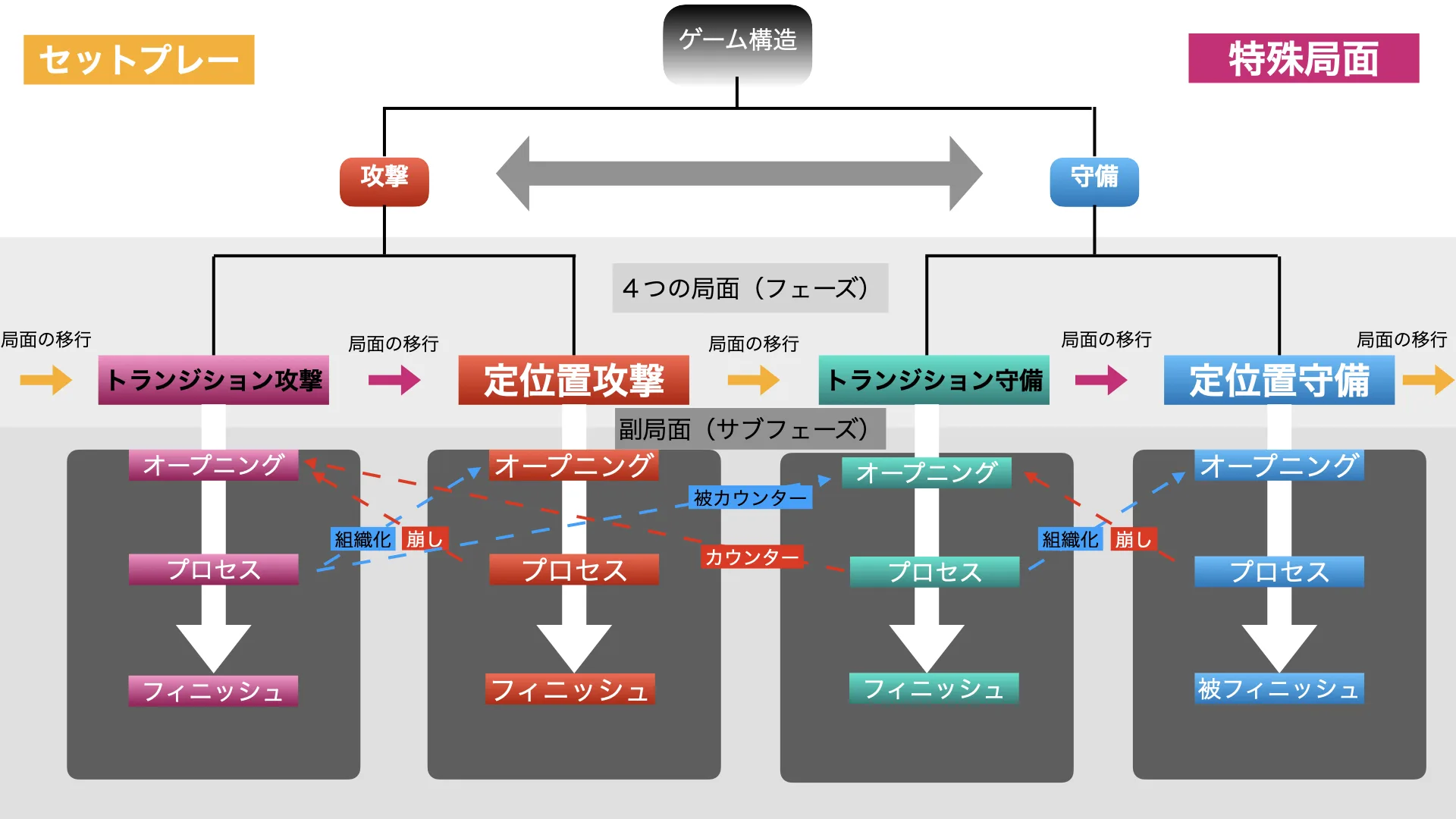
On this page, we also explain the classification of futsal phases, which is impossible to avoid if you want to study futsal tactics properly.
Because this same phase-based classification is also used to organize the articles on this site, we hope you will click the buttons at the top of the site and browse the article index pages related to each topic.
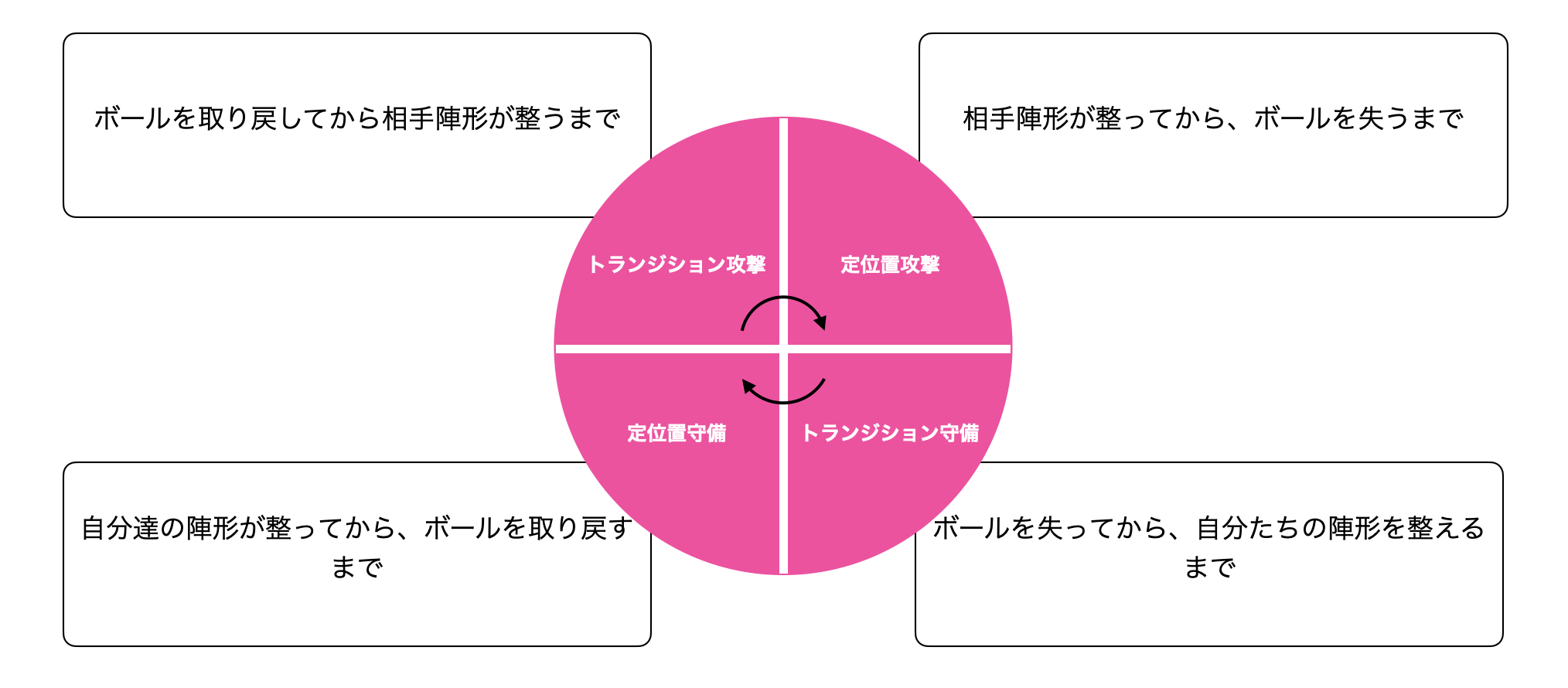
As mentioned at the beginning, grouping the elements of futsal makes discussion about futsal tactics much easier.
If we group futsal according to its game structure, it can be divided into the following four phases:
- positional attack
- defensive transition
- positional defence
- attacking transition
These four phases together are called the four main phases, and a futsal game is made up of these four phases alternating one after another.
From here, we will explain each of the four main phases in more detail.
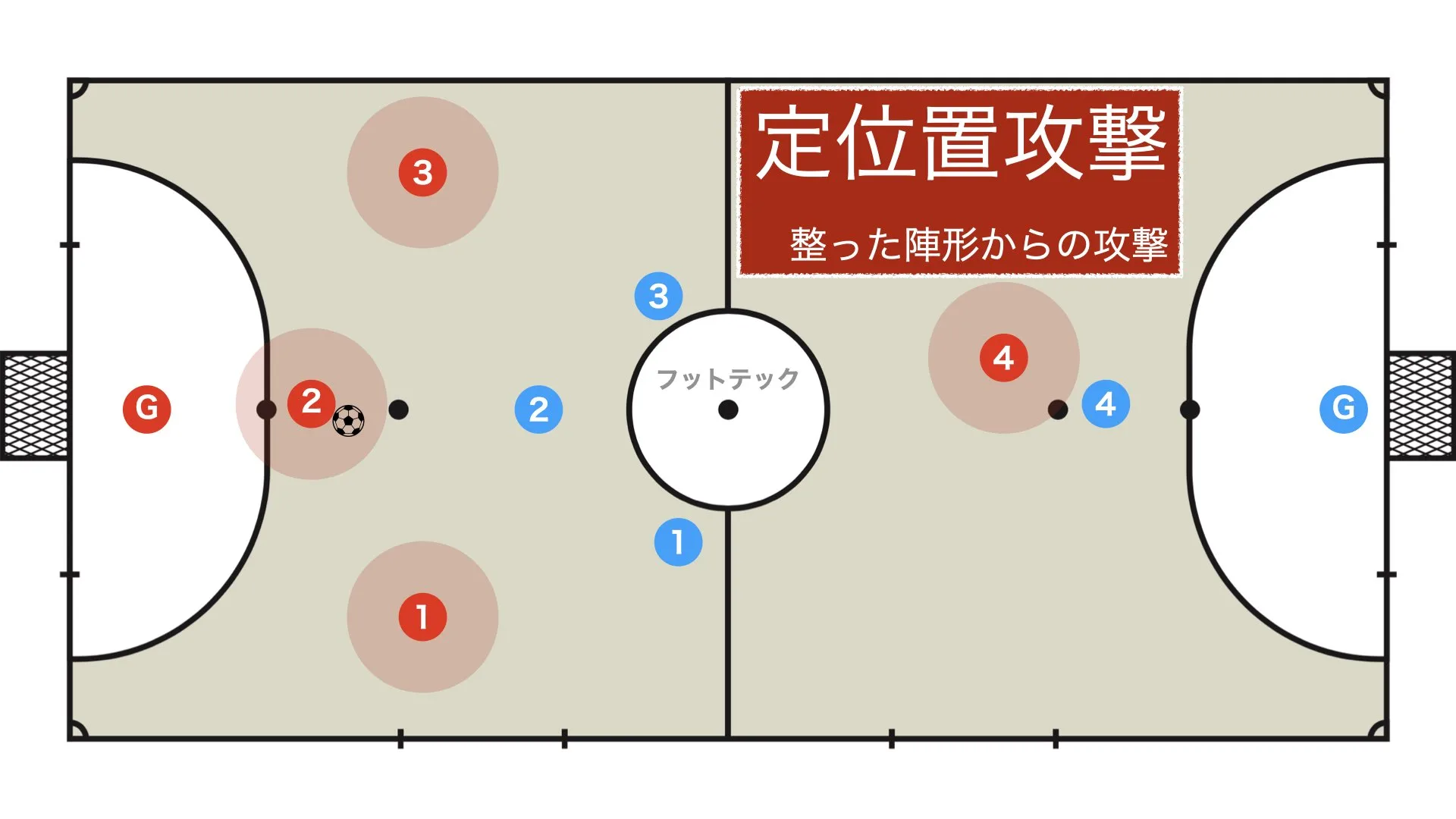
In futsal, positional attack refers to the phase where your team has possession and attacks against an opponent whose defensive shape is already set.
If you fail to score during an attacking transition and the opponent manages to organize its defensive structure, the game moves into positional attack.
We have also prepared an index page of articles about positional attack, so take a look.
関連記事
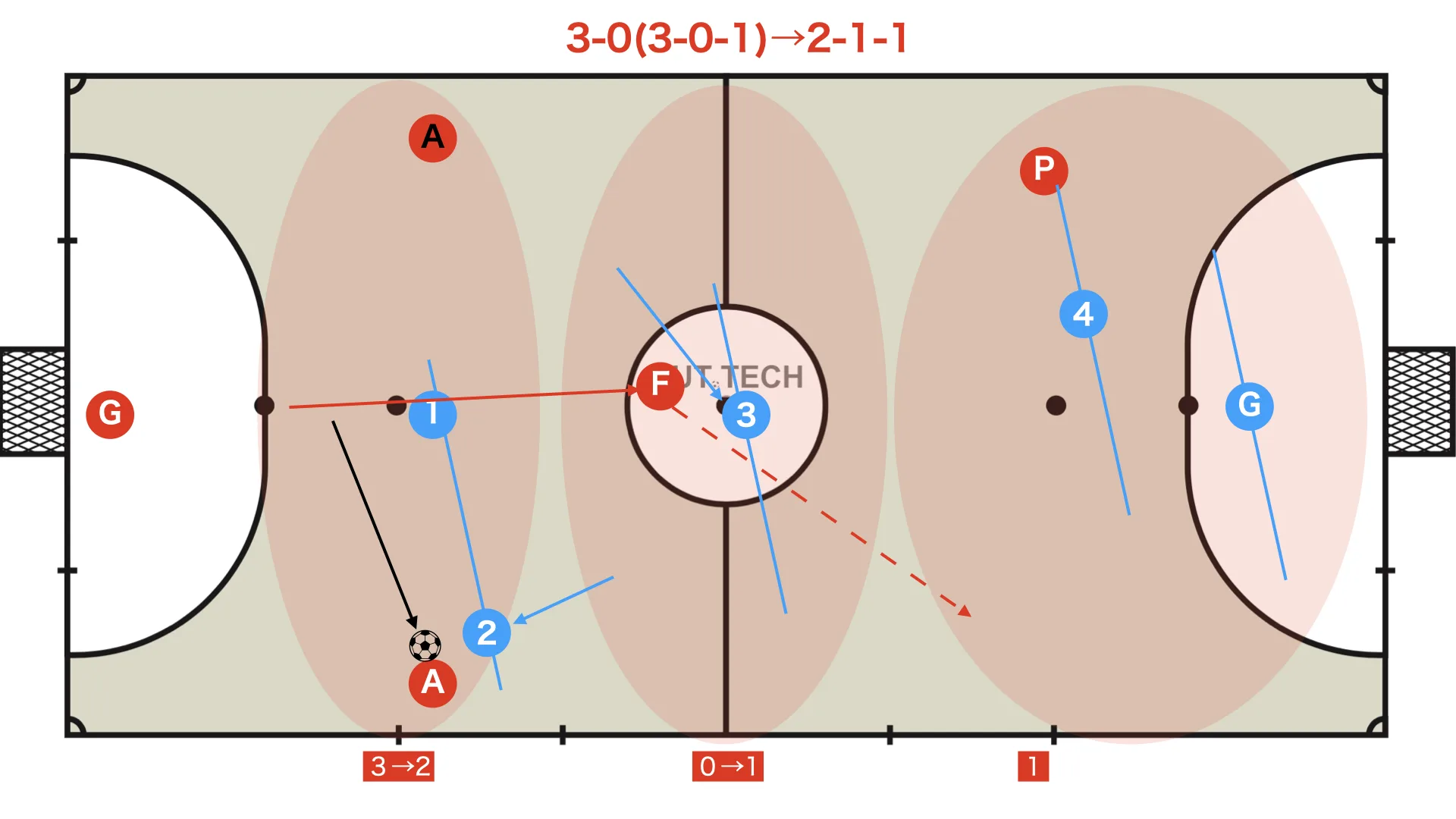
Positional Attack: How to Think About Formations and Rotations
A structured guide to formations and rotations in futsal positional attack. This article explains th…
続きを読む →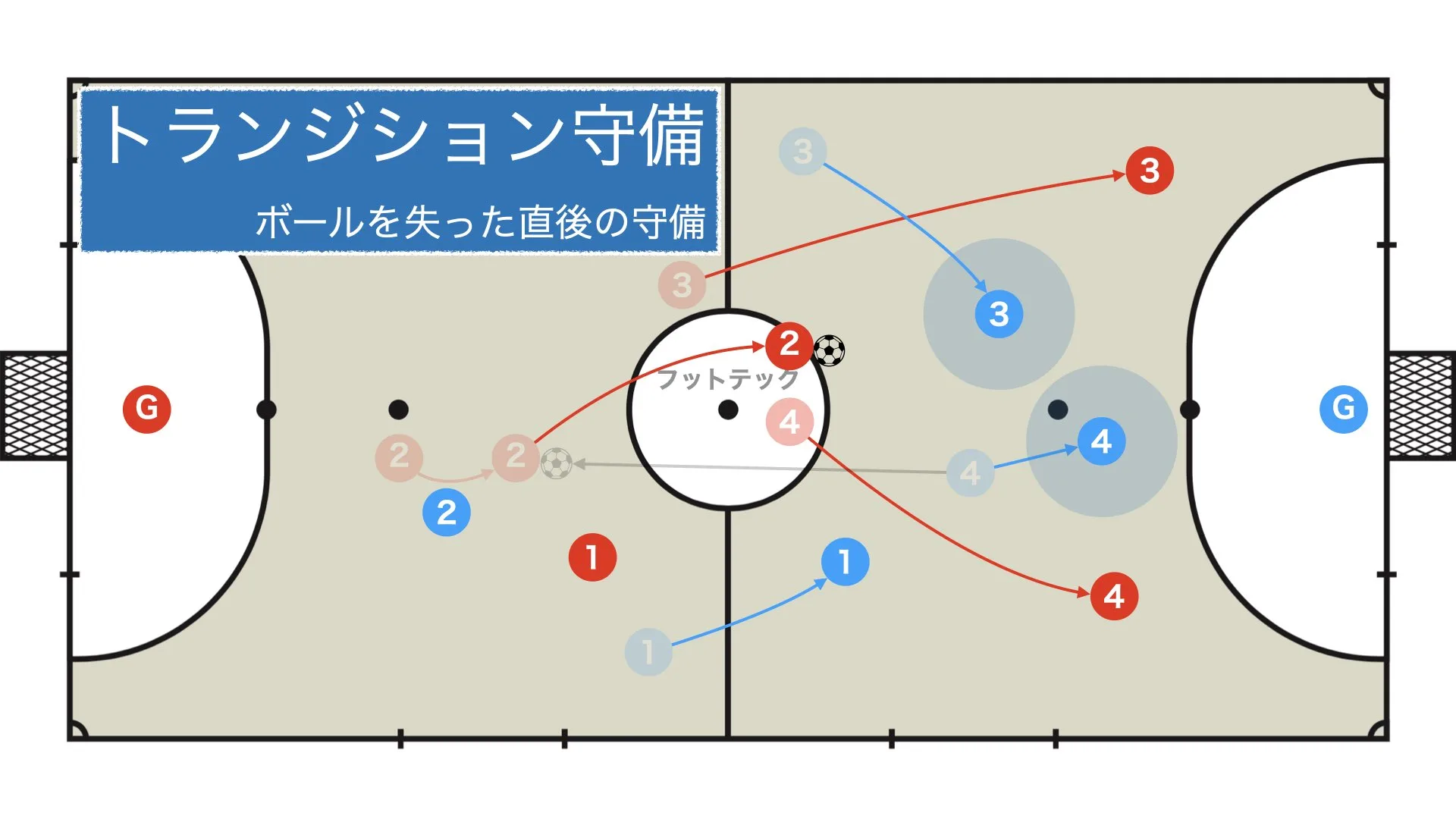
Defensive transition refers to the phase from the moment your team loses the ball until your defensive shape is fully reorganized.
Because this is also the moment when the opponent is launching a counterattack, it is sometimes described as defending against the counter.
In defensive transition, the top priority is to stop the opponent's counterattack.
関連記事
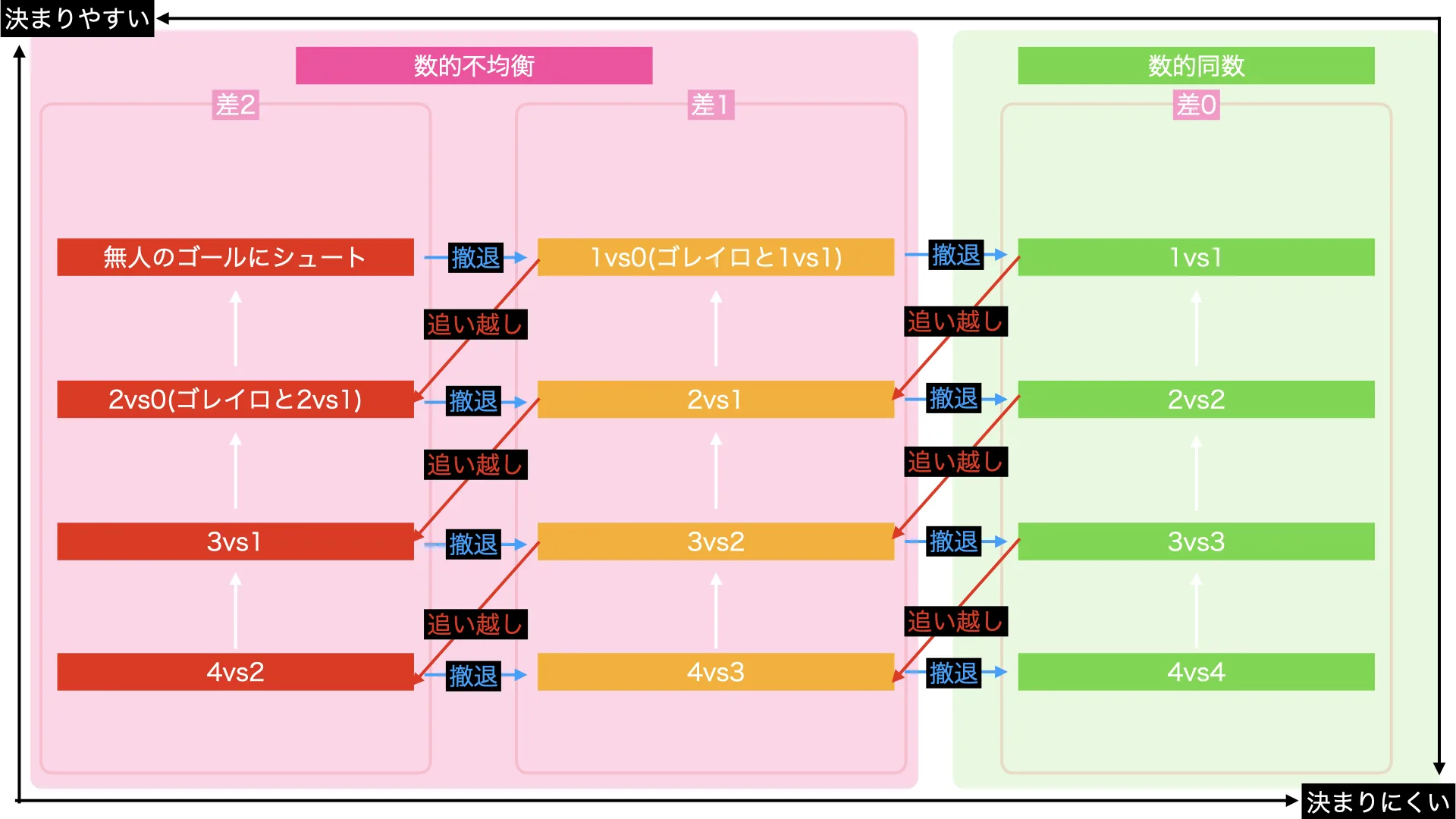
Transitions: Overview
An overview of transitions in futsal. This article organizes the definition of the attacking and def…
続きを読む →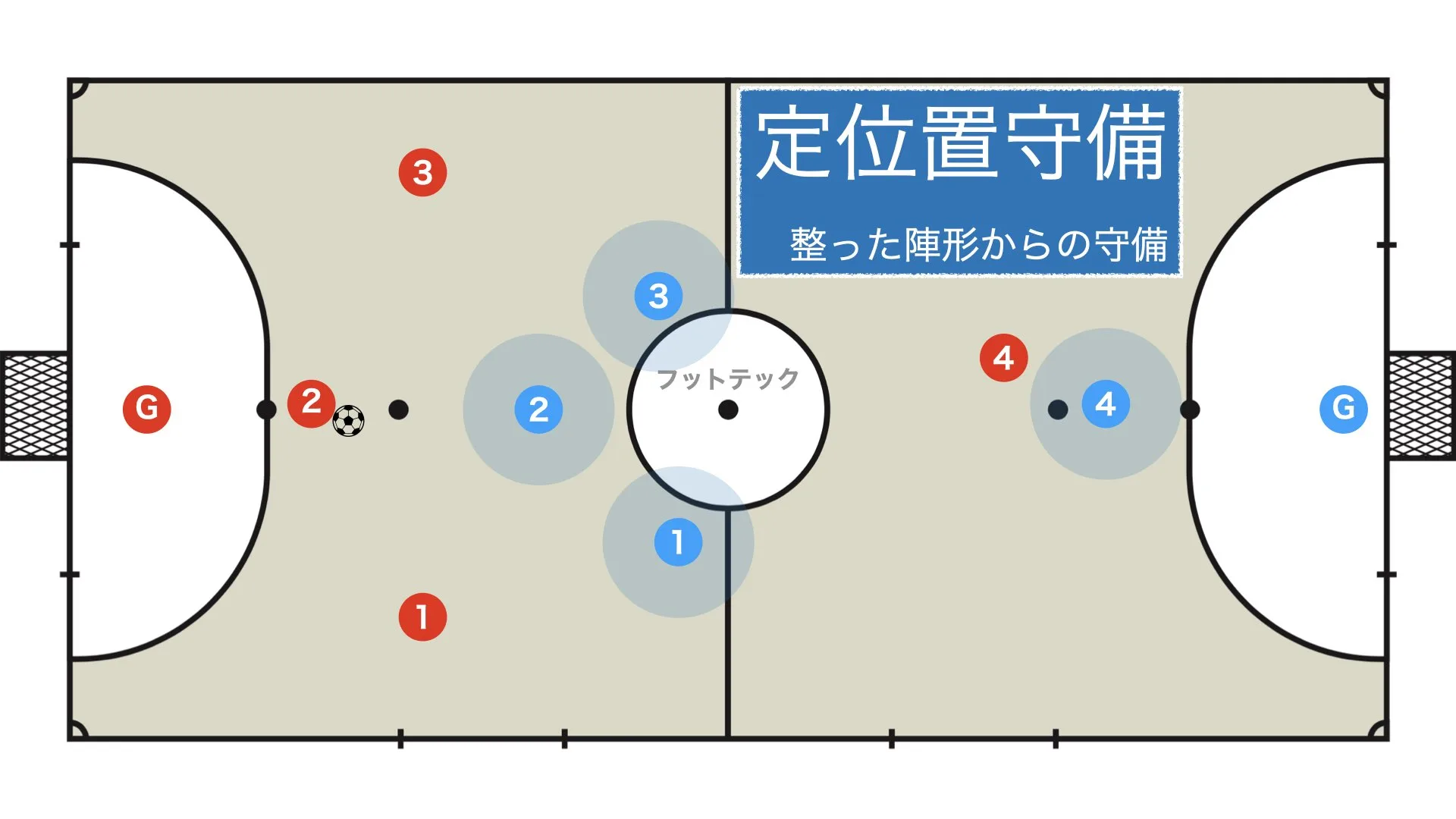
In futsal, positional defence is the phase where the opposing team has possession and your team defends with its defensive shape already in place.
Positional defence is the counterpart to positional attack. You not only need to prevent goals, but also look for the moment to win the ball.
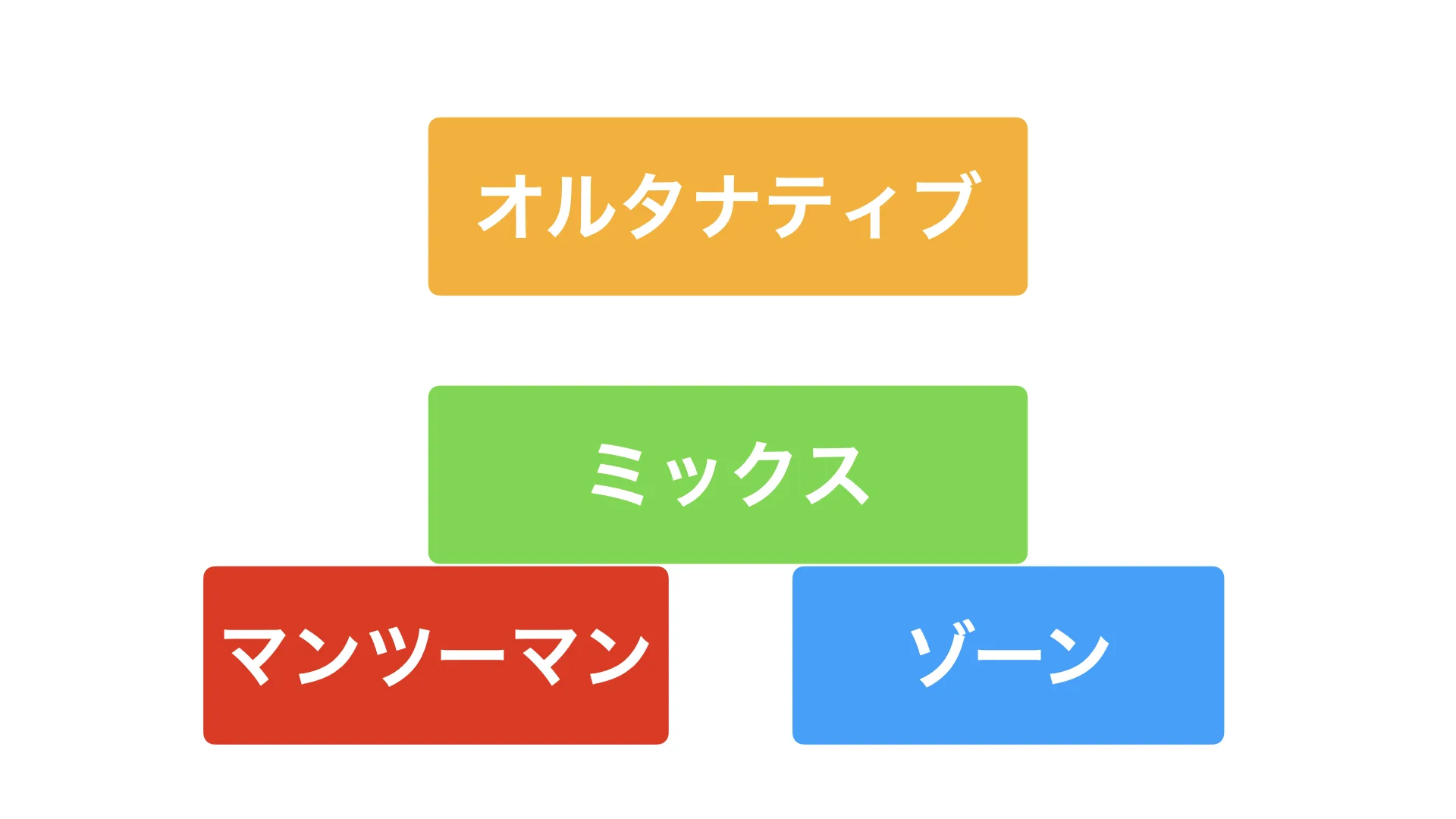
This phase includes high pressing from the front and half-court defending, where the team drops to defend around the halfway line.
We have also prepared an index page of articles about positional defence, so take a look.
関連記事
Positional Defence: Overview
An overview of positional defending in futsal. From the first defensive decision of where to set the…
続きを読む →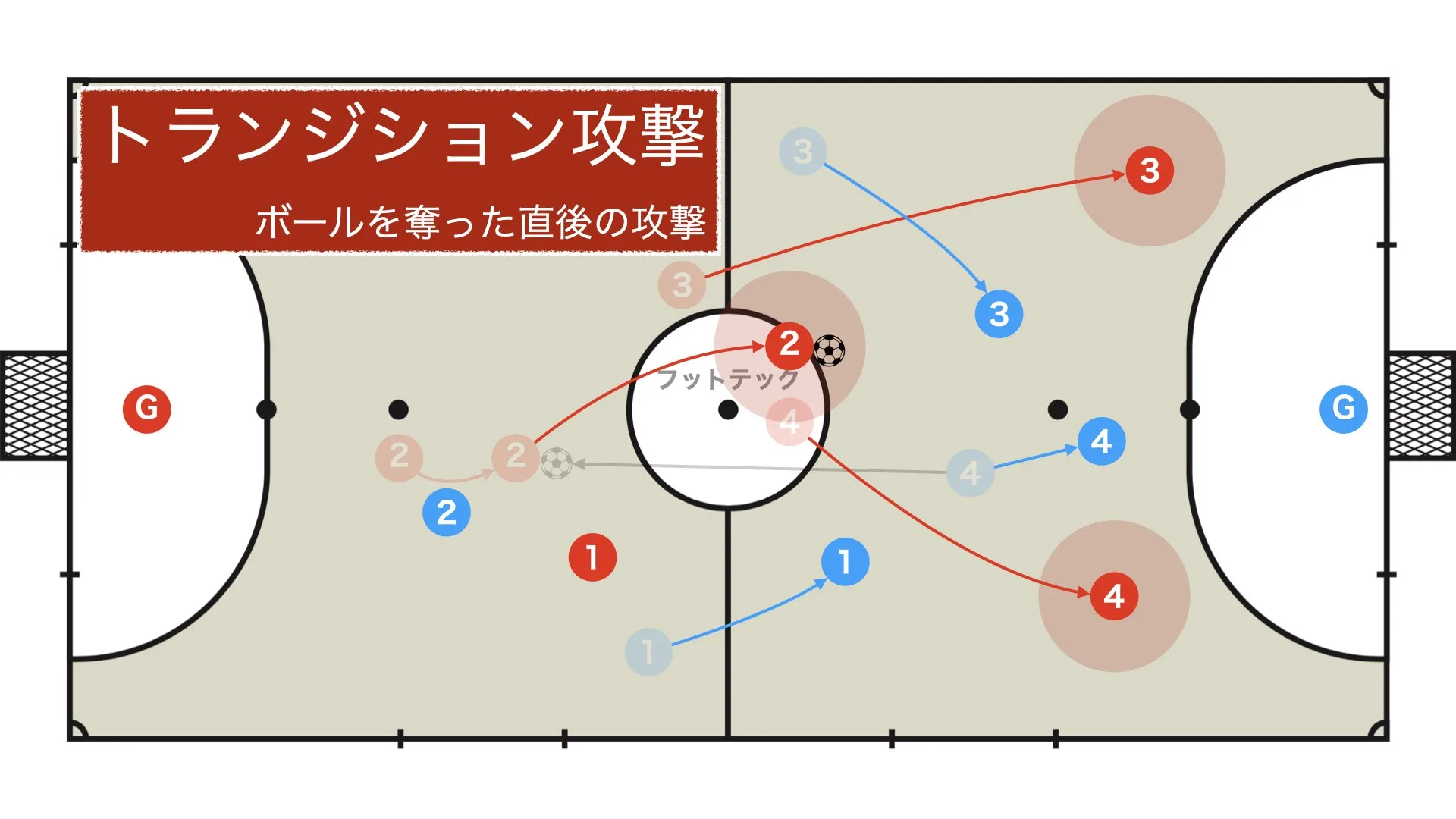
In futsal, attacking transition refers to the phase from the moment you win the ball until the opponent has reorganized its defensive shape.
Attacking transition is the moment when the team shifts from defence to attack, and it is also commonly called the counterattack.
Think of fast counterattacks that create 2v2 or 3v2 situations.
It is often said that about 50% of goals in futsal come from attacking transitions.
関連記事
Transitions: Overview
An overview of transitions in futsal. This article organizes the definition of the attacking and def…
続きを読む →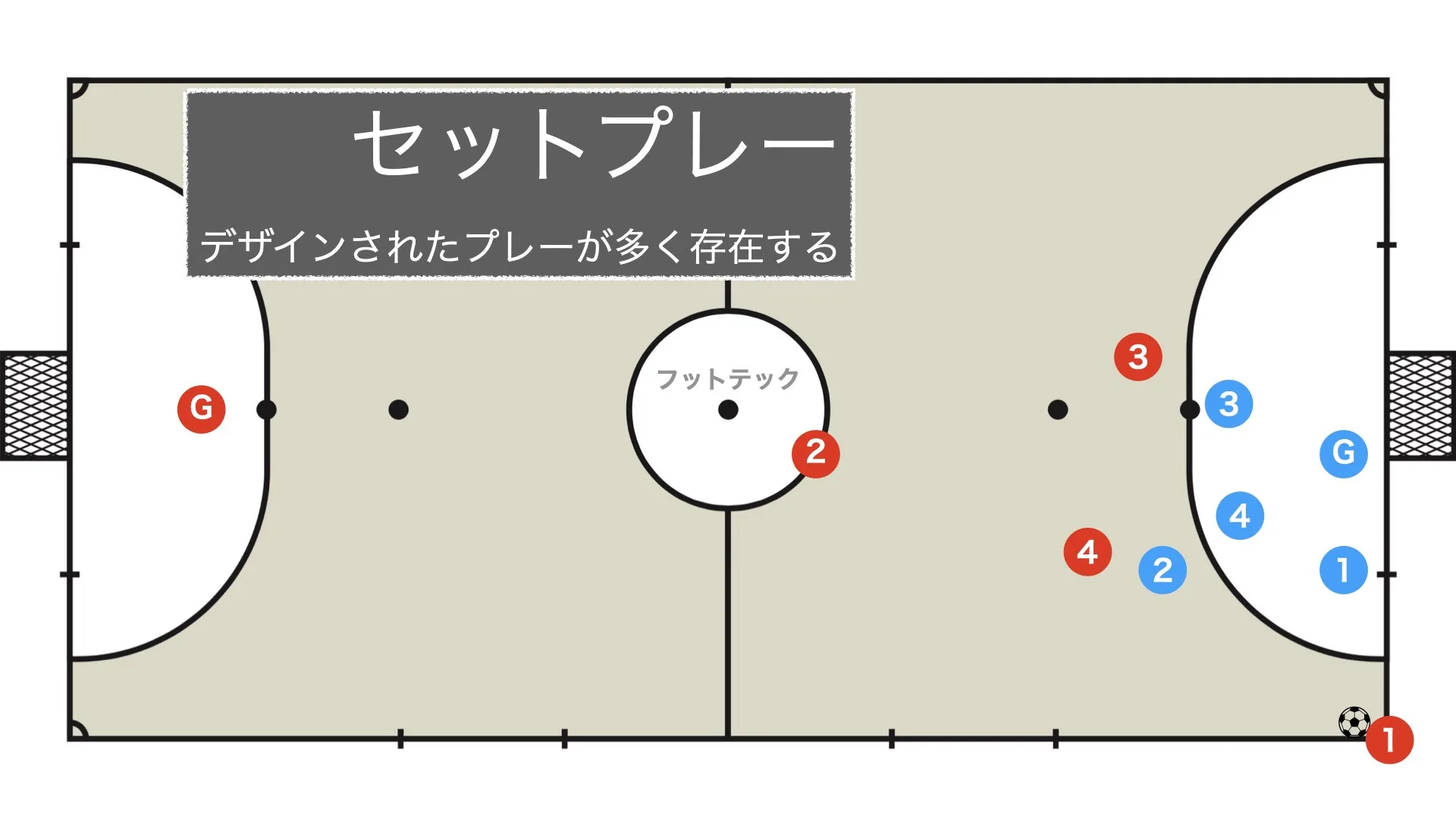
So far, we have written about the four main phases of futsal, but some readers may be wondering where corner kicks or kick-ins fit into that framework.
Phases that restart play after the ball has gone out of bounds, such as kick-ins, are called set plays.
Set plays in futsal appear in the breaks between open-play phases, with one of the four phases occurring before the set play and another after it.
There are six types of set play:
- Kick-off
- Clearance (the futsal equivalent of a goal kick in football)
- Corner kick
- free kick
- Opponent-half kick-in (a kick-in taken in the attacking half)
- Own-half kick-in (a kick-in taken in the defensive half)
In the set-play phase, many teams use designed routines known as sign plays (jogada), and it is often said to be the phase after transitions in which goals are most likely to be scored.
We have also prepared an index page of articles about set plays, so take a look.
Supplement
There are different ways to define the set-play phase. Many people treat only set plays taken beyond a certain line as set-play situations, while classifying deeper set plays as part of positional attack. In other words, set plays can also be understood as positional attacking situations with the ball in play stopped.
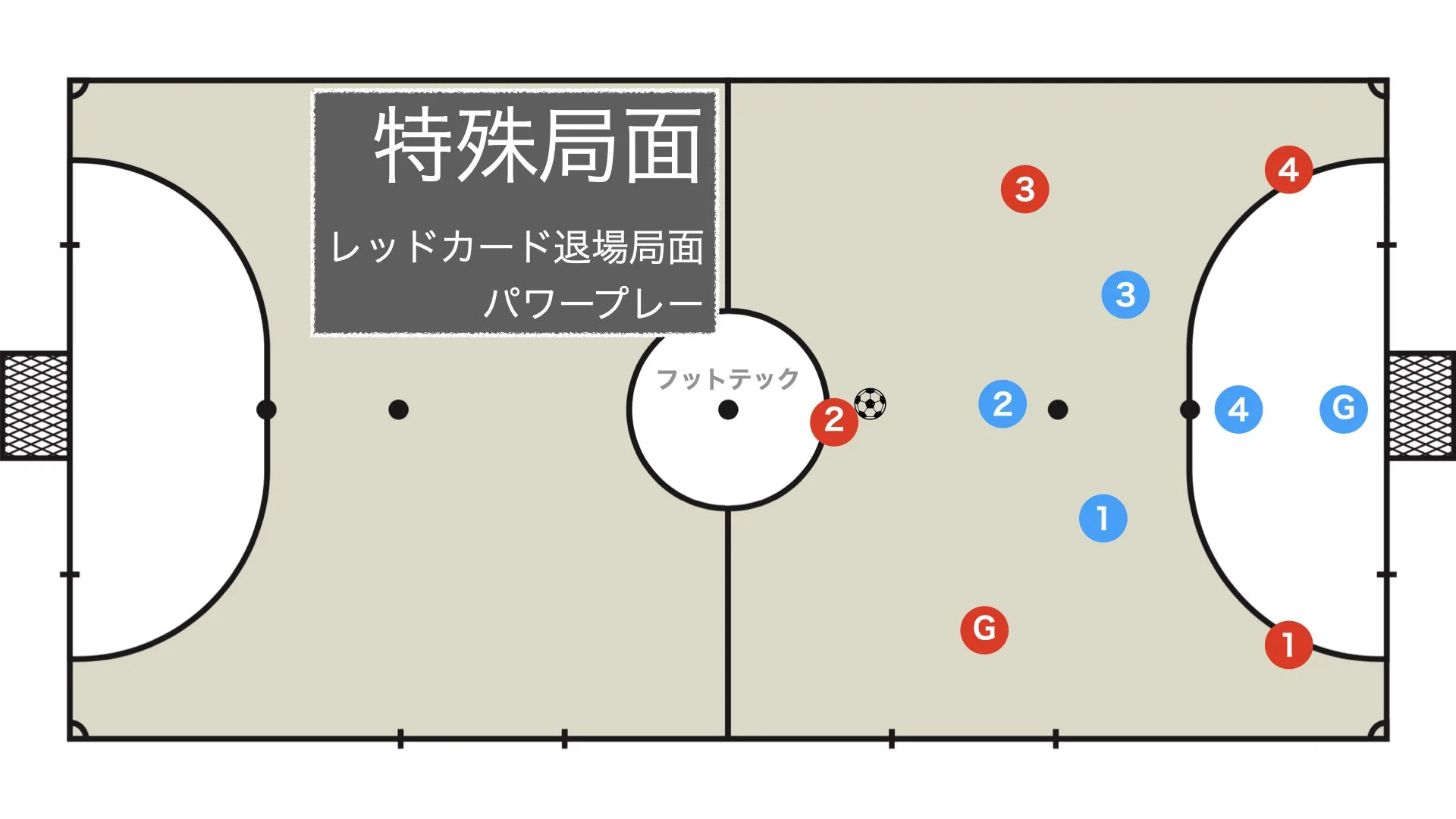
In futsal, special phases refer to the following two situations:
In a red-card dismissal situation, one field player is missing, so the game becomes 4v3. In a power-play situation, the goalkeeper joins the attack, so the game becomes 5v4. As a result, these situations develop very differently from normal futsal play.
Because they involve numerical imbalance and limited mobility, special phases are often considered separately from the four main phases.
We have also prepared an index page of articles about special phases, so take a look.
Supplement
Some people focus on the numerical imbalance and consider special phases to be a kind of transition phase. However, because the mobility and fluidity are different, the attacking and defensive essence of those situations is also very different. We treat special phases and transition phases as separate categories.
関連記事
Special Situations
An overview of special situations in futsal, such as power play and red-card dismissal scenarios. Th…
続きを読む →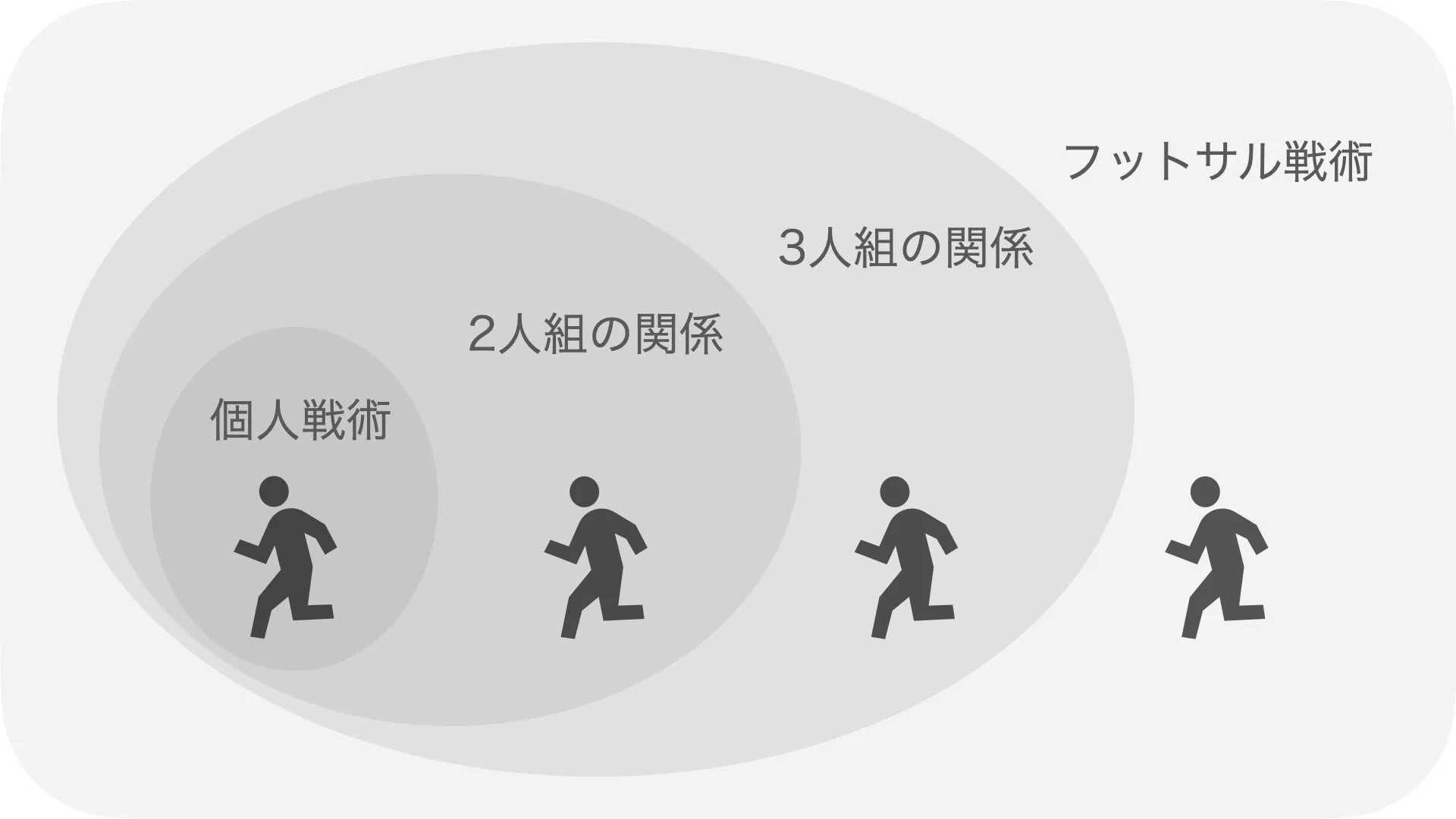
There are fundamental tactical elements that apply across every phase of the game.
We call them the foundations of futsal.
These foundations consist mainly of the following three elements:
Individual tactics are the tactical tools that strengthen the individual player. This includes things like dribbling and 1v1 defending.
Two-player relationships is the collective term for tactical actions created by two players, such as one-twos and paralela.
Organized team tactics can be understood as combinations of these two-player relationships, which is why two-player relationships are among the most important ideas in futsal tactics.
Three-player relationships are essentially "two-player relationships +1" and can be seen as group tactics that extend from two-player relationships. Examples include using the pivot and 3 on line.
If you are interested in these foundations, take a look at the index page of articles about the foundations of futsal.
From here, let us look at how to unify tactics at the team level.
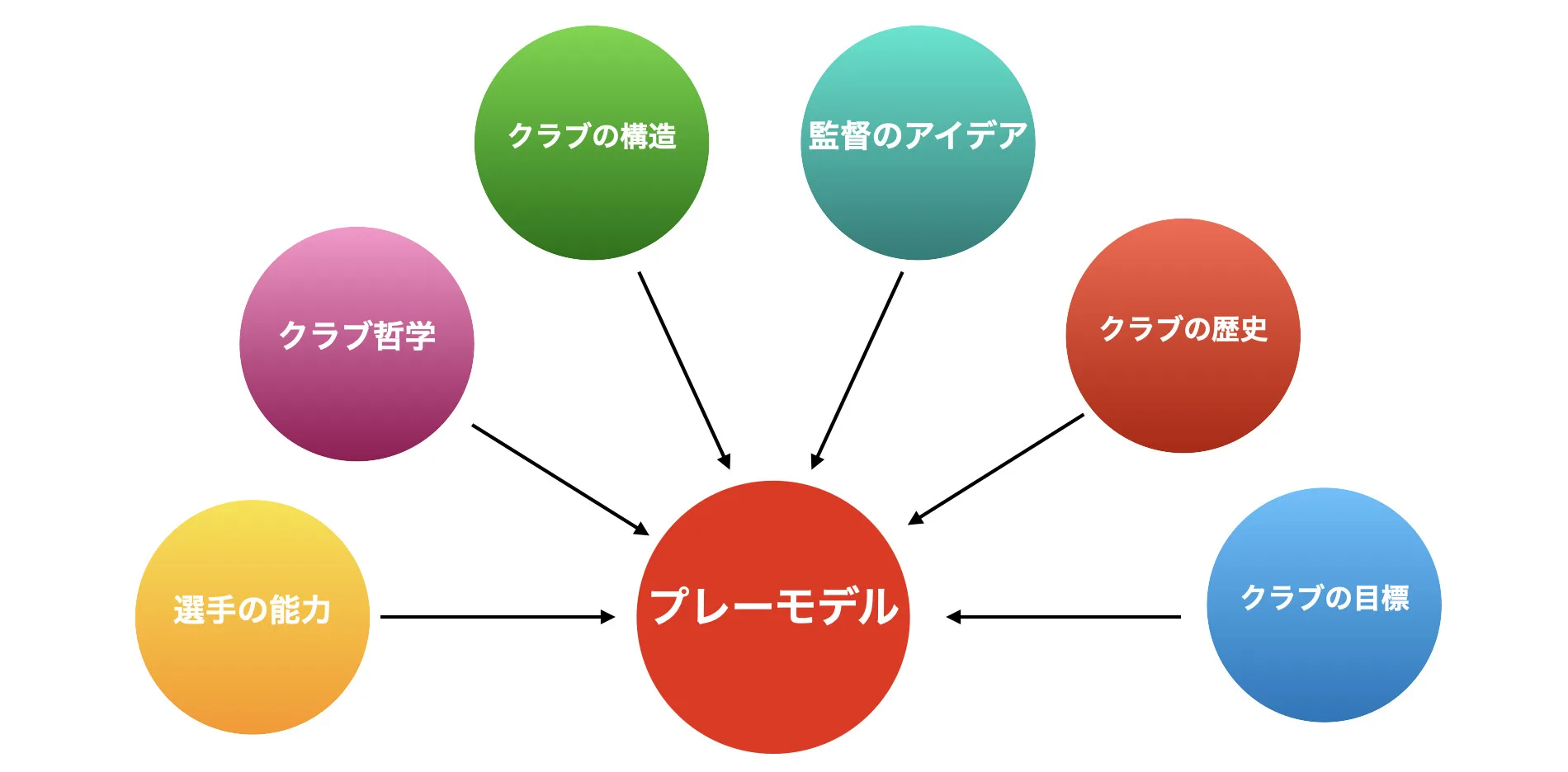
One recommended method is to create a play model.
A play model is a document that lays out the team's principles of play for each phase and each area of the court.
In other words, it puts the team's intentions and playing policy into words.
関連記事
What Is a Play Model?
An explanation of what a play model means in futsal and how to build one. This article outlines the …
続きを読む →Knowing futsal terminology is essential if you want to discuss tactics well.
Have you ever tried to explain your profession or field of study to someone else and found that it did not come across because they did not understand the technical terms?
The importance of futsal terminology is exactly the same.
Because futsal originated overseas, definitions of futsal terms are not always standardized. There are also many different expressions for the same idea, such as the fact that there are around eight equivalent ways to express a line cut.
As a result, terminology can differ from person to person or remain ambiguous. Even so, at the very least, we recommend standardizing terms within your team or community.
Supplement
Different websites often explain futsal terms in different ways. When you are unsure, it is also important to approach the concept through the original Spanish or Portuguese term. On Foottech's futsal terminology page, we define terms based on their linguistic roots and on the views of professional futsal coaches.
This is often overlooked, but understanding the rules of futsal is absolutely essential if you want to discuss tactics properly.
In the past, set plays in Brazil were restarted with throw-ins rather than kick-ins, so the thinking behind set-play tactics was very different from what it is now.
When the rules of the sport change significantly like this, tactics also need to be reconsidered on a large scale.
Conversely, that means the core logic of futsal tactics does not change unless the rules change.
To begin with, it is enough to keep the following six major rules in mind:
- the 4-second rule
- the back-pass rule
- substitutions
- fouls, and the standards for yellow and red cards
- red-card dismissal situations
- foul count
- whether a direct goal is allowed from each type of set play
Supplement
The rules were revised in the 2020/2021 season. In particular, the restriction on the support foot in set plays was removed, which led to new tactics, especially tricky routines where the kicker changes.
In this article, we explained the different phases of futsal, starting with the four main phases. We also saw that creating a play model and understanding futsal terminology are both extremely important.
In the past, this kind of information tended to remain only on the coaching side and was often not passed on to players. However, these are topics that are always taught in coaching courses at B-license level and above.
When analyzing your own play or your team, clearly identifying which phase contains the problem will make it much easier to see what you need to train.
On this site, articles are classified into the following five categories, so we hope you will explore the areas that interest you most:
- Foundations
- The four main phases: positional attack
- The four main phases: positional defence
- The four main phases: transitions
- Set plays
- Special phases
We hope this gives you a good opportunity to deepen your understanding of futsal tactics.
Browse by category
⚽
Basics
A category for learning the foundations of futsal tactics, from positional roles and court structure to individual principles and small-group relationships.
⚽
Positional attack
A category covering attacking systems such as 4-0, 3-1, 2-2, and 1-3, plus the principles behind rotations and space creation.
⚽
Positional defence
A category covering positional defending concepts such as zone defence, man marking, half-court shapes, and defensive lines.
⚽
Set plays
A category for set-play tactics on both sides of the ball, including kick-ins, corners, kick-offs, and clearances.
⚽
Special situations
A category for unusual game states such as power plays and red-card situations.
⚽
Transitions
A category for transition moments, including equal-number and overload situations and the timing of fast or delayed attacks.
Recent posts