Positional Defence: Overview
Published: 2021.07.05Updated: 2026.05.03
When working on positional defence, it is important to decide in advance where the team will start applying pressure by setting a press line beforehand.
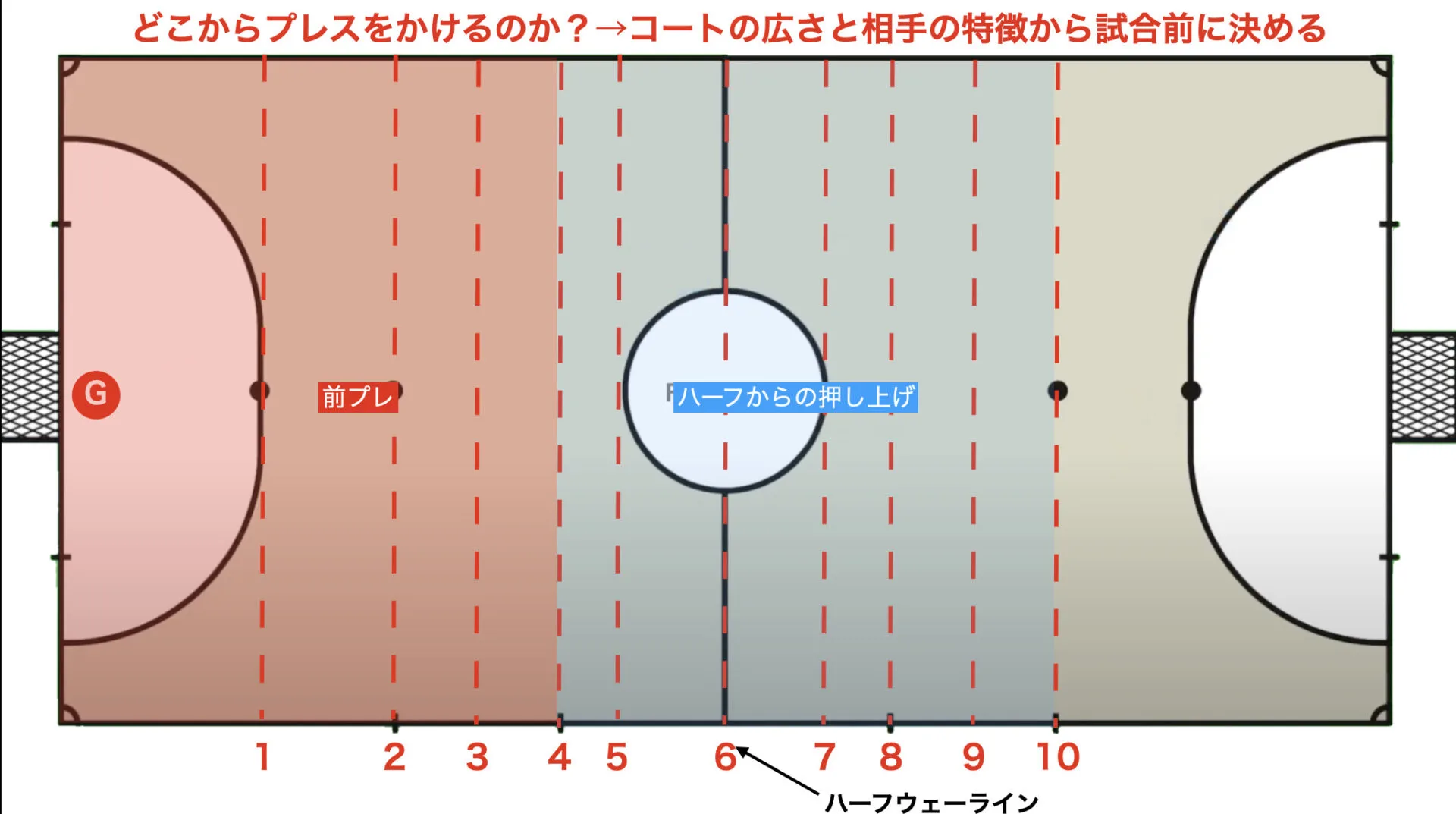
Broadly speaking, you can classify it as a high press in the attacking third, and a half-court press-up everywhere else.
(People may interpret the boundary between these differently.)
Advantages
- If you win the ball, you can shoot immediately near goal (short counter)
- You can put psychological pressure on the opponent
Disadvantages
- You can end up giving the opponent huge spaces
- The distance between defenders becomes too large, and sometimes cover cannot arrive in time
- After winning the ball, there is little space to attack
Advantages
- The distance between defenders is short, so the defensive structure stays compact -> making cover easier
- You can reduce the space the opponent can use
- There is plenty of space to break into a counterattack
Disadvantages
- Because the goal is close, it is easier to give the opponent shooting options
- After winning the ball, you are far from the opponent's goal
関連記事
Half-Court Defence and the Rotating Diamond
A detailed explanation of the rotating diamond, the most orthodox defensive shape for half-court fut…
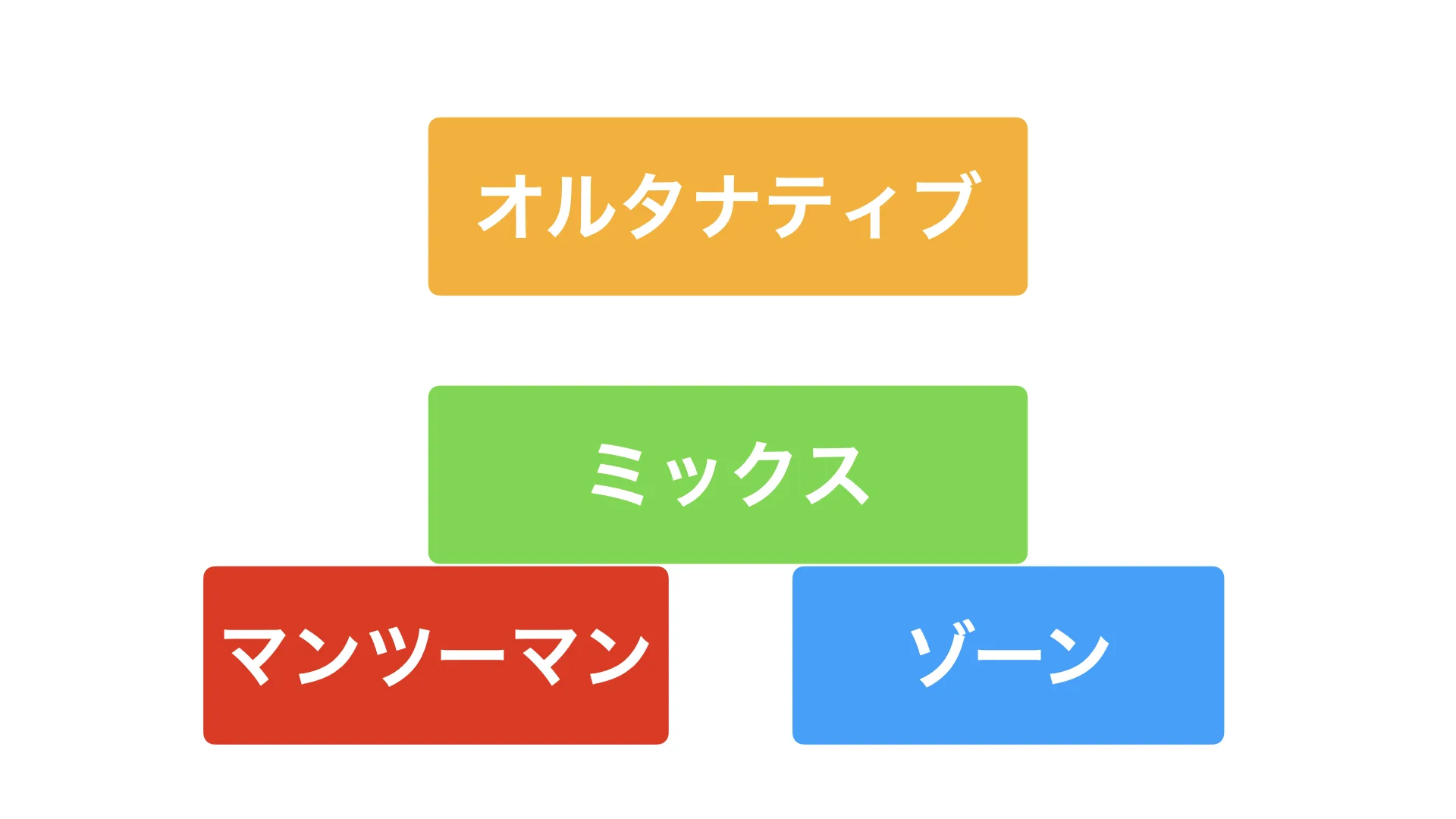
続きを読む →- Man-to-man
- Zone
- Mixed (man-to-man + zone)
- Alternative
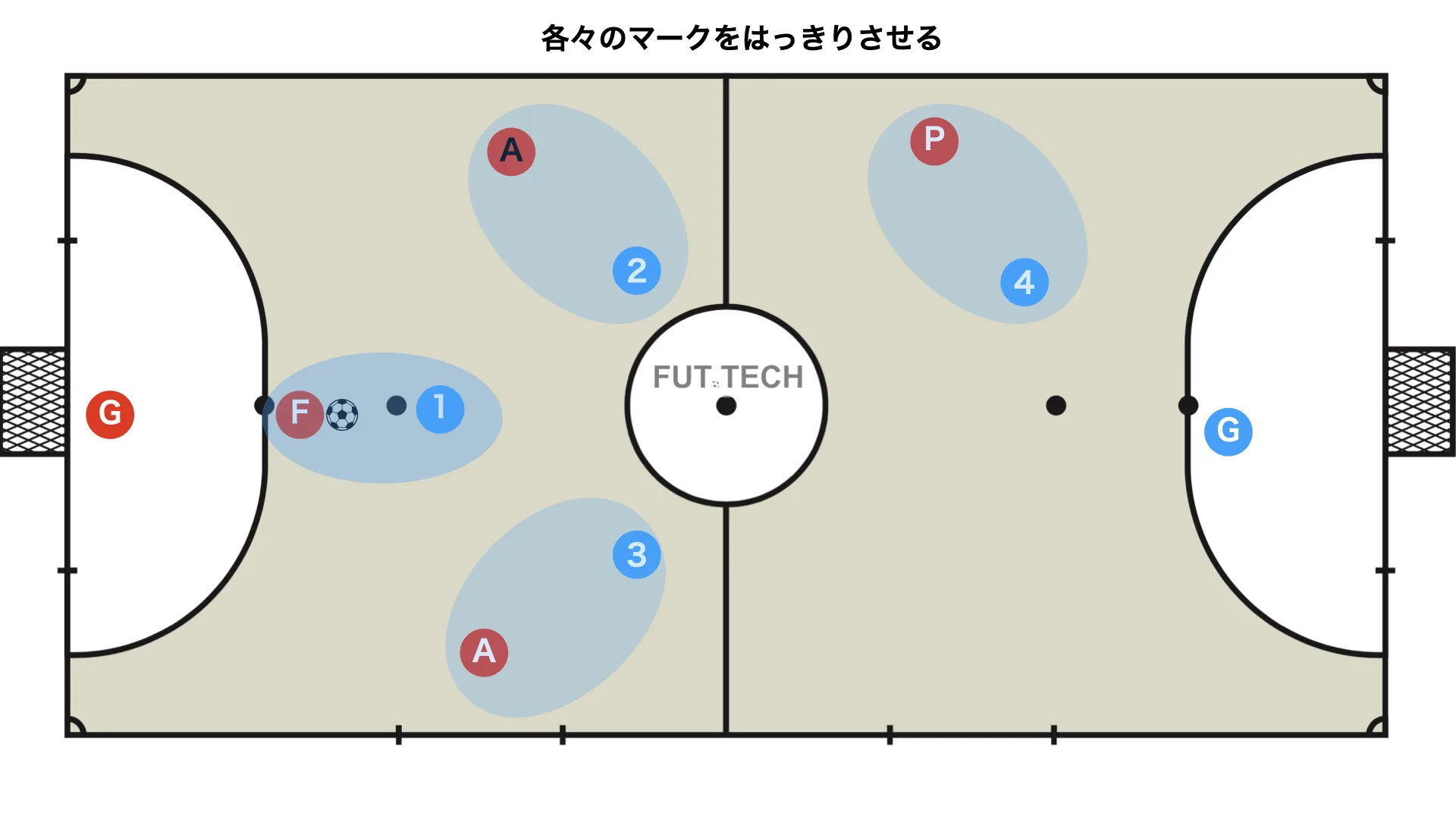
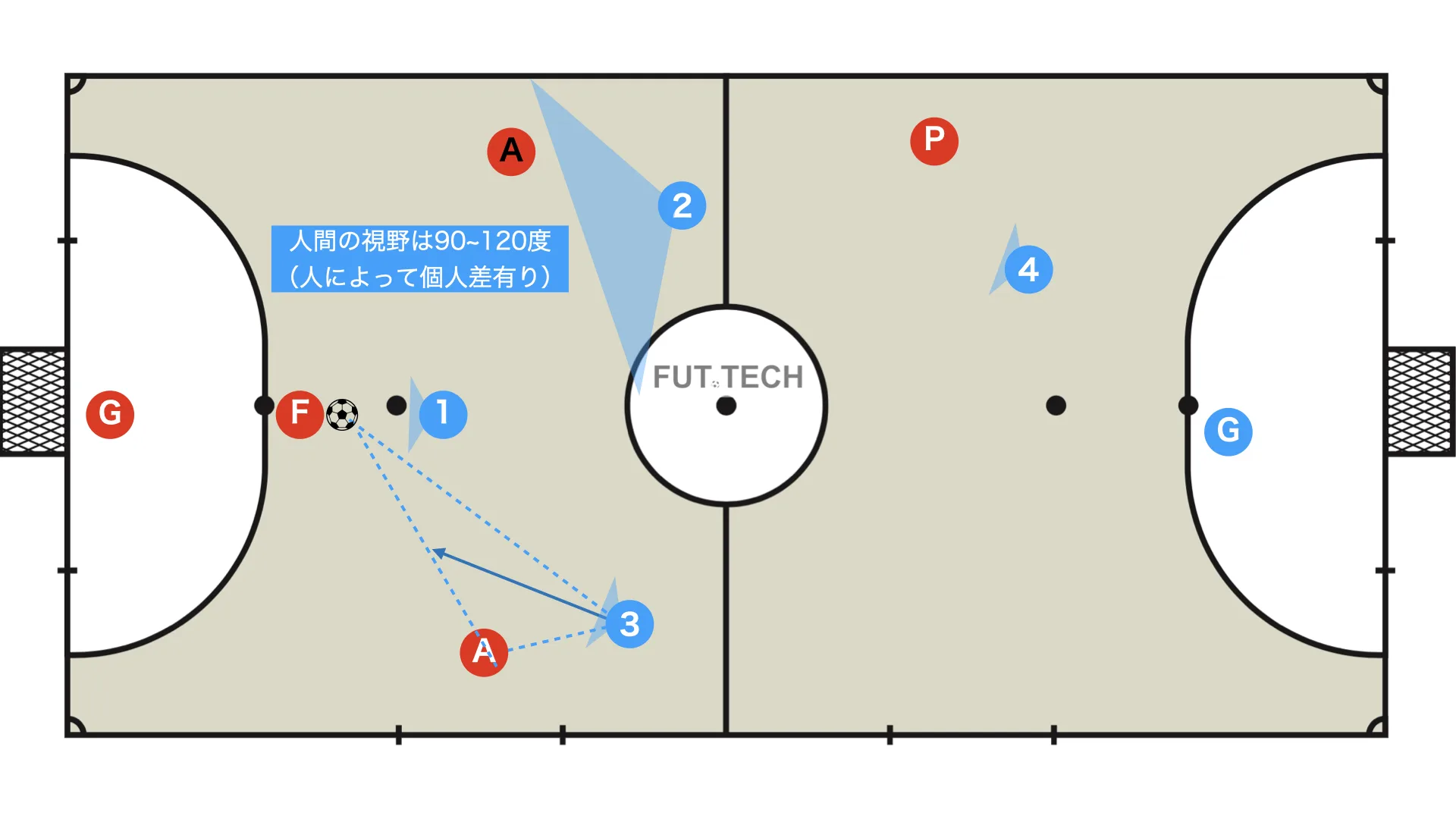
This is a defensive system where each player stays with their own mark.
It can be a very powerful tactic when used by a team with solid individual ability, but if inexperienced players try it, it can be broken down easily. It looks simple at first glance, but it is actually a difficult style of defending.
Advantages
- Simple and easy to execute decisively. (It is easy to teach and install into the team.)
- Because a marker is always attached, you can keep constant pressure on the opponent's attack
- Defensive responsibility is clear
Disadvantages
- It depends heavily on individual ability
- You end up matching the opponent's shape -> allowing them to create space
- When an individual duel is lost, there are often cases where no support (cover) is available
- It is physically demanding
関連記事
Man-to-Man Defence in Futsal: Simple in Theory, Difficult in Practice
A detailed explanation of man-to-man defending in futsal. This article breaks down the principles, c…
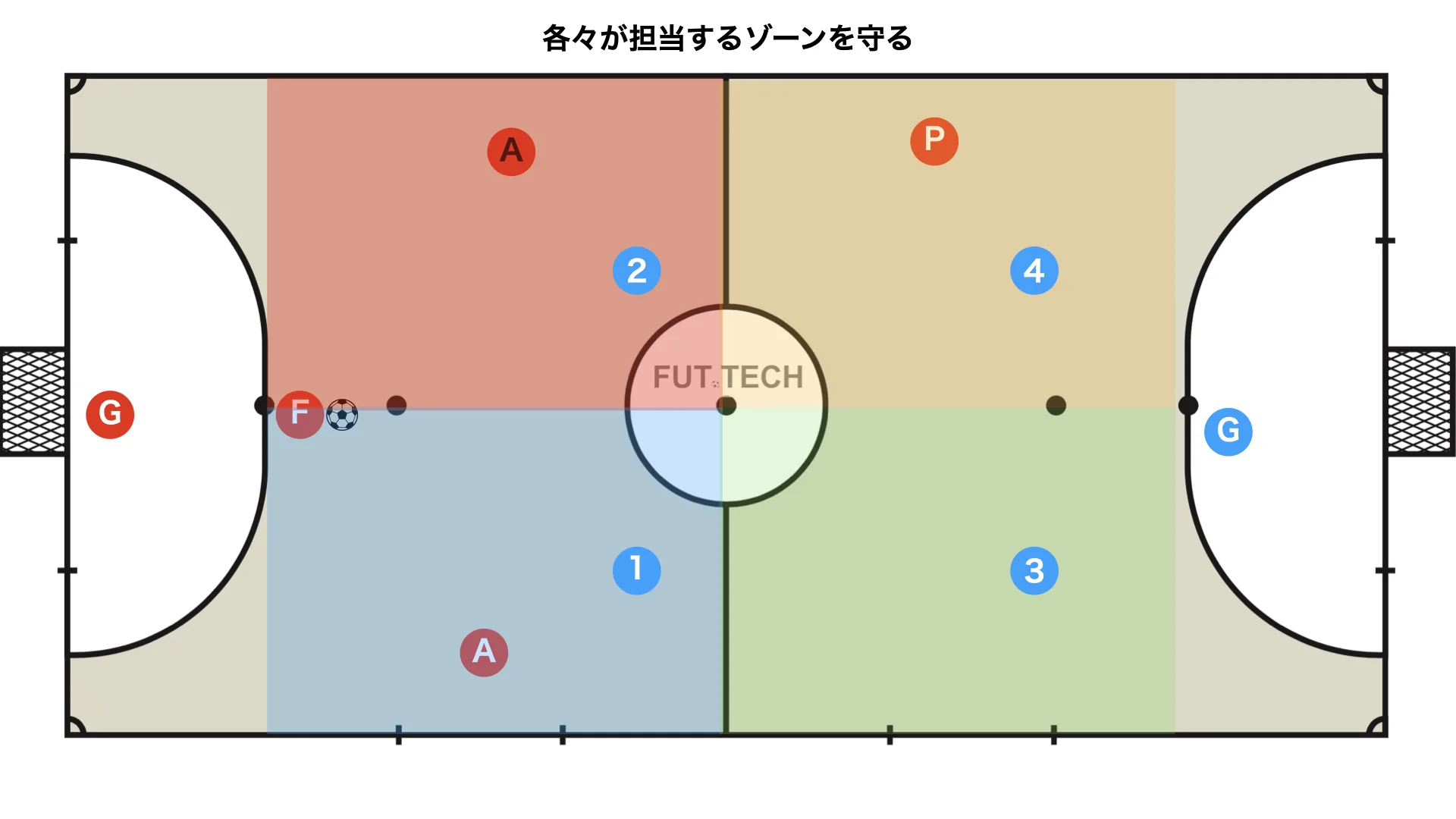
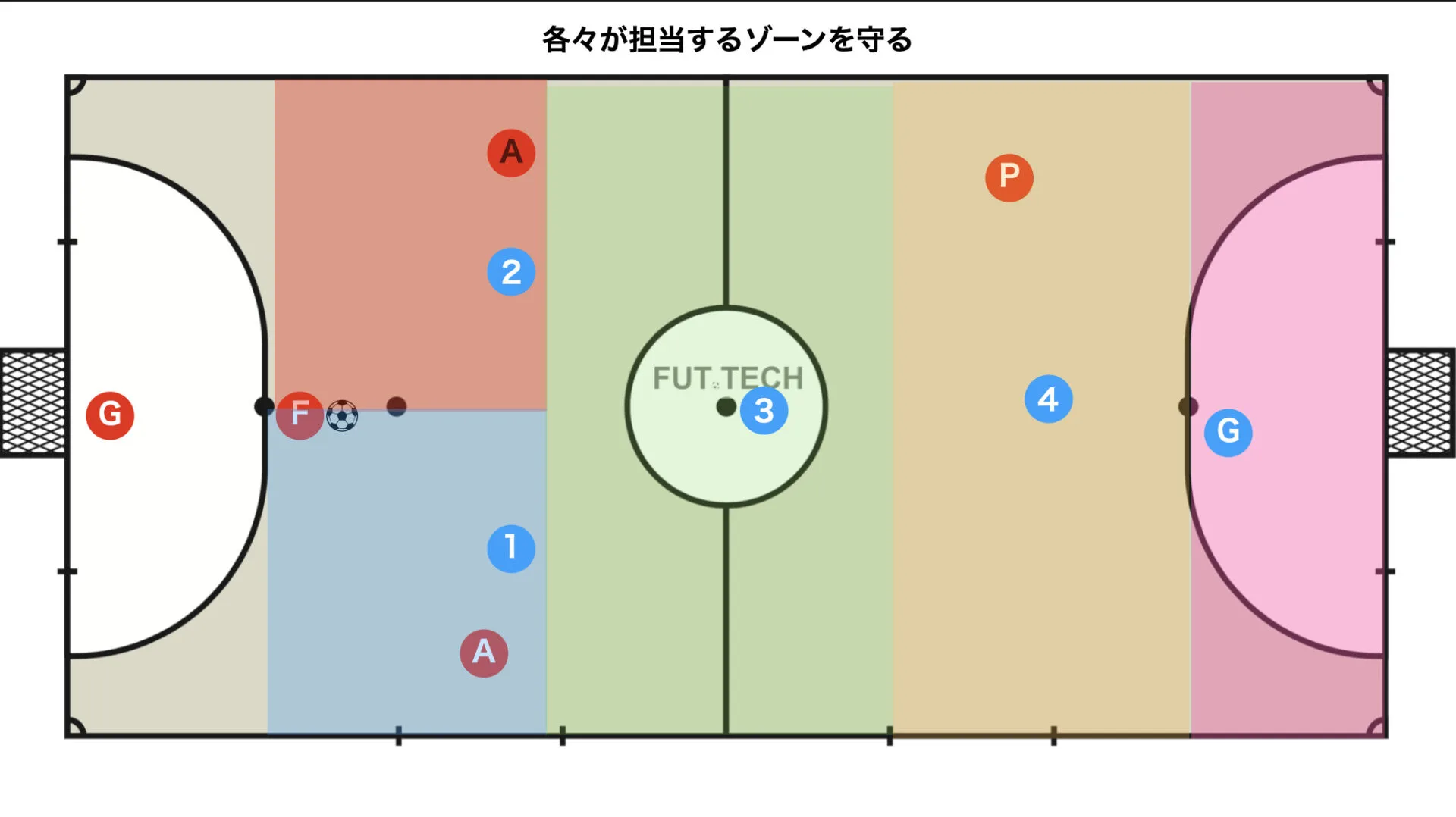
続きを読む →This is a defensive system where each player is assigned a zone in advance and mainly defends that area.
It is common in football, but in futsal positional defence there are almost no teams that use a completely pure zone defence.
(It is used frequently on set plays.)
Still, the idea of defending by zone is an important concept that can be applied in many situations.
Advantages
- You can reduce physical fatigue
- It is easy to break into a counterattack
Disadvantages
- Local numerical disadvantages are likely to occur
- It is difficult to anticipate and react to quick ball movement
- Until the opponent enters your defensive area, you do not have the initiative
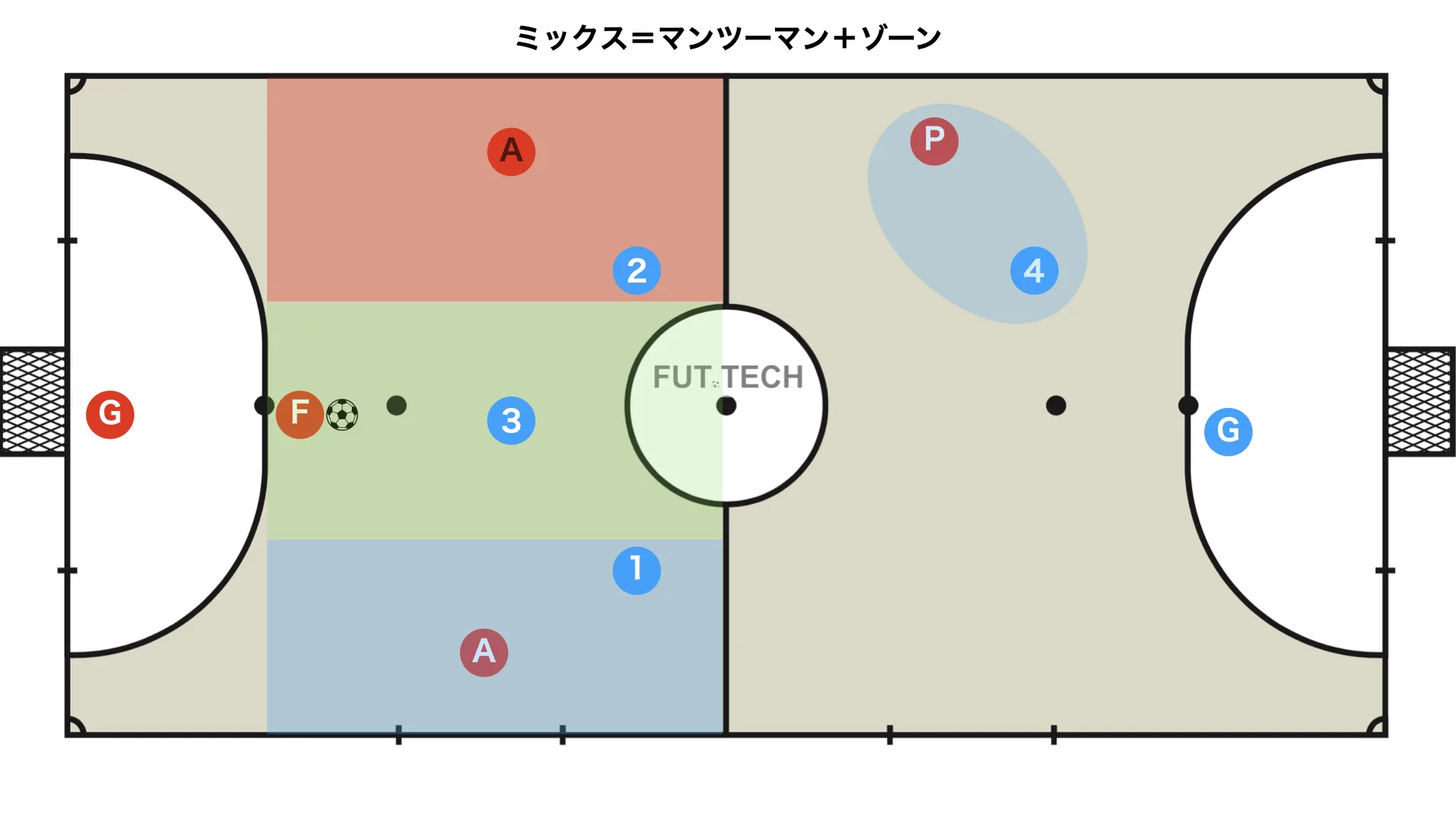
Mixed defence combines the man-to-man and zone approaches explained above.
It is not used very often in positional defence, but it is commonly used on corner-kick defence in a shape known as triangle-and-one.
Alternative defence is also sometimes called mark-change pressing. (Some people distinguish it from the original style in other ways as well.)
Alternative means selective, and as the name suggests, the team selectively changes marks depending on the situation at that moment.
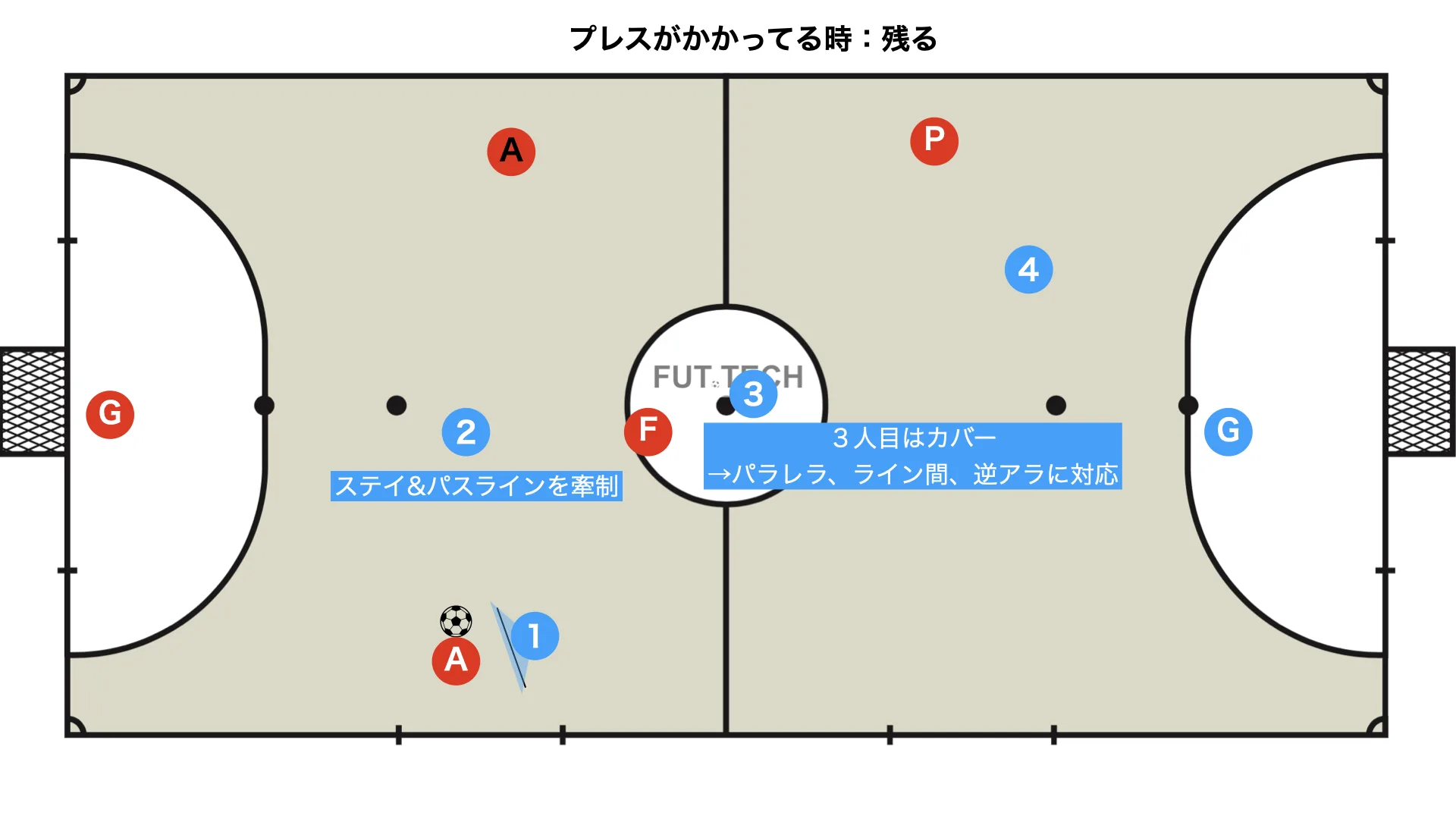
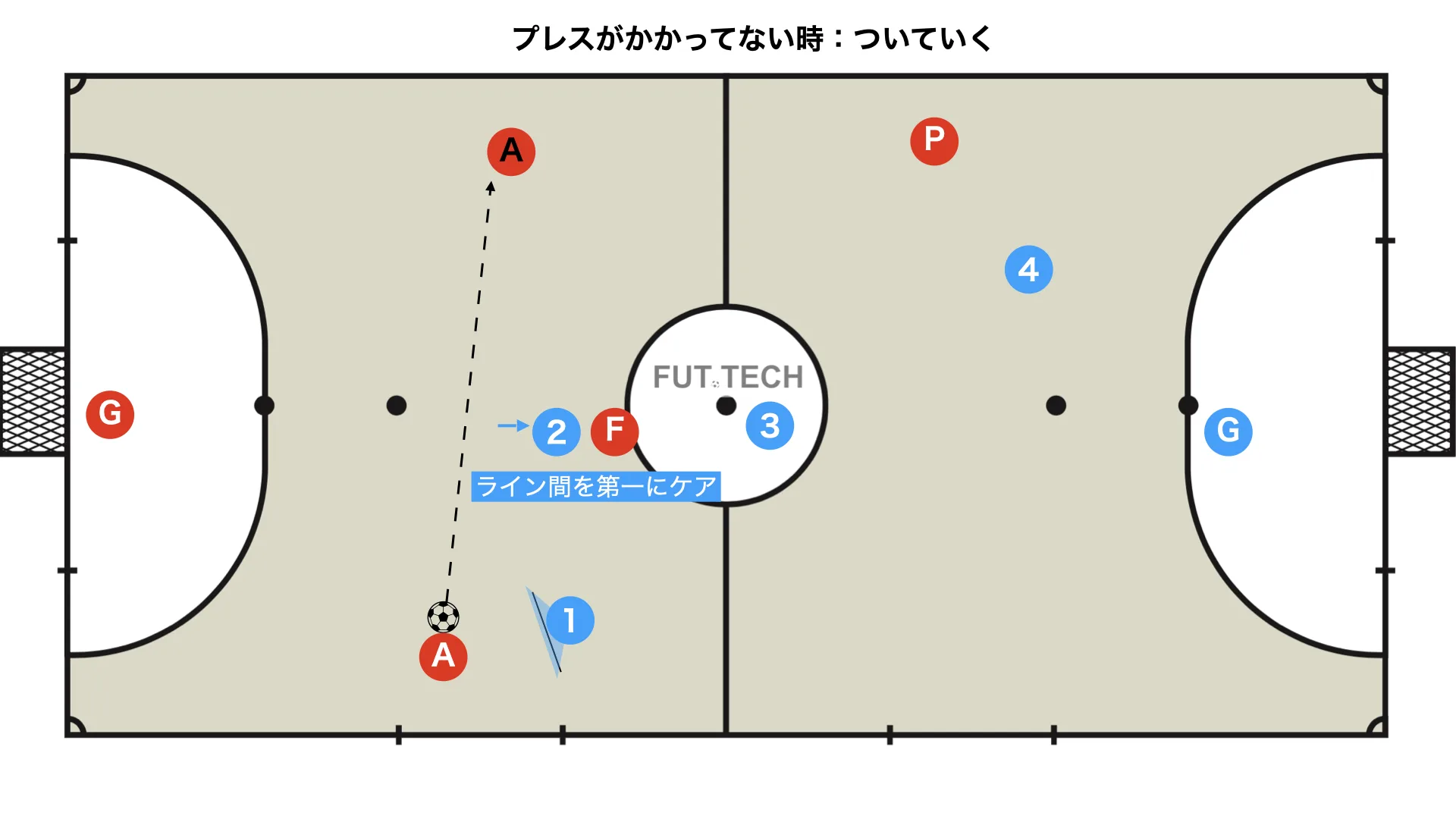
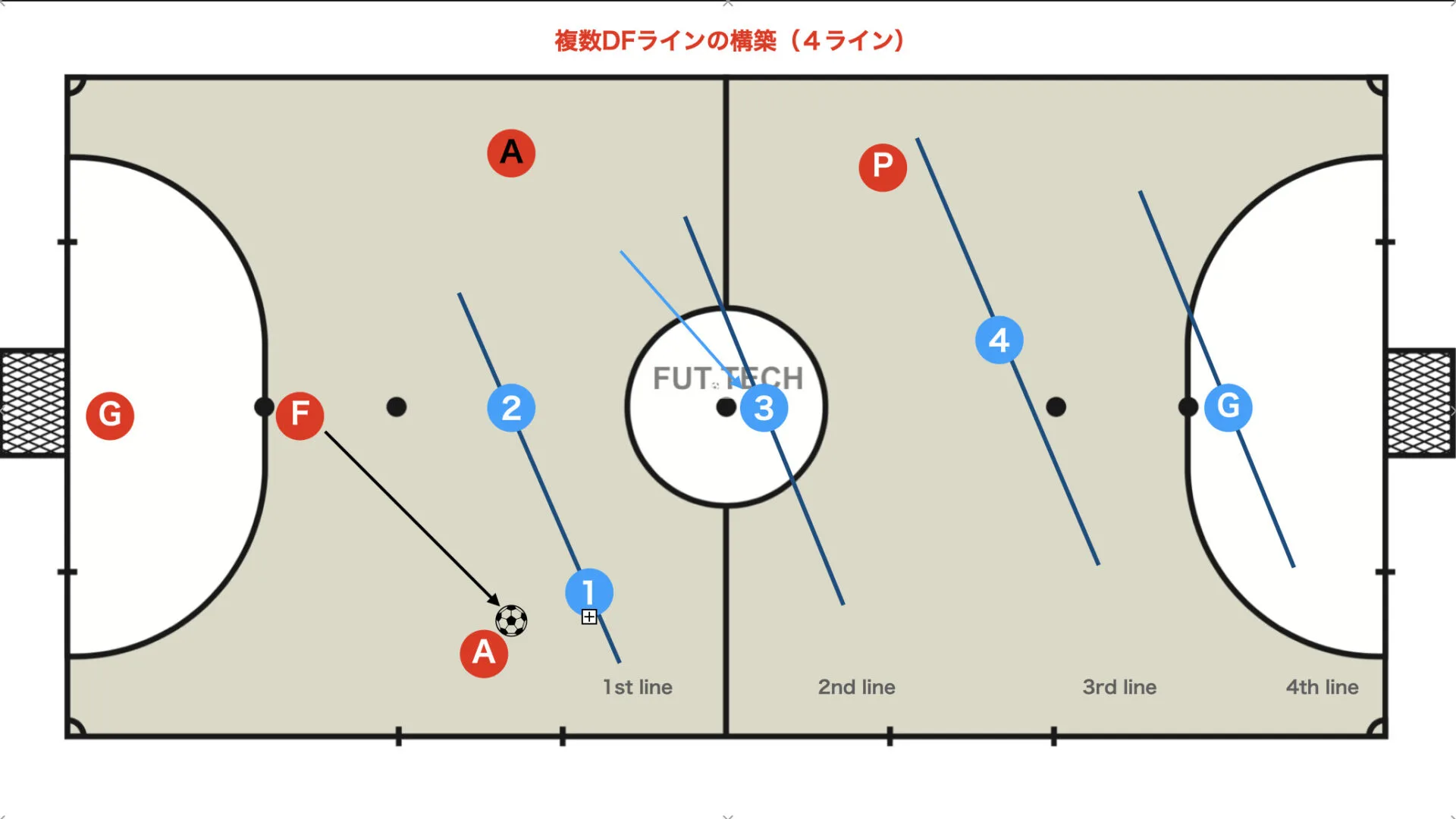
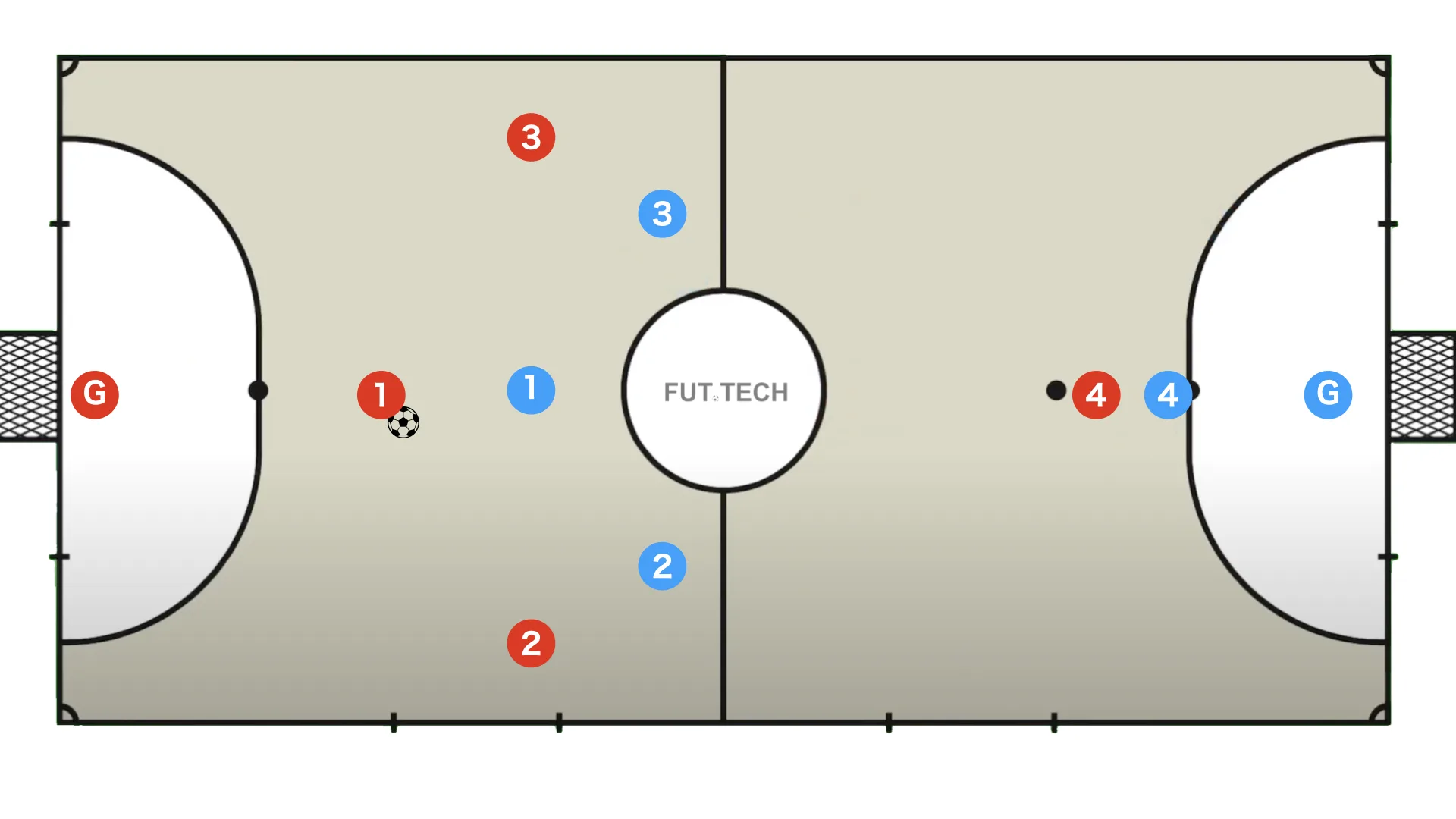
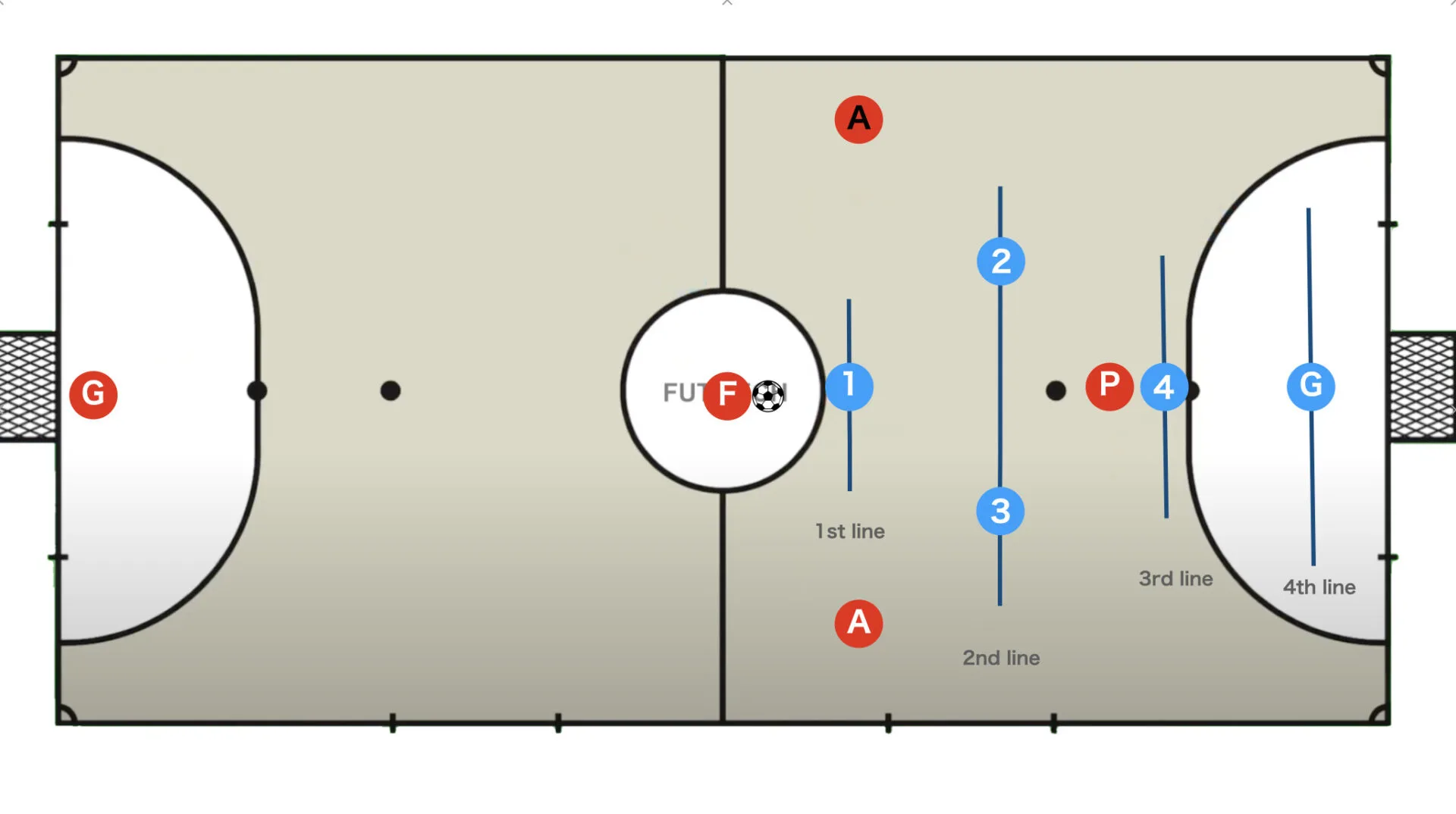
In futsal defence, building multiple lines is an extremely important concept, and it is also indispensable when thinking about attacking play.
In the diagram above, Blue 3 narrows in (floats), creating a 2nd line between the 1st line and the 3rd line formed by Blue 4.
In particular, when applying a high press (pressing in the attacking third), the movement of the third player narrowing in is highly valuable.
関連記事
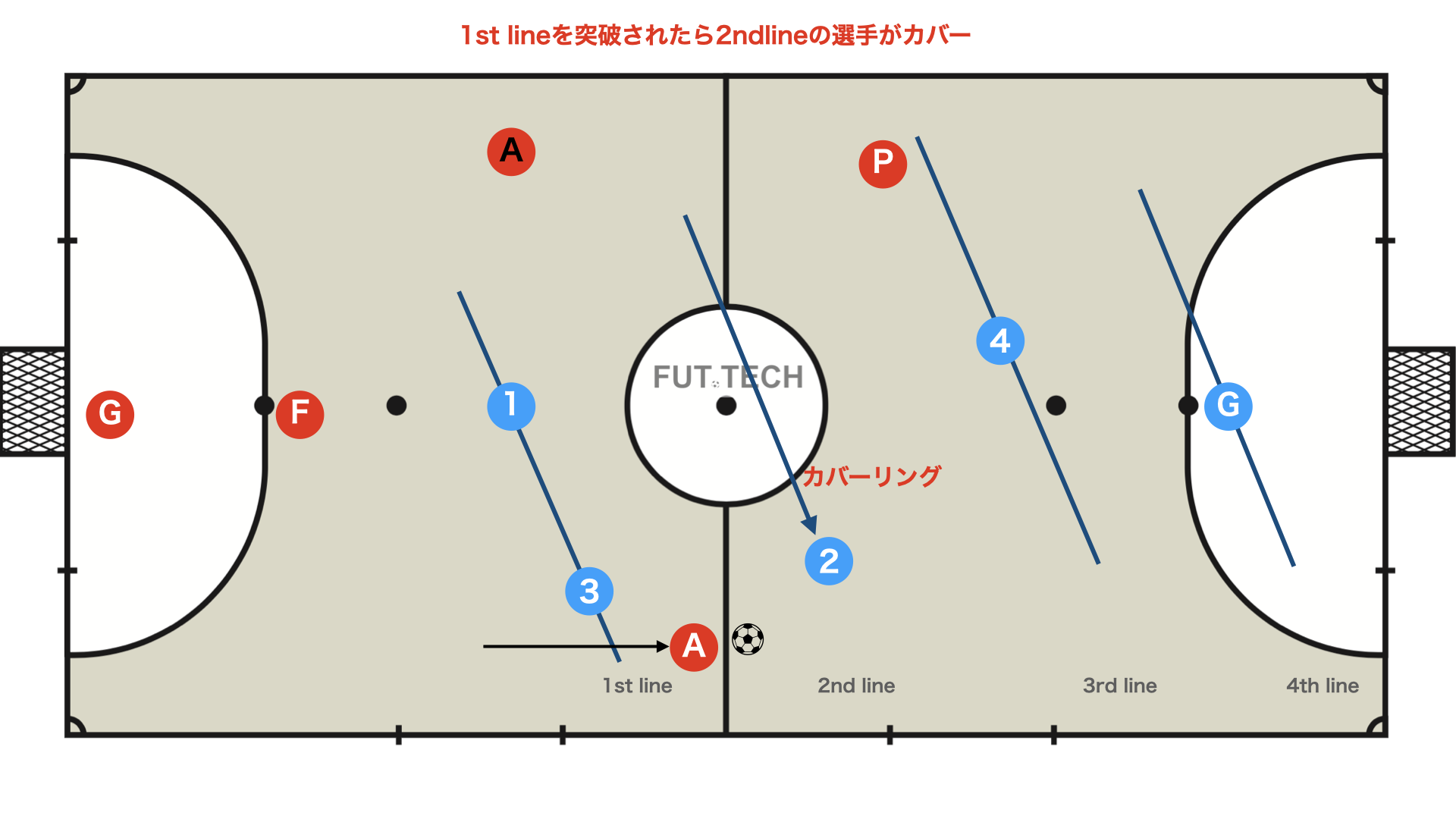
Zone Defence Basics: Building Multiple Defensive Lines and the Ala-to-Ala Pass
A guide to a core concept in futsal zone defence: building multiple defensive lines. This article ex…
続きを読む →- Slide
- Rotation
- Retreat
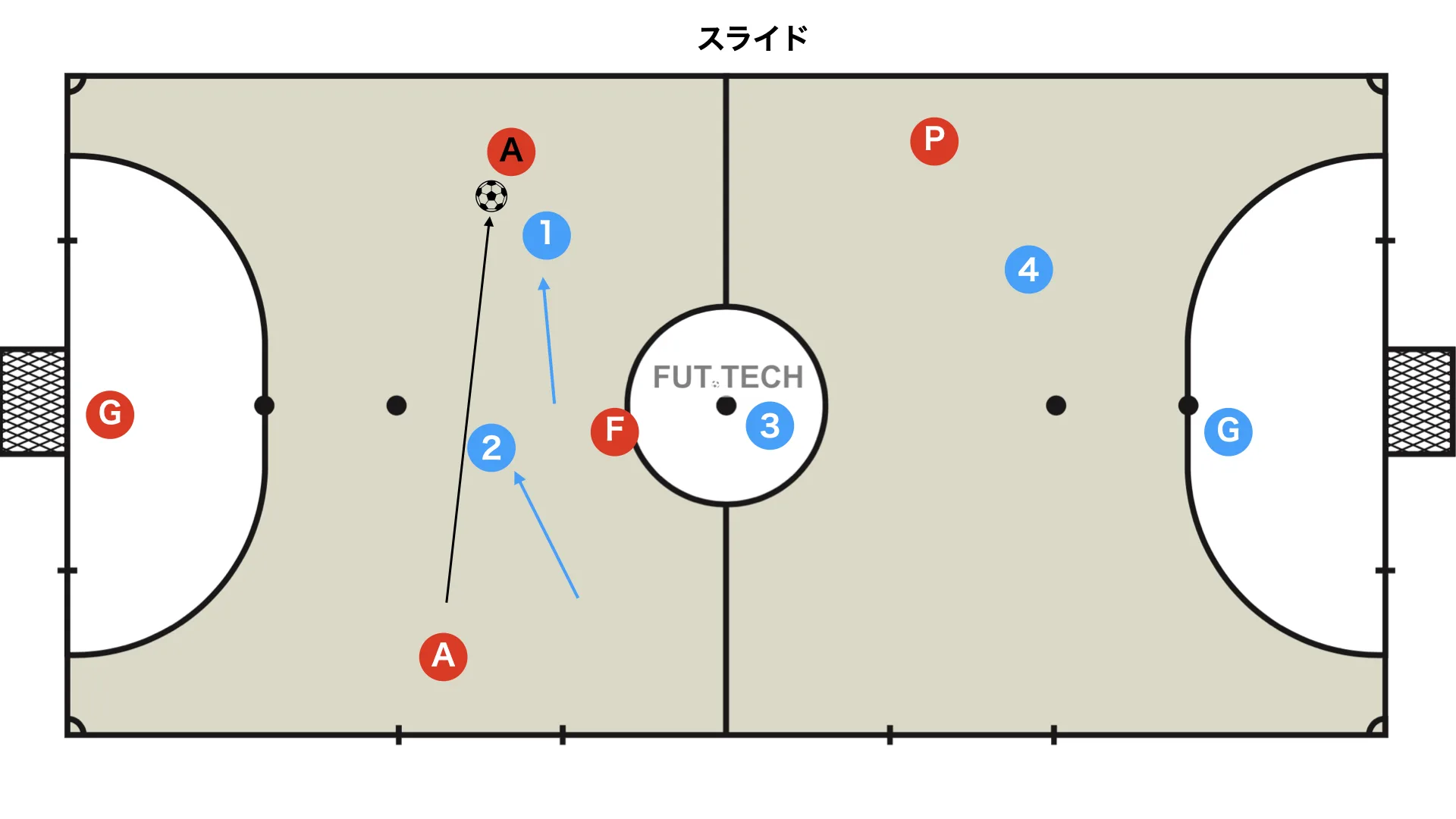
Two defenders exchange roles.
This is often used against defences built on multiple lines when the ball is switched heavily from one side to the other.
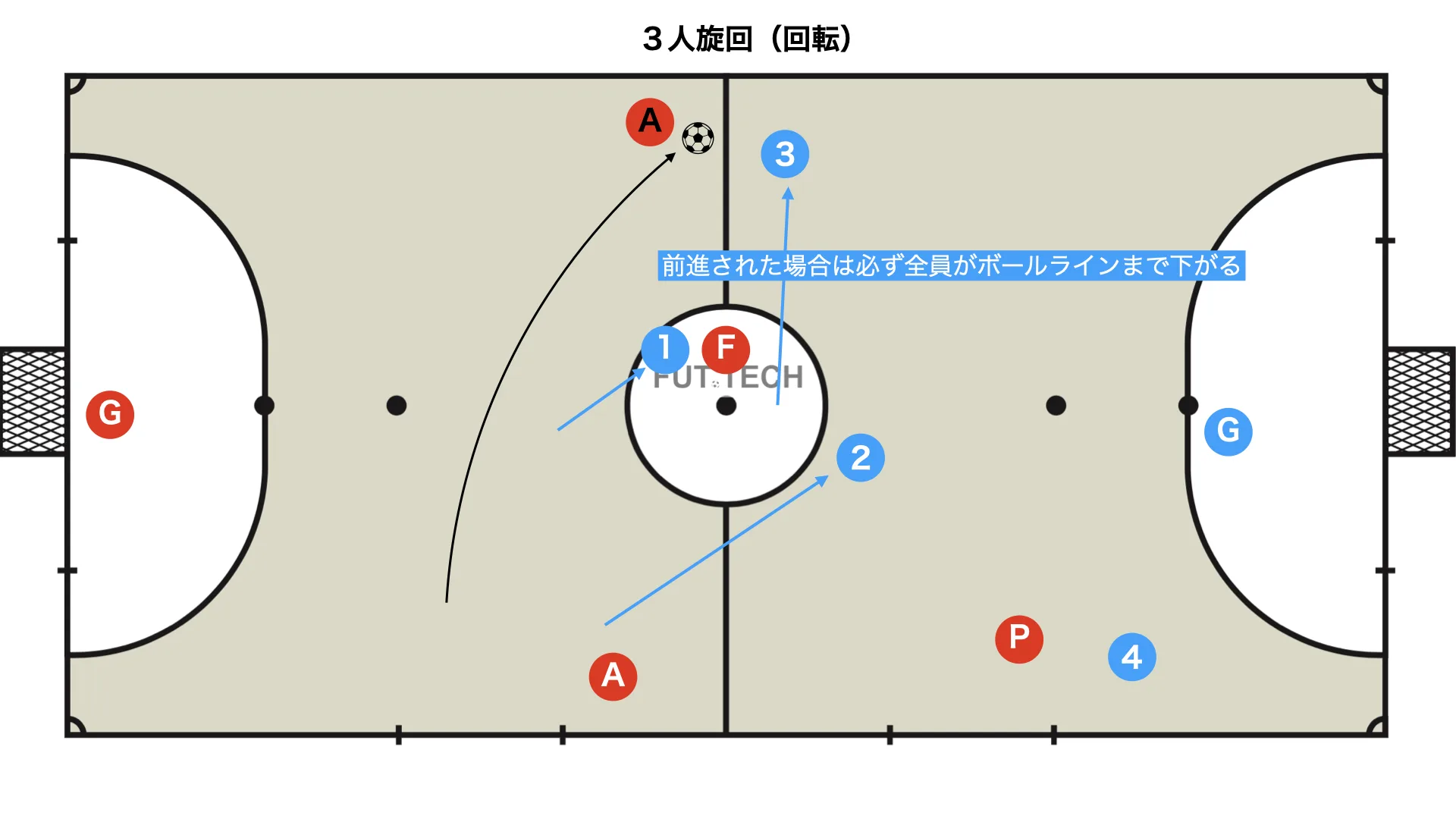
Three players exchange roles.
This is used when the high press is beaten and the opponent is allowed to advance a long way up the court.
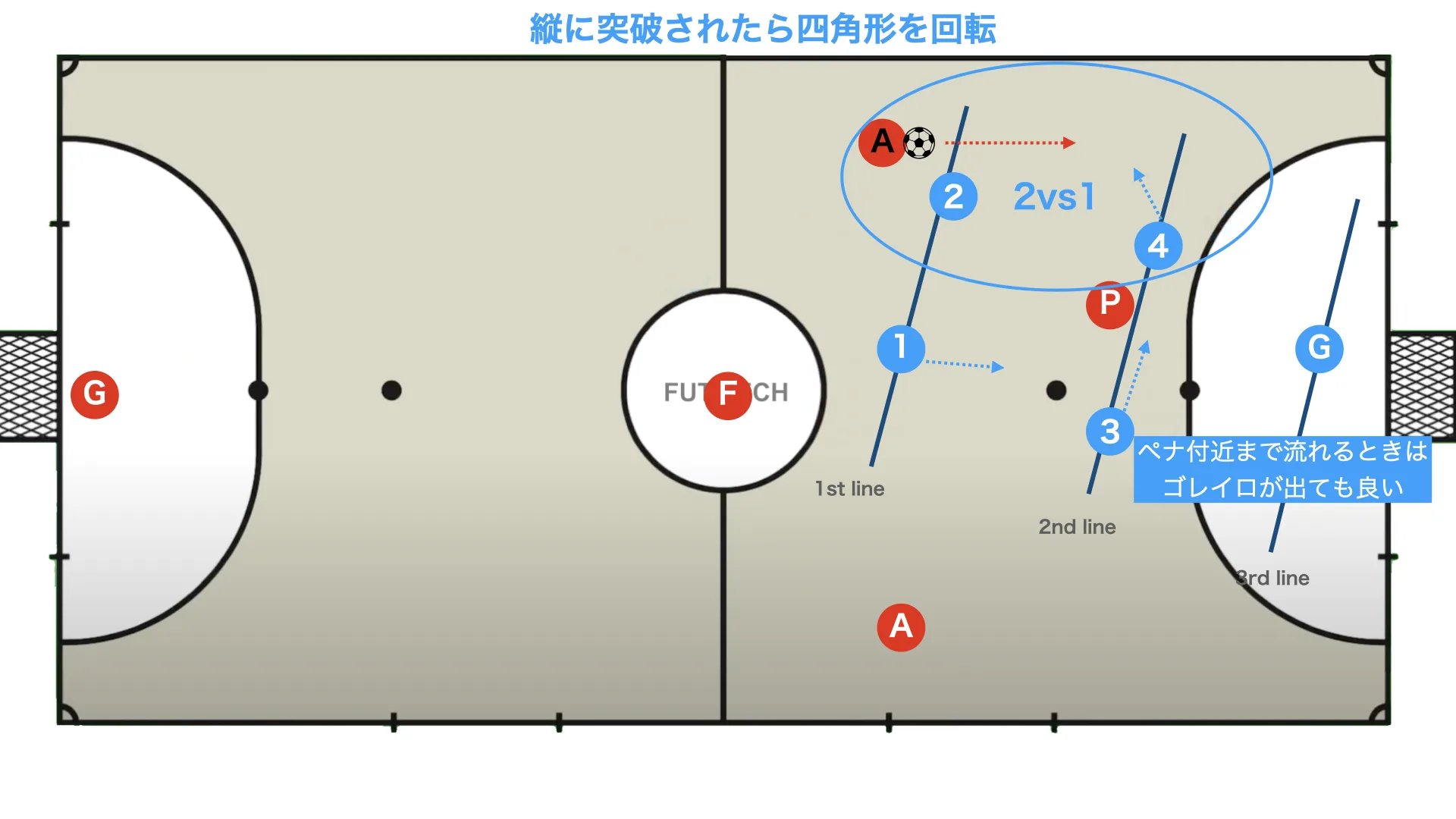
All four players rotate, each shifting one position and exchanging roles.
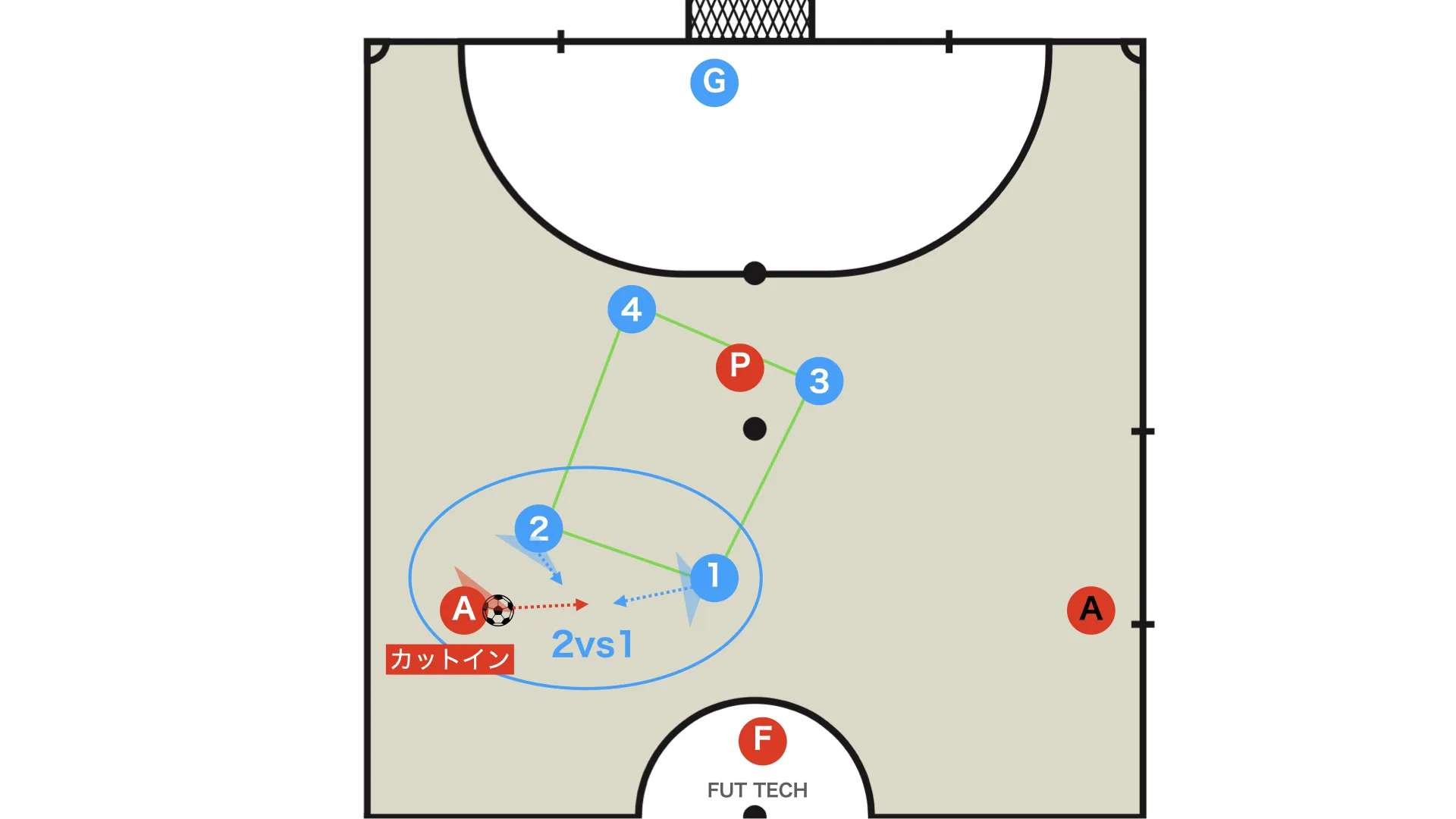
This is the solution used in half-court defensive shapes that rotate as a square.
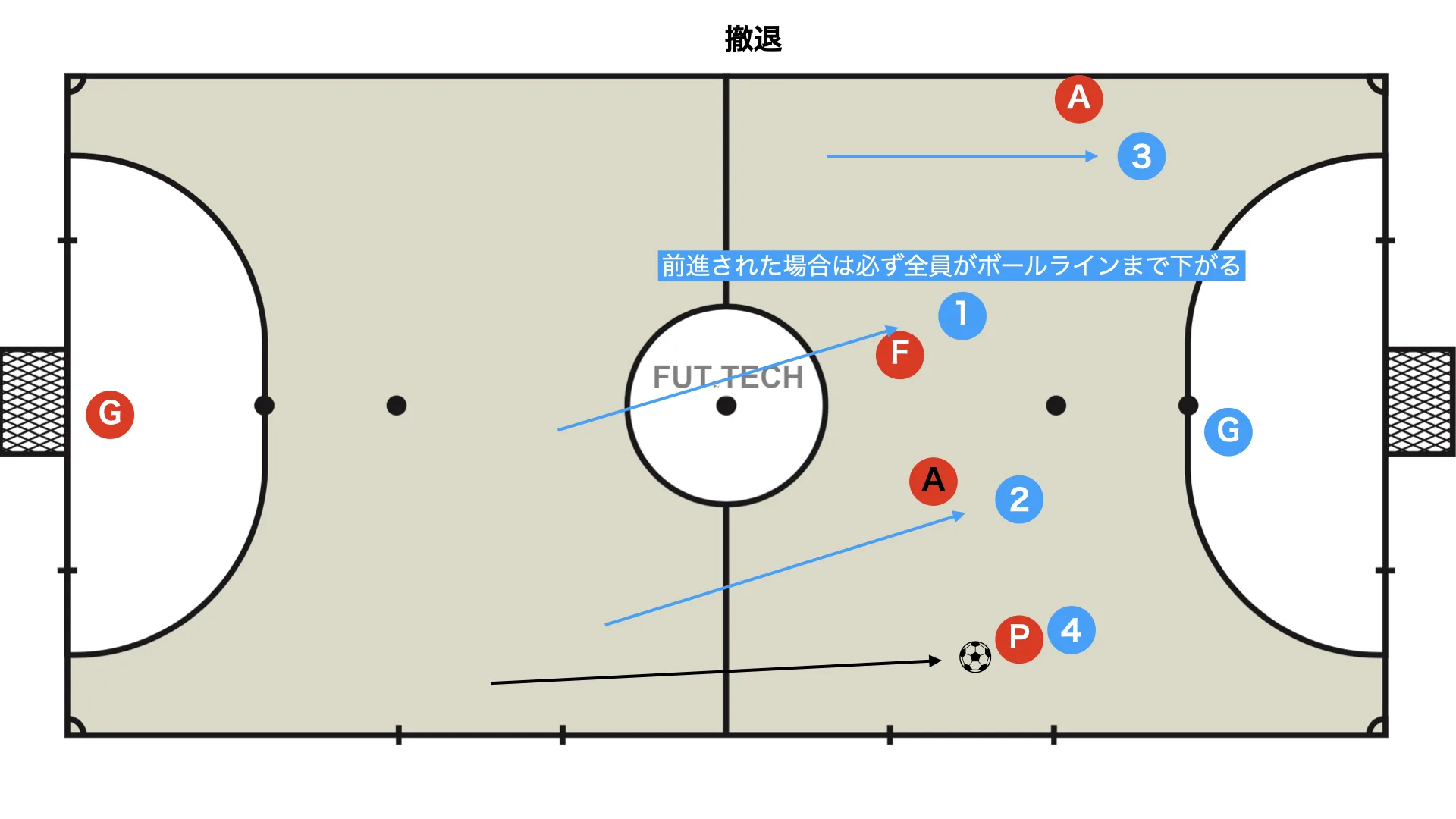
When the ball is played into the pivot, the team retreats to the ball line.
If you only react to the opponent's attack, you will let them keep the ball forever, so at some point you need an action that actively tries to win it back.
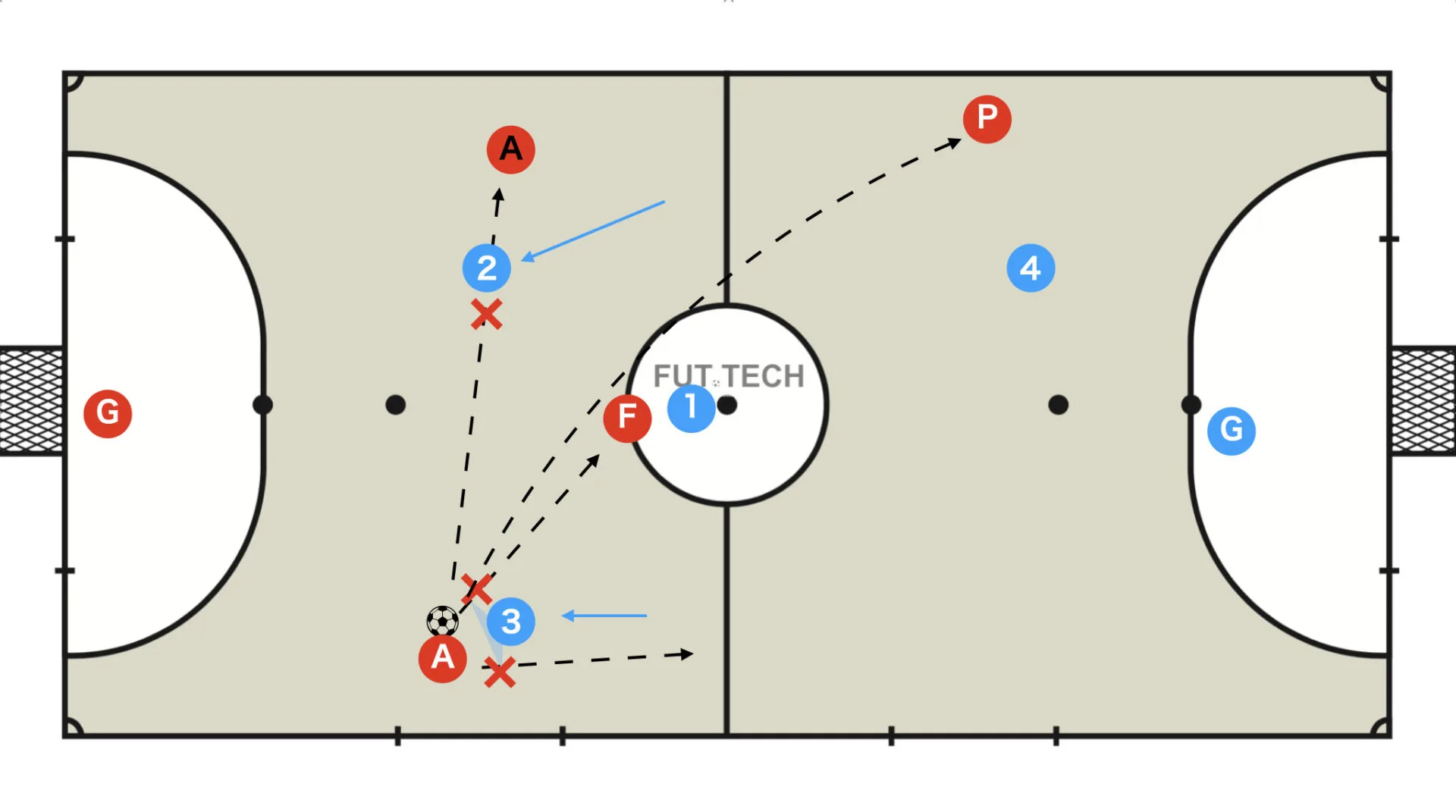
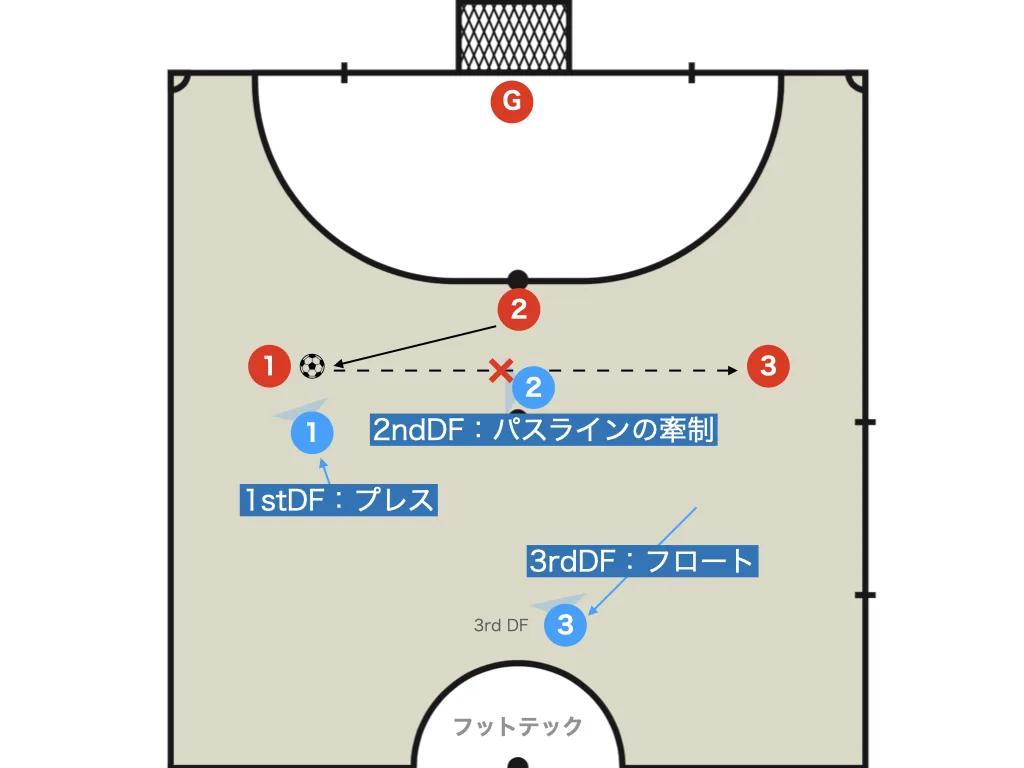
If the 1st defender is able to press, the passing lane in behind is already cut off, so the job is simply to close the remaining space.
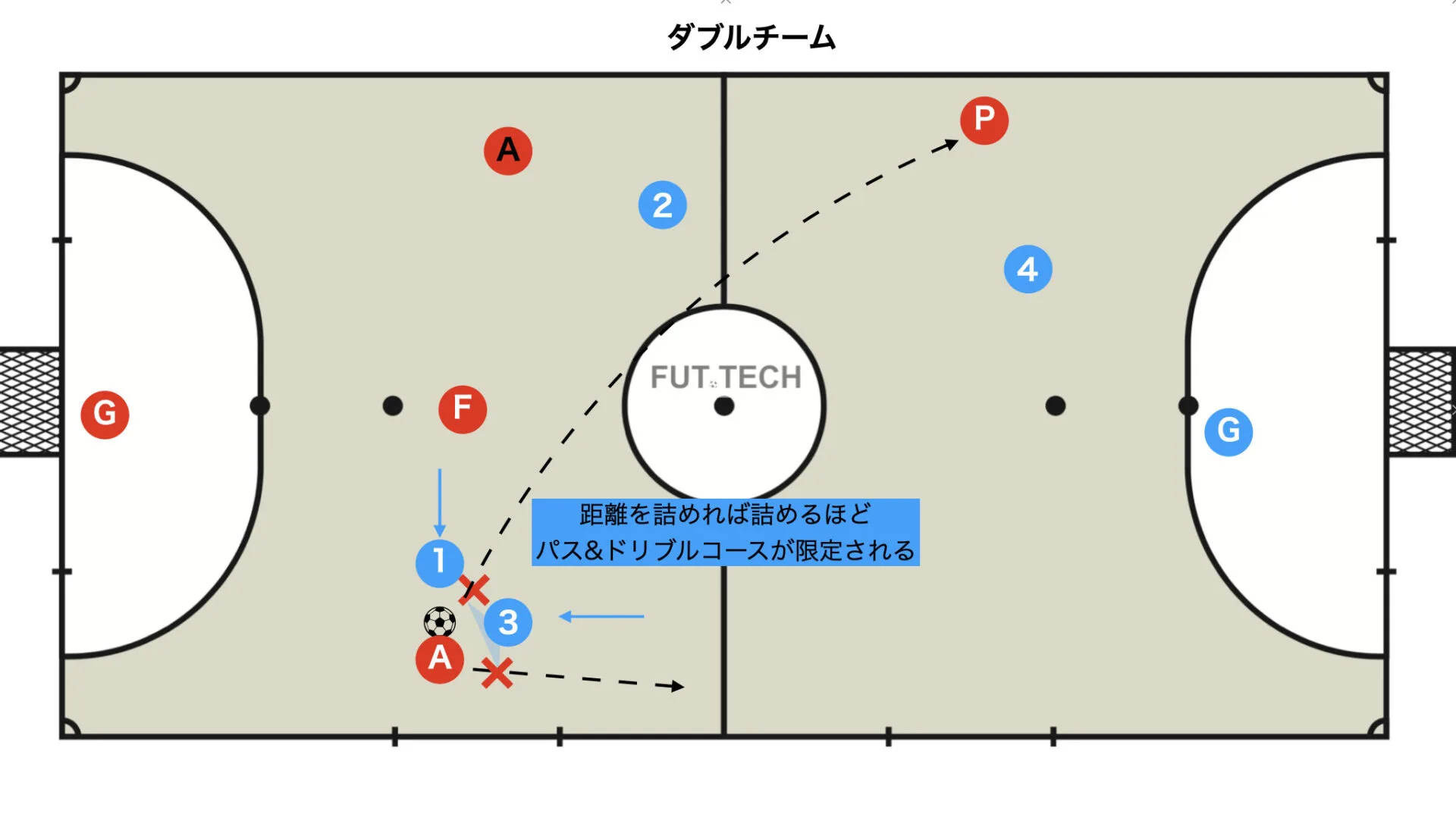
This is essentially the same idea as blocking the passing lane described above, but when two defenders surround the opponent and go directly to win the ball, that defensive tactic is called a double team.