Zone Defence Basics: Building Multiple Defensive Lines and the Ala-to-Ala Pass
Published: 2021.01.30Updated: 2026.05.03
If you have only just started playing futsal, you may think basic defending in futsal should simply be man-to-man.
In practice, many beginner teams end up sticking tightly to individual opponents and neglecting the space behind them.
Of course, man-to-man defending is absolutely an effective defensive option in futsal. But if your team does not have especially strong individual defenders, the defence will collapse unless you build a zone defence with multiple defensive lines.
This idea of multiple defensive lines is so important that not understanding it is almost like not knowing even the first letter of futsal tactics. It matters not only in defence, but also in attack, because attacking well depends on knowing how to break those lines.
In this article, I will explain the basic defensive concepts you absolutely need in futsal, with a particular focus on building multiple defensive lines, using diagrams and video.
Futsal is a sport where you win by scoring more goals than your opponent and conceding fewer.
To score, you have to shoot. To create better shooting chances, you need to find space, use it well, and break down the opponent's defensive structure.
In other words, attack in futsal is about creating and finding space, then using it effectively. And because attack and defence are two sides of the same coin, defending in futsal is about filling space and preventing the opponent from using it effectively.
Put even more simply, futsal is a sport of space.
That is why a futsal defence needs to build multiple defensive lines in order to cover and control more space.
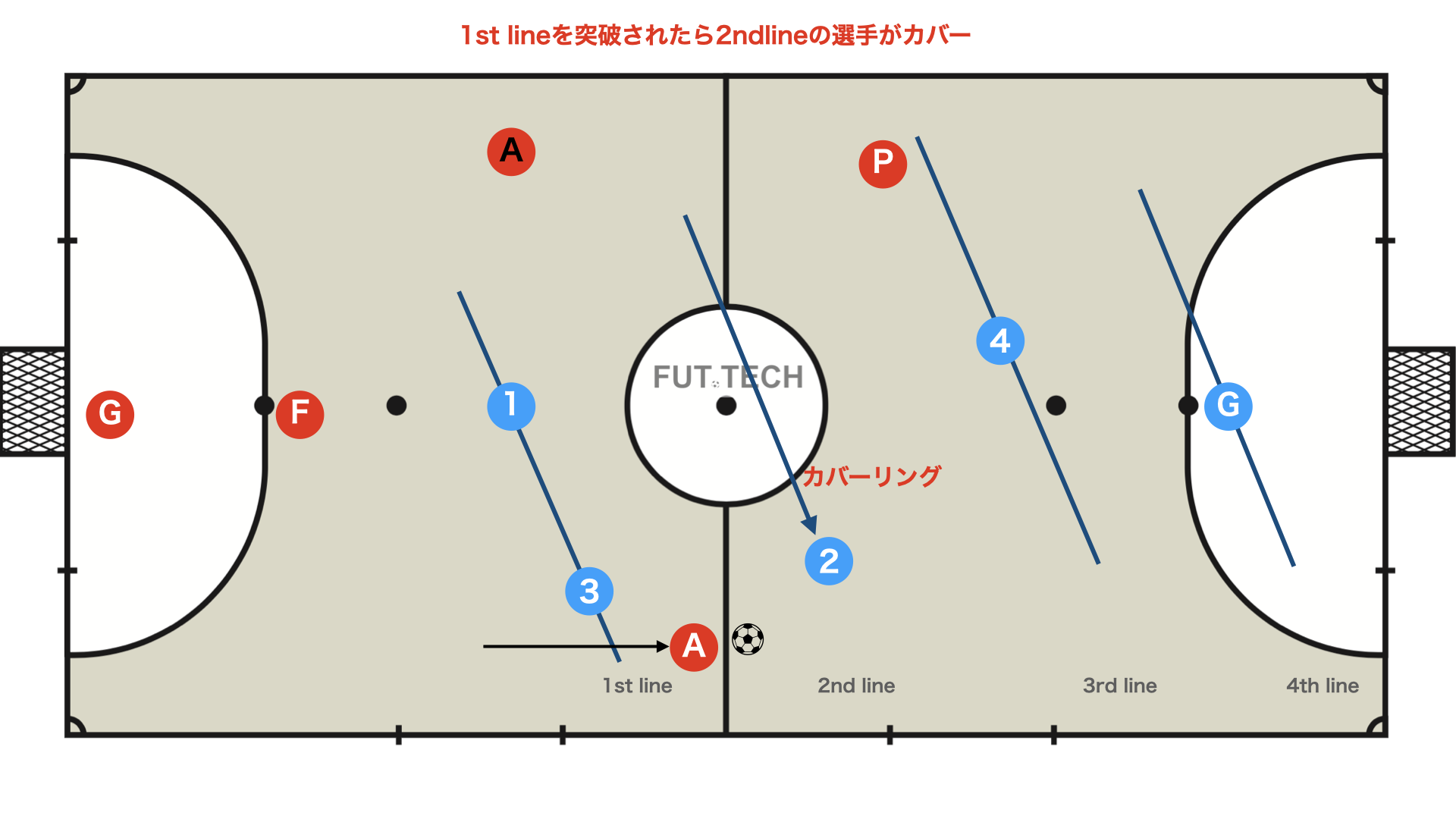
The more defensive lines you have, the safer you are, and ideally the five players, including the goalkeeper, should form three to four layers (lines).
Based on that, the basic principles of attack and defence can be summarized as follows:
- Attack: separate or absorb the opponent's defensive lines
- Defence: keep the defensive lines compact and never become a single flat line
These principles are extremely important.
Now let us look at what that means in practice.
Building multiple defensive lines is an important concept throughout futsal defending, but here I will use defending against a false-pivo setup within a 3-1 as the example.
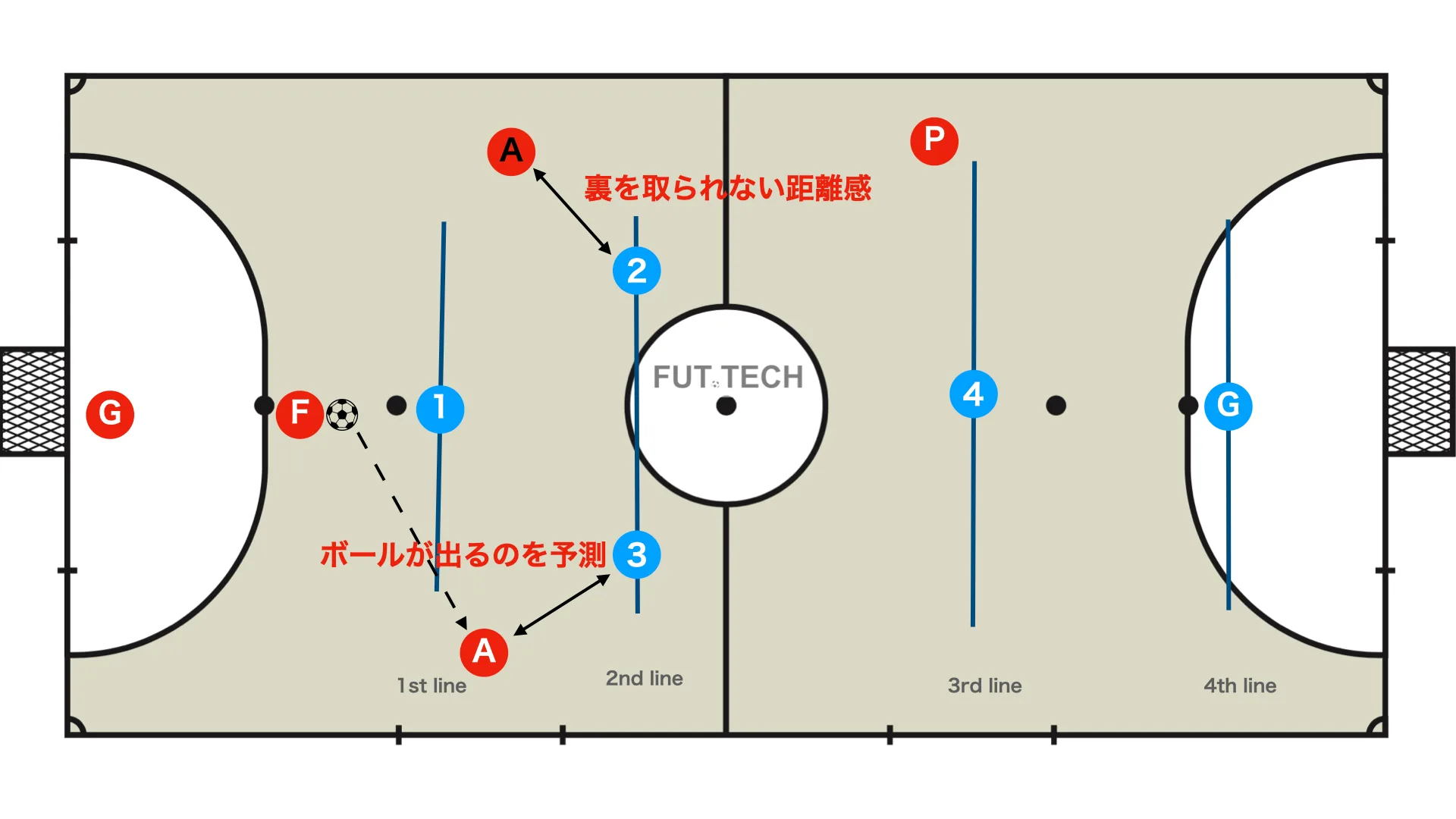
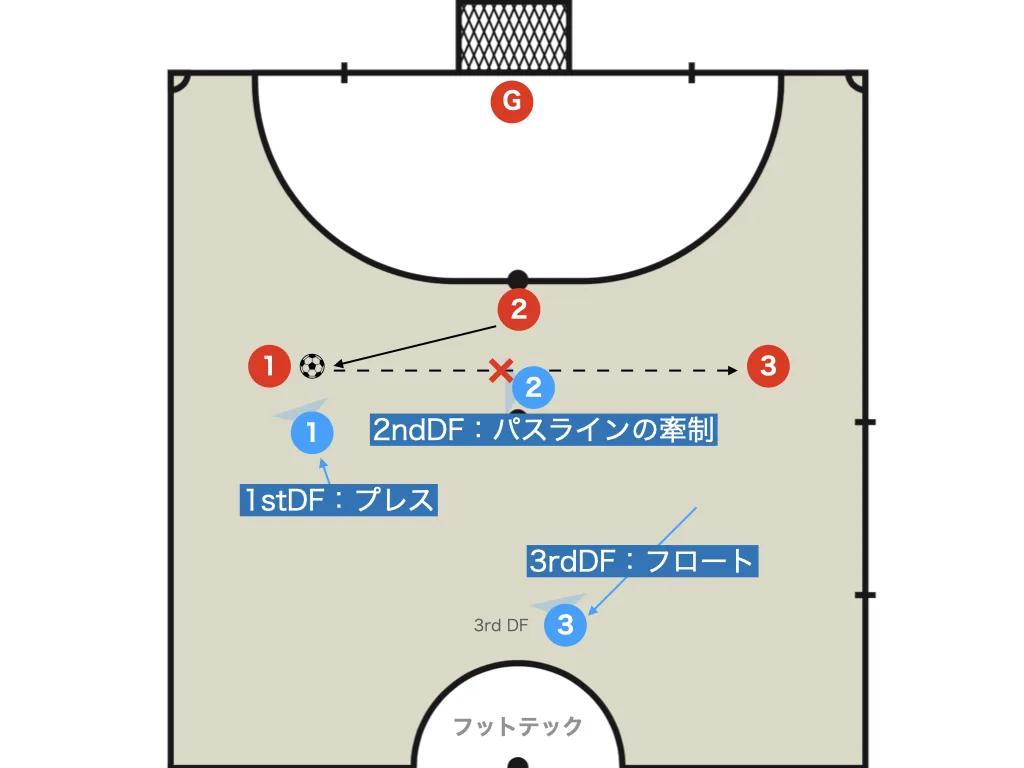
When the fixo has the ball, blue 1 presses the ball carrier, while blue 2 and blue 3 in the second line keep enough distance that the opponent's alas cannot get in behind them.
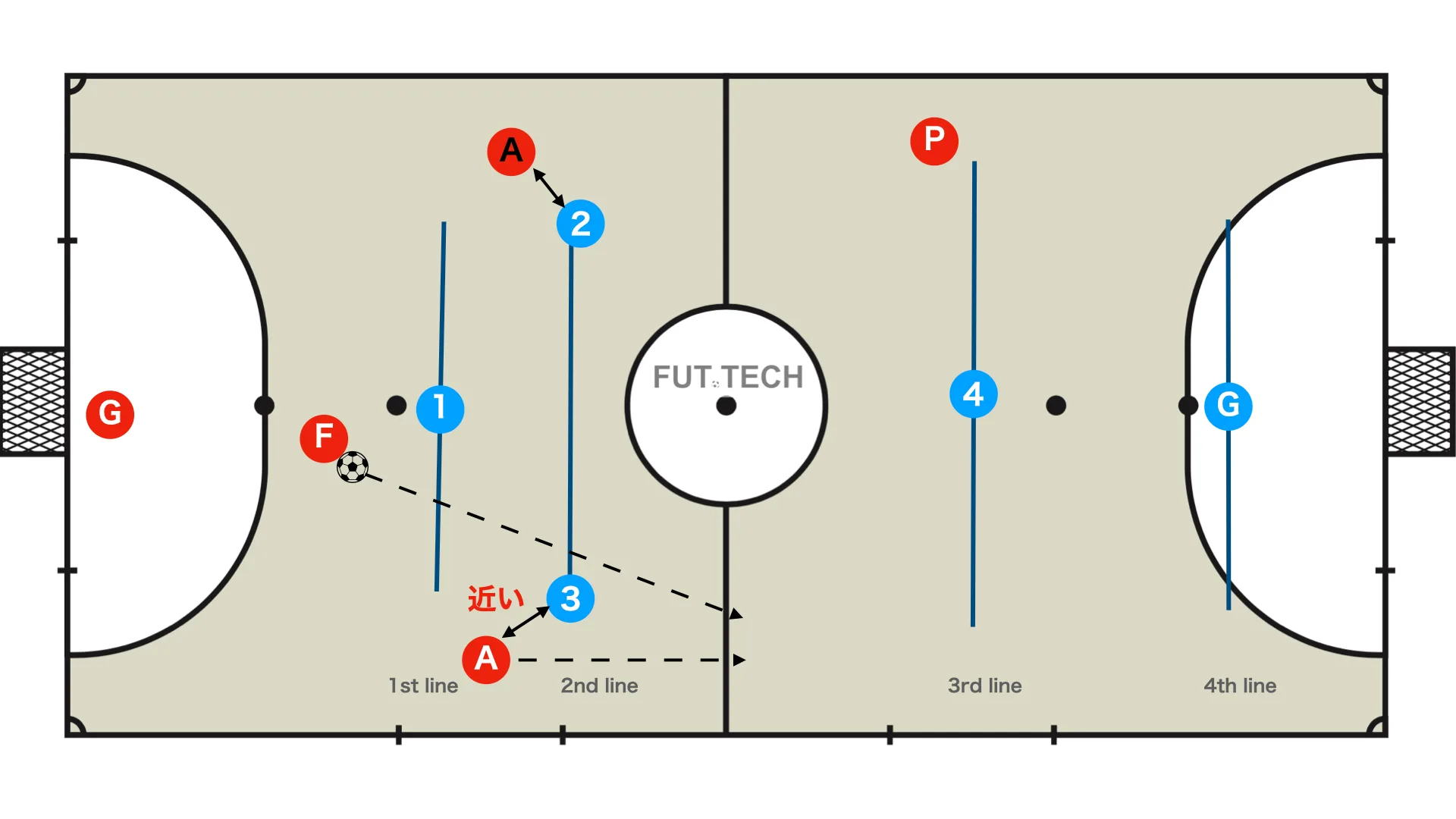
At this moment, if they mark the red alas too tightly, or if they step forward too aggressively when the ball is still at the opponent's feet, they can be beaten in behind very easily with a parallel run.
In general, if a defender is facing away from goal and an attacker is moving toward goal, and both start at the same time, the attacker will usually win the race. Defenders need to take that into account and manage their distance correctly.
They should anticipate the pass from the fixo to the ala and start moving before the ball is played, close down as much as possible, and then make sure to stop as the receiver takes the first touch so they do not get beaten in one move by a tonpa or similar action.
The pressing defender should basically stay between the ball and the goal, while also thinking about the opponent's stronger foot and which passing or dribbling lane to block.
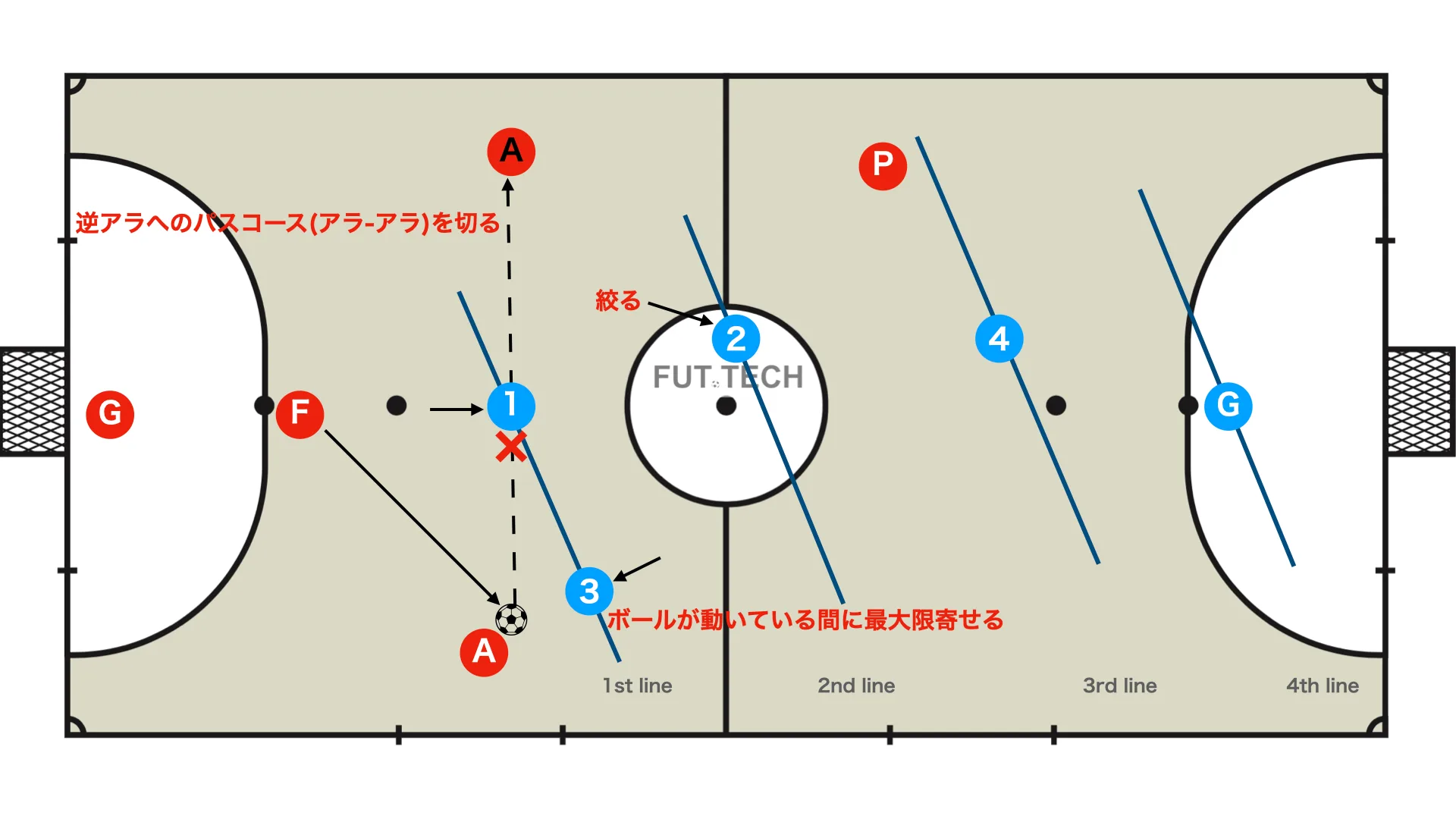
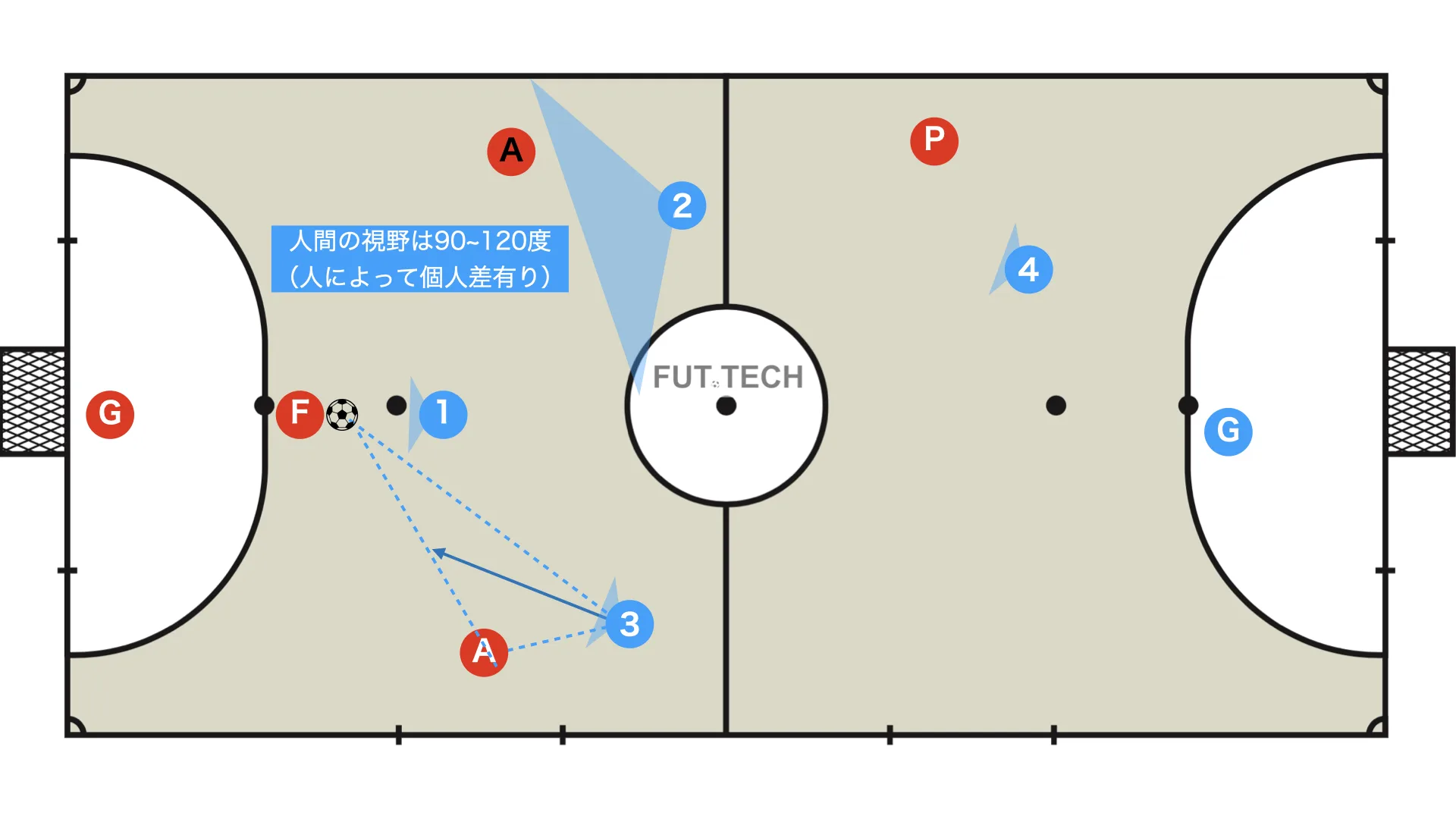
When the ball goes to the ala, blue 1 should take up the correct position, as shown in the diagram, to cut the pass from one ala to the other.
I will explain the importance of cutting the ala-to-ala pass in the next section.
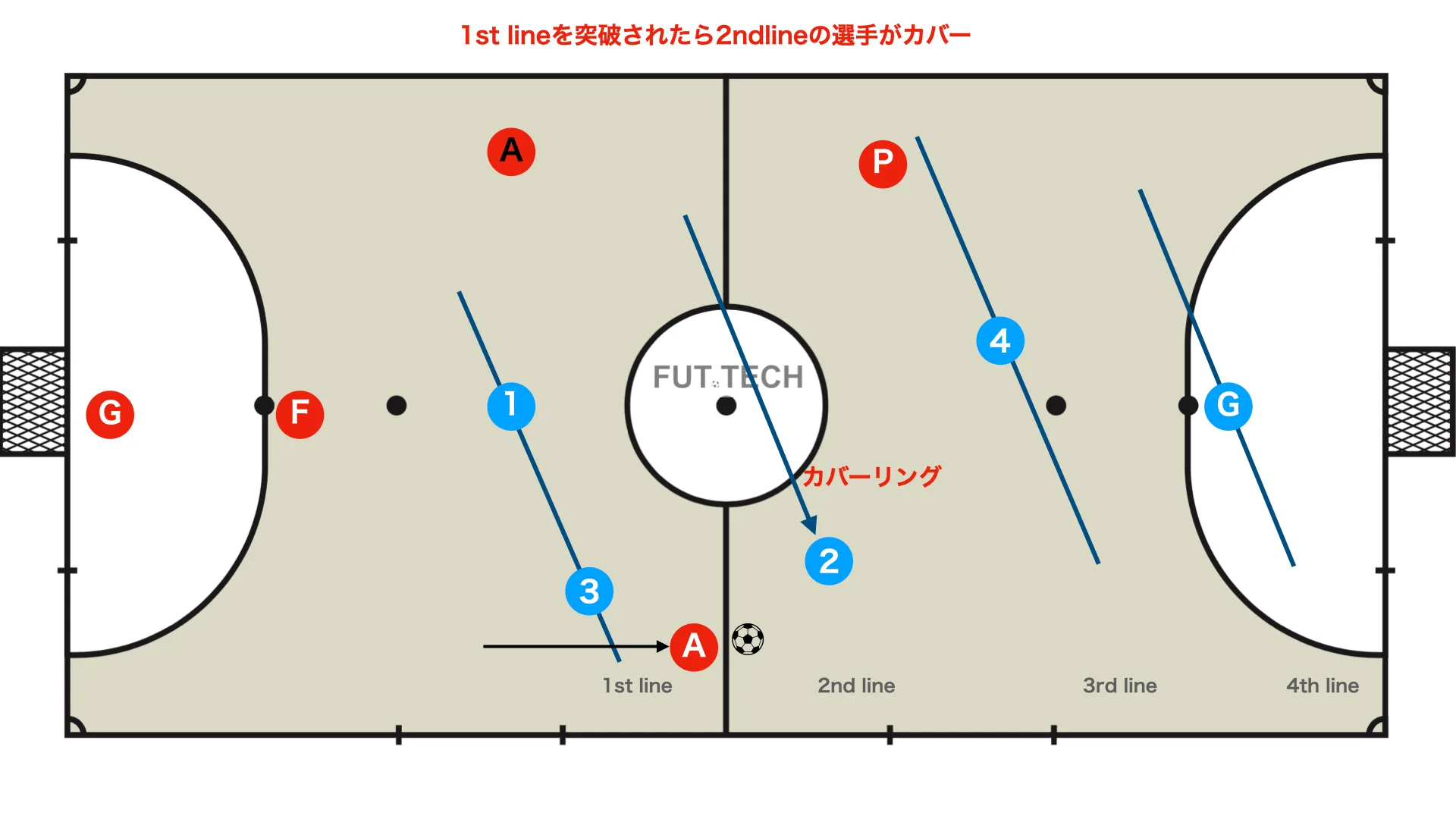
Blue 2 should not stay glued to the opposite ala. Instead, blue 2 should tuck in slightly and be ready to cover in case the first line is broken.
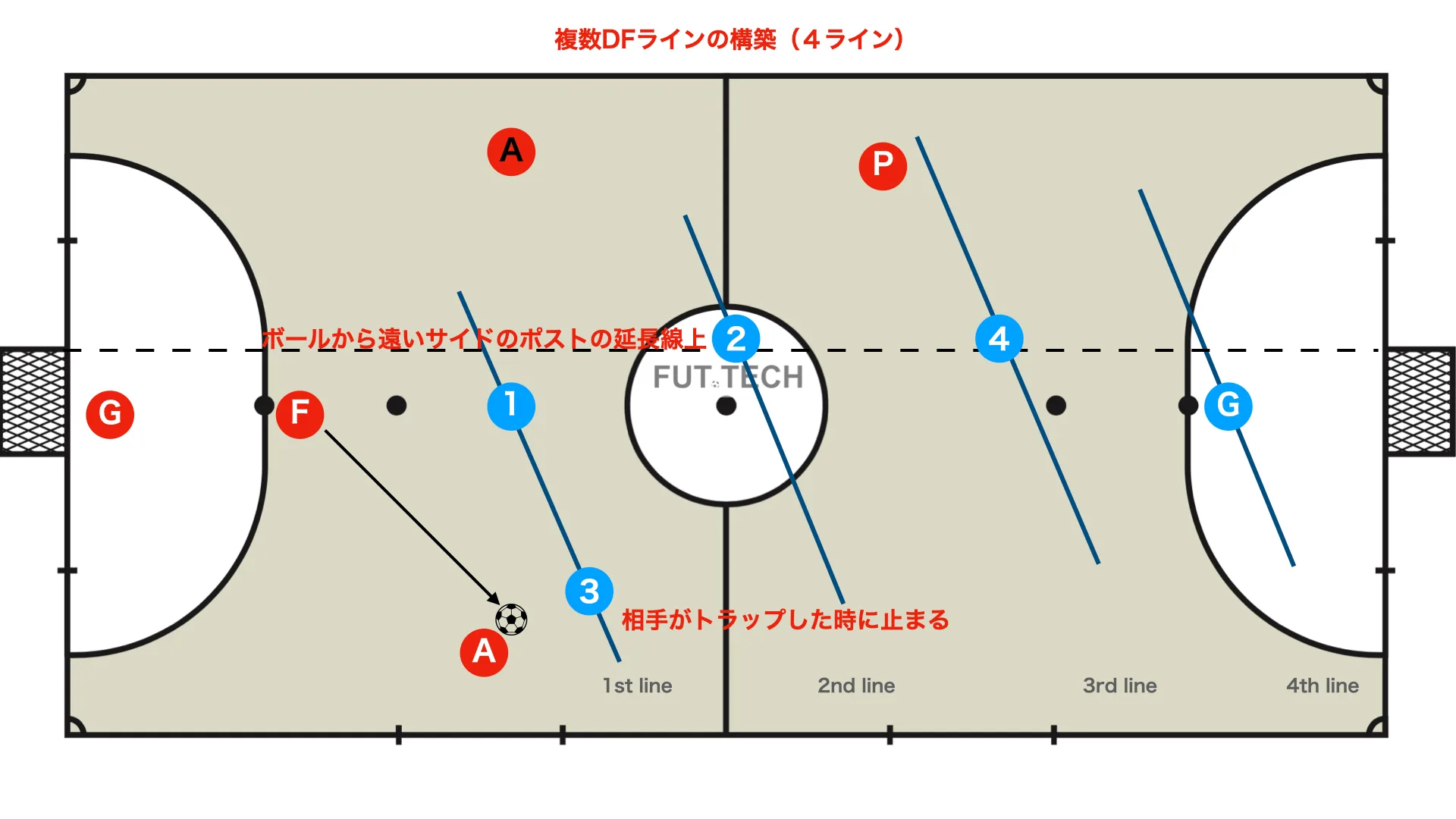
How much blue 2 tucks in here depends on that player's agility and defensive range, but at minimum it is preferable to narrow in as far as the extension of the far post on the side away from the ball, as shown above.
It is best for each team to decide in advance how much the weak-side player should tuck in.
関連記事
High Pressing: The Defensive Triangle (Epsilon / Y-Shaped Zone Defence)
An explanation of the Y-shaped (epsilon) zone defence used in futsal high pressing. This article bre…
続きを読む →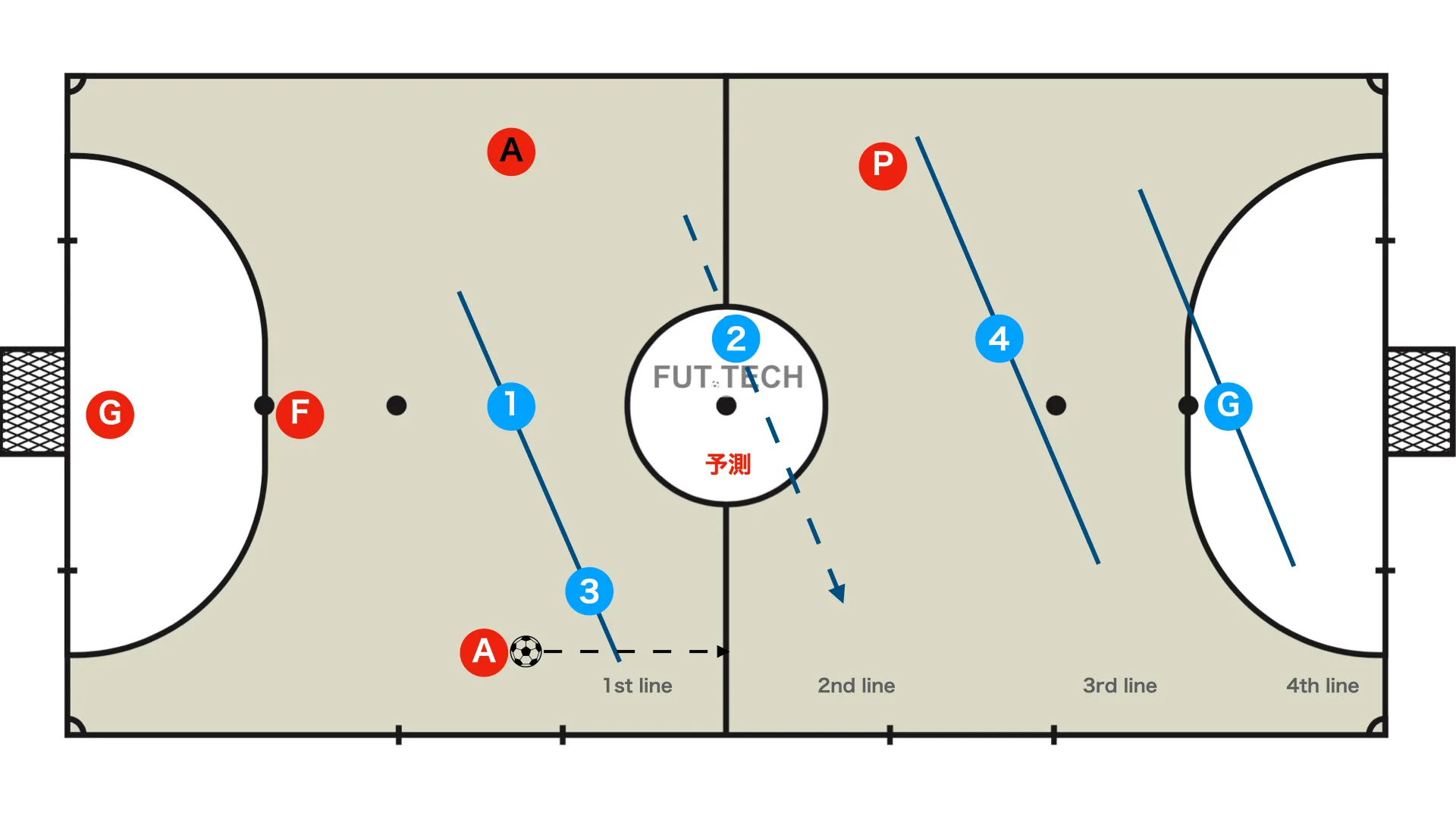
As shown above, if the ball carrier on the ala looks ready to attack down the line, blue 2 should start moving in anticipation that the first line may be beaten.
Here is a match clip showing that sequence in a real game.
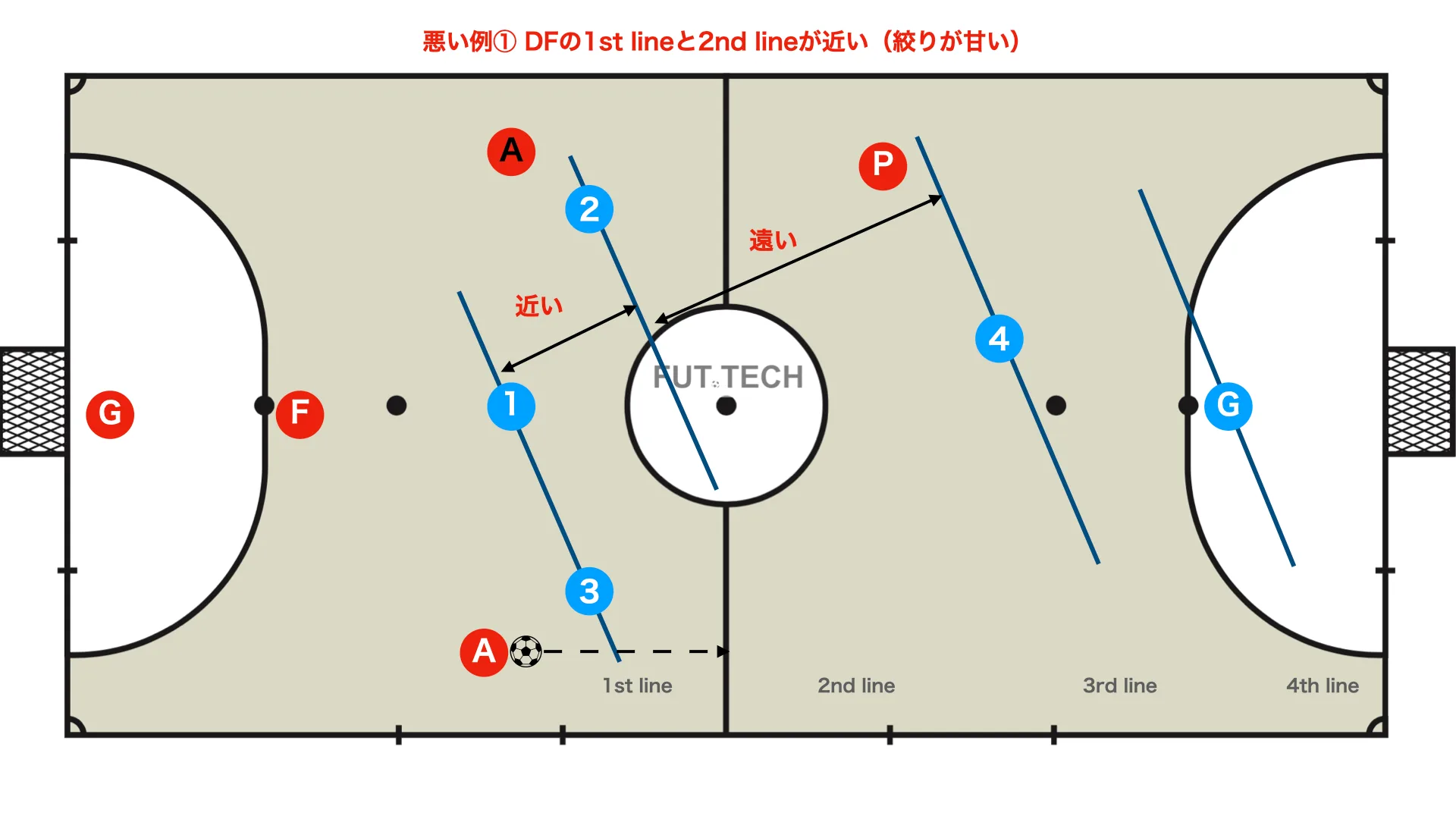
This is a classic bad example that futsal beginners make all the time.
Blue 2 is too focused on marking the opponent (the red ala) and is not in position to cover the first line.
At first glance, the diagram may look as if there are multiple lines, but if the defensive lines are too close together, they overlap and function only as a single line.
In other words, in this situation, even including the goalkeeper, the team has effectively built only three lines.
In futsal, this kind of problem is sometimes described as the absorption of multiple defensive lines.
A very effective attacking method for causing this absorption is 3 on line , where three players line up horizontally.
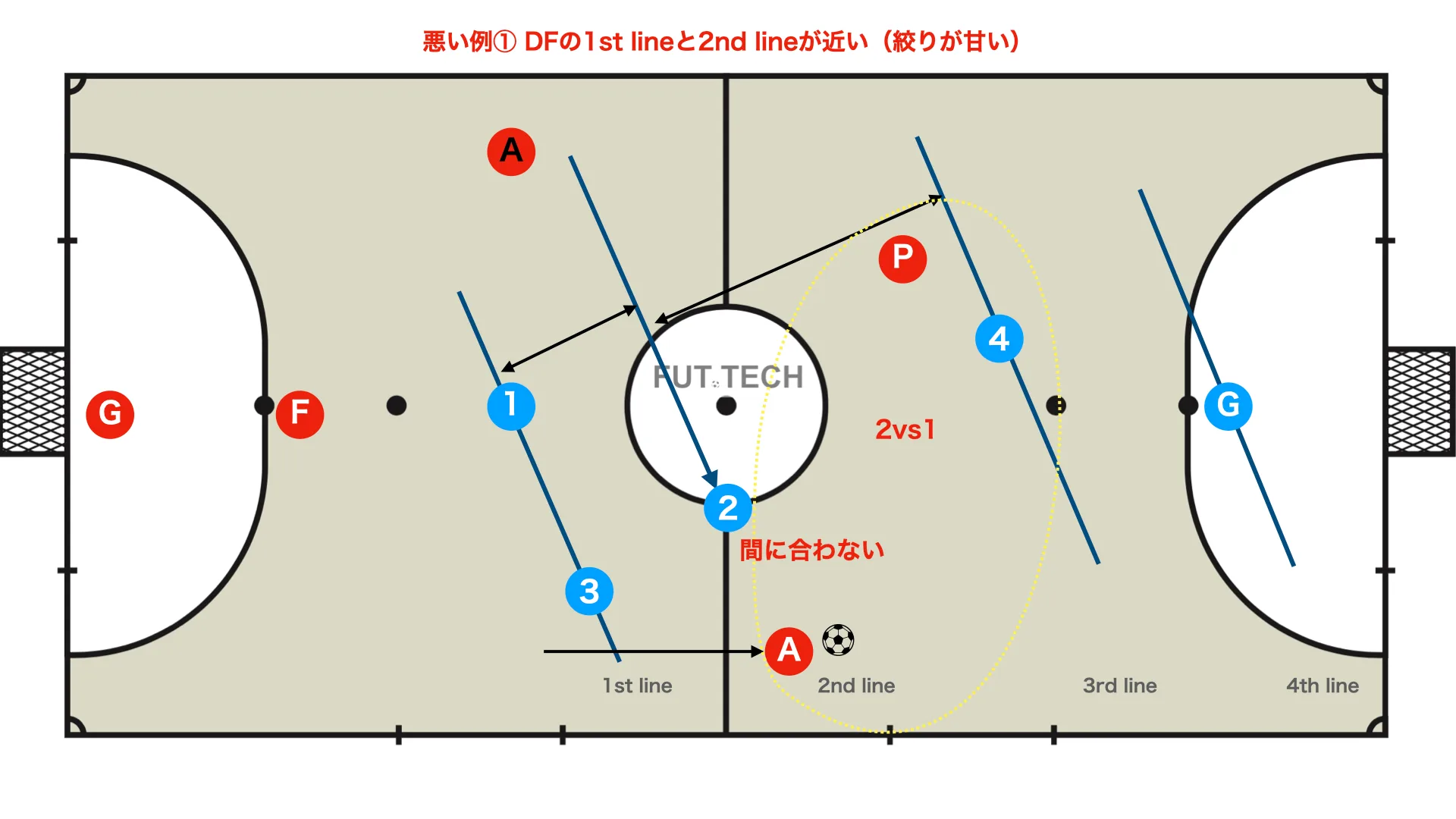
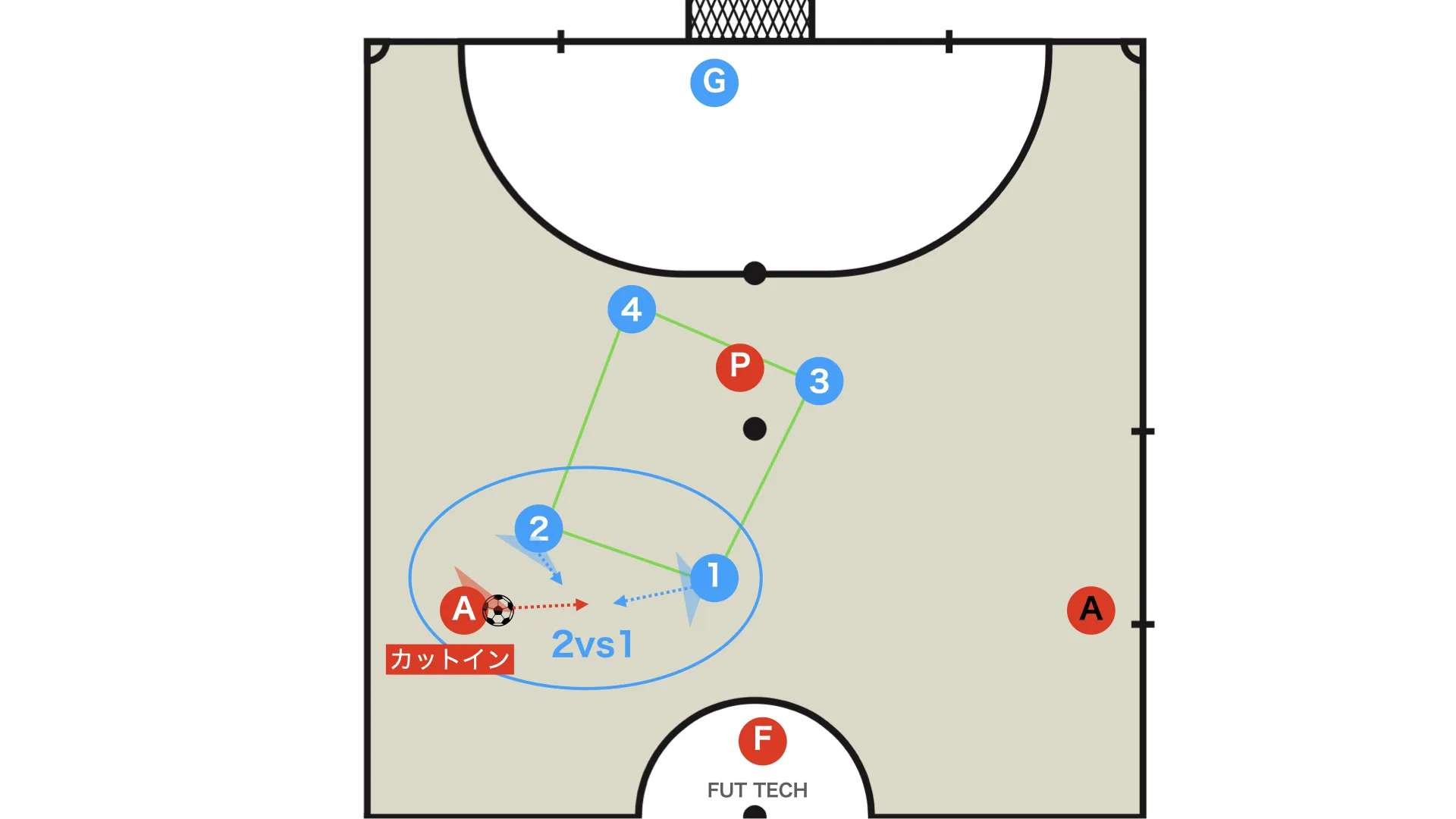
If you cannot cover the ala's run down the line here, the opponent creates a 2v1 (or 2v2 if you include the goalkeeper), which produces a numerical disadvantage and greatly increases the risk of conceding.
This is an example that really shows the importance of building multiple defensive lines.
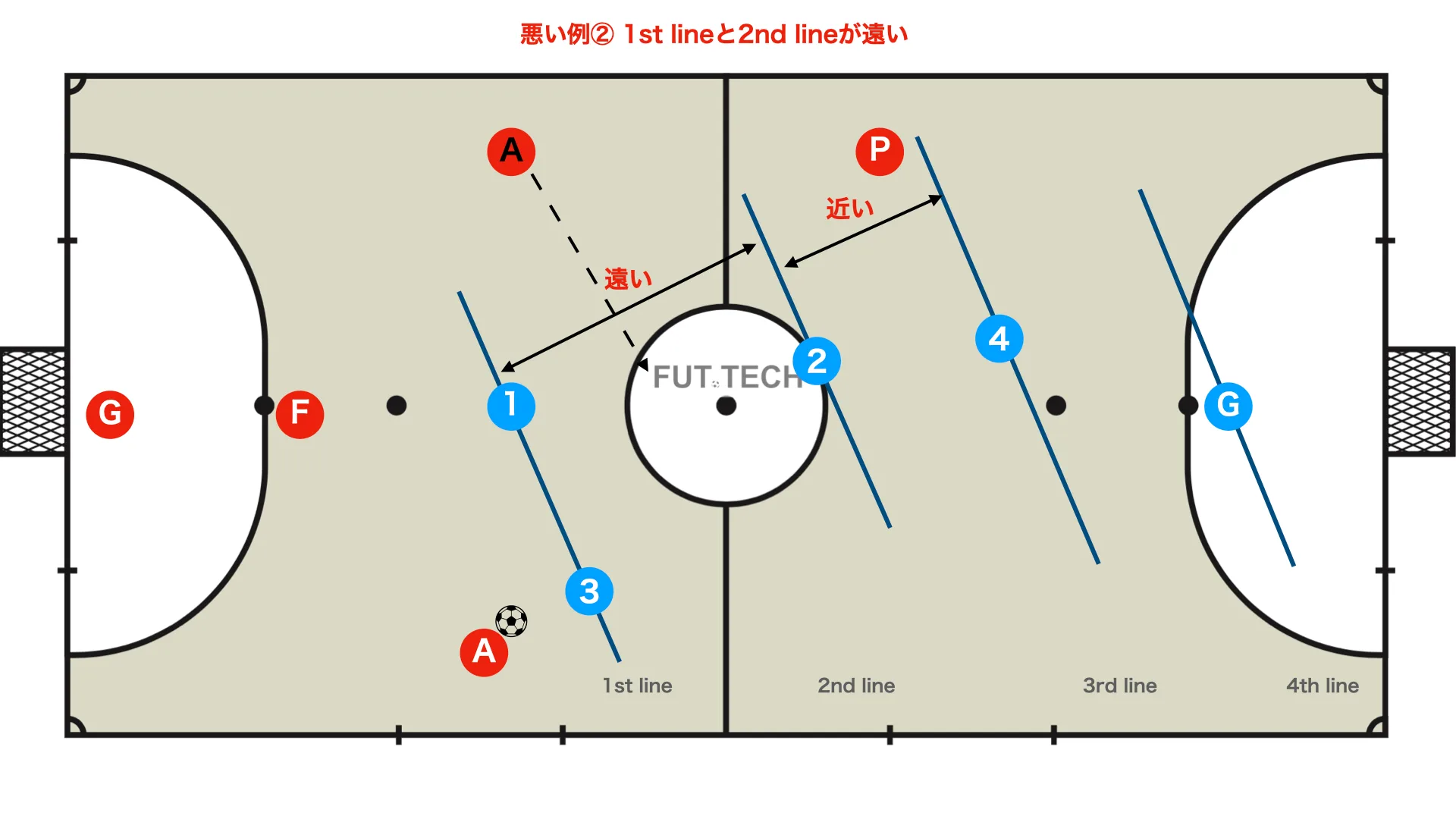
At first glance, blue 2 seems to have tucked in properly and looks ready to cover if the first line is beaten, but this is still not good because the first and second lines are too far apart.
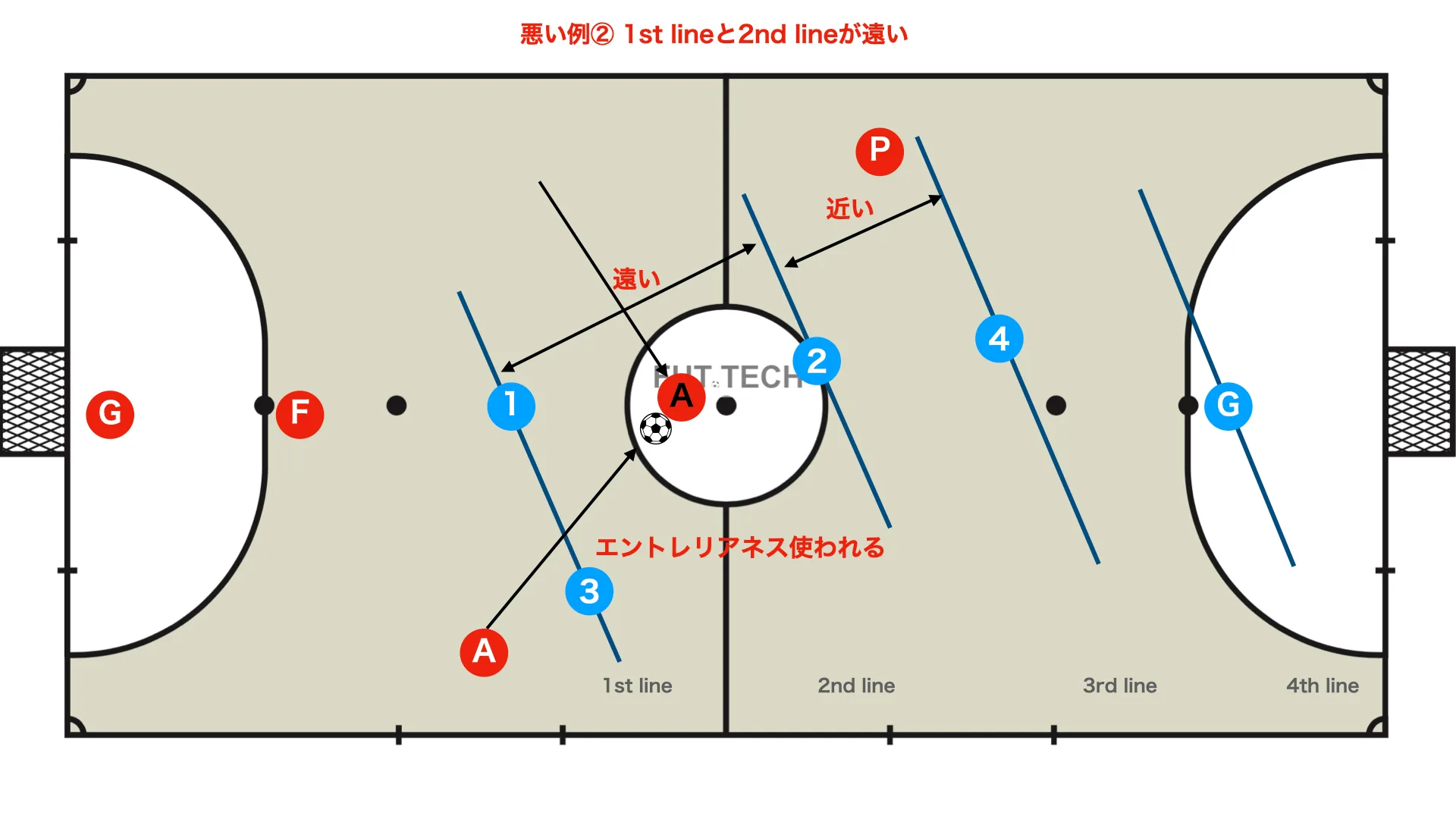
When the distance between the lines is this large, the opponent can easily use the entre lineas space between the lines.
関連記事
How to Use the Space Between the Lines to Break Down Zone Defence
A guide to using the space between defensive lines in futsal to attack zone defence. This article ex…
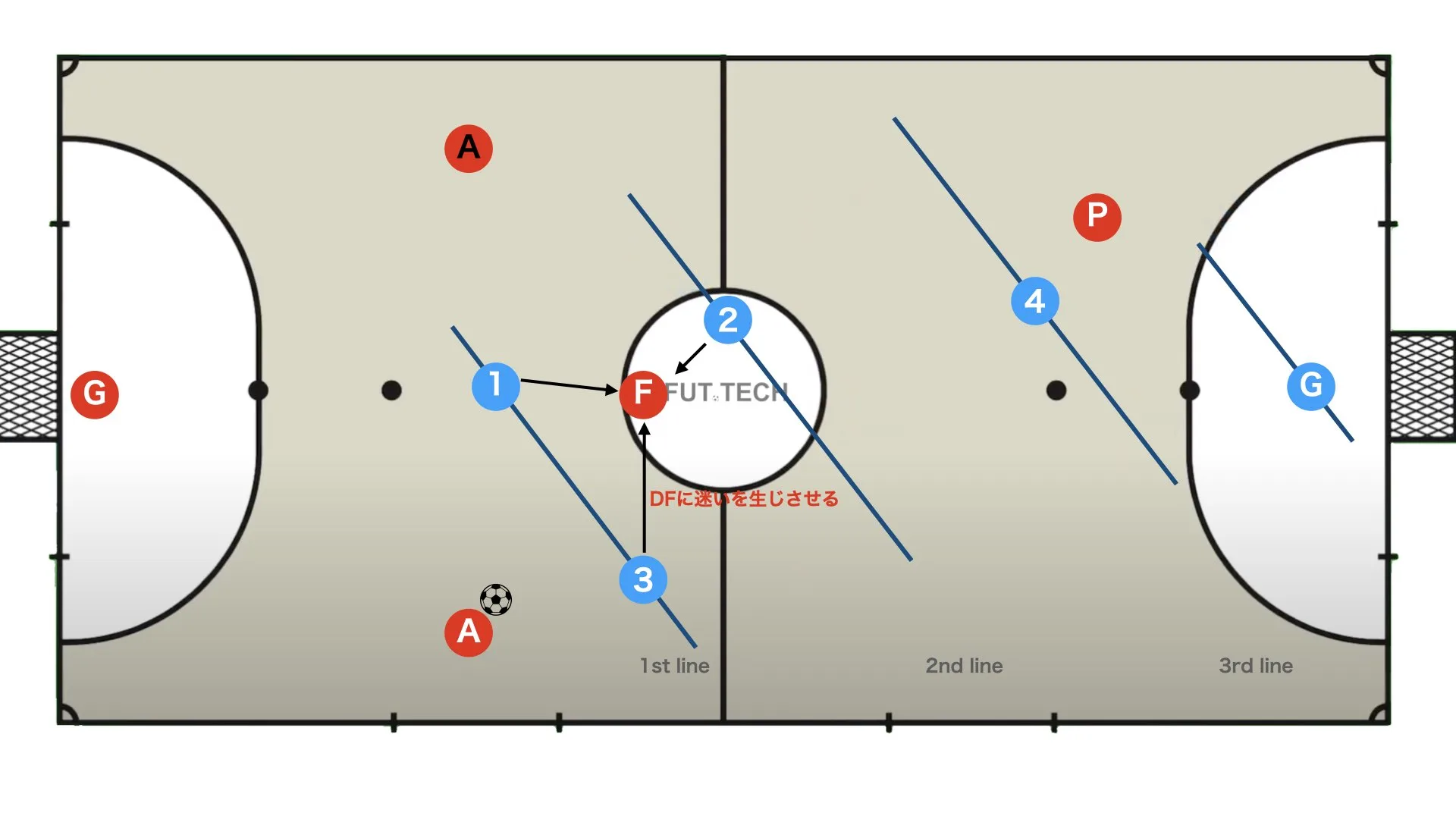
続きを読む →If the defensive lines are too far apart, the covering that should be possible no longer works efficiently, and you end up giving the opponent a large space between the lines where they can play.
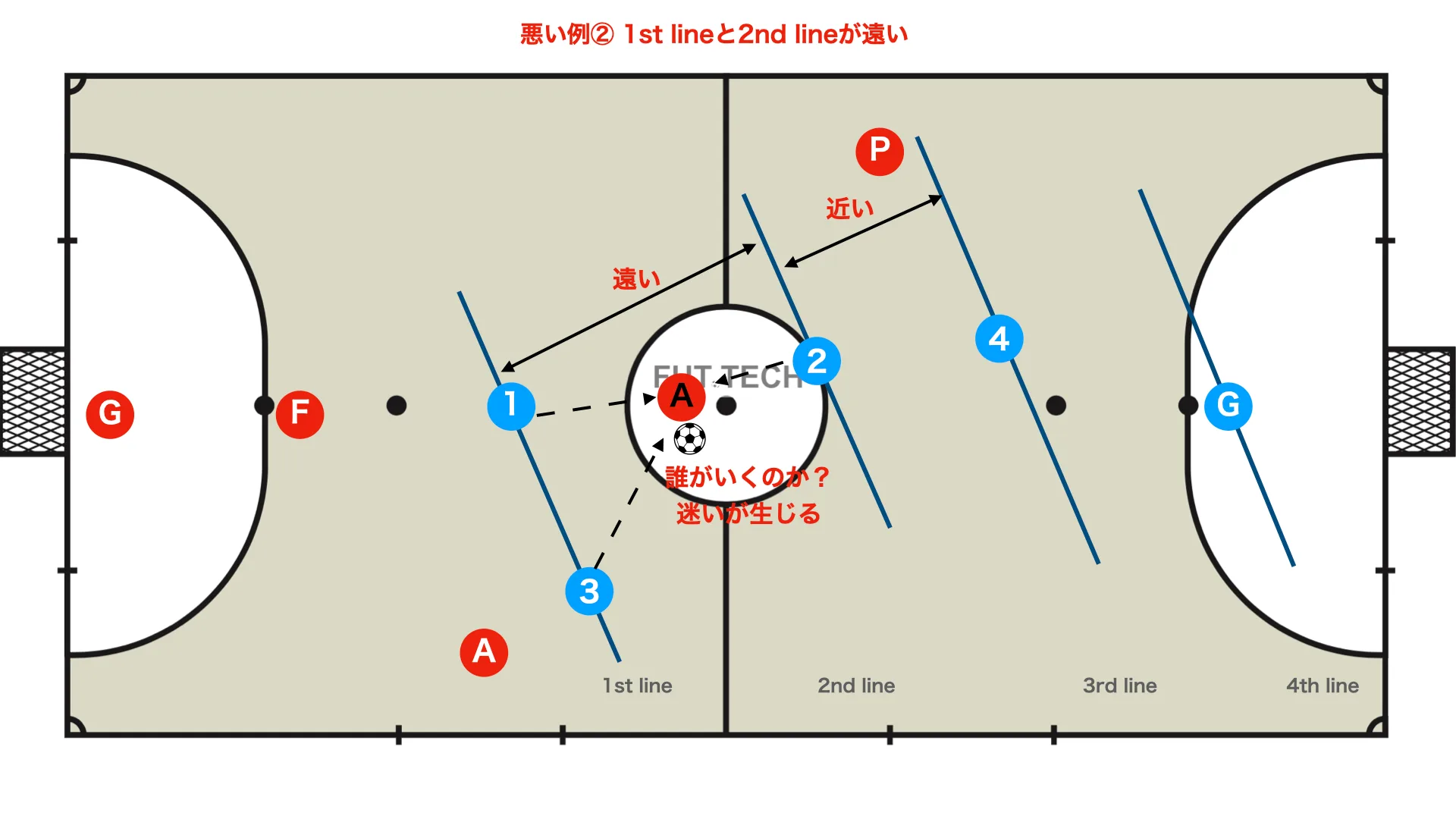
Once the opponent starts using the space between the lines, defenders begin to hesitate and the organized defensive structure can collapse.
In other words, the distance between defensive lines must be neither too close nor too far. It has to be appropriate.
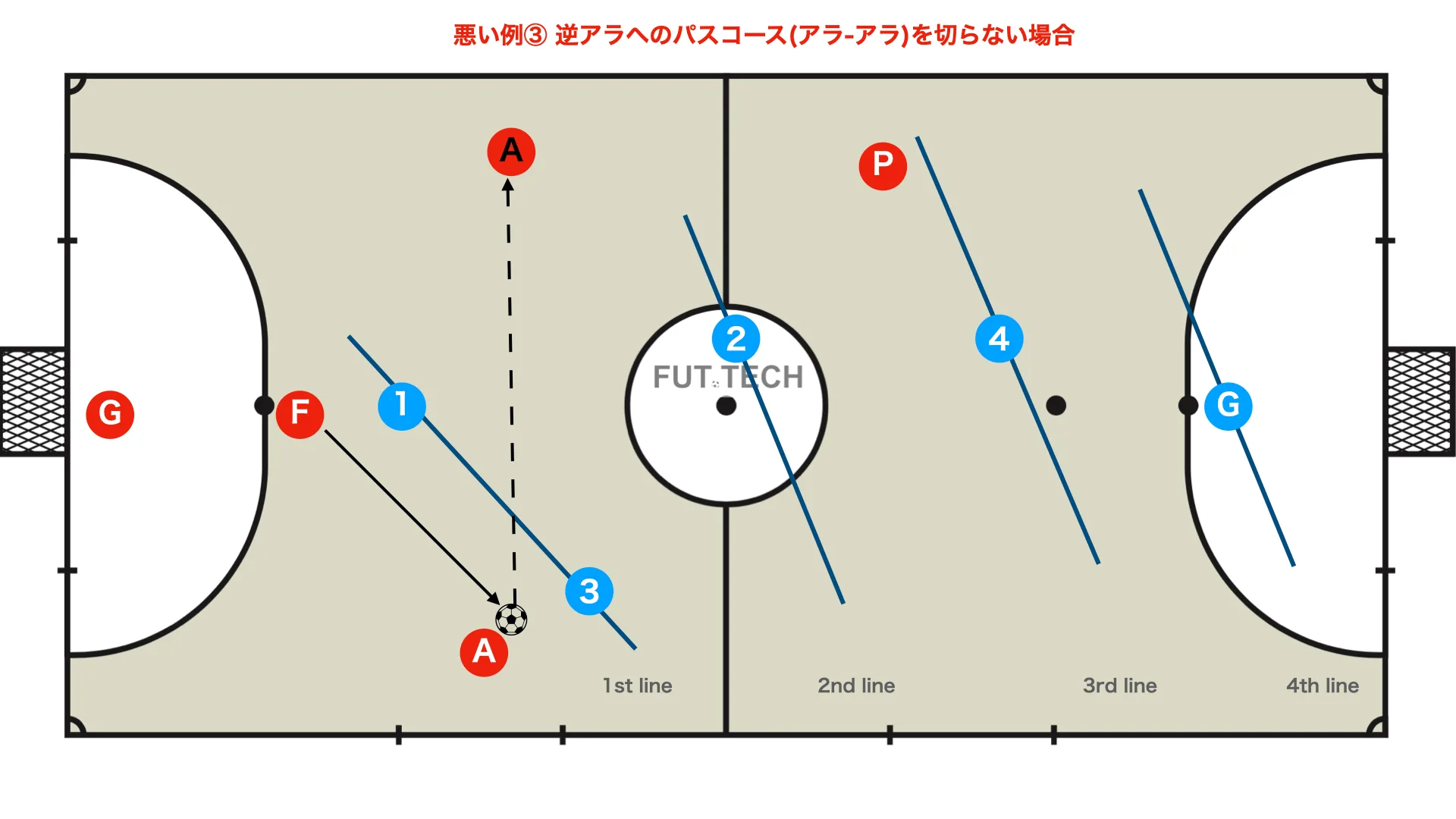
If you fail to cut the ala-to-ala passing lane, the opponent can break the first line easily, switch play, and make the defensive slide arrive late. It is one of the worst outcomes.
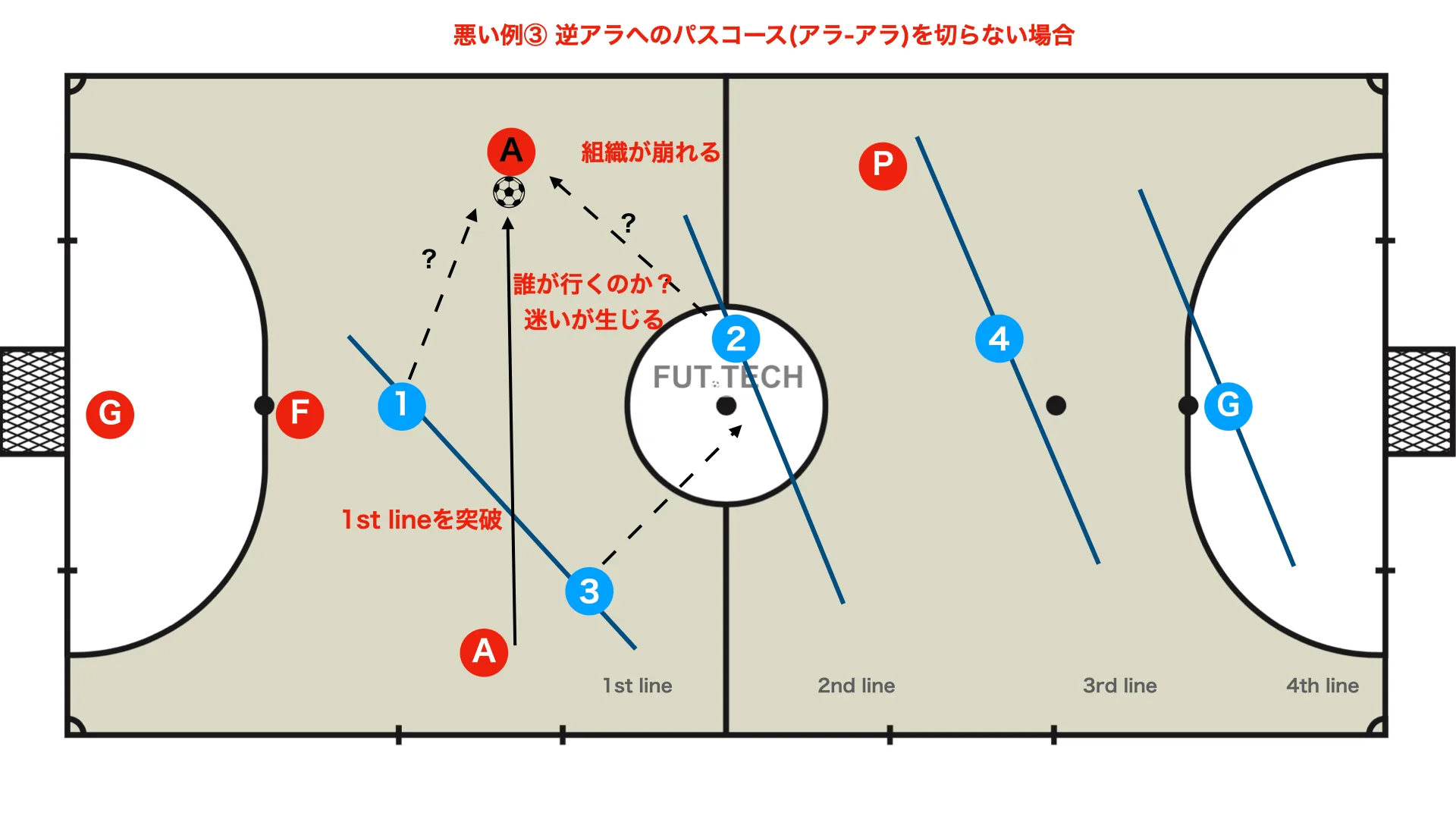
As shown above, uncertainty appears in the defending and the defensive structure temporarily falls apart.
That is why, in futsal, you often hear players shouting "ala ala" during matches.
More generally, one of the core defensive principles in futsal is that you should not easily allow skip passes that bypass one defender.
In this article, I explained one of the most important underlying principles in futsal defending: building multiple defensive lines.
If you have only recently started playing futsal, it will probably be difficult to understand all of this in one go, so come back to the article and review it as many times as you need.
Once you understand this basic principle, you can then add questions such as:
- How high should the press be, and where should the line be set?
- How often should players exchange marks?
- What kind of defensive shape should be used?
- Should it be zone, mixed, or man-to-man?
- With what intention and objective, and where and how intensely, should the team press?
By adding these elements, you can build a complete organized defensive system.
There is plenty of other useful information on the site as well, so take a look if you are interested.
関連記事

Positional Defence: Overview
An overview of positional defending in futsal. From the first defensive decision of where to set the…
続きを読む →