Man-to-Man Defence in Futsal: Simple in Theory, Difficult in Practice
Published: 2021.07.08Updated: 2026.05.03
Man-to-man defence is, as the name suggests, a very simple defensive tactic, but it is not easy to use it successfully in real competitive futsal matches.
That said, in reality it is used very often by national teams with strong individual players, and you could even say it has become a global defensive trend.
This article gives a thorough explanation of man-to-man defending in positional defence.
Note
Why has man-to-man defending become so popular?
One long-established defensive idea is to build multiple defensive lines, and that is still widely used today. A few years ago, attacking methods such as line cuts and dropping a player into the pivot/volante lane became trendy as ways to break down those layered defences. Man-to-man defending can be seen as the defensive answer that eventually returned as a response to those solutions.
More recently, block-and-continue actions (pick and roll) have become a popular way to beat man-to-man defending.
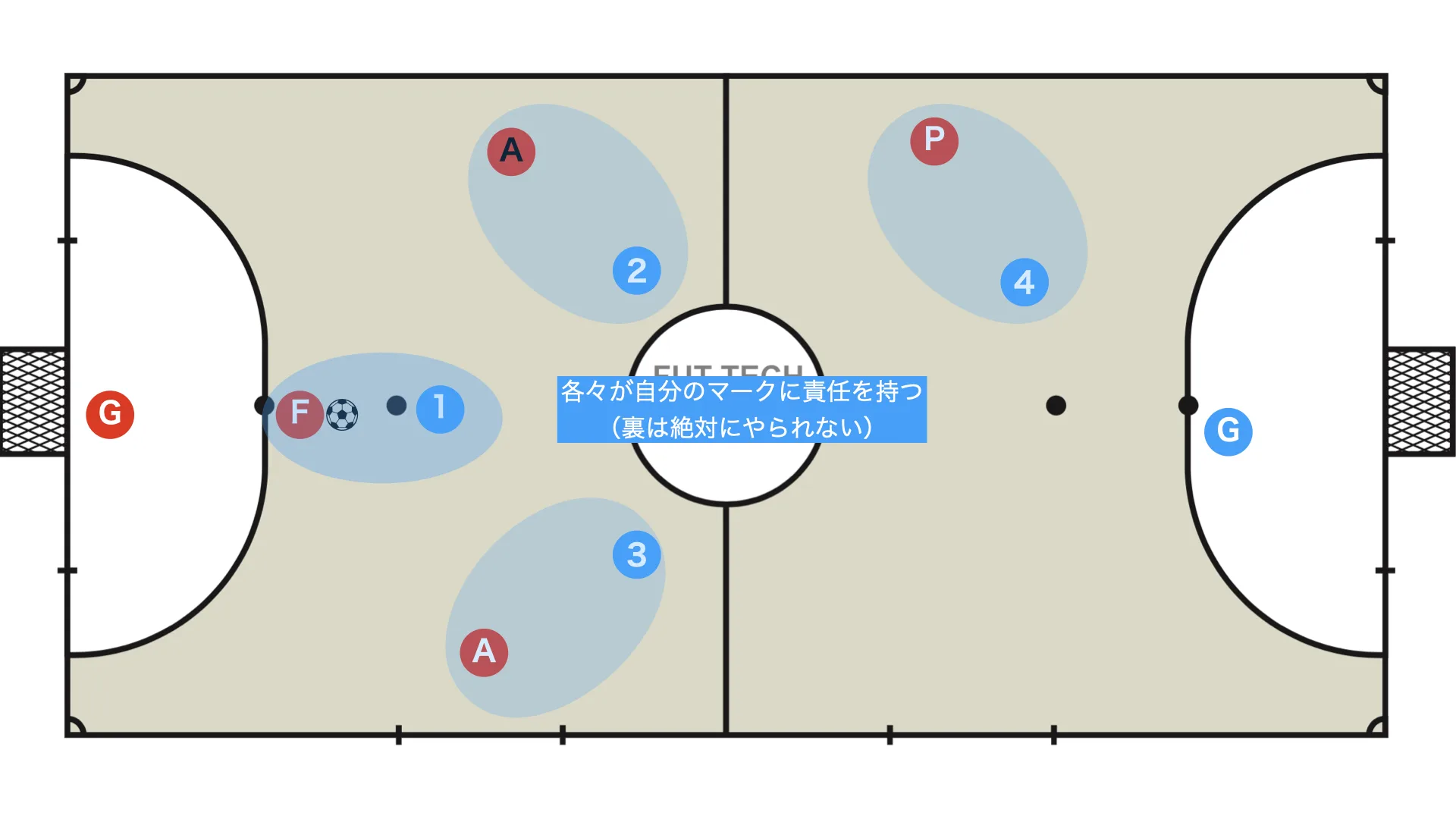
Each of the four outfield players picks up one opponent and takes responsibility for that individual mark.
Because this kind of defending assumes you will not lose your individual duel, it requires a high level of individual defensive ability.
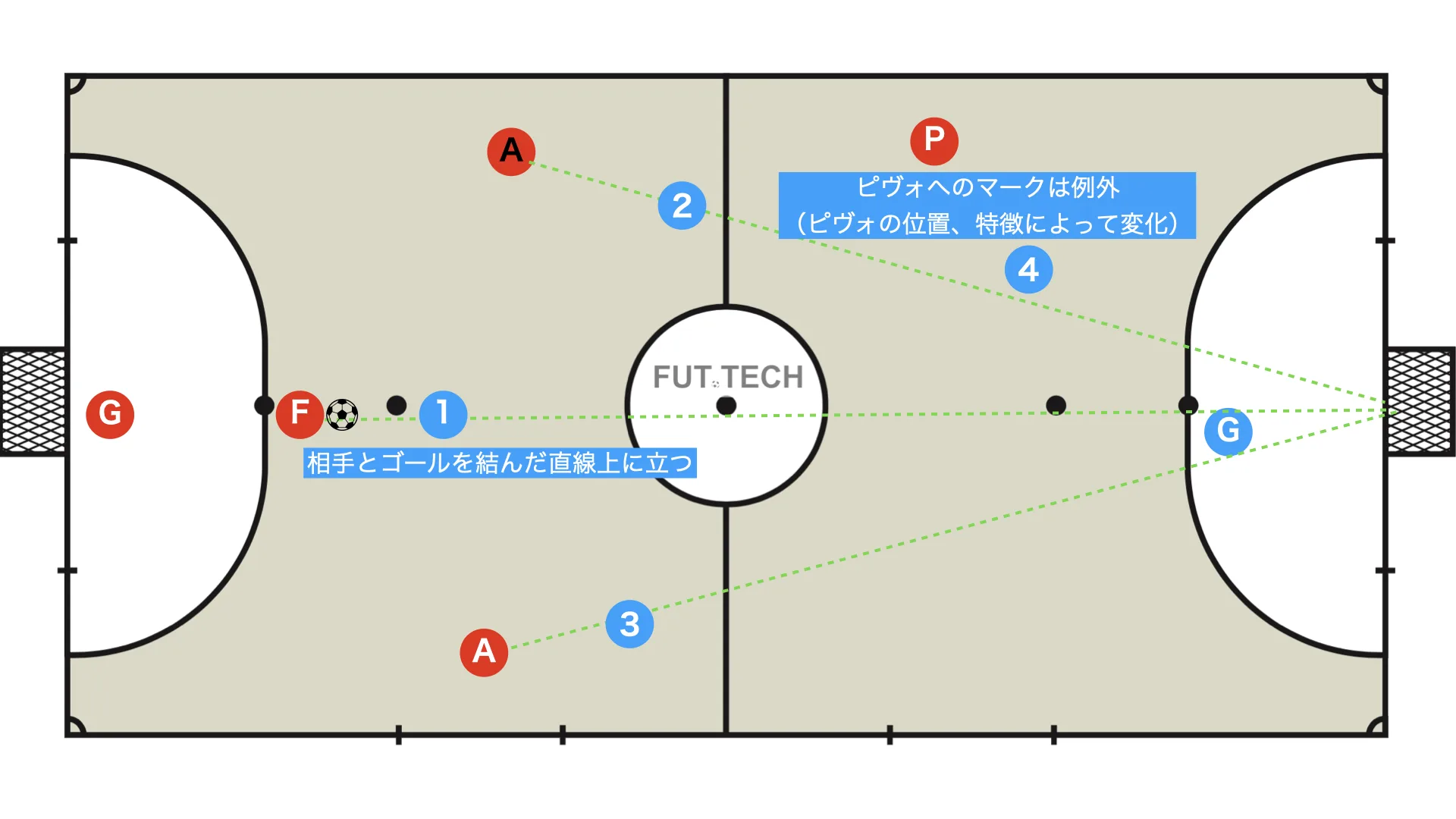
The first principle is to protect the goal and not get beaten in behind, so the basic positioning is to stand on the same line with the order being opponent, you, then goal.
That said, when marking a pivot who does not have the ball, you also need to manage the distance and angle with interception in mind.
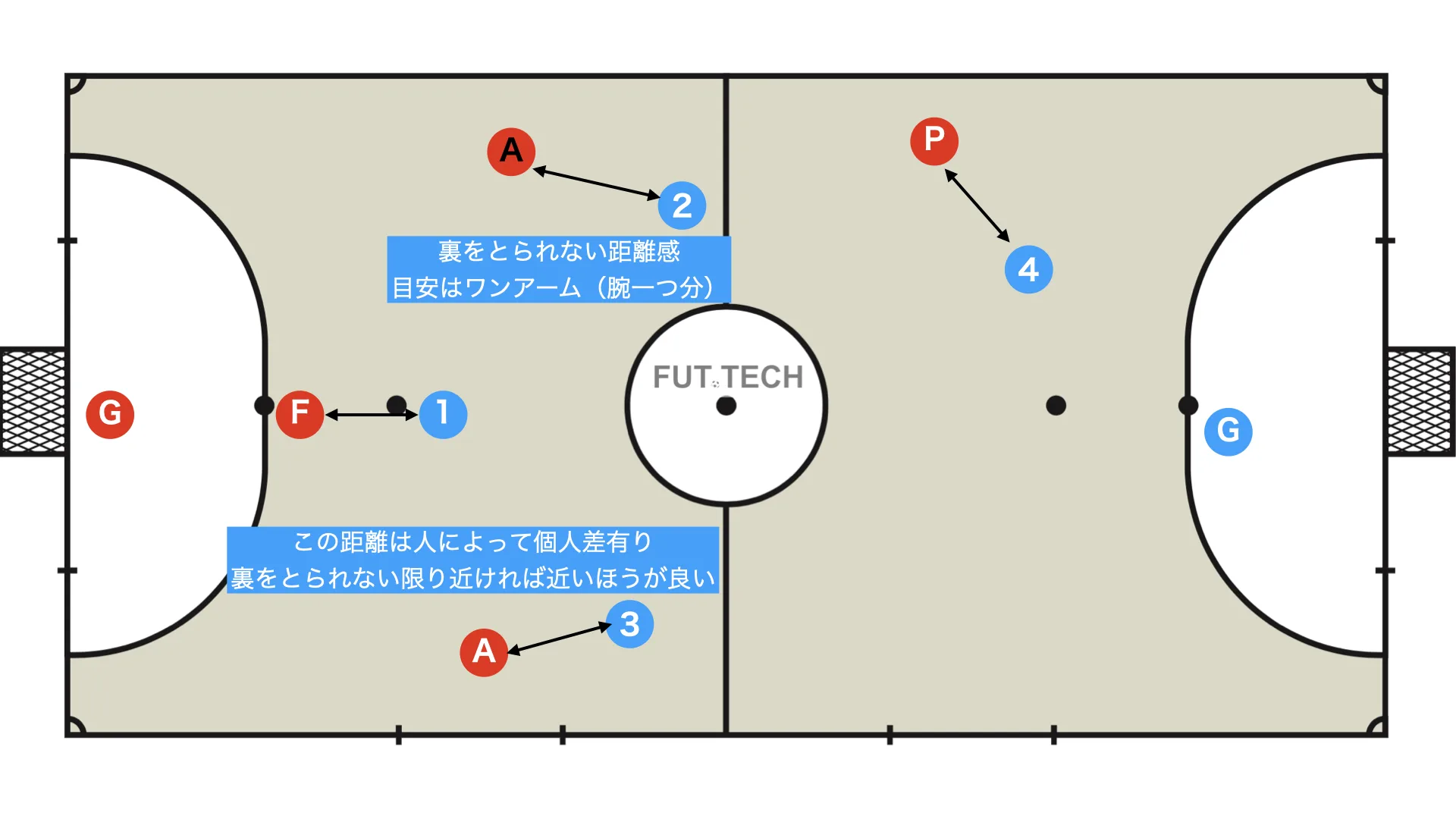
The exact safe distance depends on the defender's individual ability, but it is often said to be at least one arm's length.
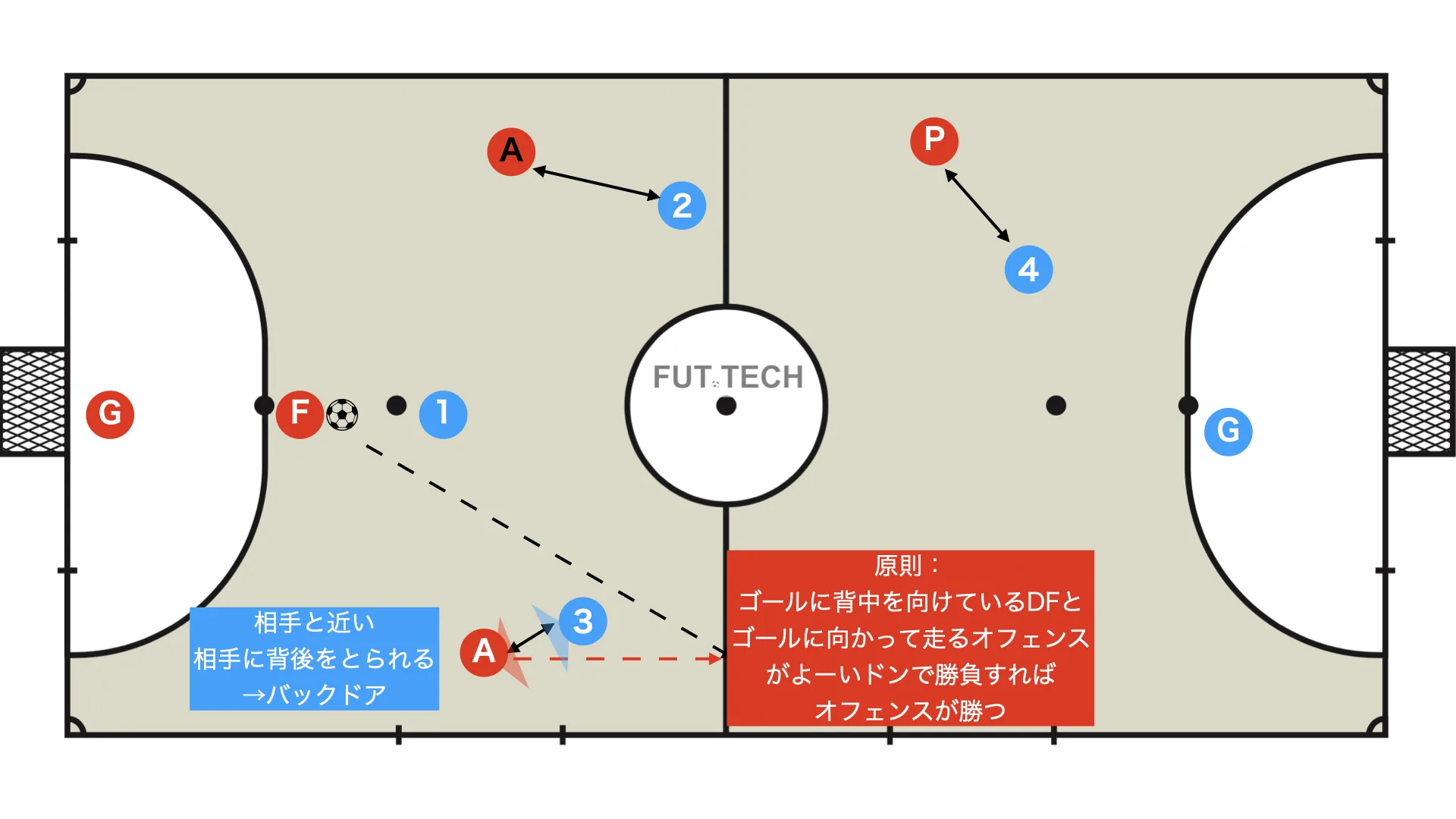
Even if you are standing in the correct order of opponent, you, then goal, you will still get beaten in behind easily if you are too close to the opponent.
The biggest advantage here is not raw speed, but positional advantage: whether you are facing your own goal or facing up the court.
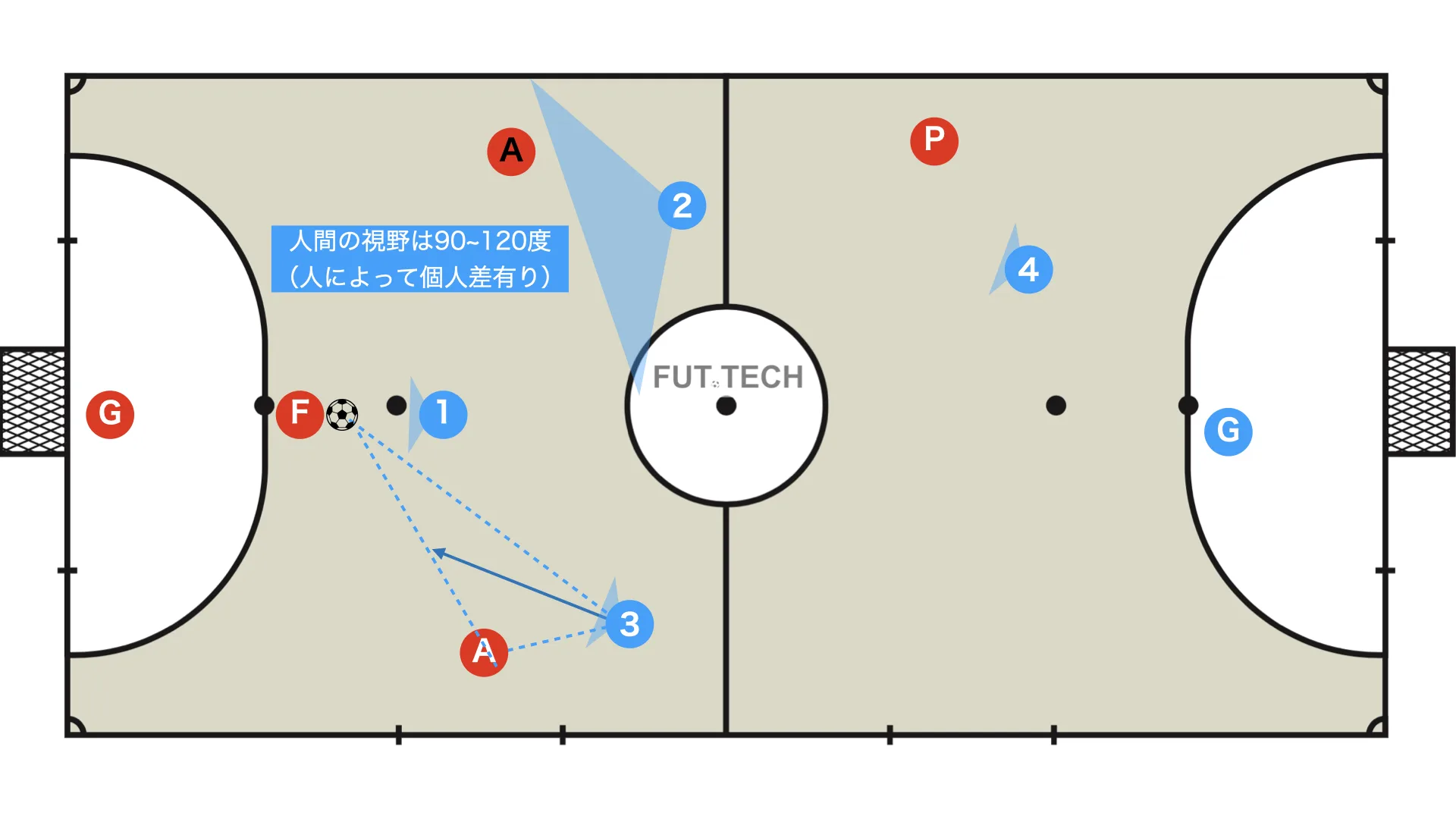
To defend man-to-man, you constantly need to read a pitch situation that changes moment by moment, and that is impossible unless you keep both your mark and the ball in the same field of view.
That is why body orientation matters so much. In practice, it helps to look toward the midpoint between the ball and your mark, so that you stay aware of the triangle formed by you, the ball, and your mark.
If you cannot keep both in the same field of view, scanning is mandatory.
Human field of vision
There is individual variation, but the maximum physical angle of peripheral vision is said to be 180 degrees, while the angle in which we can recognize things relatively clearly is around 90 to 120 degrees.
It is worth holding your fingers out to the left and right in front of your face beforehand so you understand the width of your own vision.
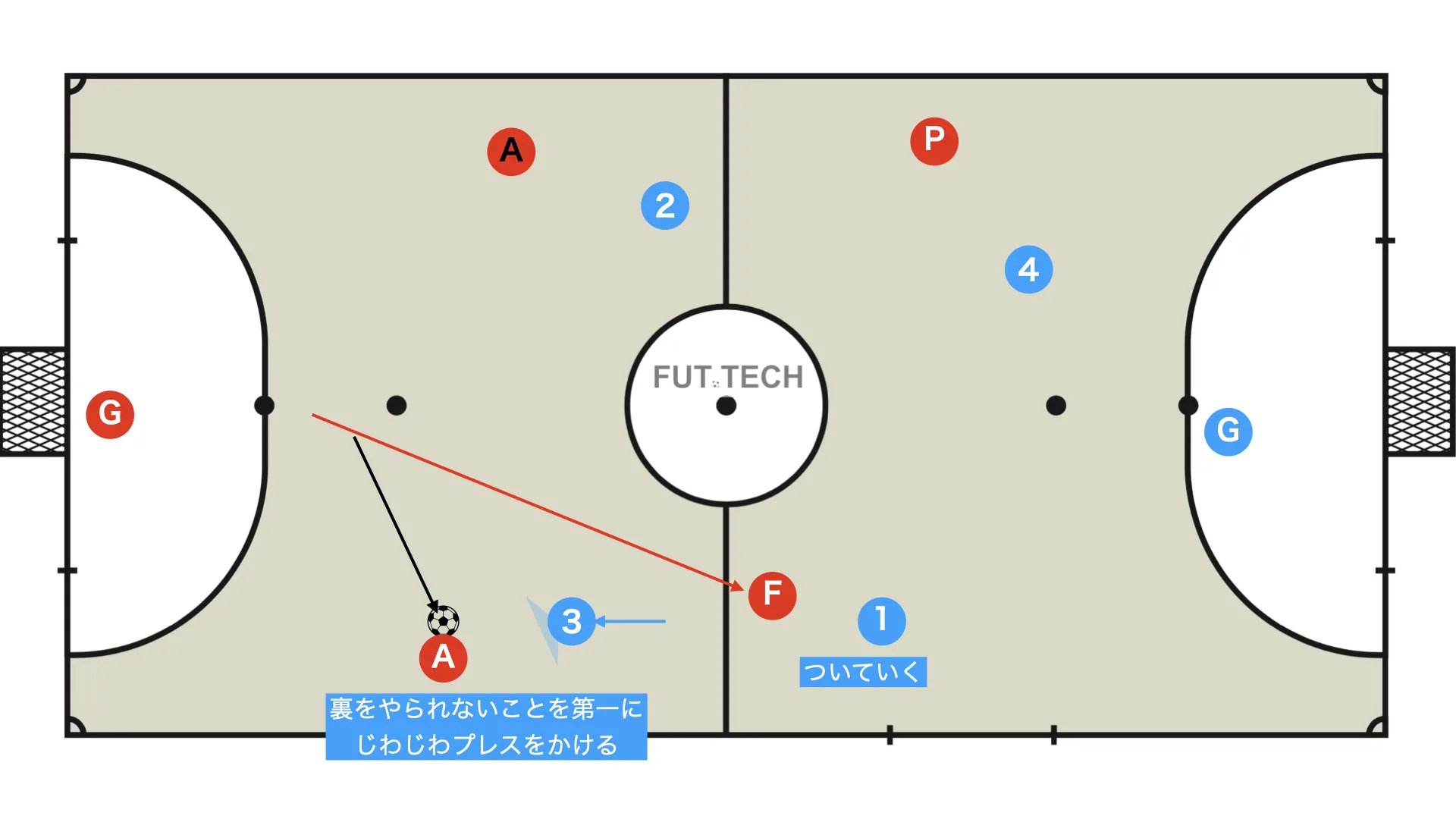
In man-to-man defending, you do not normally switch marks. You simply follow the opponent who runs through.
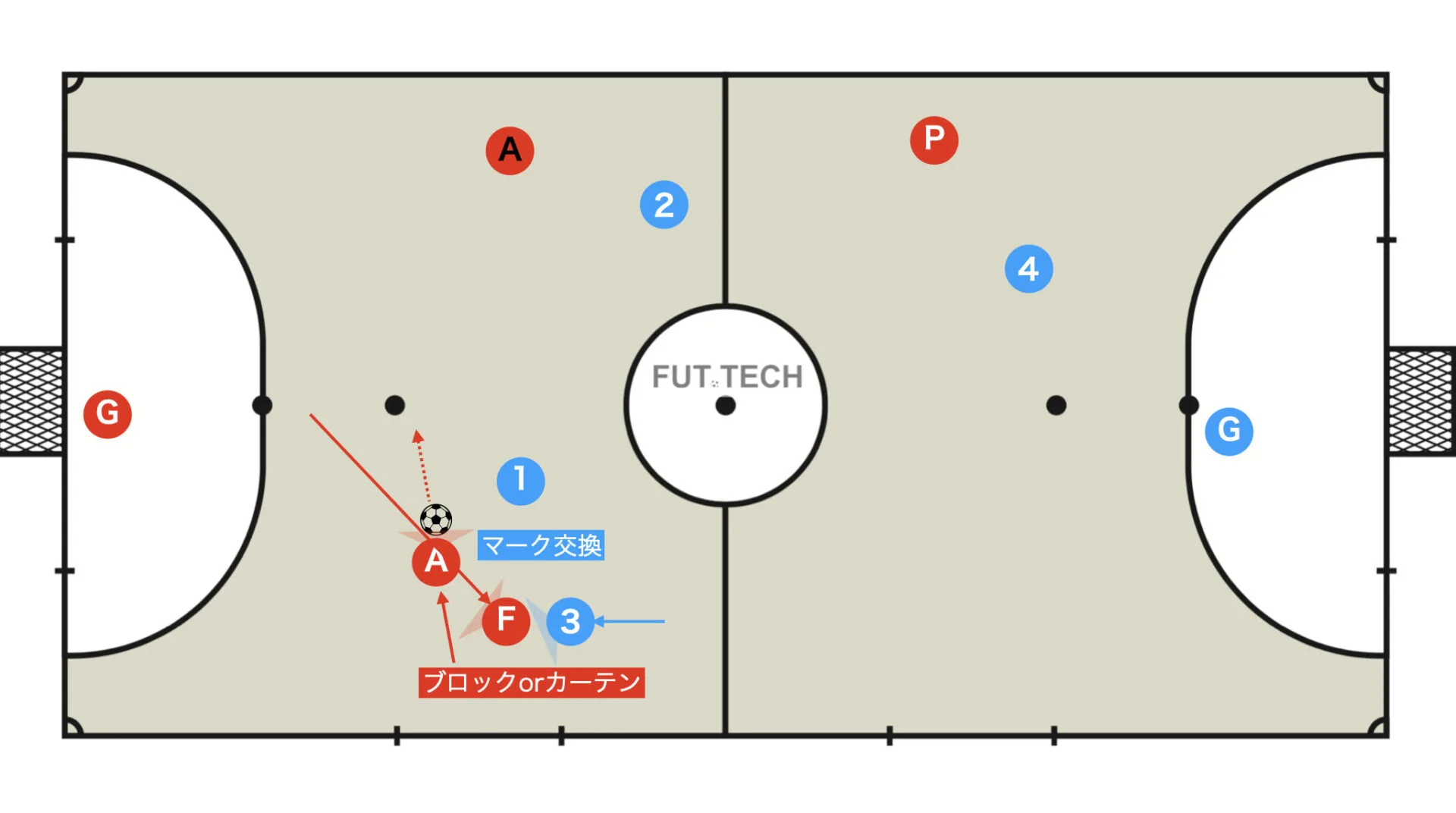
If you try to defend a block or curtain without switching marks, the offence will usually get exactly what it wants and shake the defender loose, so switching marks is the safer solution.
Is it still man-to-man if you switch marks?
You sometimes hear people argue that once you switch marks, it should no longer be called man-to-man defending.
Strictly speaking, that is true in the narrowest sense, but in a broader sense it is still reasonable to describe it as man-to-man defence.
At the top level, there are almost no completely rigid man-to-man systems that never switch marks. The basic idea is to switch when needed.
If you only keep following opponents all game, you will just drain your energy, so at some point you need to flip the switch and go win the ball.
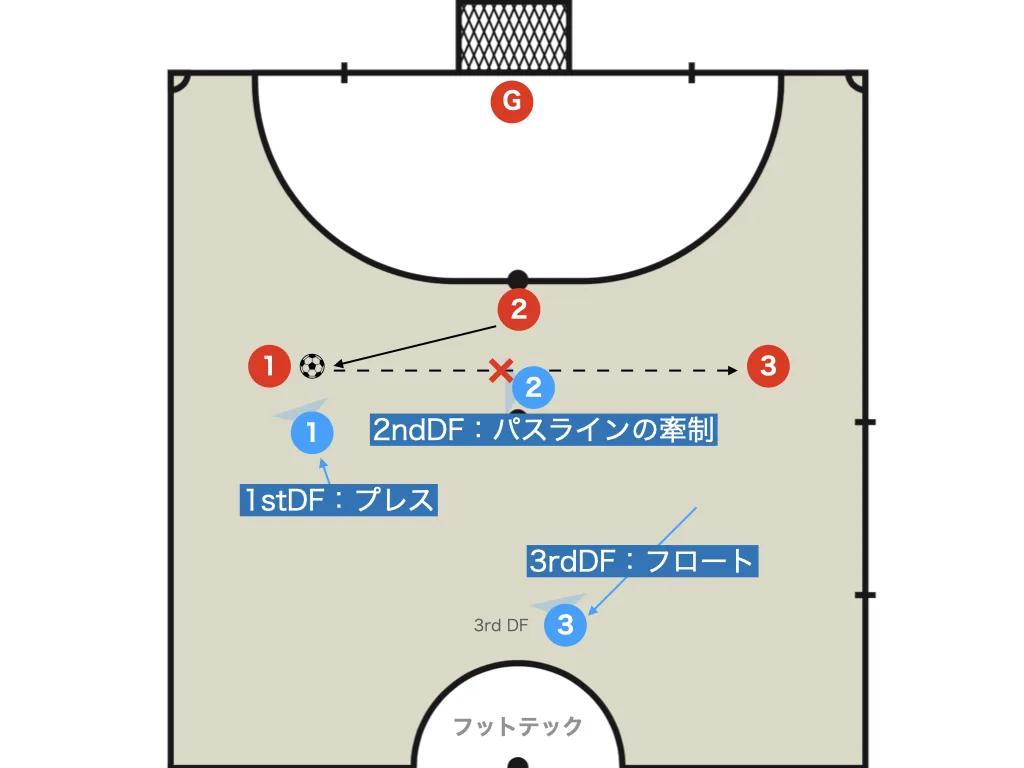
One clear trigger is when the 1st defender is close enough to press = when the defender has closed to within one arm's length.
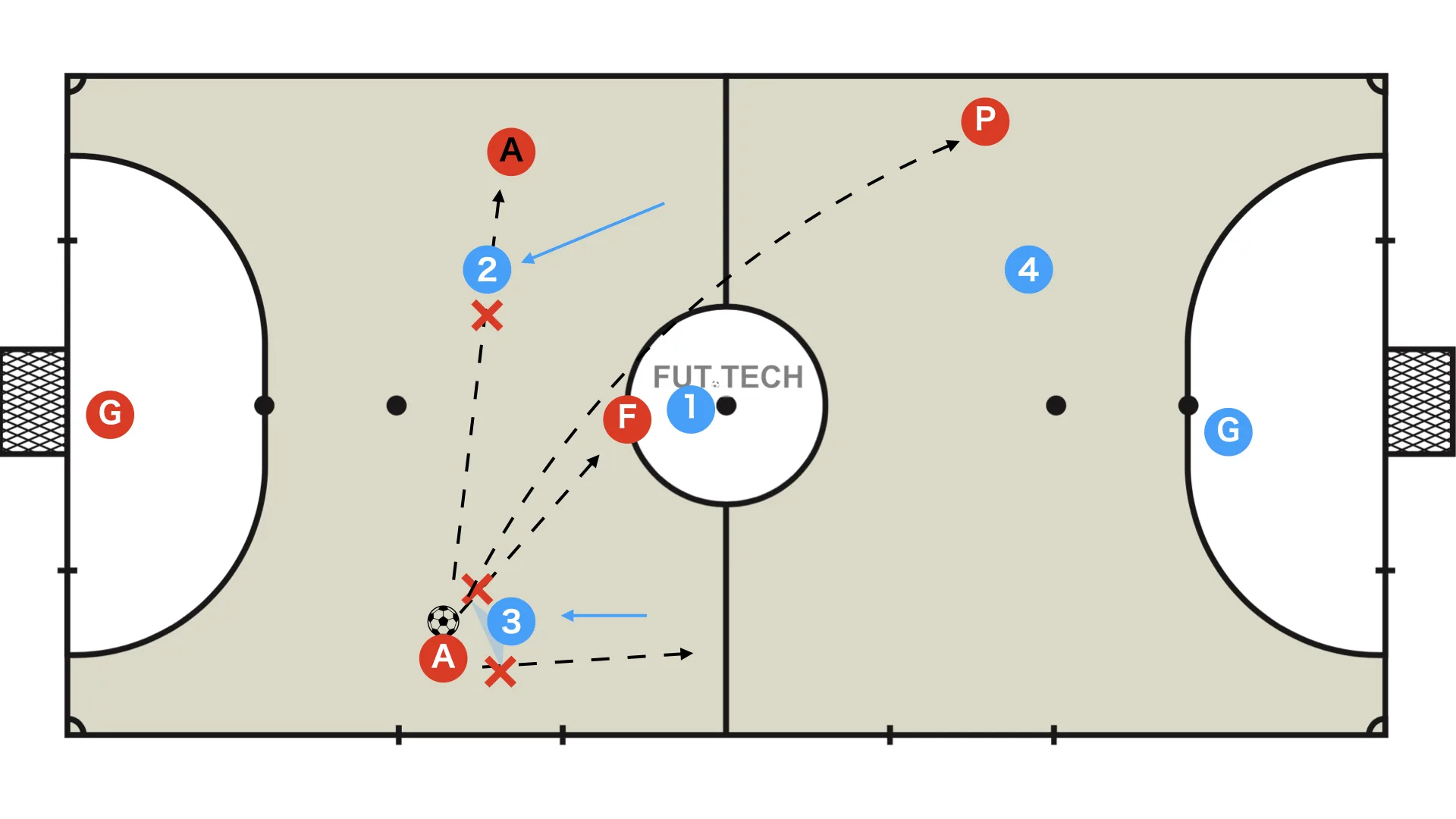
Normally blue 2 should stand between their own mark and the goal, but because the 1st defender is able to press here, blue 2 steps out to shut down the remaining passing lane.
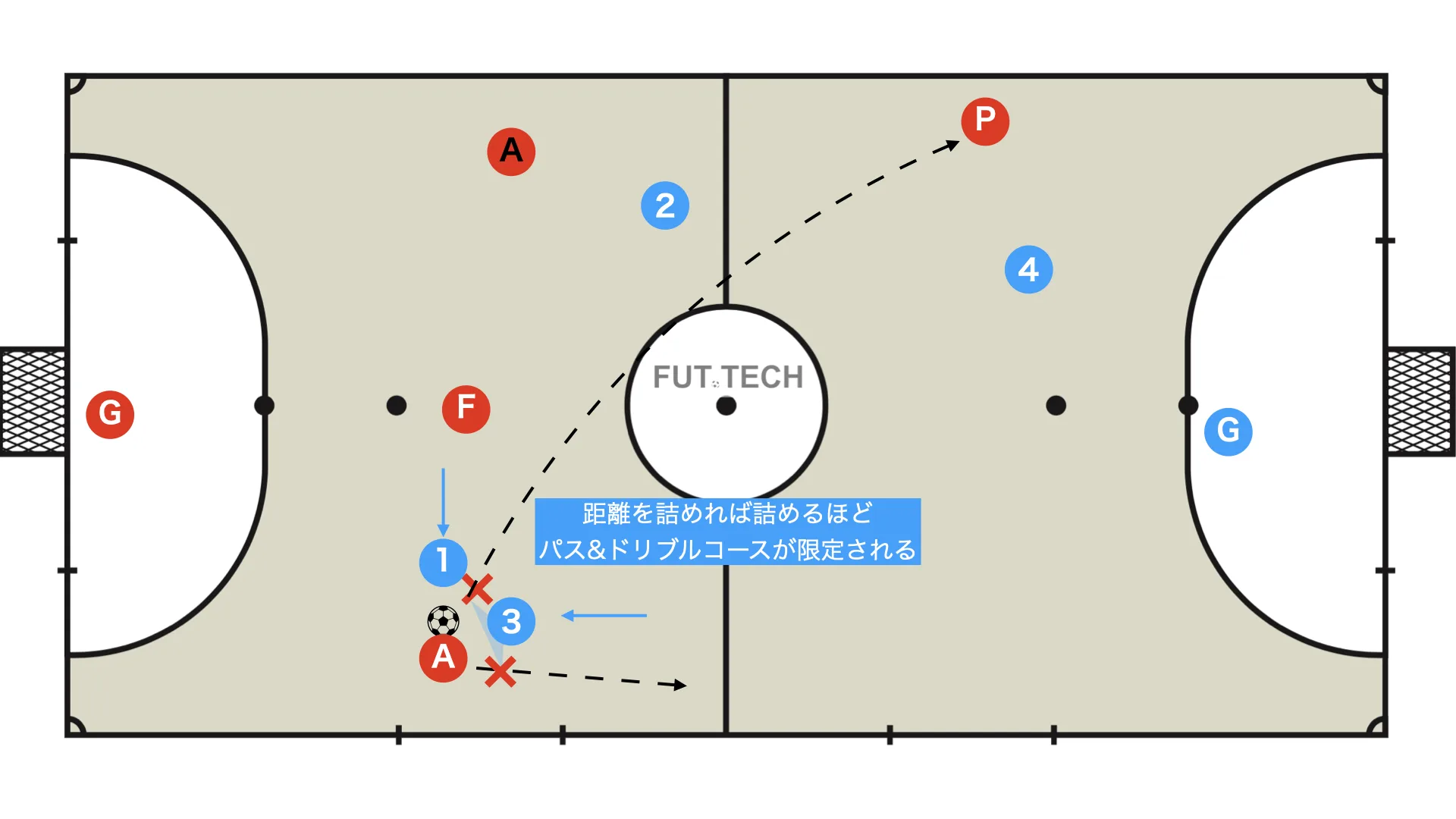
If the second defender is already close enough, a double team, where two defenders trap the ball together, can be very effective.
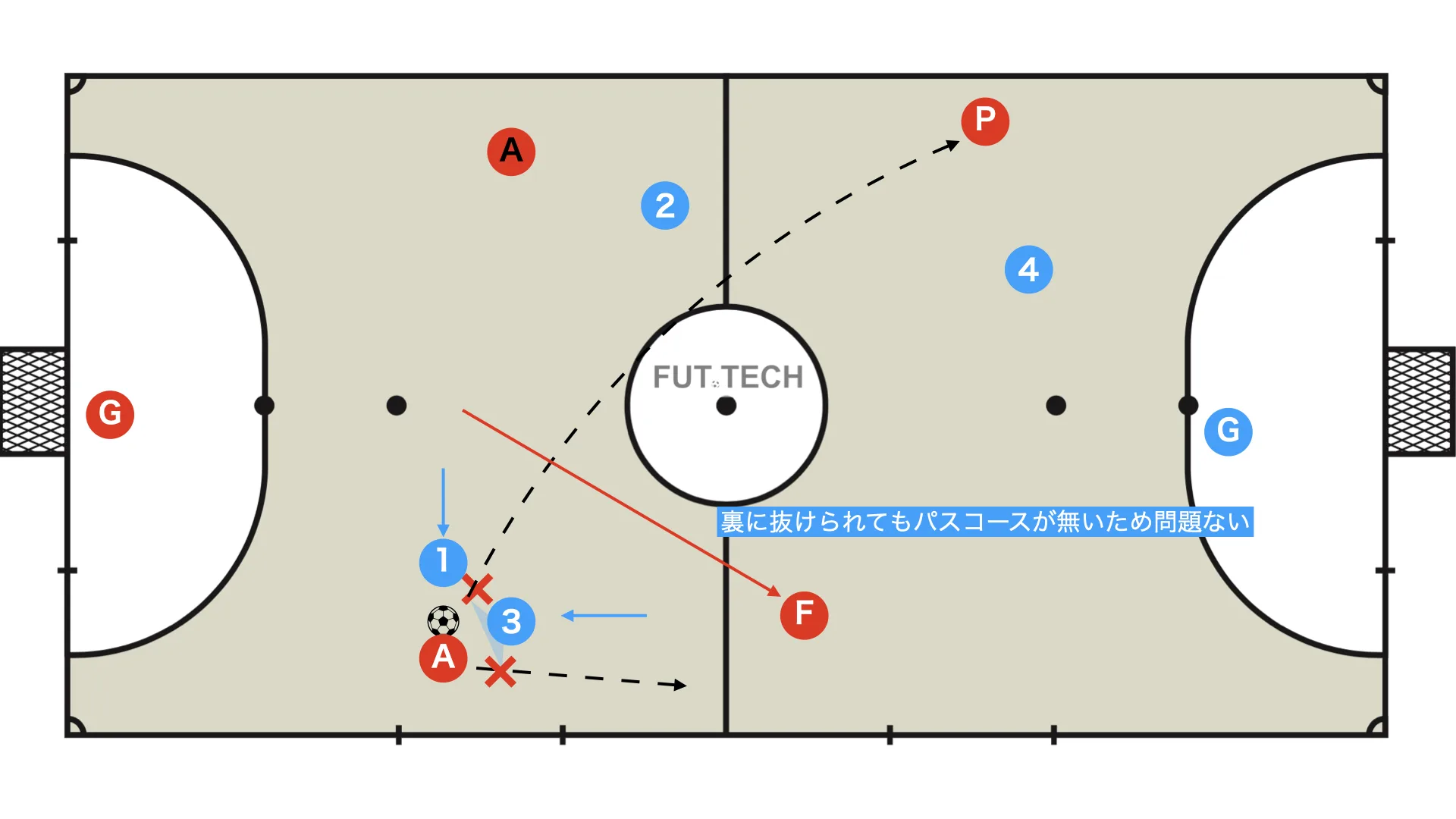
If the 1st defender is properly taking away the lane in behind and the passing lane into the pivot, the opponent cannot play the ball there, so there is no problem with abandoning your own mark.
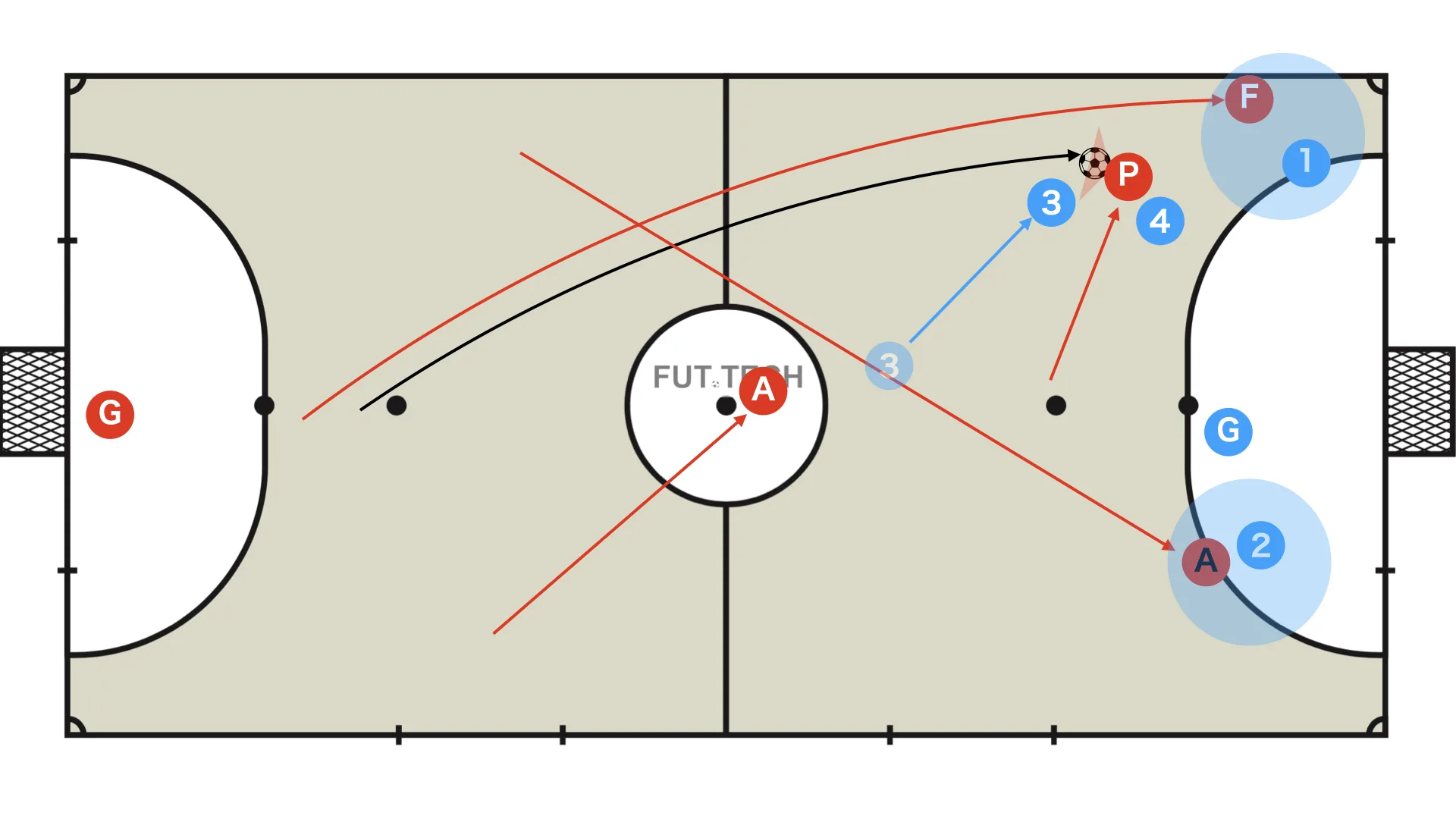
After the ball is played into the pivot, the general rule is for everyone to recover back to the ball line. But the 4th defender, the one responsible for the opponent's fixo, can leave that mark and join the double team on the pivot without a problem.
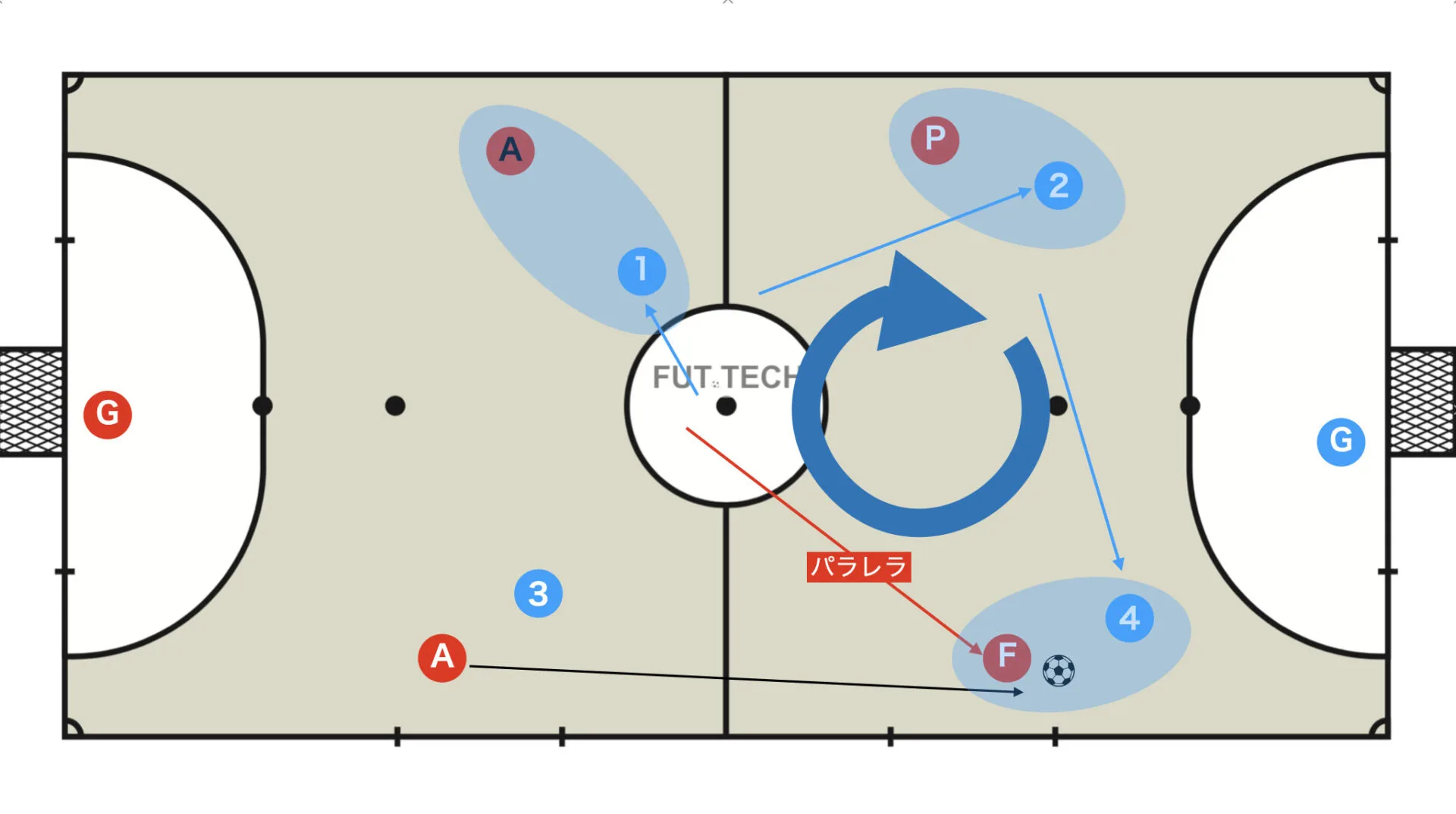
Man-to-man defending assumes you will not lose individual duels, but you still need an emergency solution in case a defender gets shaken off and beaten.
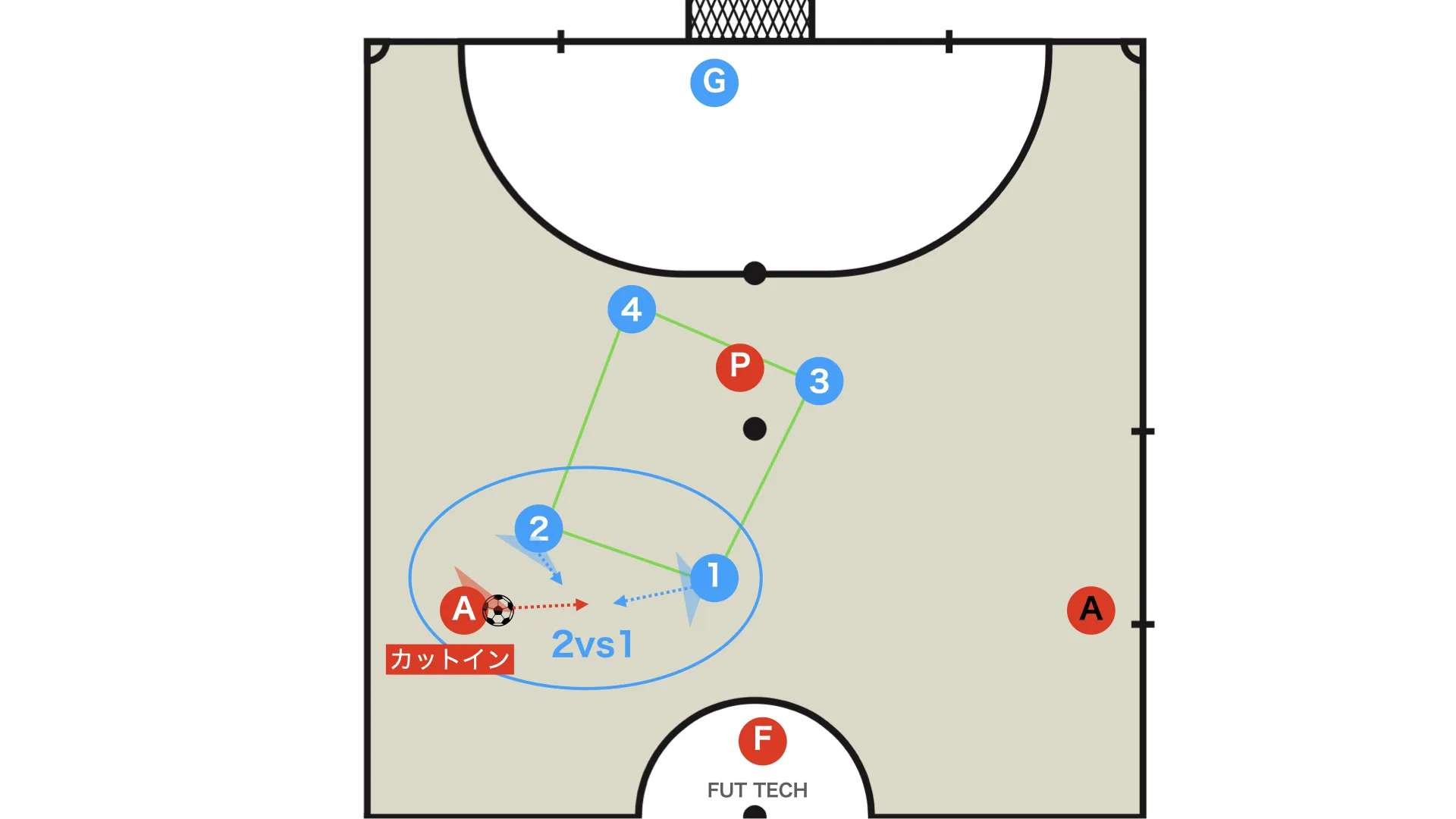
If a high man-to-man press is broken by a one-two, parallel, or similar action, the player who had been marking the opponent's pivot slides across to deal with it, as shown in the diagram above.
That leaves the pivot unmarked, so the nearest defender drops back to pick up that mark. As a result, three or four defenders each shift their mark by one player and the team rotates.
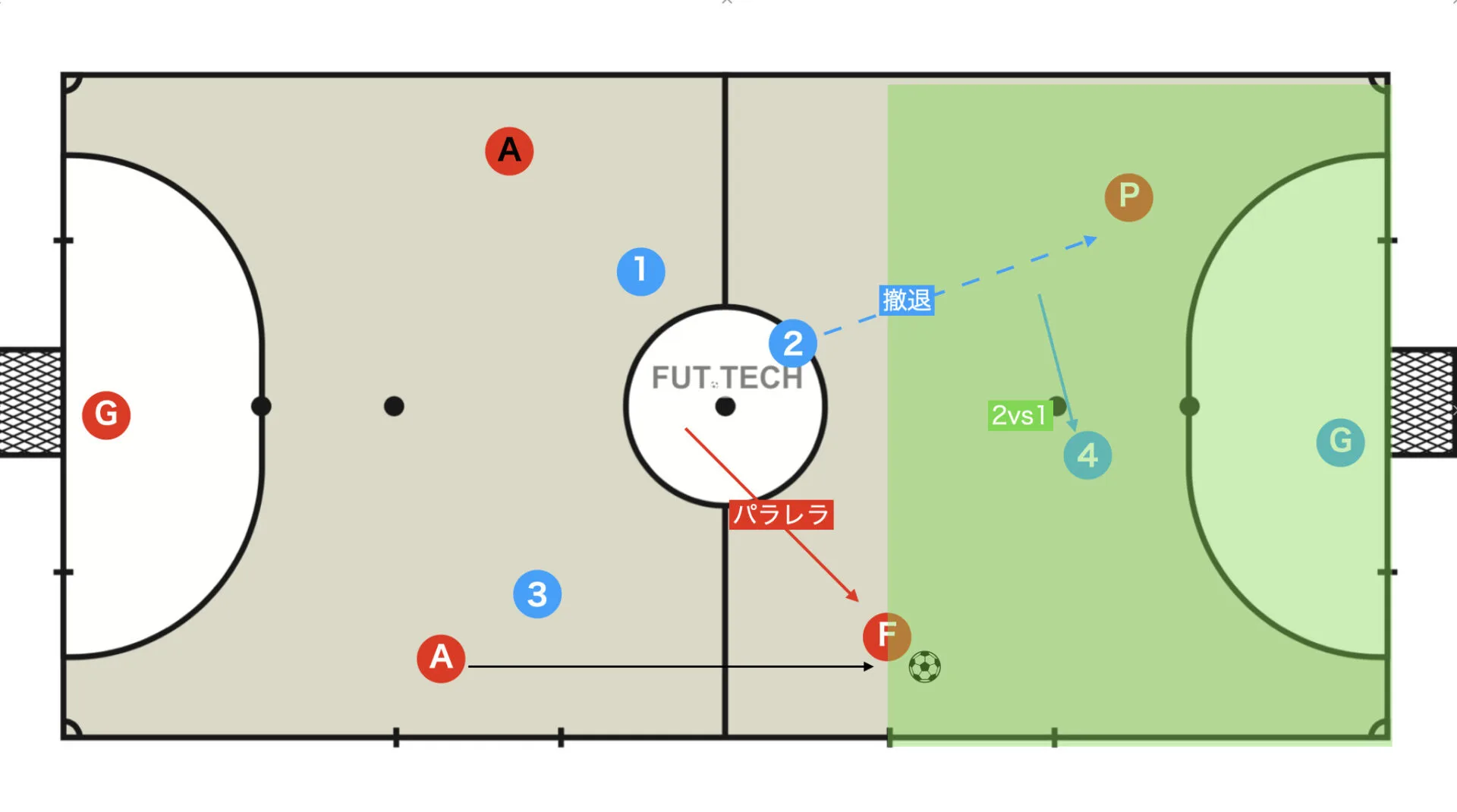
If the defensive rotation cannot recover in time, the safest response is to defend it the same way you would defend a transition.
In the example above, it becomes a 1v2 transition-defence situation, so the nearest defender recovers toward the weak side of the defence.
関連記事

Transition: Plus-One Numerical Imbalance (1v1 with the Goalkeeper, 1v2, 2v3, 3v4)
A systematic guide to the most common transition situation in futsal: plus-one numerical imbalance. …
続きを読む →As a last resort, you should always keep the option of stopping the play with a foul in mind.
If it is your sixth foul, you concede a second penalty, so the foul count has to be part of the decision as well.
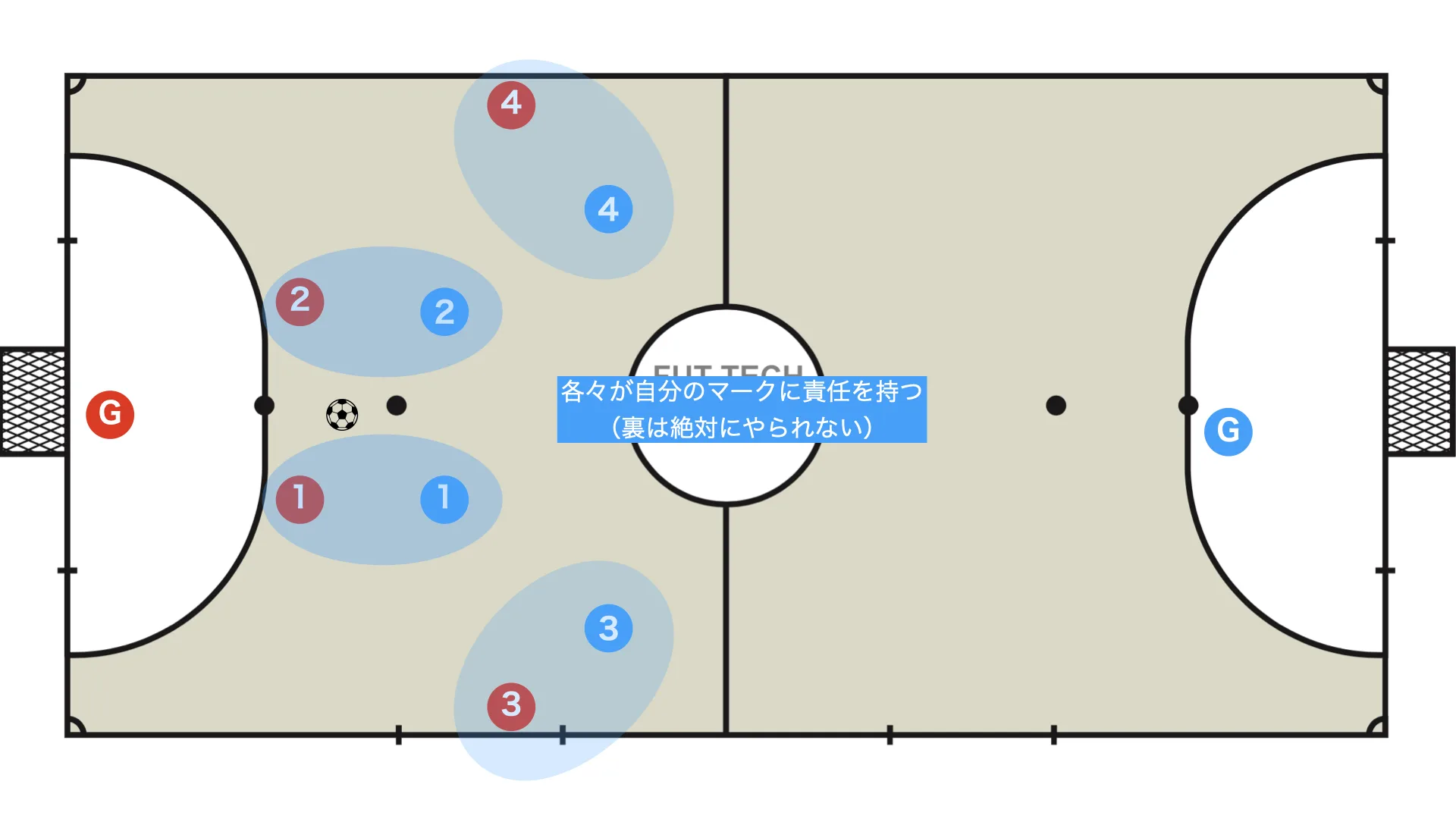
Man-to-man can be effective not only against a 3-1, but also against various other attacking shapes, including 4-0.
However, if you defend a quattro with man-to-man marking and get beaten in behind even once, there may be nobody left to cover.
That is why it is extremely risky for inexperienced teams to use man-to-man defence casually as their default.
Still, among European national teams, there are definitely some that use man-to-man defending even against a quattro.
What did you think?
A lot of people may play man-to-man without thinking too deeply about it, but it is probably more complex than it first appears.
Man-to-man defending is the foundation of all defending, and starting with it makes it easier to branch out into other defensive systems later.
At youth level as well, using man-to-man defending makes a great deal of sense from the standpoint of individual player development.
Hopefully this article has helped you understand at least a little more of what makes man-to-man defence so effective.
関連記事

Positional Defence: Overview
An overview of positional defending in futsal. From the first defensive decision of where to set the…
続きを読む →