Overview: Two-Player Combinations in Futsal
Published: 2021.07.13Updated: 2026.05.03
In one sentence, a two-player combination is a set of principles that lets two players shift the opponent's defensive reference points and move the ball forward on their own.
In futsal, group tactics reduce down to pairs at the smallest unit, so the quality of positional attack depends heavily on how well a team understands two-player combinations.
By reading this article, you will first understand these three things:
- what two-player combinations are trying to achieve
- on what basis actions like the one-two, parallel, and diagonal should be selected
- in what order to read the detailed articles
If you want to jump straight to a specific topic, these are the best starting points:
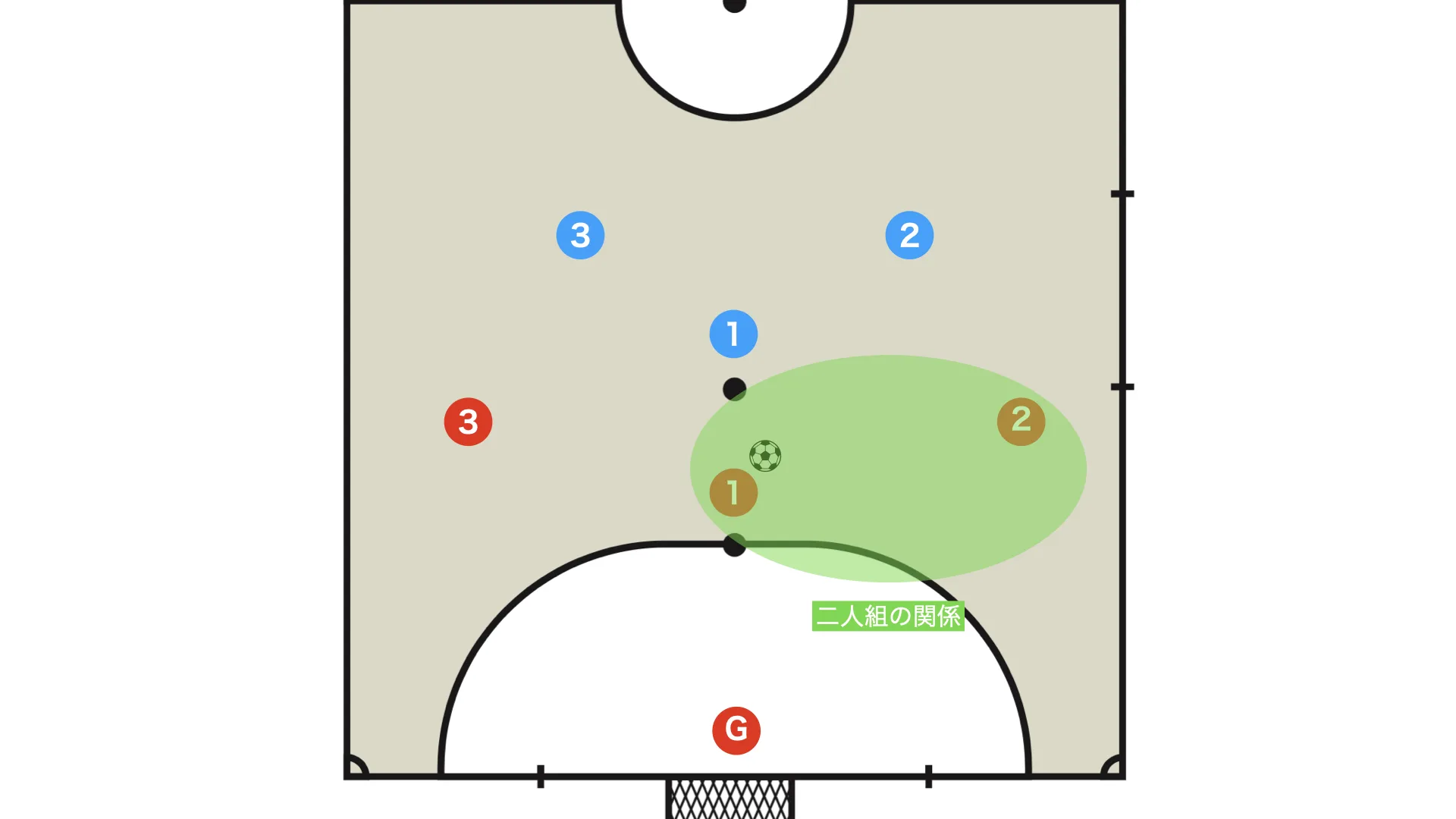
Two-player combinations in futsal refer to the relationship between two players when they try to break a situation using only those two players.
There are four field players on a futsal court, but four-player group tactics can be thought of as a collection of two-player relationships.
That is why two-player combinations are the most fundamental tactical unit, and why it is impossible to discuss futsal tactics without them.
The quality of positional attack tends to depend strongly on the quality of these pair relationships, and even in top categories many teams place major emphasis on them.
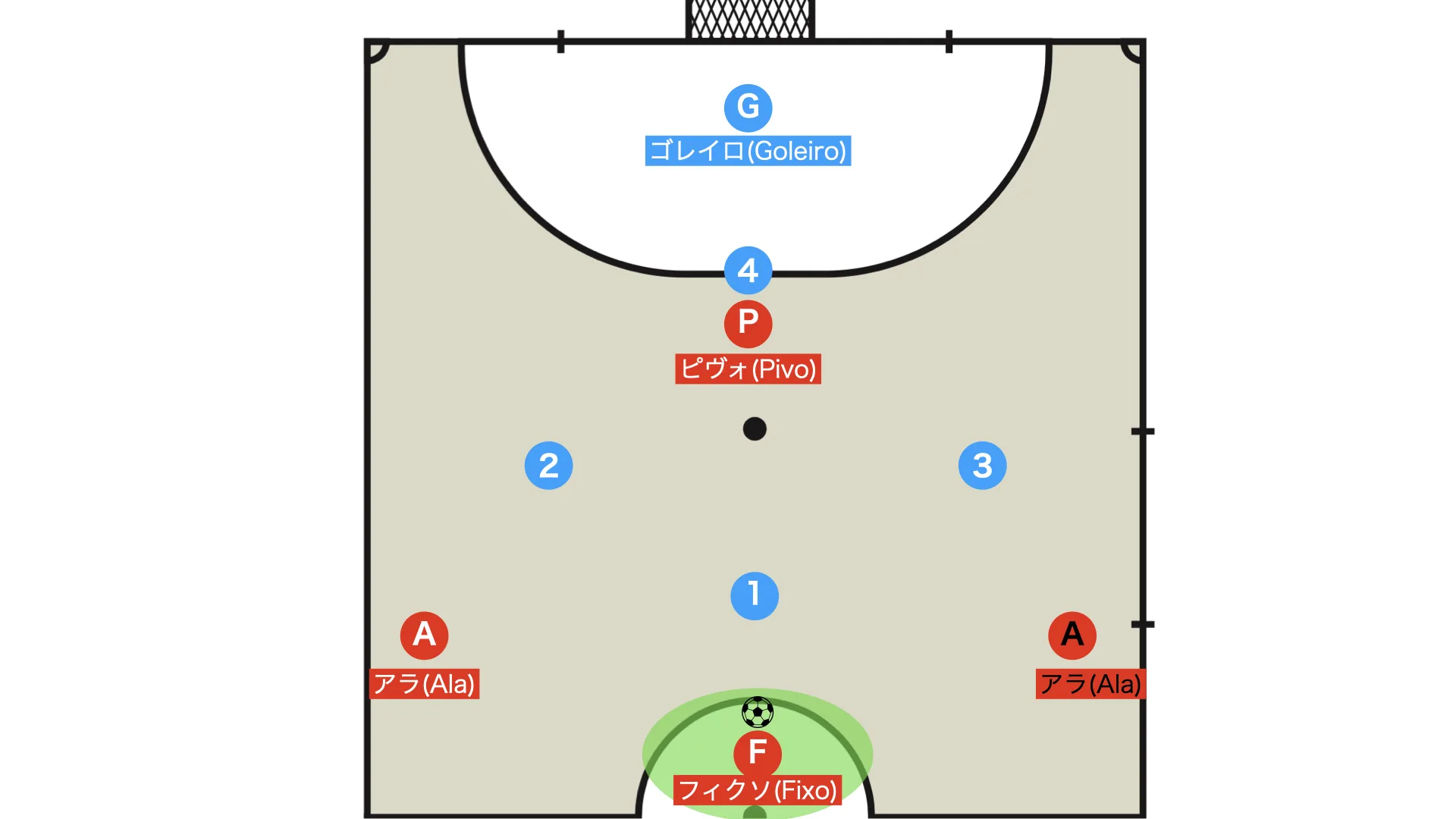
There are many kinds of pair relationships, such as the connection between the pivo and the ala, but this article focuses on the short horizontal relationship between the ala and the fixo.
Note 1
Two-player relationships are determined by "distance from the teammate (short or long) x angle (horizontal or vertical)." In other words, the ala-fixo relationship can be broken into four types: short horizontal, long horizontal, short vertical, and long vertical. Another way to classify them is to treat angles around 45 degrees as diagonal and make that a separate category.
Note 2
You can also think about two-player relationships between the goalkeeper and a field player. This is especially important on clearances. On teams where the goalkeeper participates aggressively in attack, the goalkeeper also needs a solid understanding of two-player combinations. In some European teams, you even occasionally see goalkeepers score after playing a one-two with a field player.
If you understand this first, the actions in the rest of the article are easier to see not as "named moves," but as solutions for specific situations.
As mentioned at the start, when two players break a situation together, we call that a two-player combination.
Before getting into the details, here are two pieces of background knowledge you should know in order to understand them properly.
It is obvious, but to break a situation you need to move the ball forward.
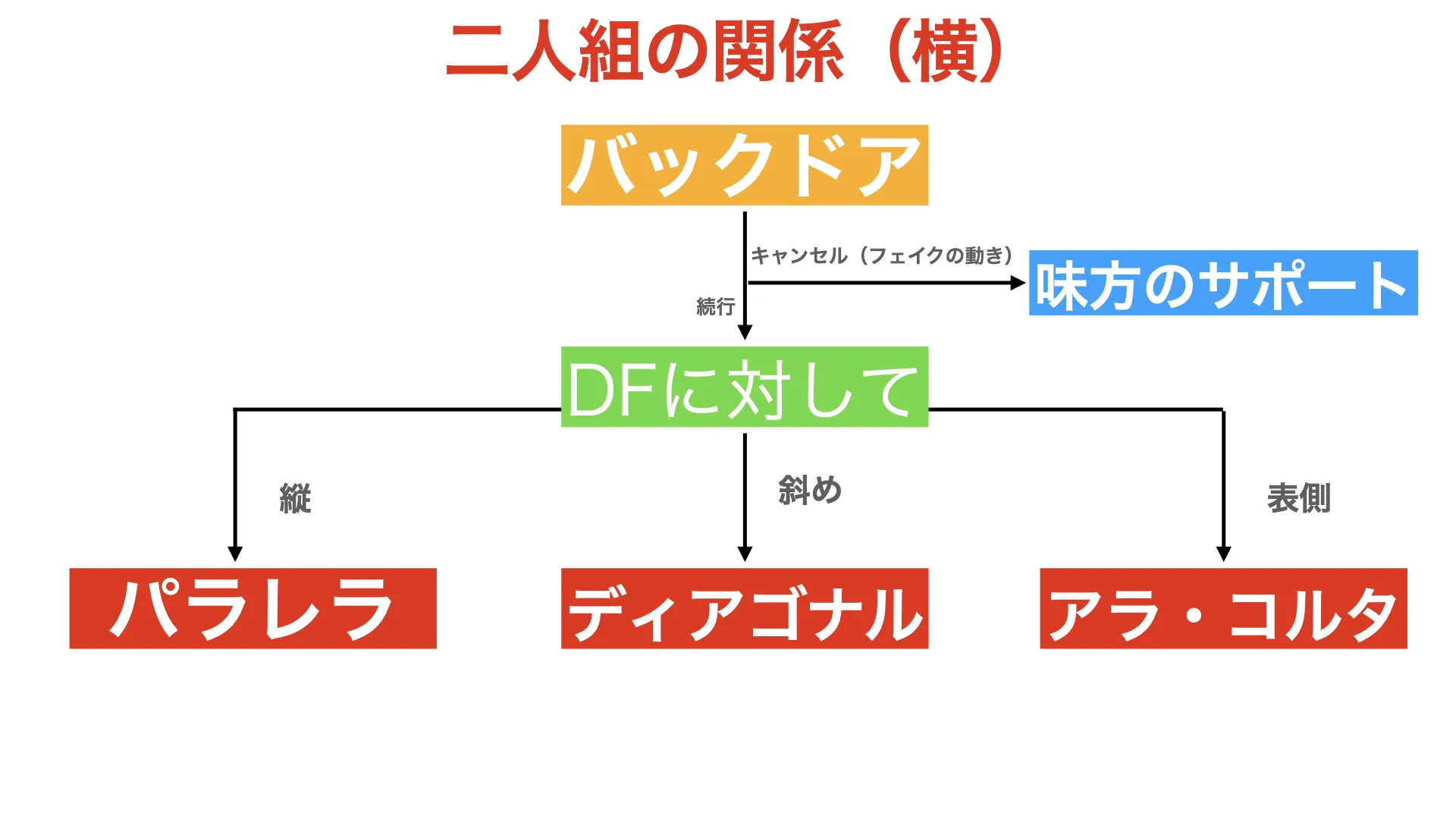
In a two-player relationship, the only way to advance the ball is for one of the players to try a backdoor run and attack the space behind the defender.
There are also several ways to move when you go after the backdoor. That is the branching workflow shown in the diagram above.
In two-player combinations, the aim is for the receiver to duel with the defender and shake that defender to create a numerical advantage. Because of that, the receiver takes the initiative, while the passer needs the ability to read the receiver's intention.
This article deals with the short horizontal relationship between the ala and the fixo.
If we take the opponent defender's position into account, there are four possible situations in this pairing:
- close (fixo) - far (ala)
- far (fixo) - close (ala)
- close (fixo) - close (ala)
- far (fixo) - far (ala)
This article explains in detail what action should be taken in each case.
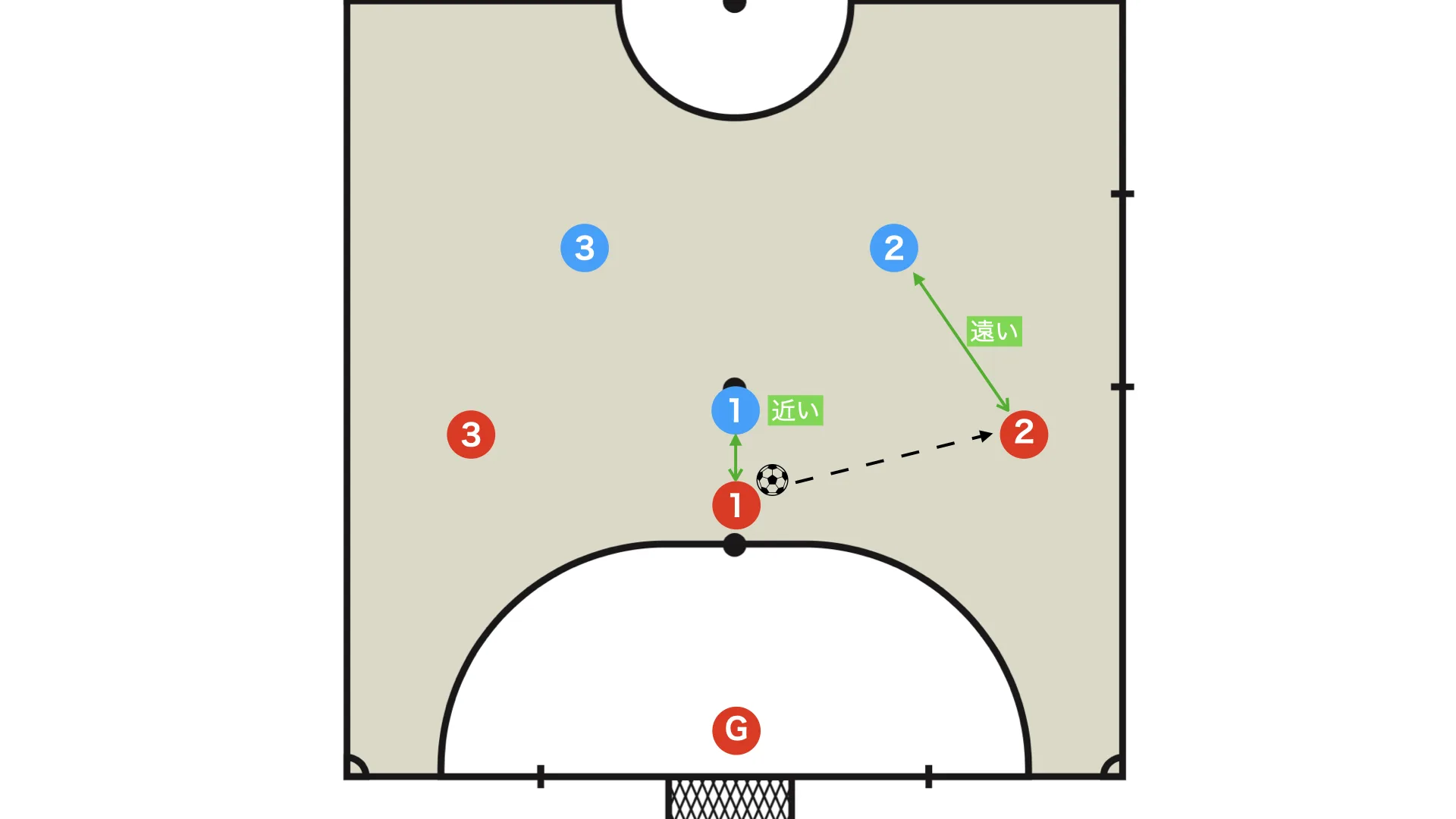
This is the situation where the fixo is under pressure from the defender and is about to pass to the ala.
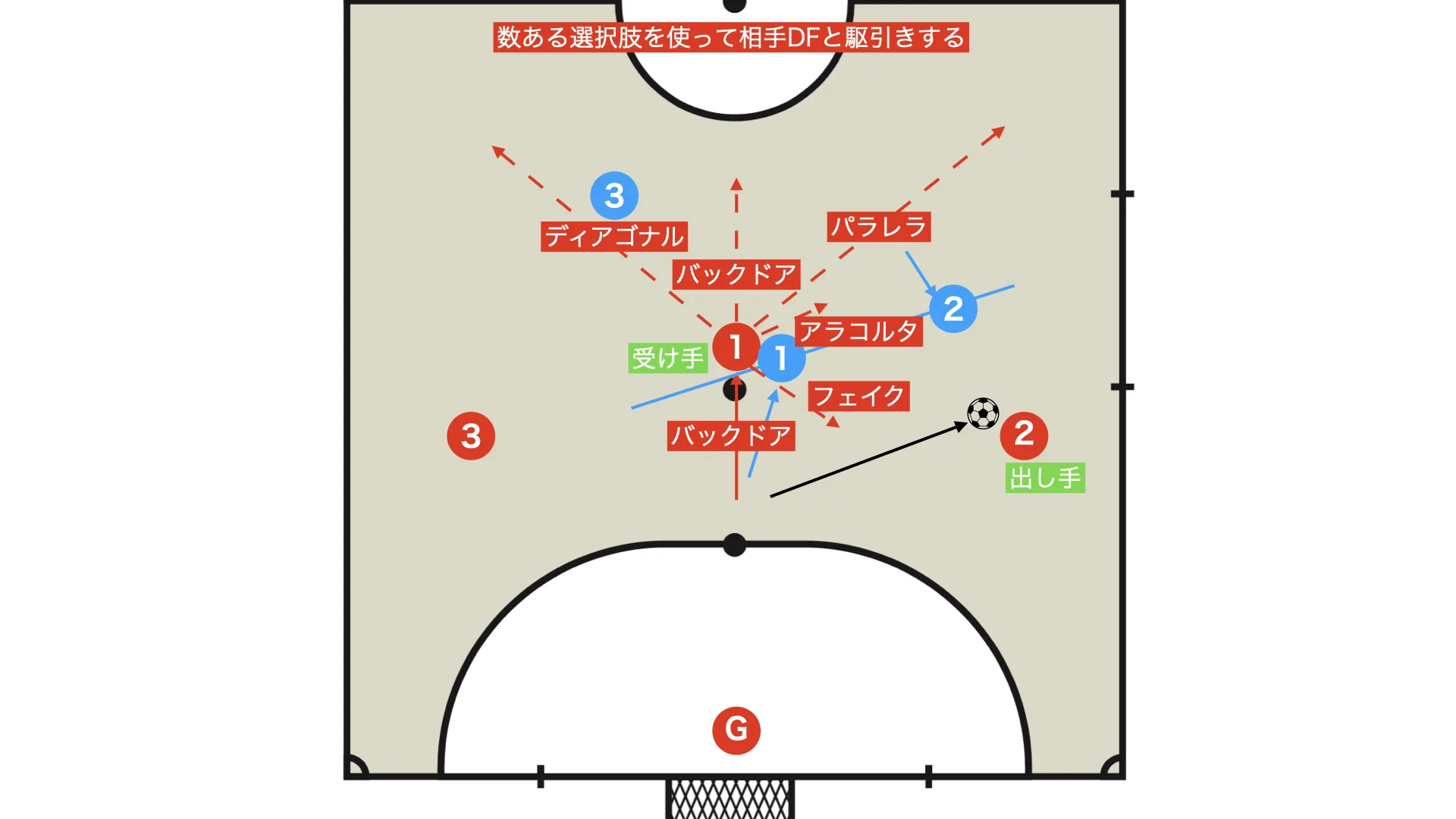
Use that pressure against the opponent, attack the space behind, and keep the workflow shown earlier in mind as you go after the defender's back.
"Parallel" comes from Spanish and means running parallel to the touchline.
It is also used as a general term for two-player relationships that break the defensive structure through this kind of movement.
There are several kinds of parallel action. A longer one is called a long parallel, and a shorter one is called a mini parallel.
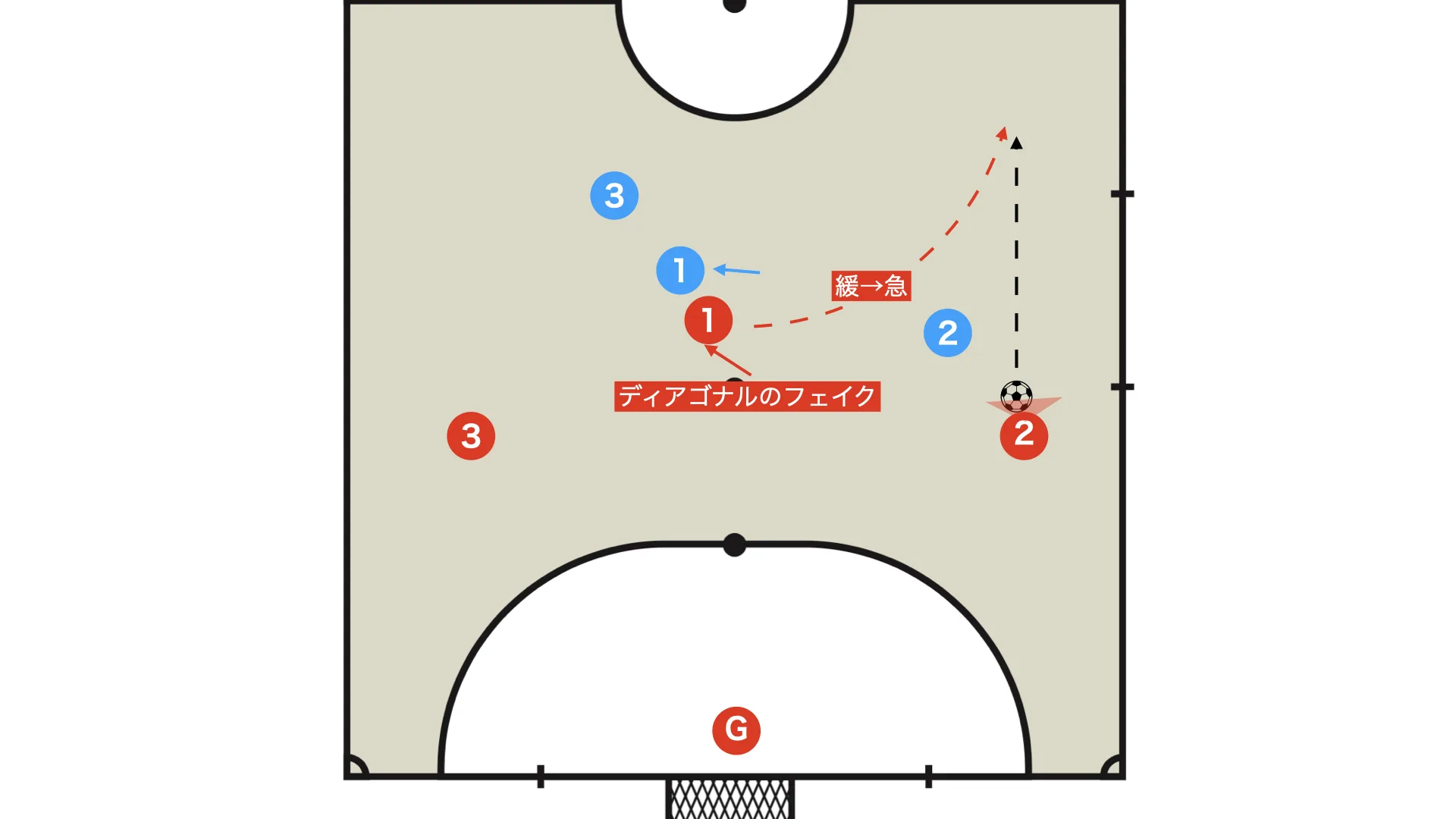
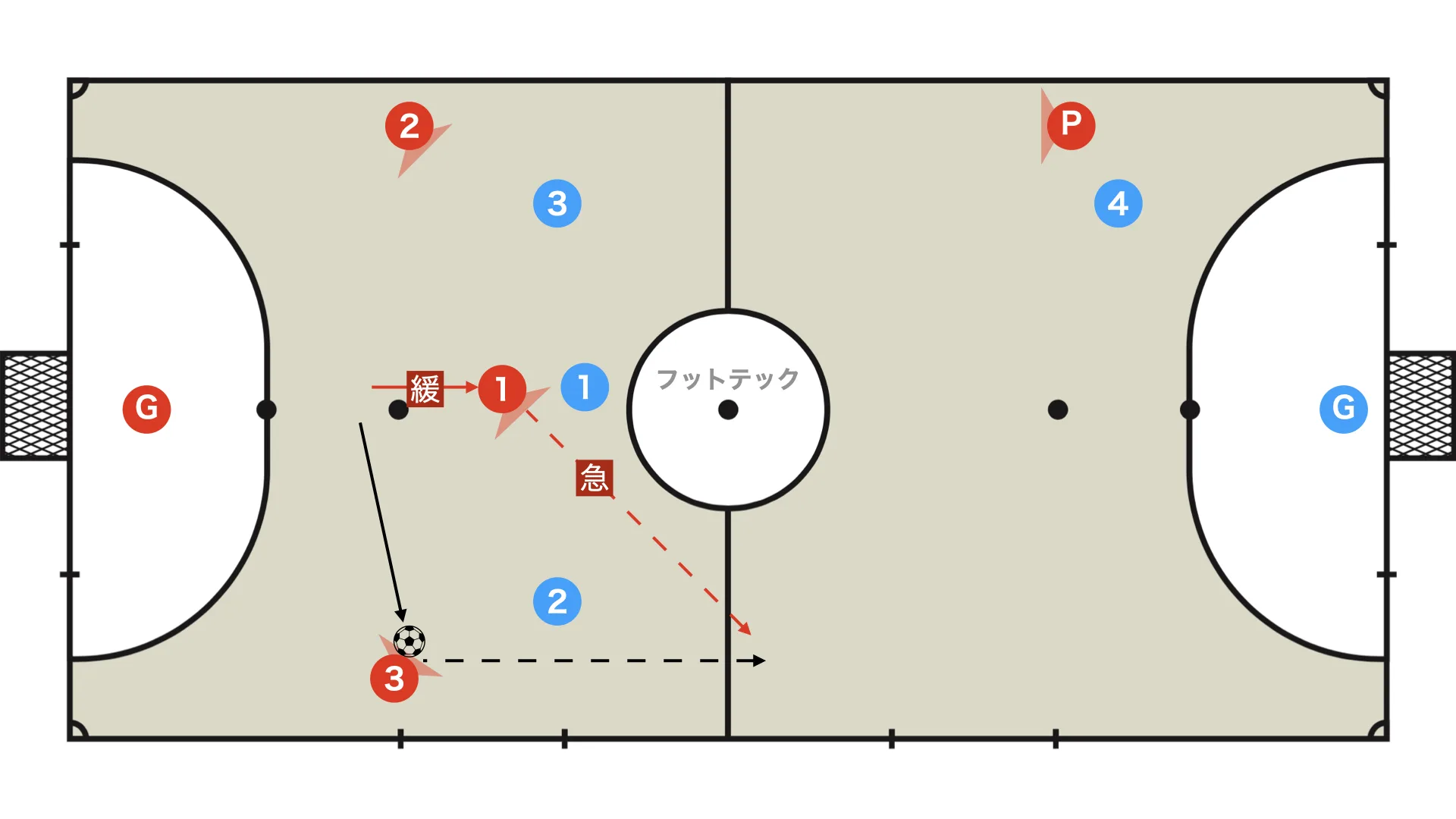
If the defender has already been detached before the pass is played, the receiver can go directly with a parallel run. But if the mark is still tight, it is important to use a diagonal feint or a change of pace, as shown above, to burst away from the defender in one move.
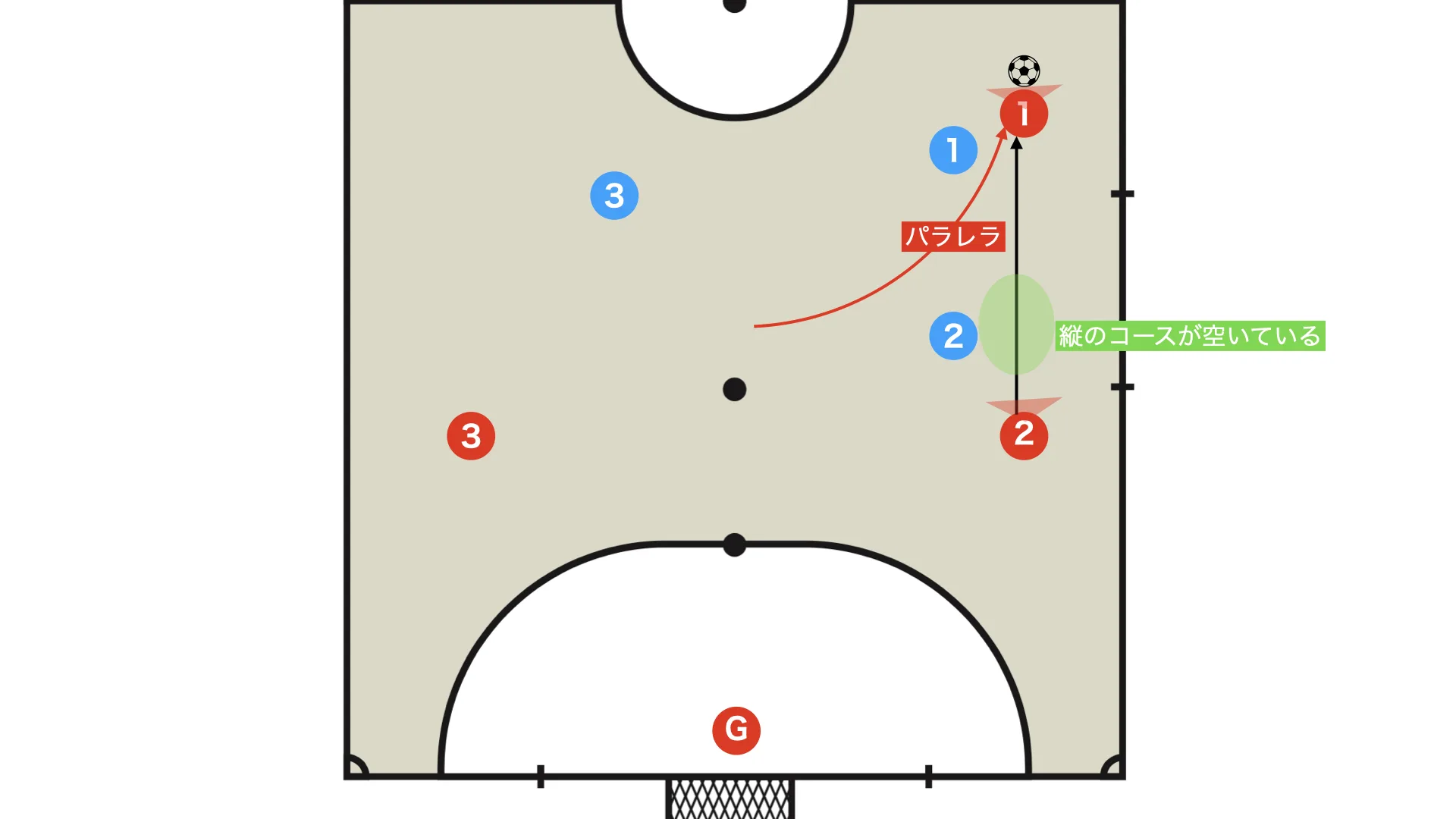
There are two conditions required to break the defence with a parallel combination:
- the vertical passing lane is open for the passer
- the receiver has shaken free of the defender
Parallel only works when both conditions overlap. On top of that, you also have to manage the timing between passer and receiver and the weight and trajectory of the pass, so although it looks simple, it is actually a very difficult tactic.
関連記事
Parallel in Futsal: 3 Key Points and 4 Types of Runs
A complete breakdown of the basic two-player futsal action called parallel, using three key principl…
続きを読む →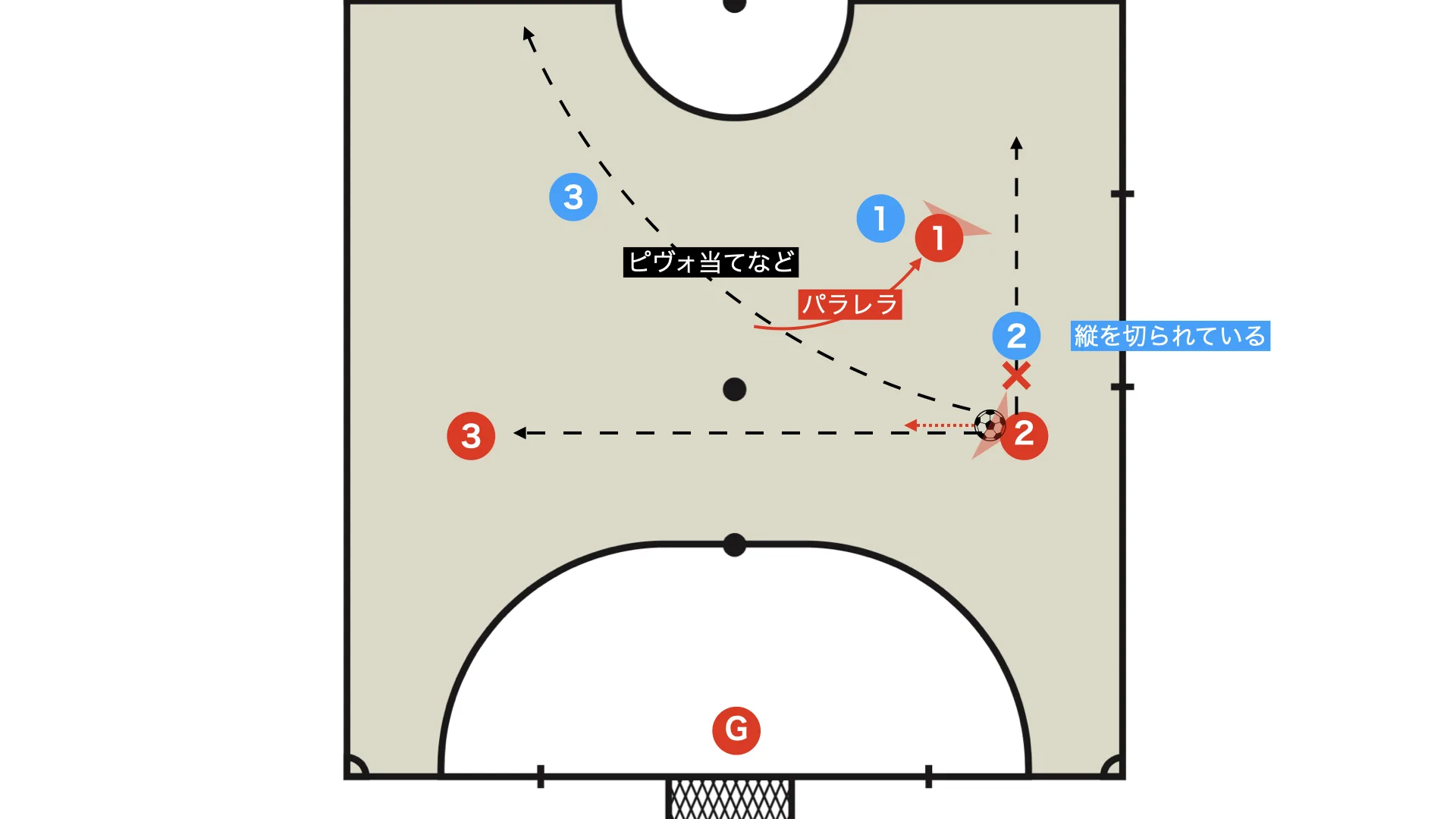
If you force the pass when the vertical lane has been cut off, you risk losing the ball and giving up a counterattack.
In that case, the best option is to cancel the parallel, dribble slightly inside, and look for a diagonal pass, either a backdoor ball or a pass into the pivo.
If that diagonal pass into the pivo succeeds, the player who made the parallel run can then function as the third man.
If the diagonal pass is not available either, the safest option is to play a sideways pass to red no. 3.
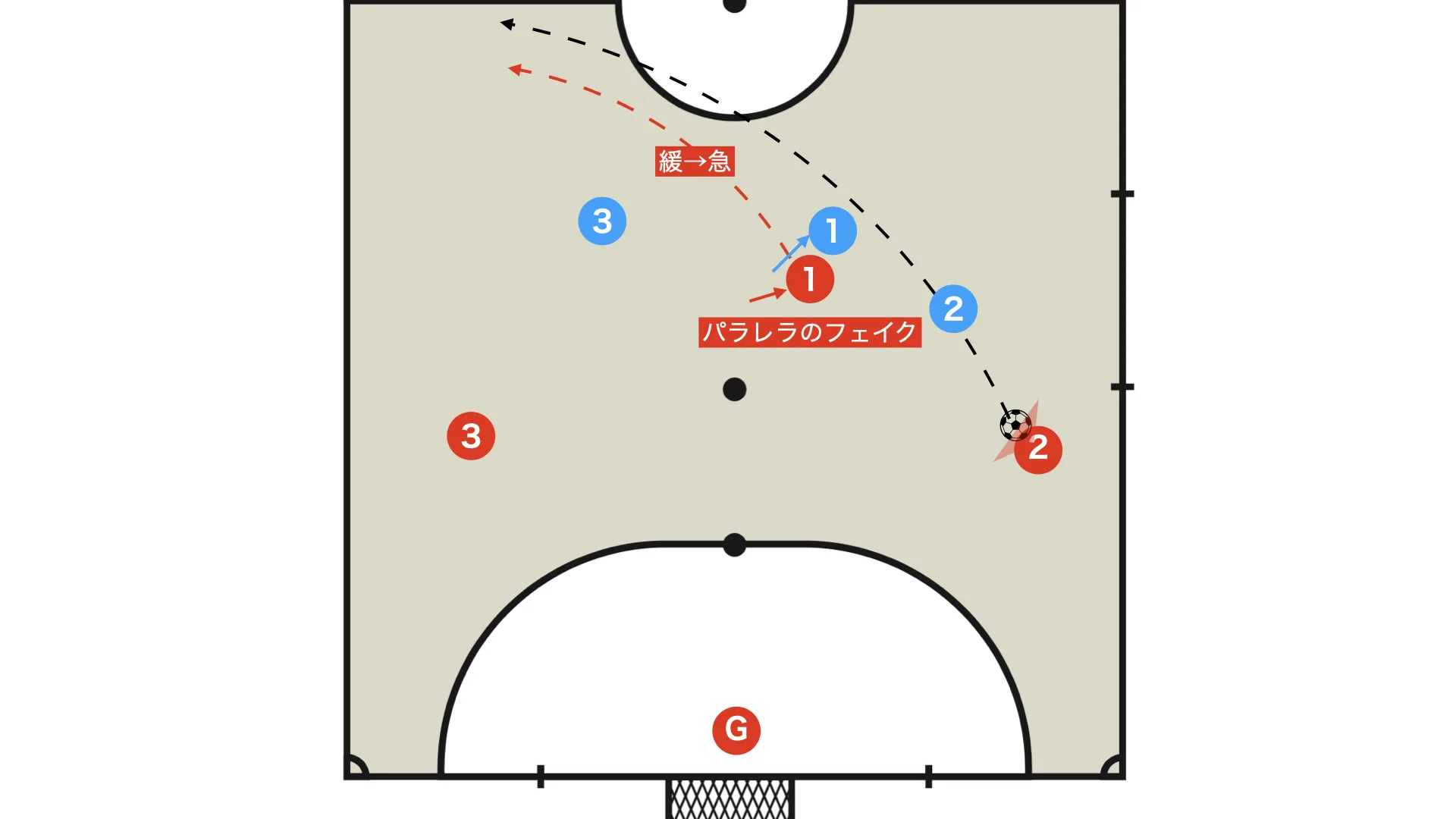
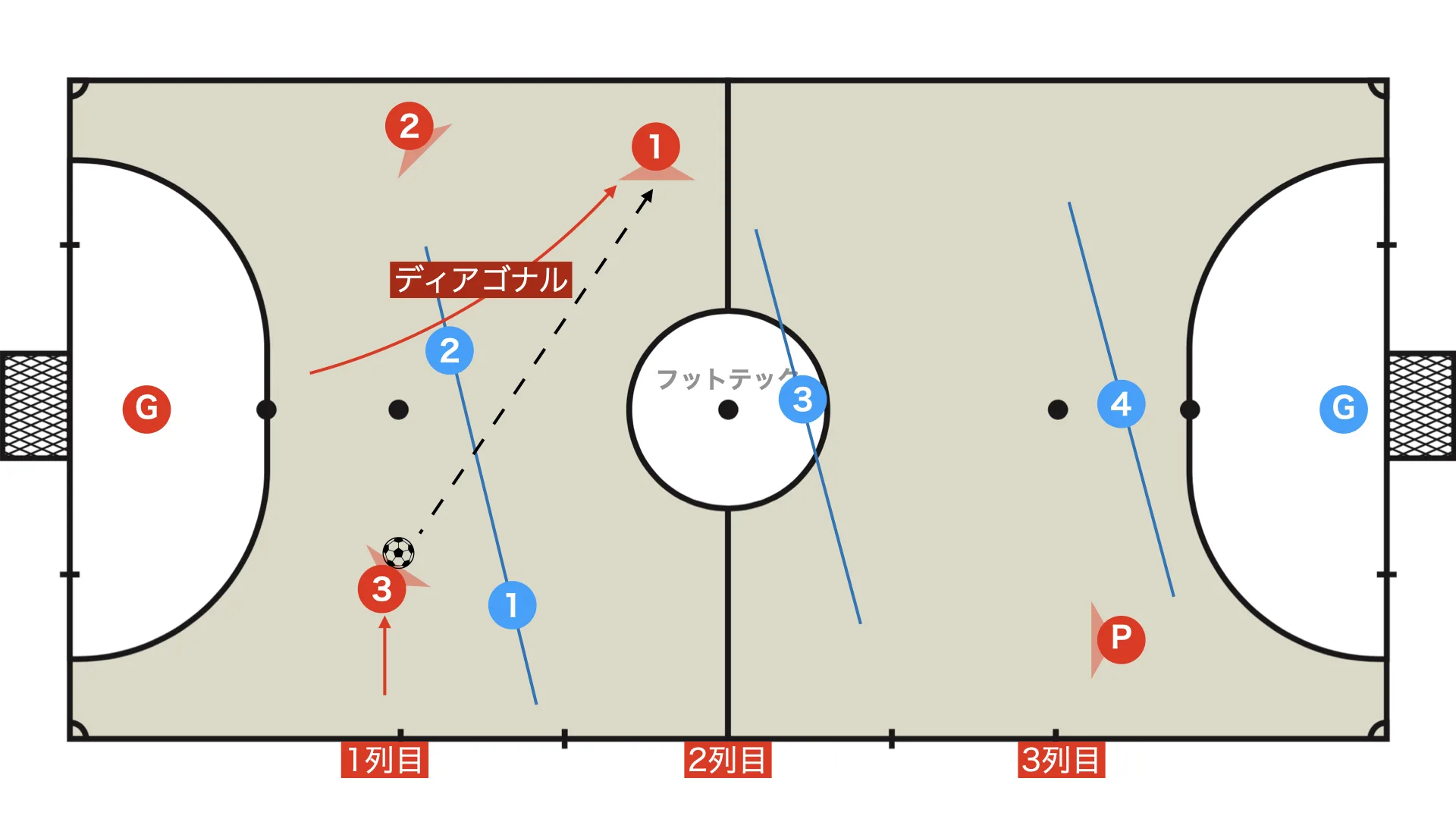
"Diagonal" refers to diagonal movement.
The term also serves as a general label for two-player relationships that break the defensive structure through this kind of diagonal run, like the one shown above.
As with the parallel, if the defender is already detached before the pass, the receiver can run directly on the diagonal. But if the mark is still tight, it is important to use a parallel feint or a change of pace, as shown above, to burst away from the defender.
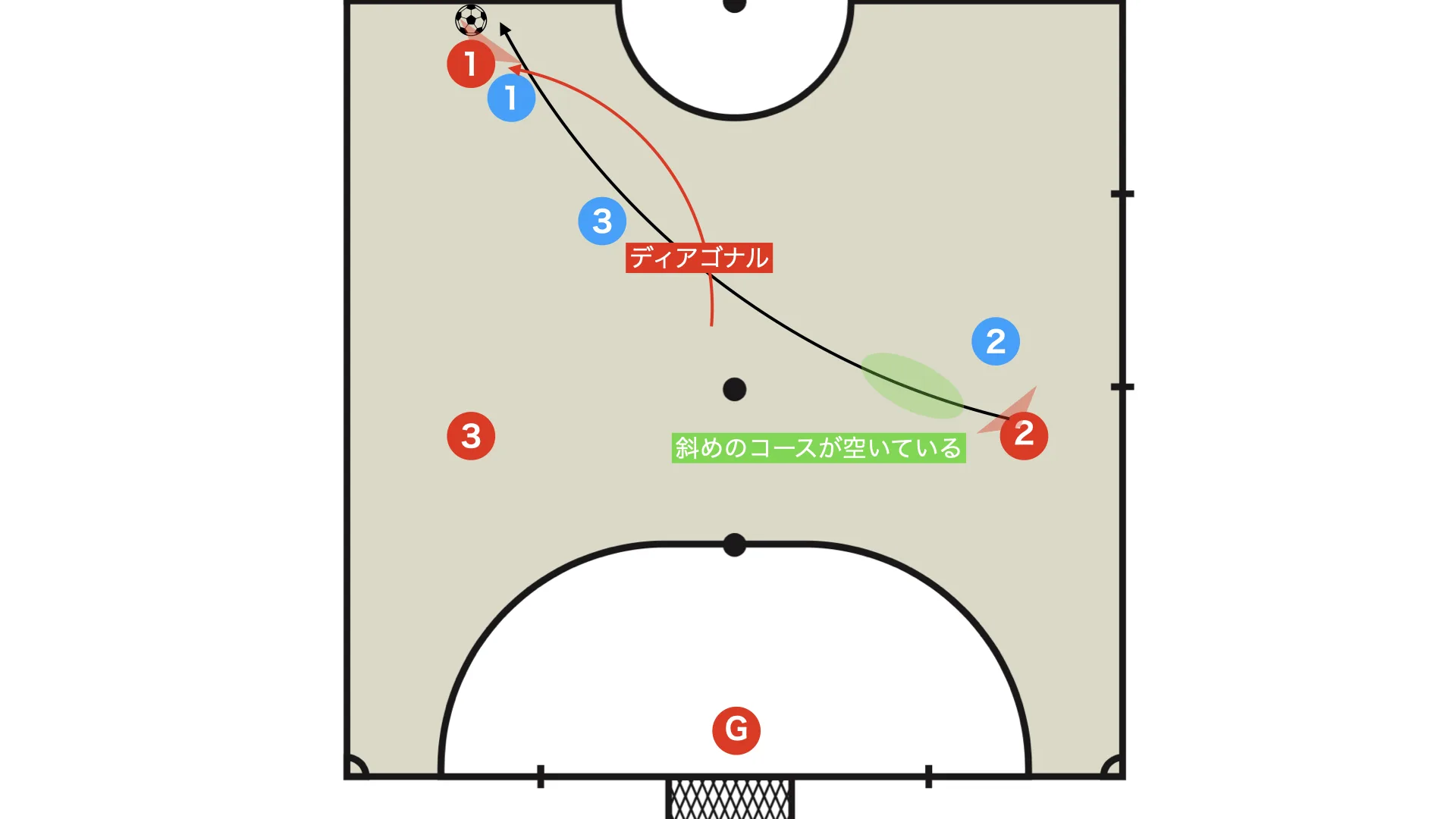
There are two conditions required to break the defence with a diagonal combination:
- the diagonal lane is open for the passer
- the receiver has shaken free of the defender
You can create the diagonal passing lane with a lofted pass, but compared with a parallel, the pass is longer and the receiver's body orientation makes the first touch more difficult. So the entry conditions are easier to satisfy, but it is not easy to turn it into a finish.
関連記事
Diagonal (Jagonau) Explained in Depth
A thorough breakdown of diagonal, one of futsal's key two-player actions. Learn how this diagonal mo…
続きを読む →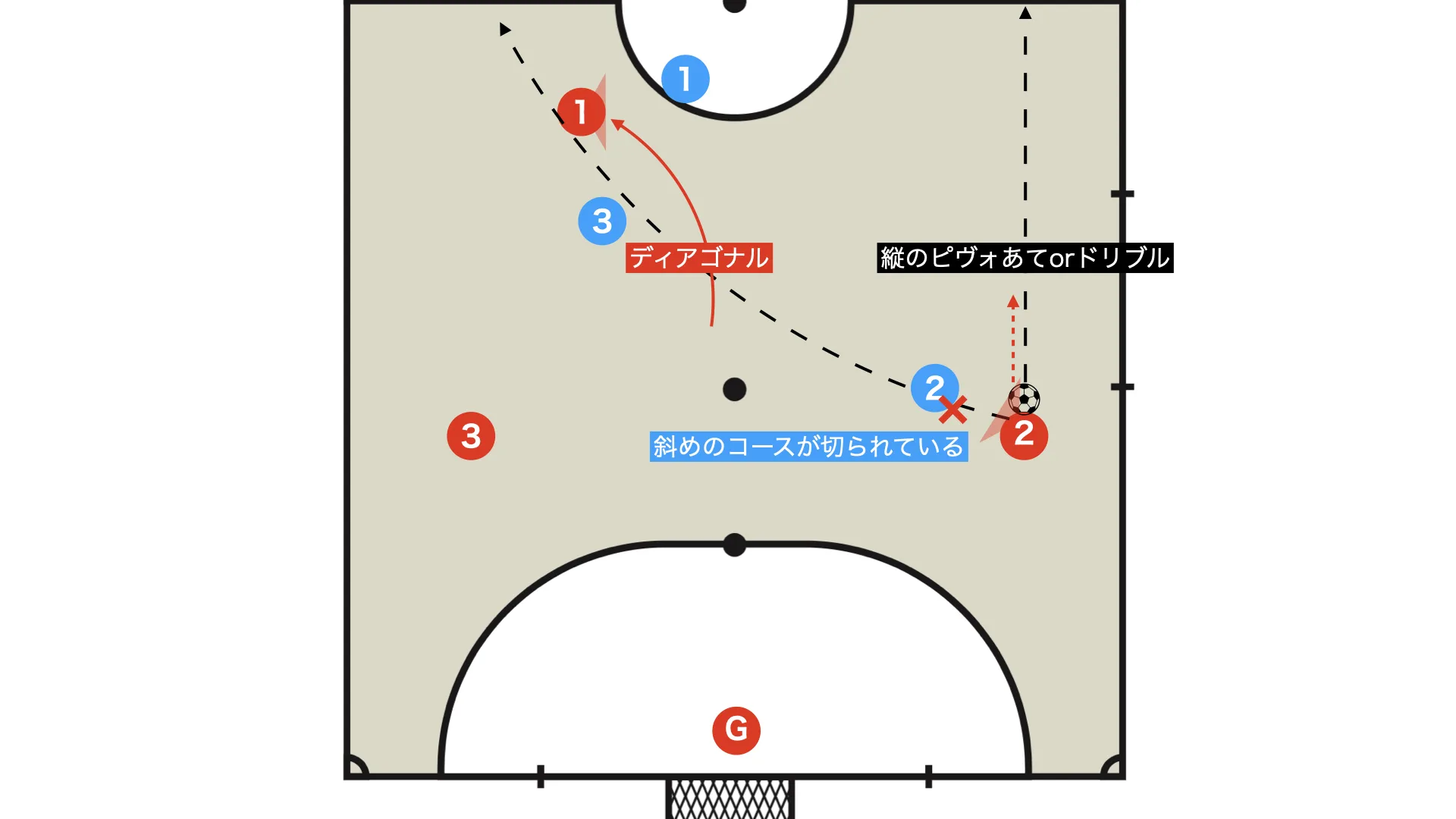
If the diagonal lane is obviously blocked, the vertical lane usually opens up, so the team should progress either with a vertical pass into the pivo or by dribbling forward.
At this point, the individual tactic contrapie is useful for breaking the defence smoothly.
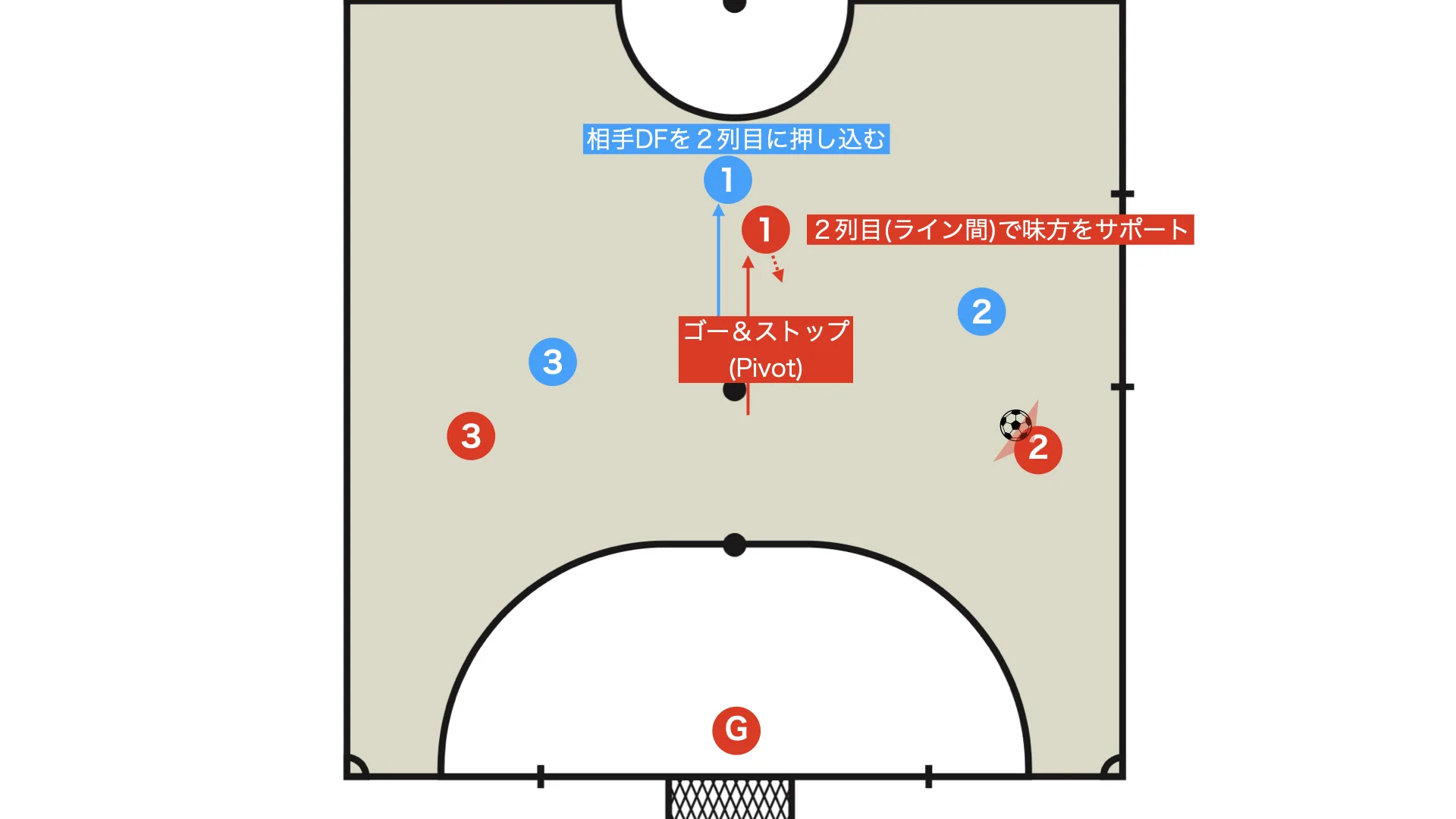
If the player attacks the space behind but the defender follows, another option is to stop and call for the ball.
The tactical aim is to force the opponent's defence deeper and to make use of the space between the lines.
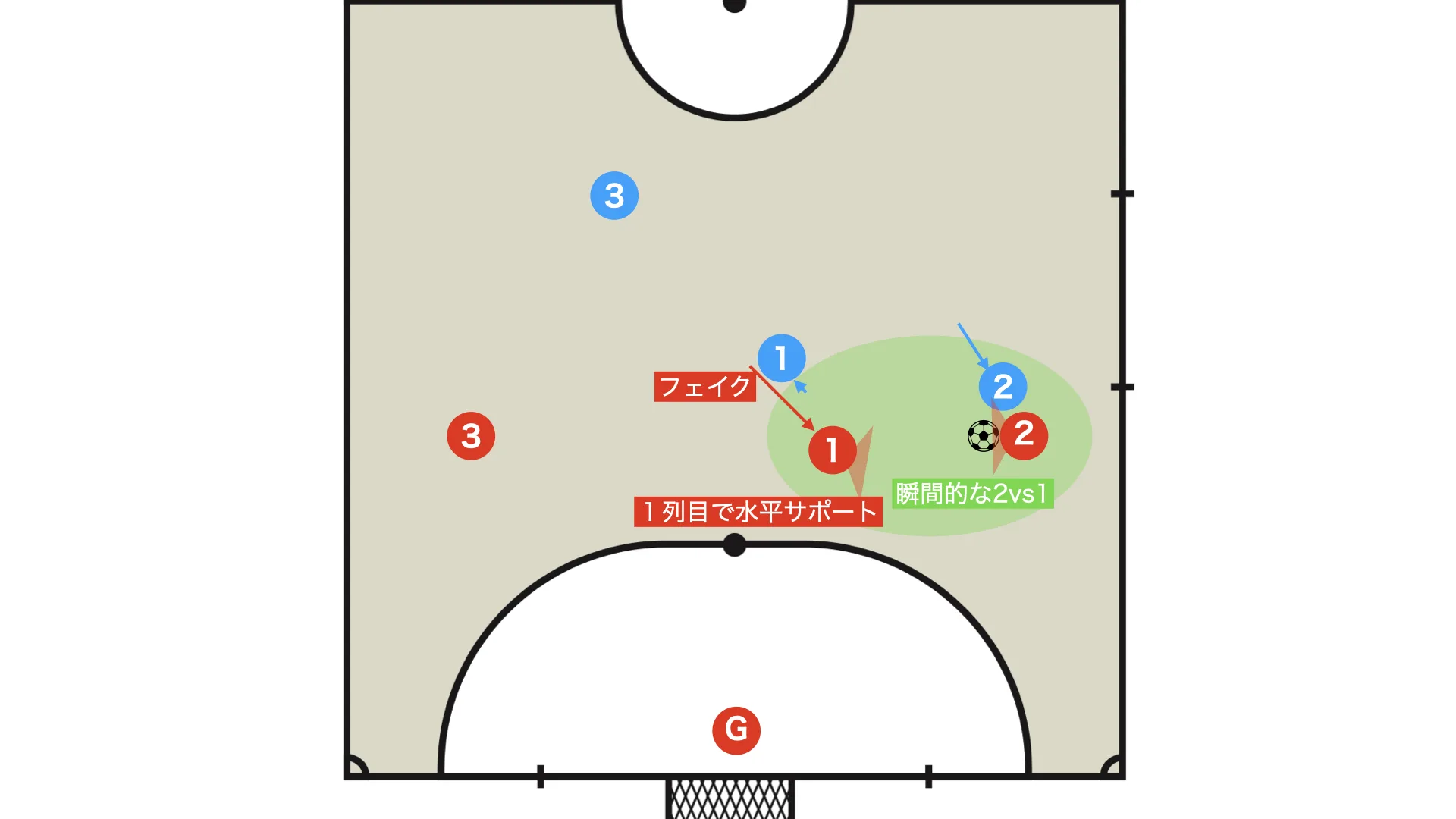
The next section will explain the case of far (fixo) - close (ala), but if the ball holder is already under pressure, making the run in behind does not help because the pass will not come. In that case, the best option is to cancel the run behind and offer horizontal support instead.
This is essentially a feint movement.
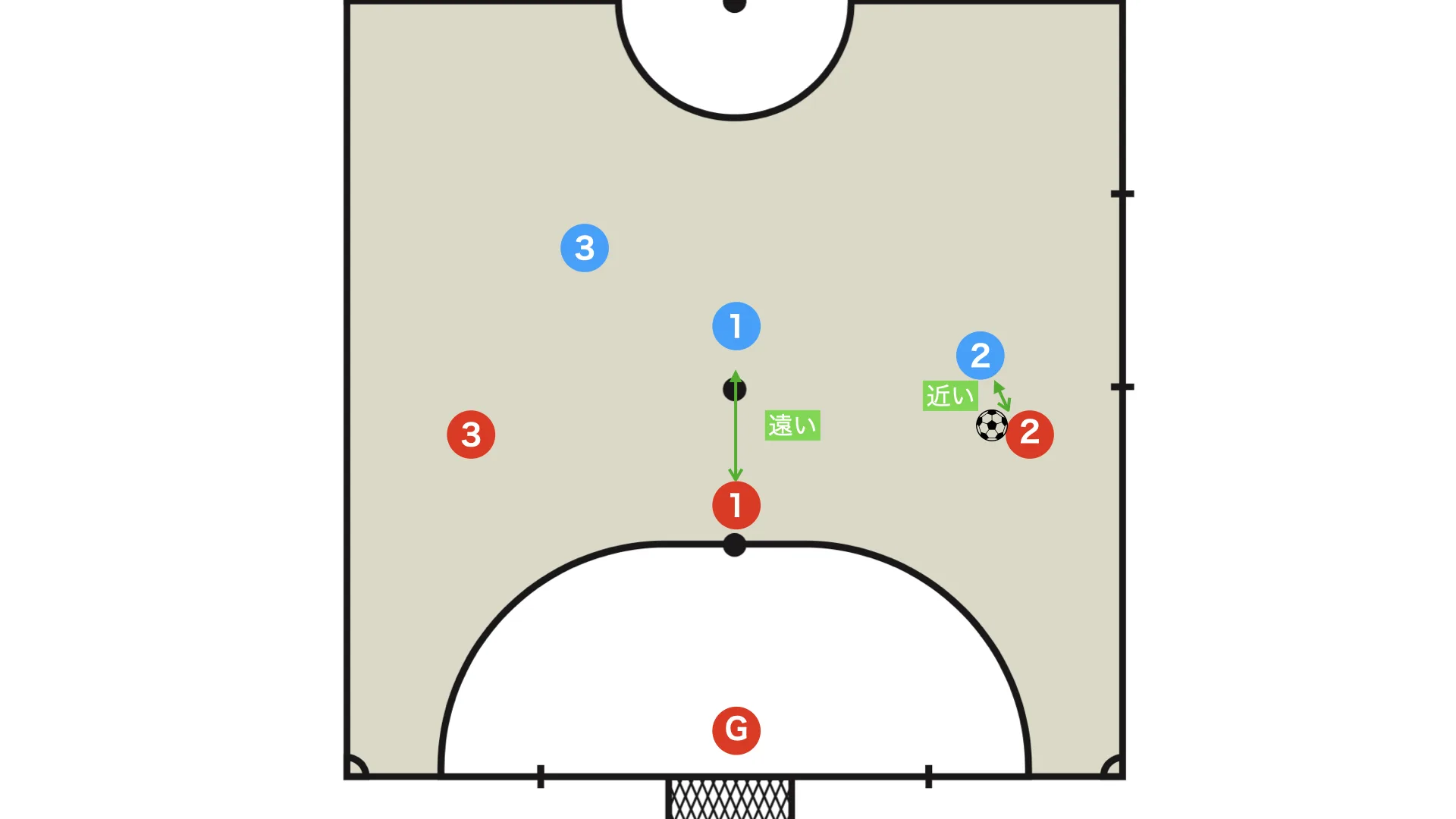
When the fixo is far from the defender and the ala is close, the correct choice is not to run in behind but to support the ball holder.
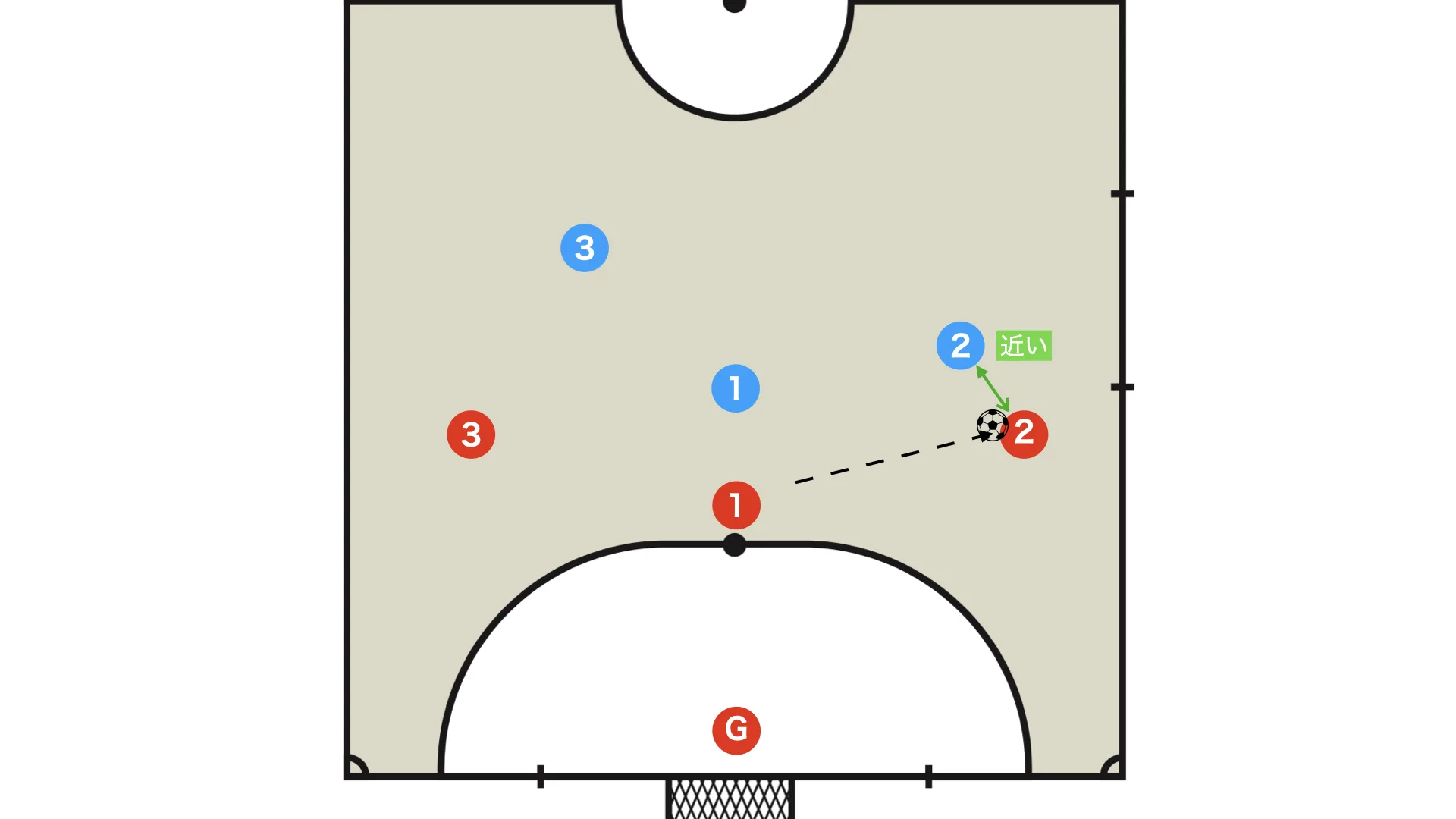
This commonly happens when the fixo has just passed the ball to the ala.
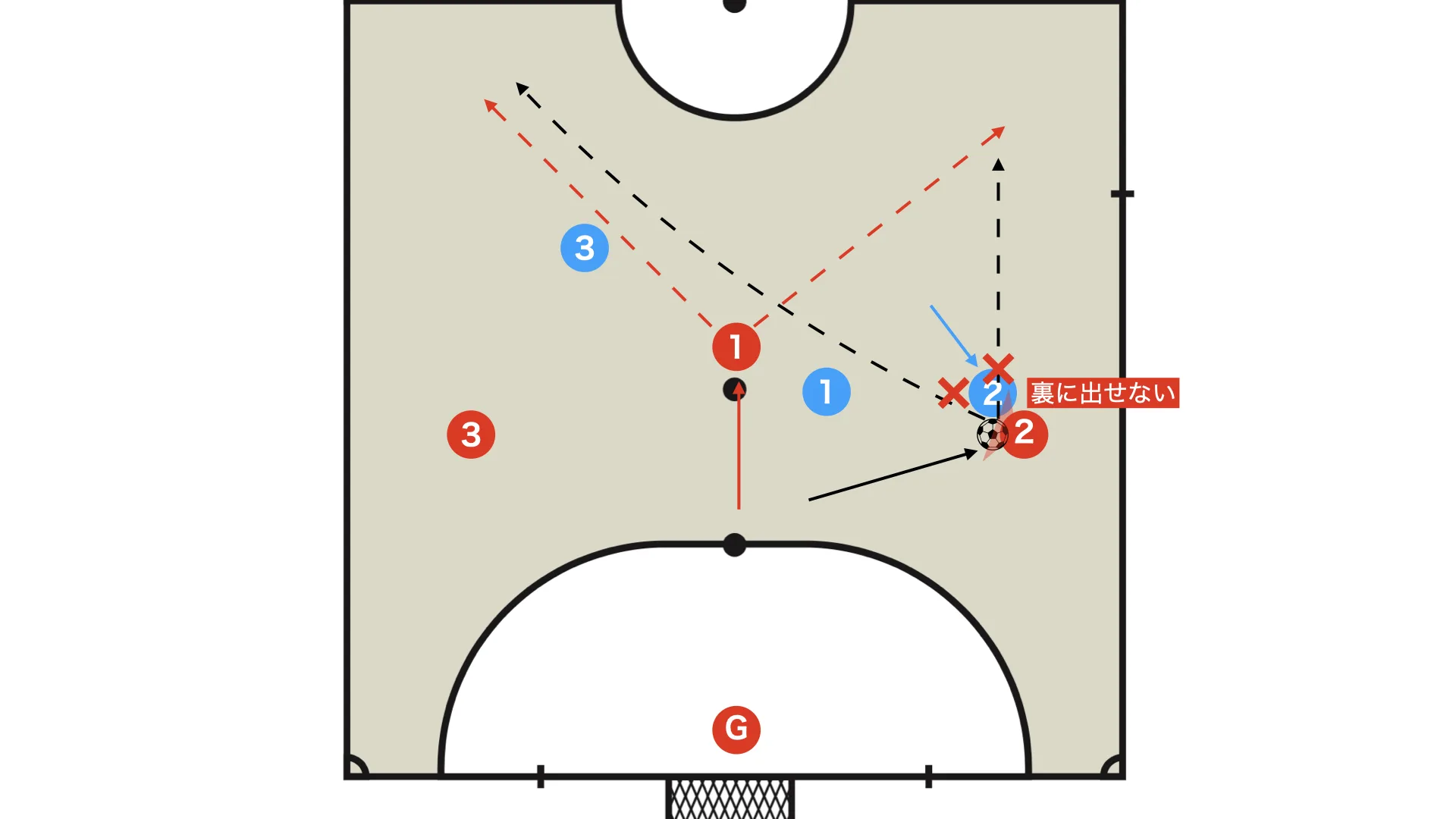
If the ball holder is already under pressure, running in behind anyway just means the passing lane behind is closed and the ball holder is left isolated.
This is a common bad habit among futsal beginners and among players or teams that run blindly without reading the situation.
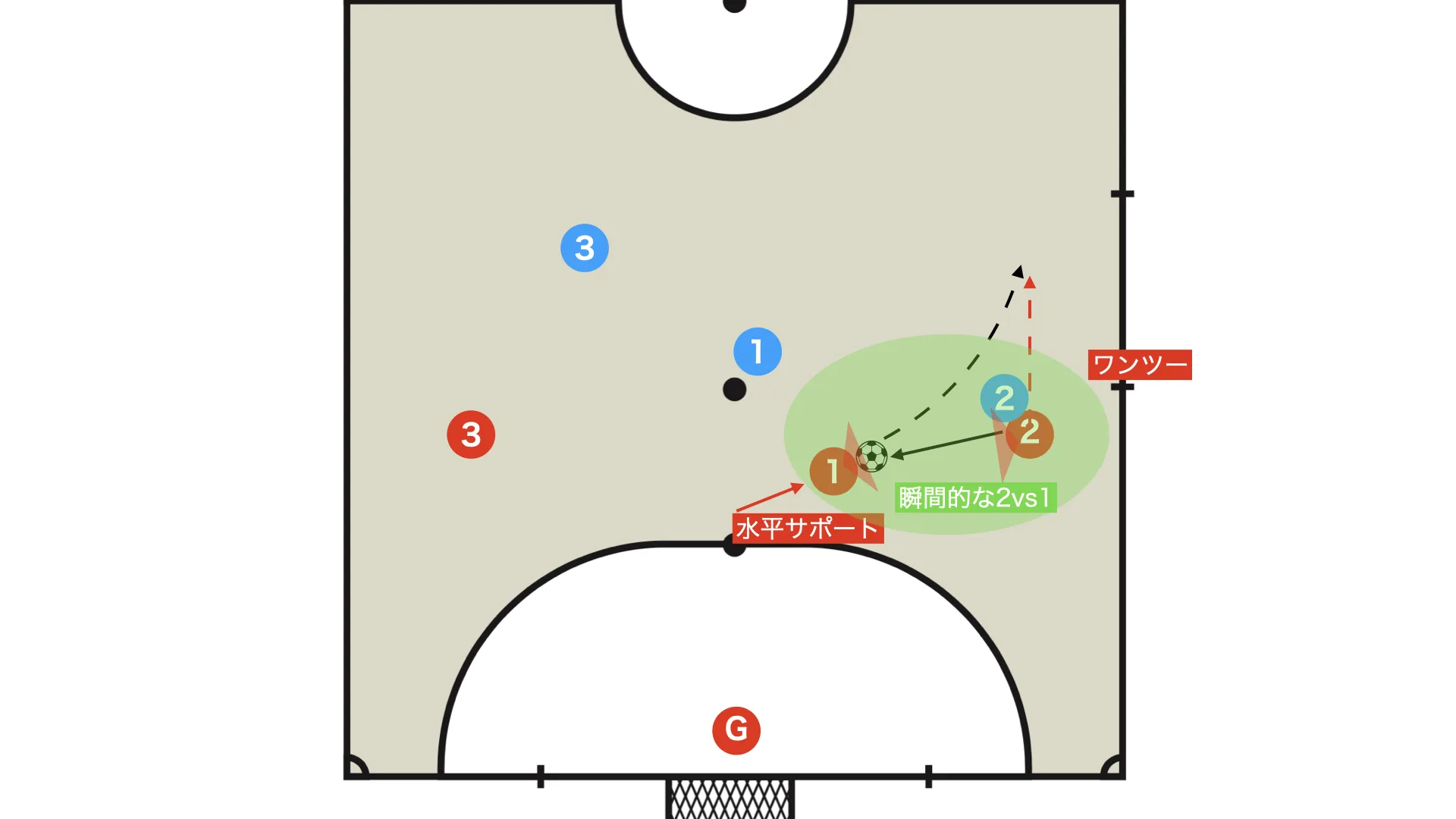
It is effective to support from the same height as the ball holder, or even from a slightly negative position, receive the ball, and then use the opponent's pressure against them by attacking the backdoor.
This kind of pattern is commonly called a one-two.
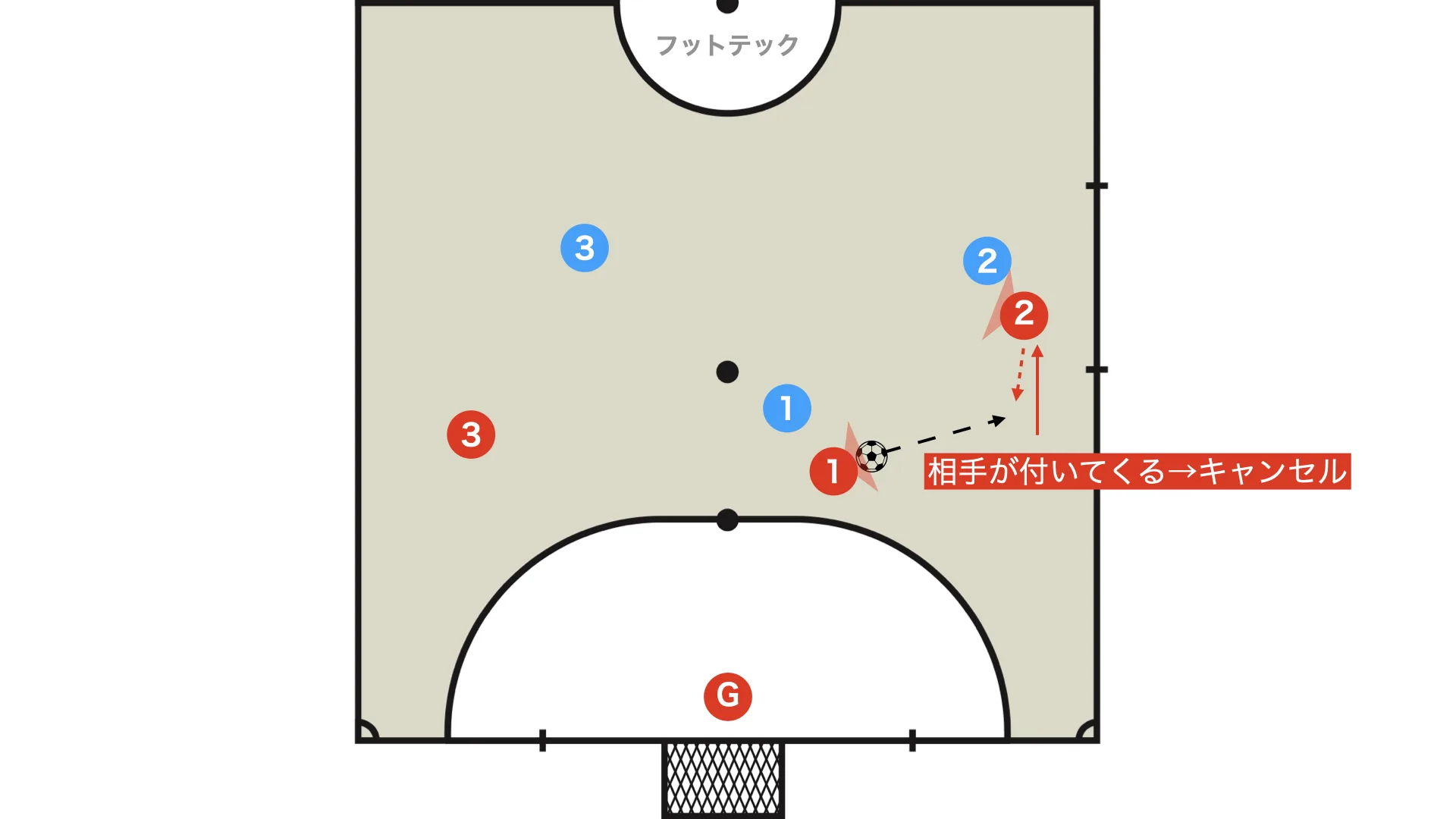
The ala should not run behind blindly. If the defender is following, the correct choice is to cancel and receive to feet again.
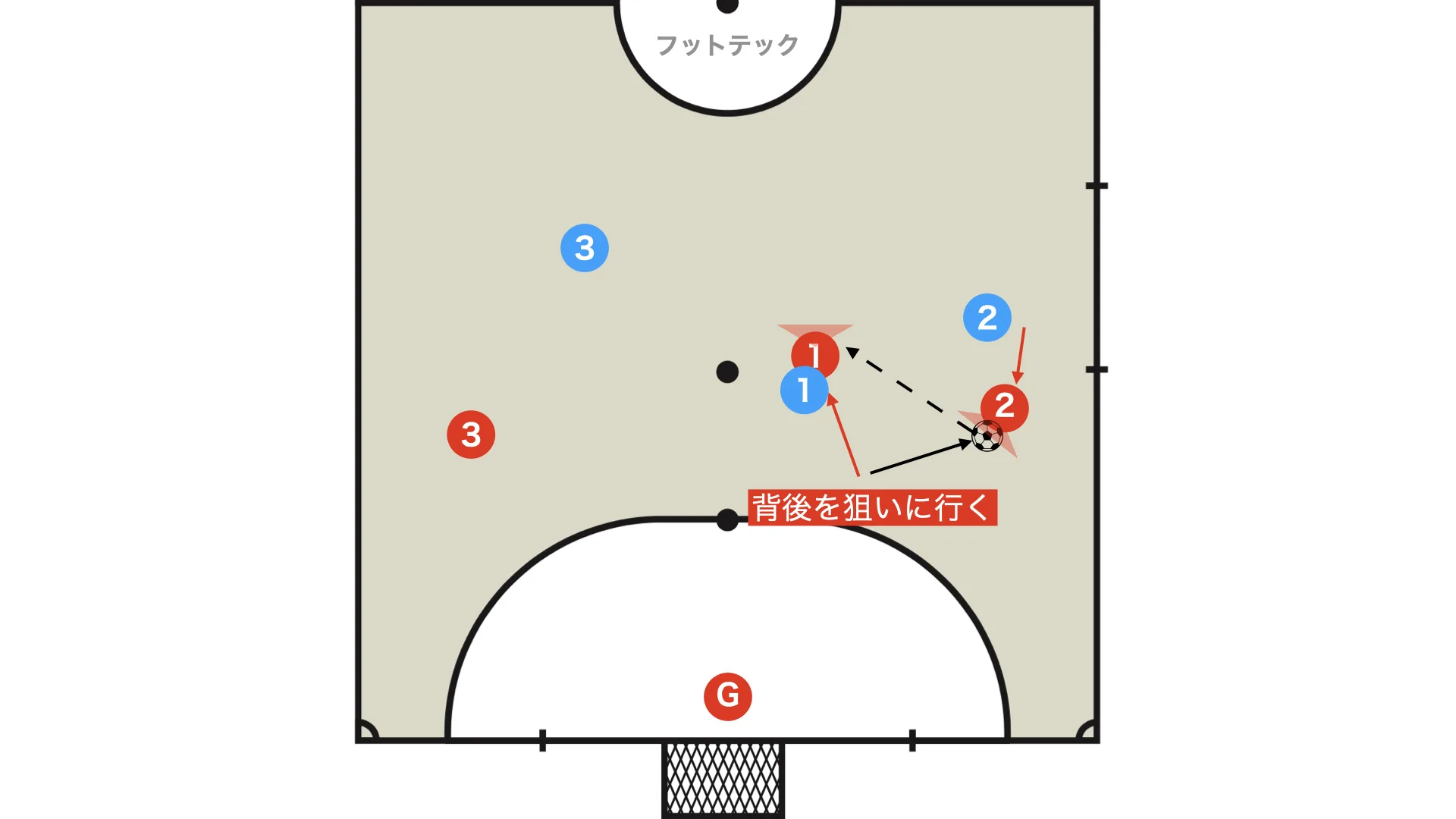
If the defender has jumped toward the fixo, the next step is for the fixo to attack the space behind the defender.
This kind of one-two, where the player in the central lane becomes the one attacking in behind, is called an inside one-two.
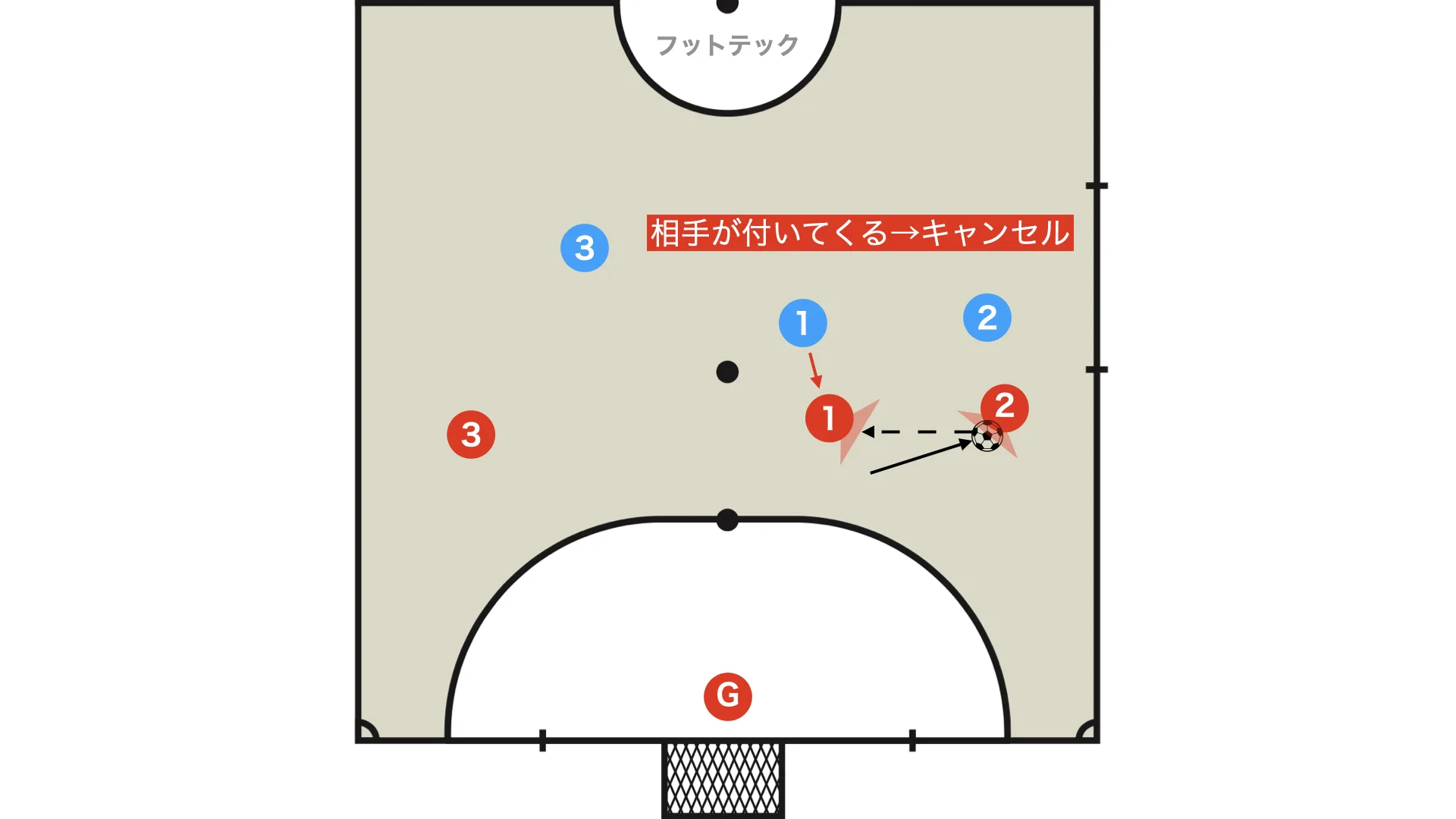
If the defender follows again, cancel once more and receive to feet again.
This kind of continuous sequence of one-two feints and pass exchanges between two players is generally called dualidad.
Dualidad means duality.
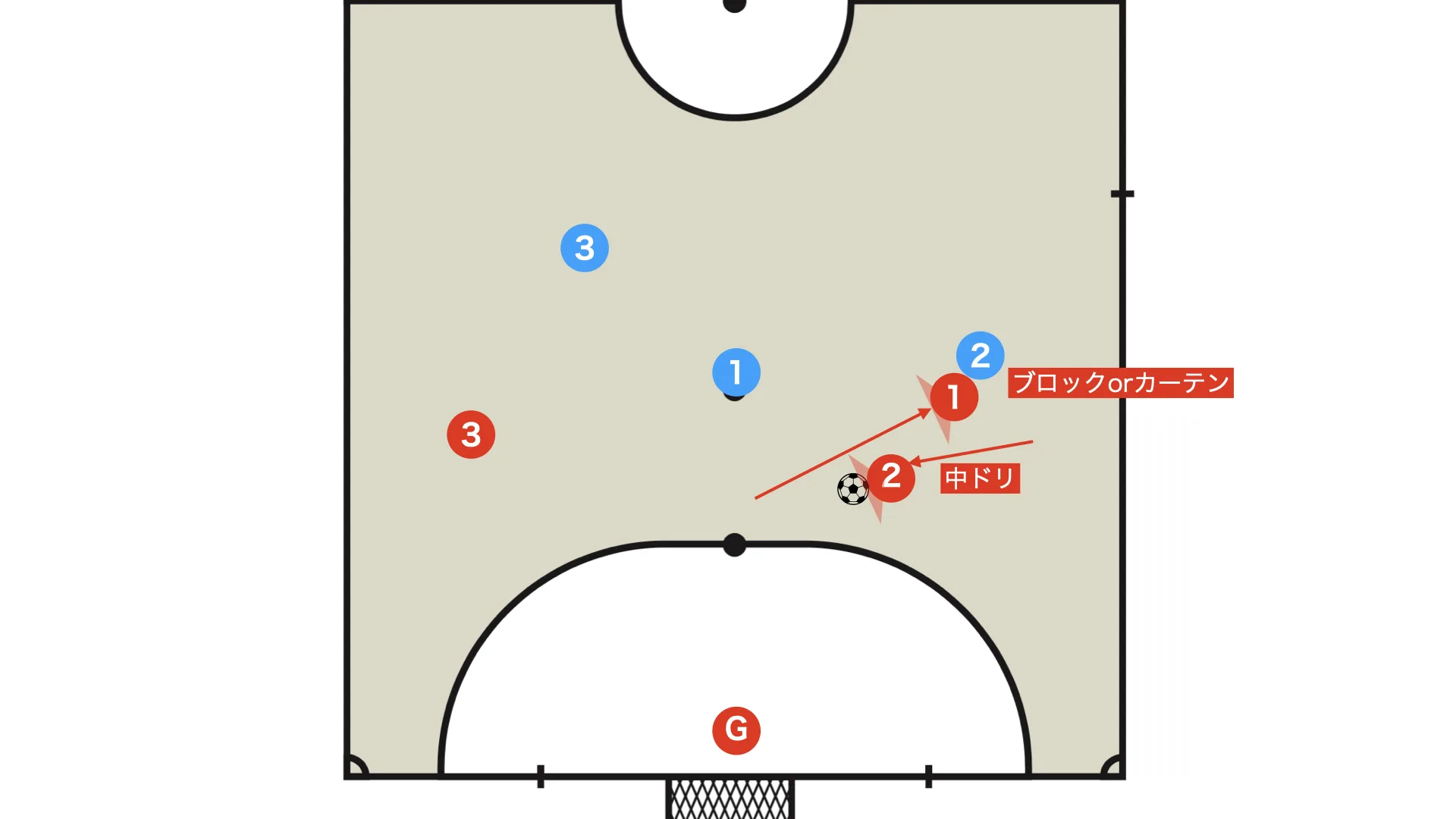
There are two support methods for helping the ball holder dribble inside: the block and the curtain.
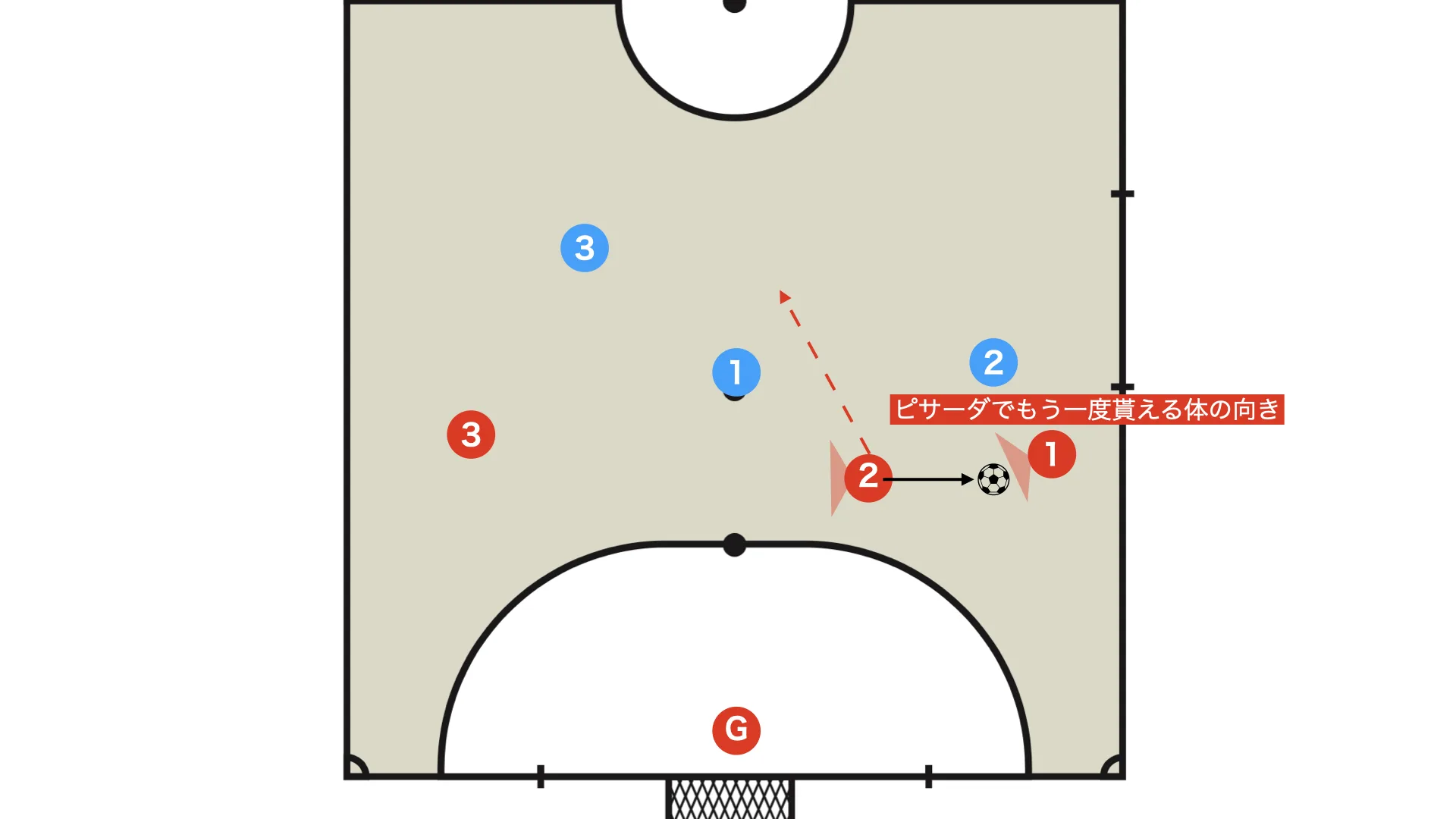
When using a block or a curtain, always turn your back toward the touchline and support while scanning the whole court.
That makes it possible to receive the ball again with a pisada.
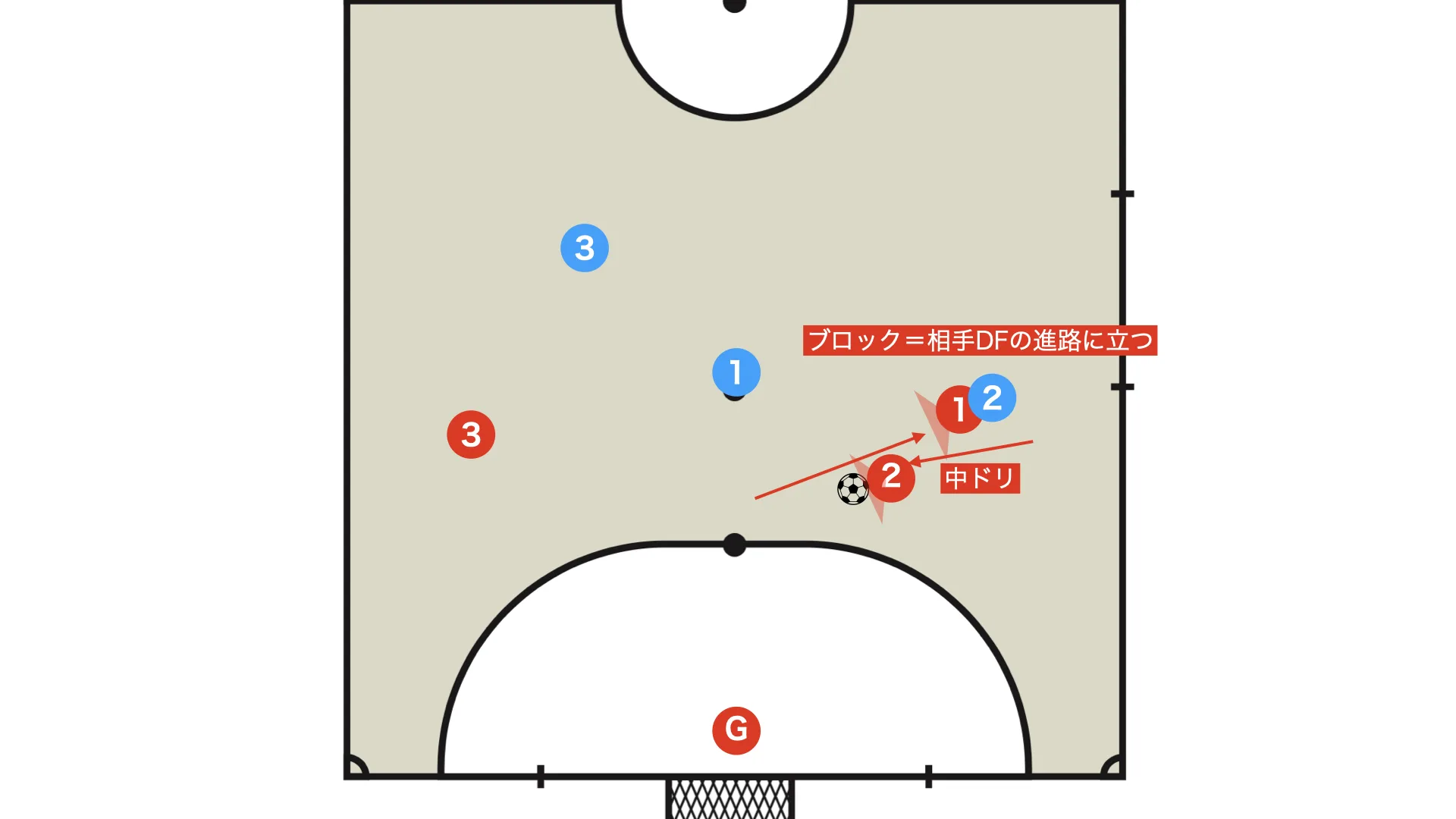
A block is an action that supports a teammate by standing in the defender's path and becoming an obstacle.
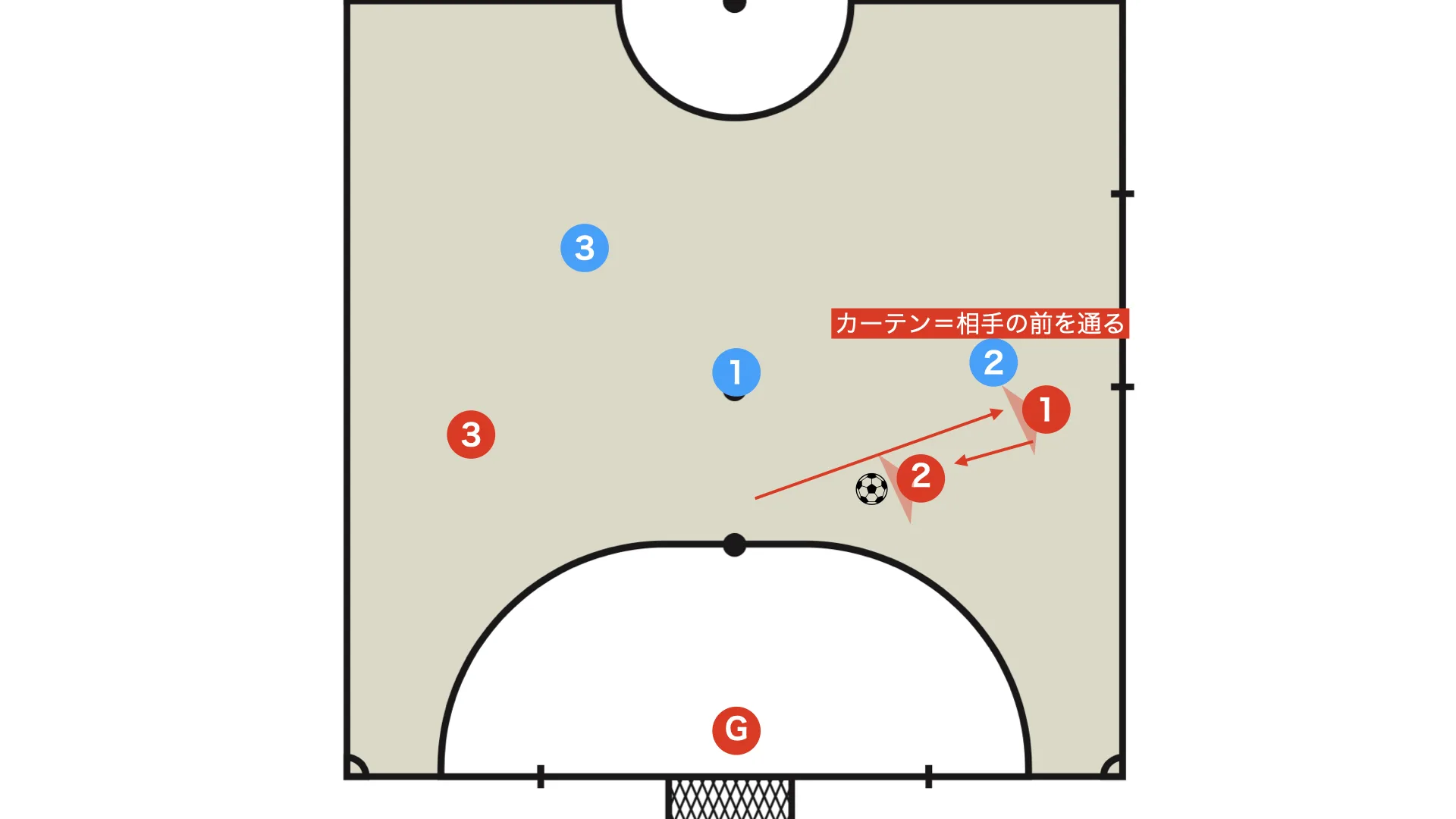
A curtain is an action where a player runs between their teammate and the defender, temporarily weakening the pressure on the teammate.
関連記事
Do You Actually Know the Difference? Block vs Curtain, plus Indirect Curtain and Indirect Block
A thorough explanation of the difference between blocks and curtains in futsal. This article sorts o…
続きを読む →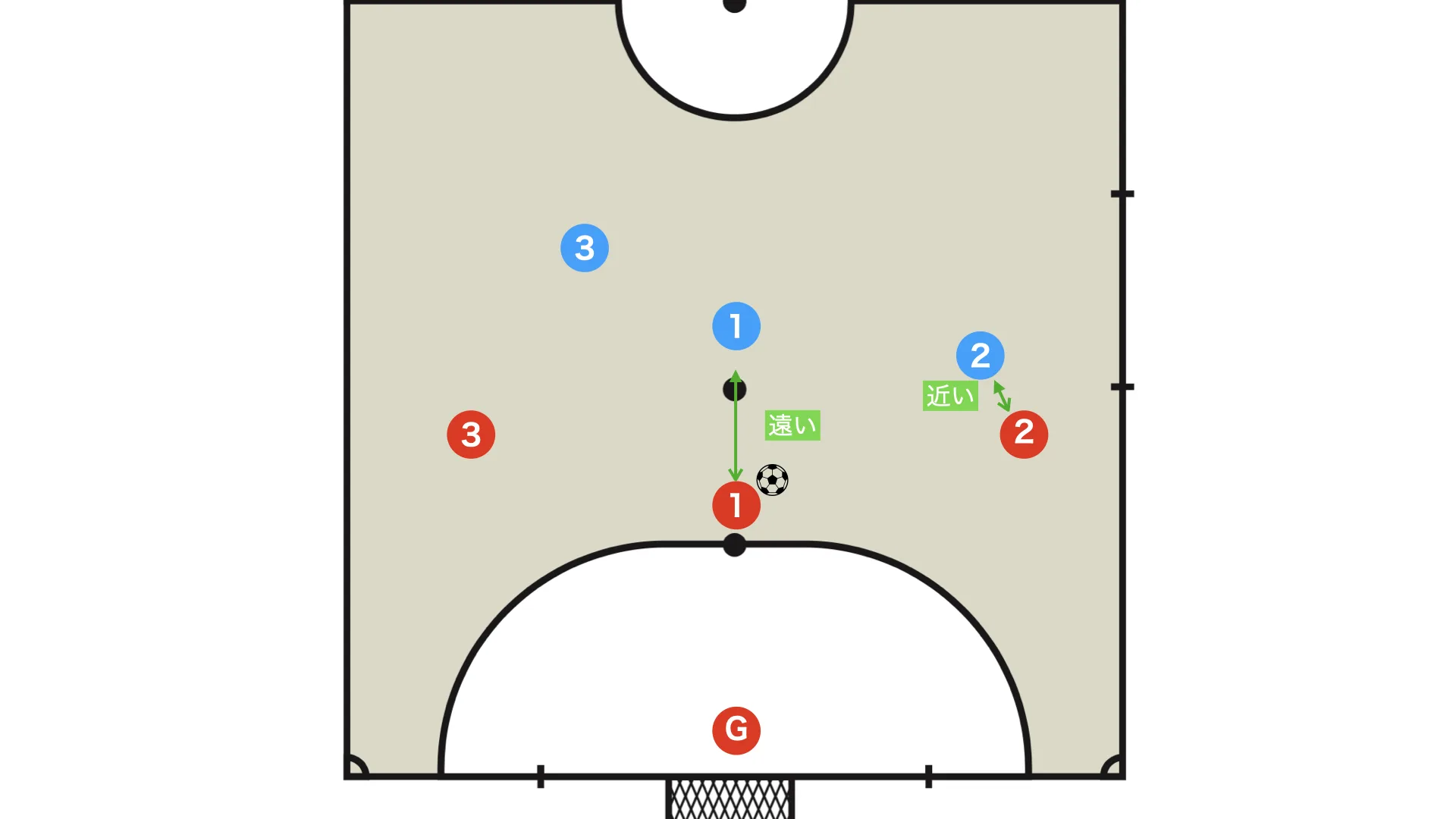
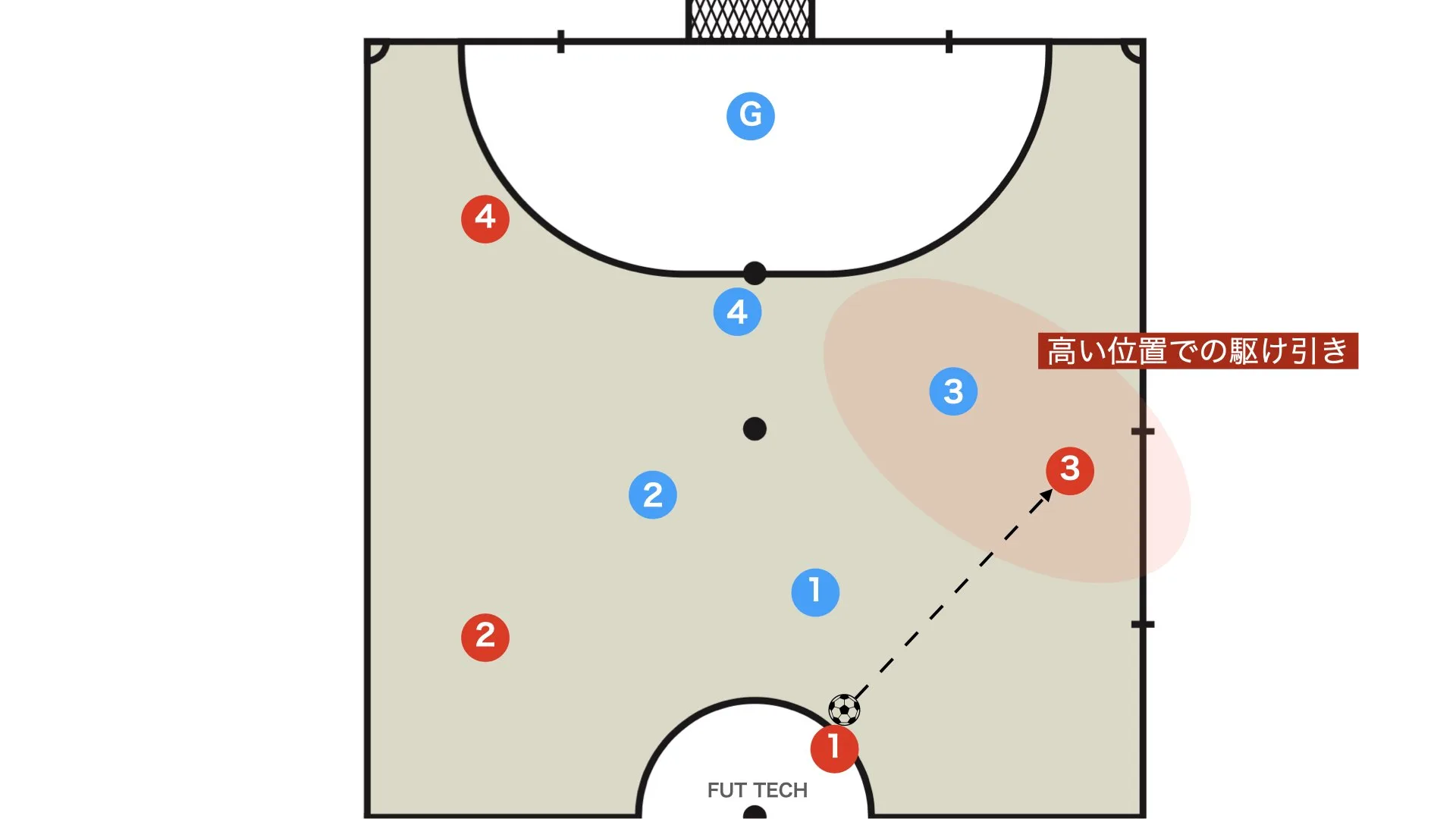
Just as in the far ala - close fixo case, the ala attacks the space behind the defender.
This kind of duel, where the ala takes a high position and tries to get in behind, is used more often in the attacking half than in the team's own half.
For details, see the article below.
関連記事
Two-Player Relationships: The Ala's Tactical Moves (A la Corta, Mini Diagonal, Central Push-Out)
An explanation of the tactical interplay between the fixo and the ala in two-player relationships. U…
続きを読む →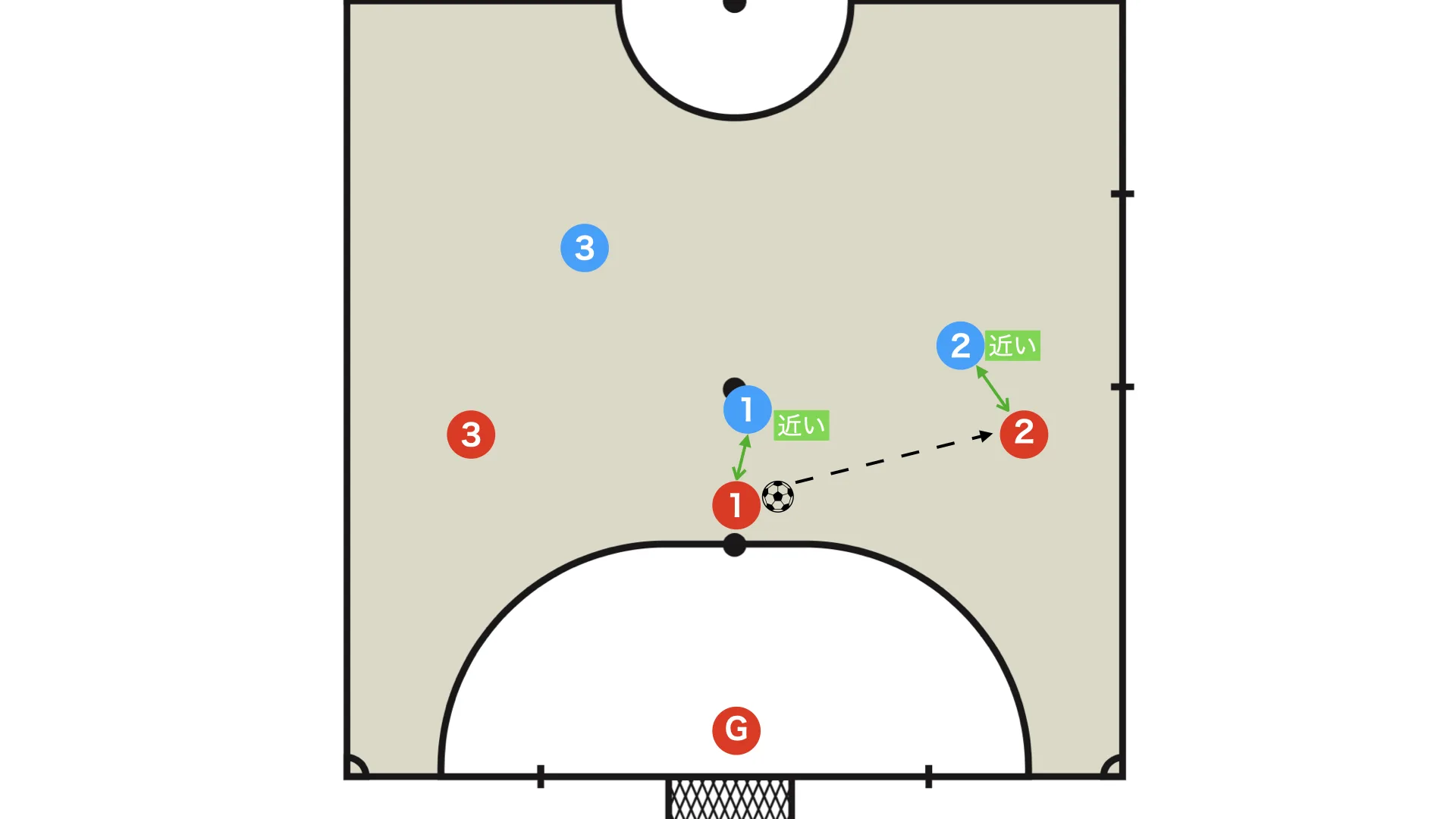
The diagram above shows a situation where both the receiver and the passer, the ala and the fixo, are being closed down by defenders and the press has fully locked on.
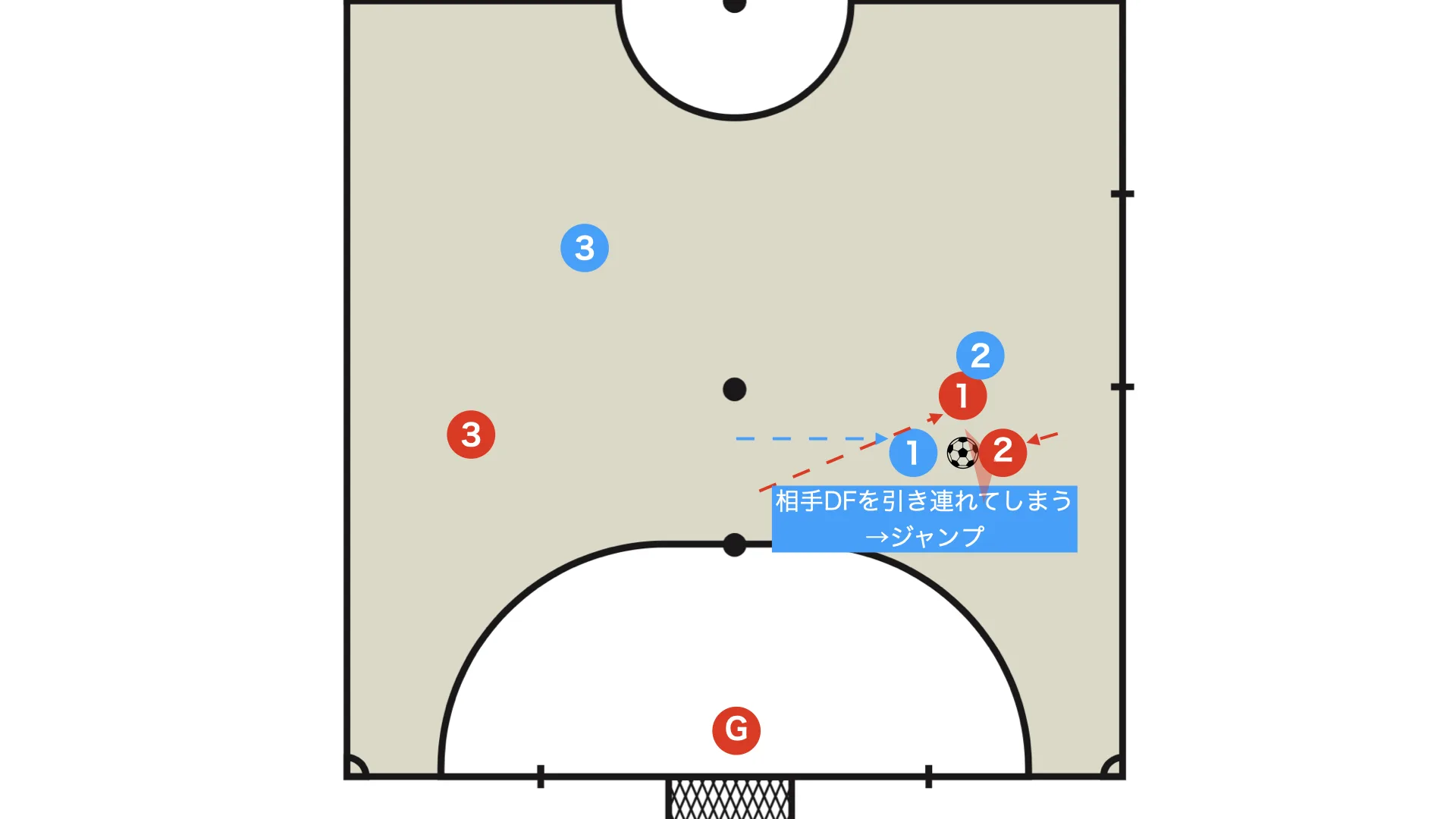
This is a common bad example among players who blindly try a block or curtain.
If you move too close to your teammate in a situation like this, the defender can simply jump the mark and win the ball.
The chance of receiving the ball directly is low, but if the player succeeds in dragging their defender away, the sideways passing lane opens up.
On the other hand, if the defender does not follow and instead stays put, the ball holder can end up surrounded.
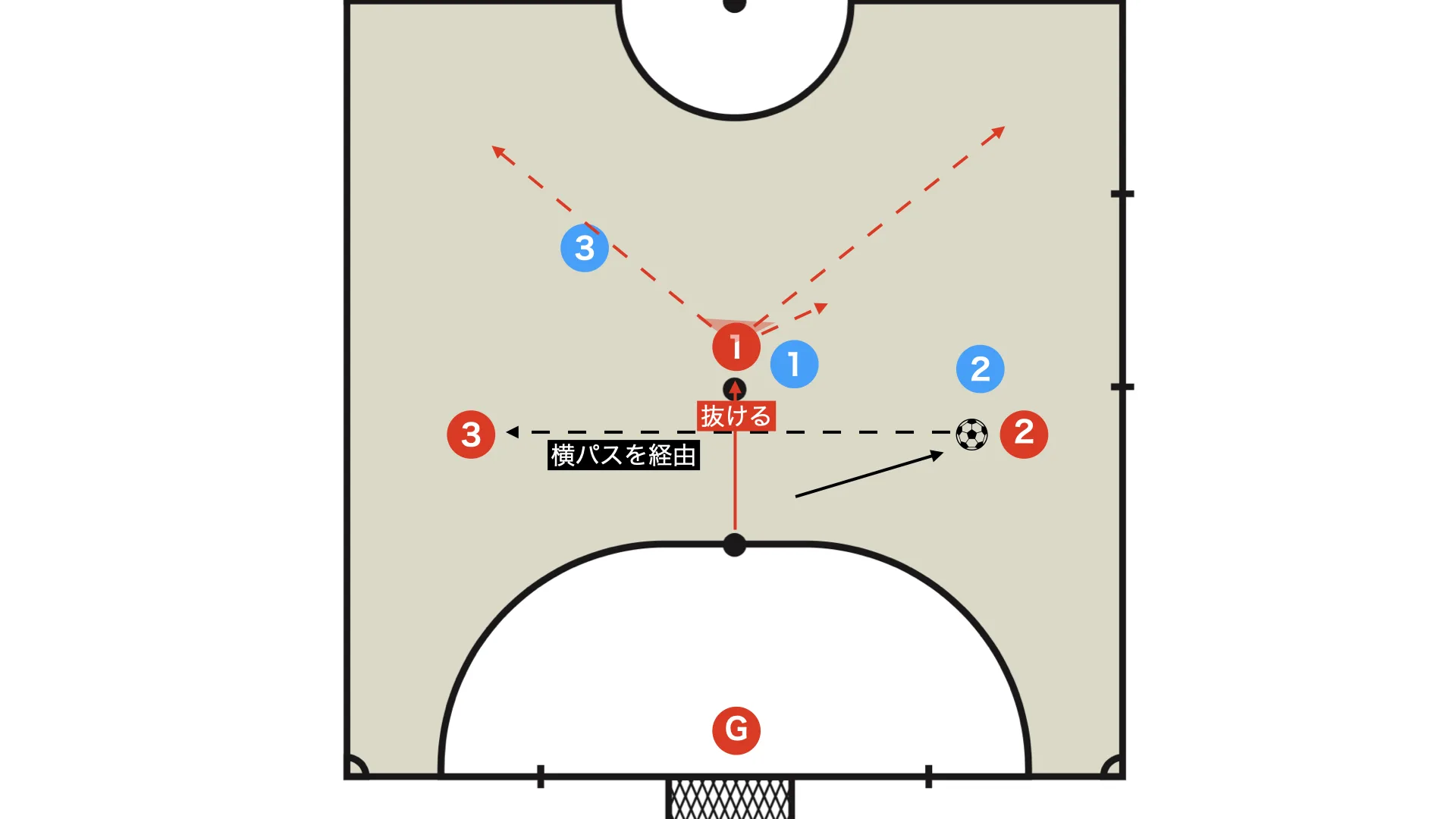
Use the passing lane that opens because the defender was dragged away.
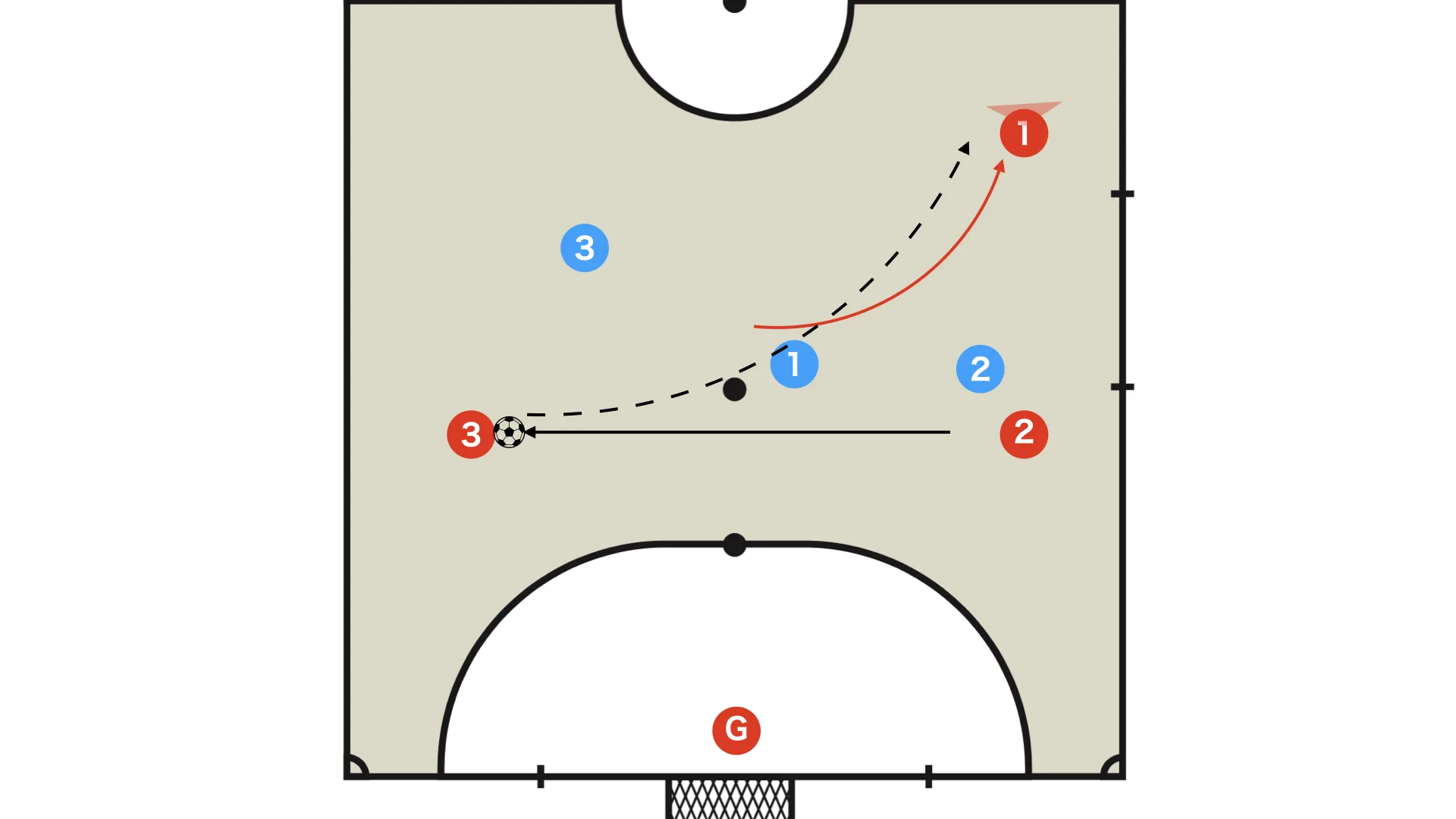
If the sideways pass gets through, the red no. 1 who made the initial run can then function as the third man.
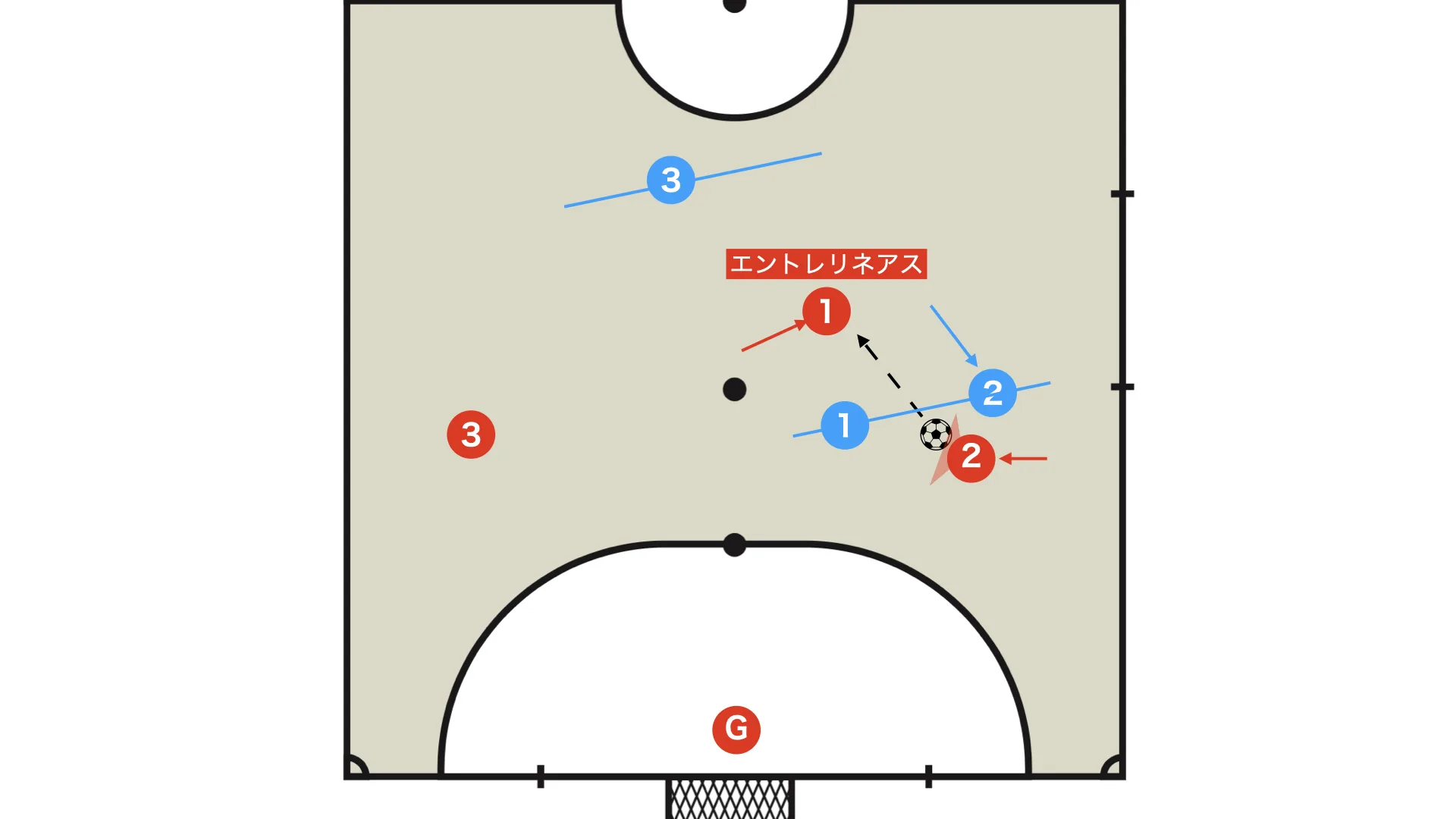
This is a higher-risk attempt, but one way to break the situation is to show for the ball through the gap between the two defenders and receive between the defensive lines.
If the pass into the space between the lines is cut out, it leads to a dangerous counterattack. But if it succeeds, it creates a chance.
The ball holder should dribble slightly inside to secure the passing lane, then thread the ball through like an ankle pass.
関連記事
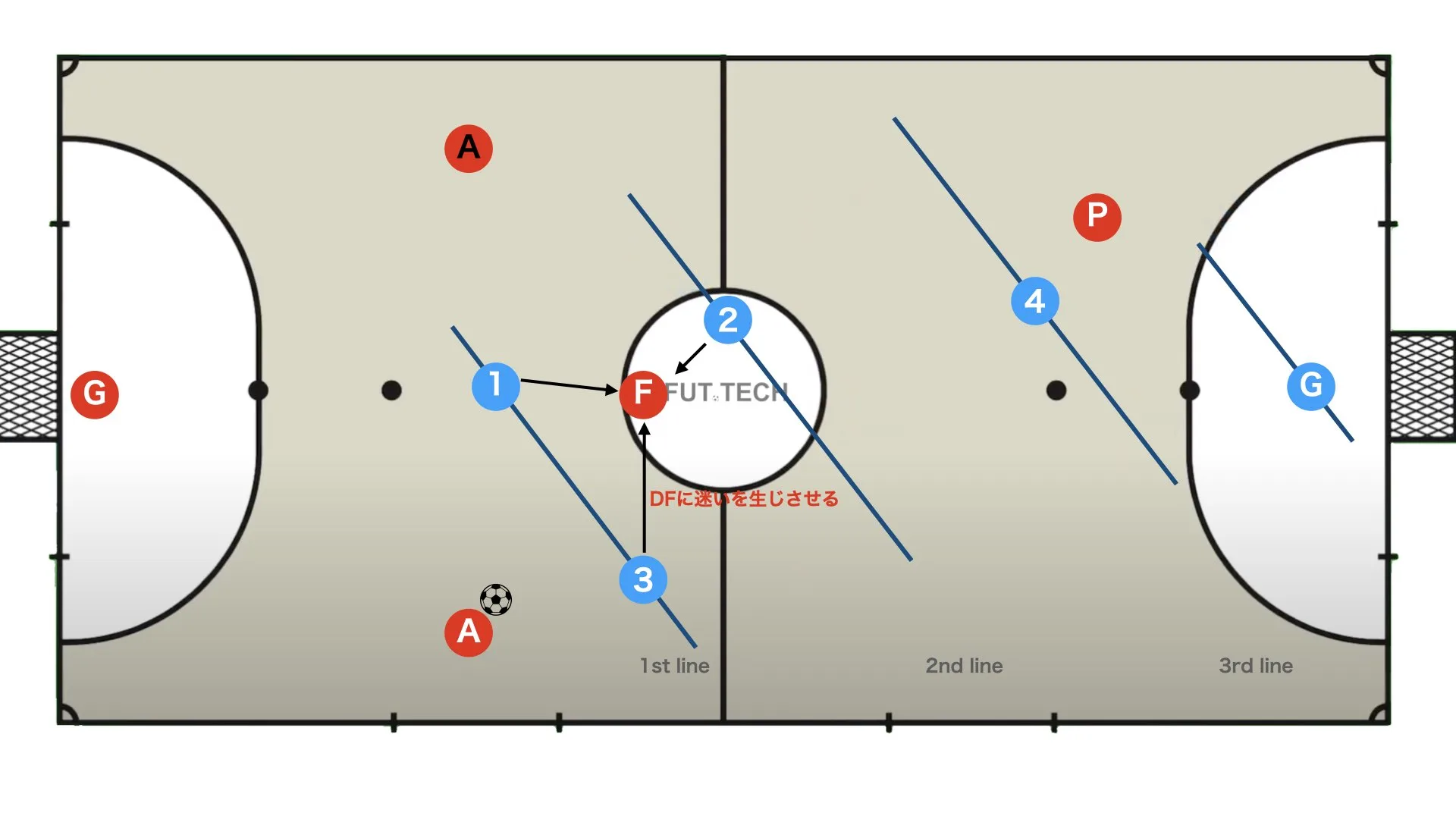
How to Use the Space Between the Lines to Break Down Zone Defence
A guide to using the space between defensive lines in futsal to attack zone defence. This article ex…
続きを読む →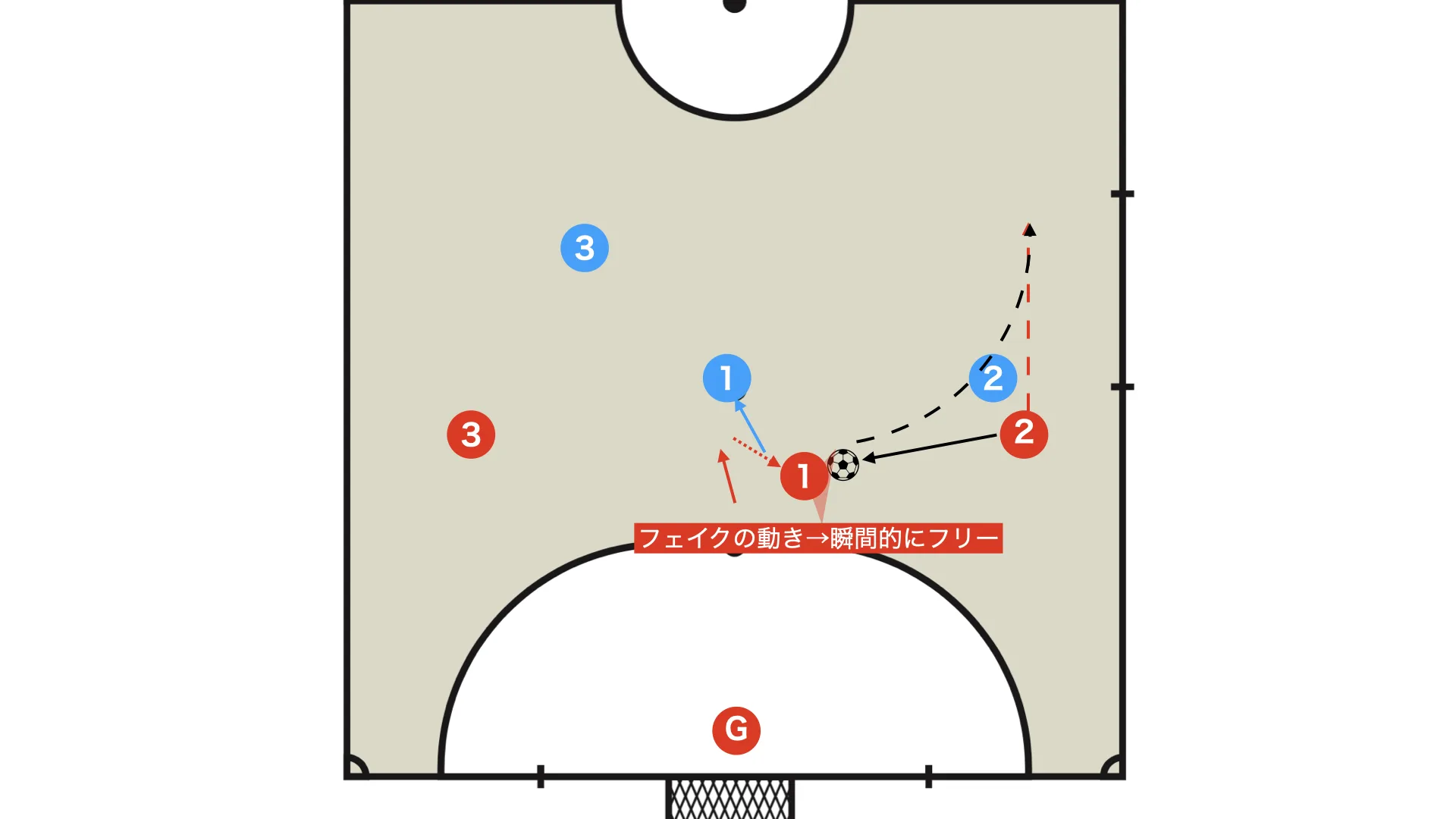
By first taking one step as if attacking the space behind and then receiving to feet again, the player can momentarily create separation.
That makes it possible to try a simple one-two to break the defence.
If the defender does not react to the feint, however, the action achieves nothing.
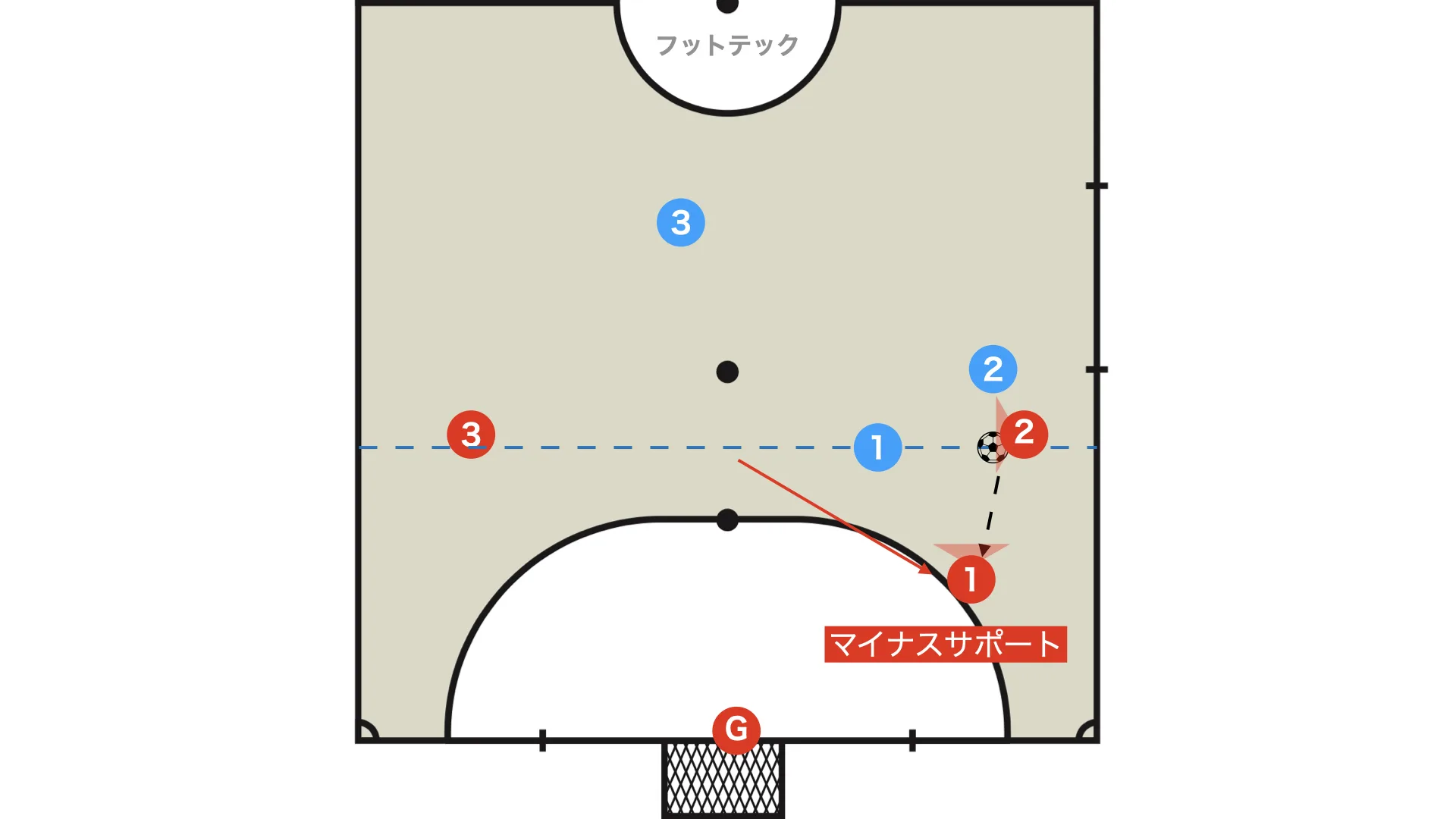
If the opponent uses a defensive tactic in which the second defender (blue no. 1) does not step beyond the ball line, negative support can be used to secure a passing lane.
What kind of tactic keeps the second defender from stepping beyond the ball line?
If the opponent is using a multiple-line defensive structure (the defensive triangle), the third defender floats in cover, so teams generally keep the second defender dropped to the ball line in order to discourage the skip pass from ala to ala.
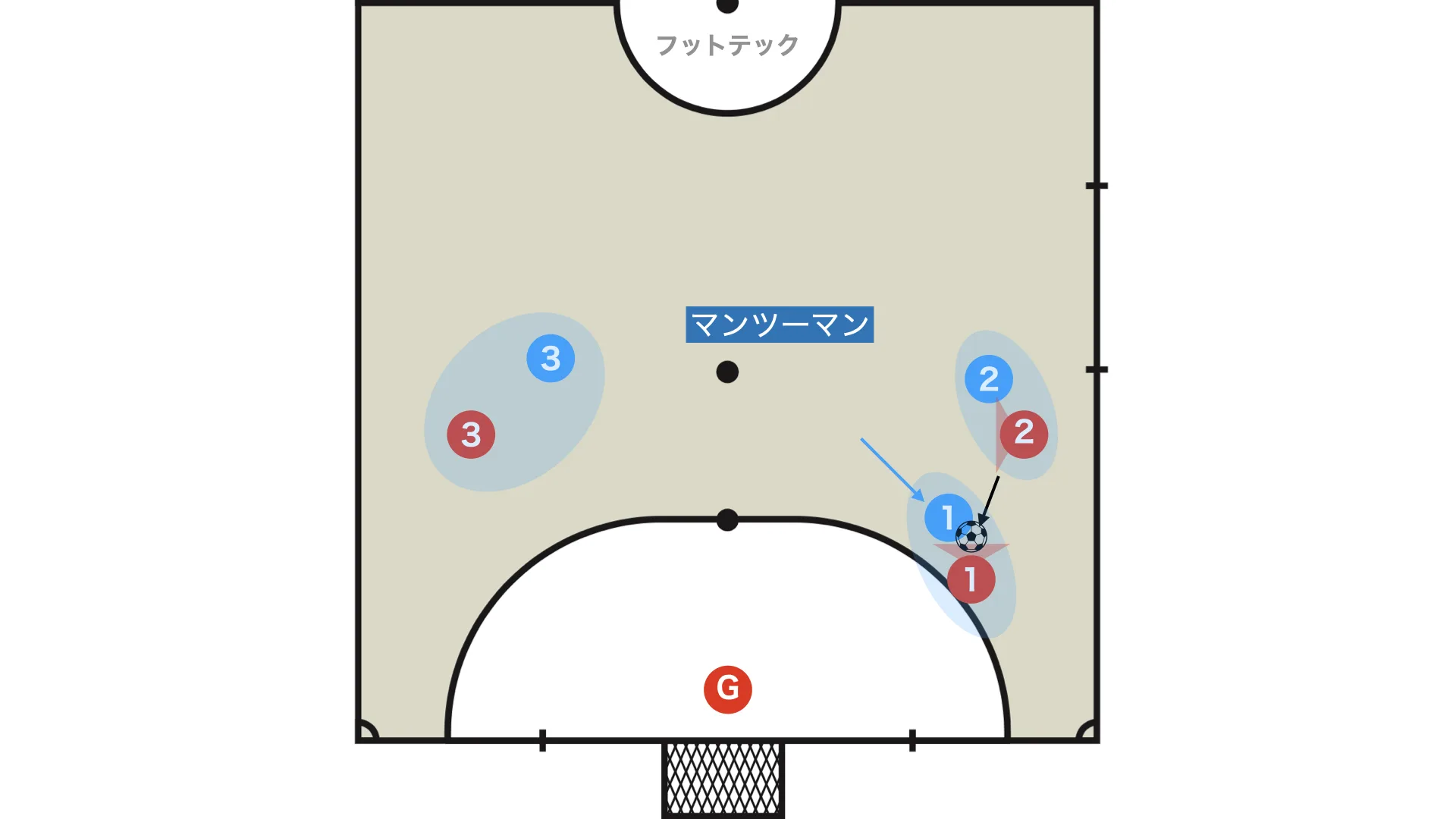
If the opponent is defending more man to man, negative support will simply be tracked and the attack gets trapped.
The important point is not to act blindly, but to make the decision based on the opponent's defensive characteristics.
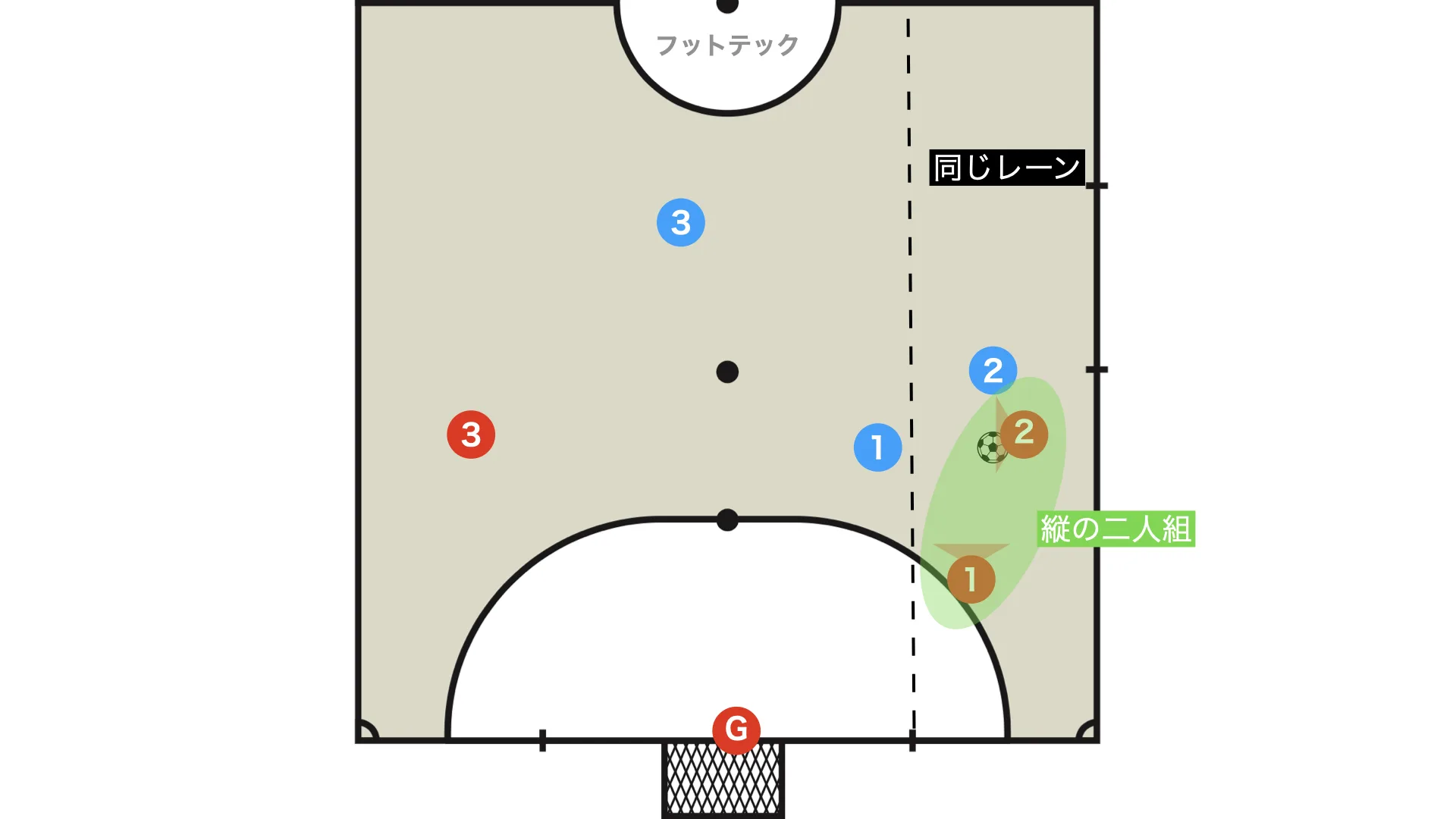
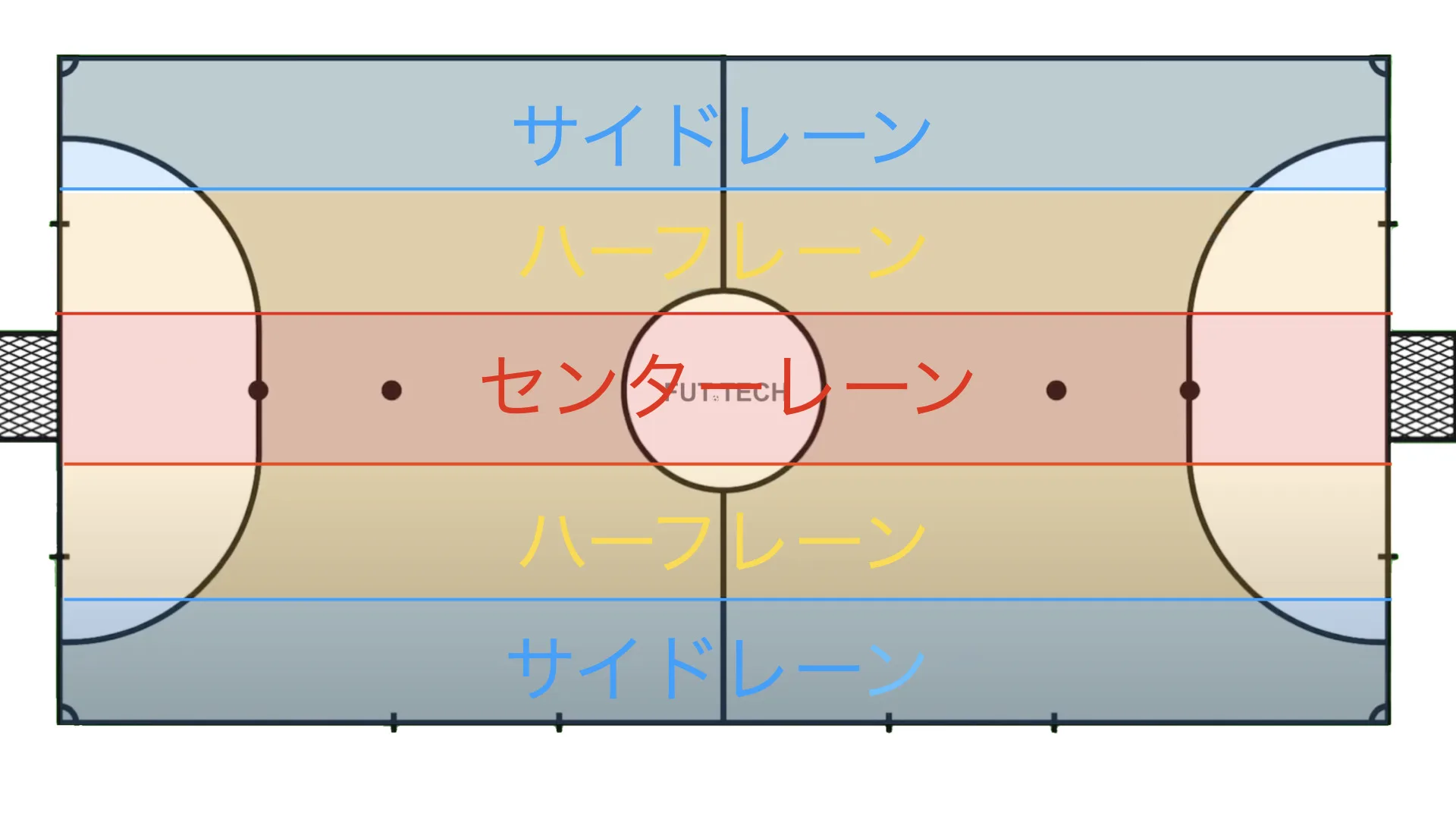
If two players enter the same lane, roughly 5 meters wide, as shown here, the idea should shift to a short vertical two-player relationship.
関連記事
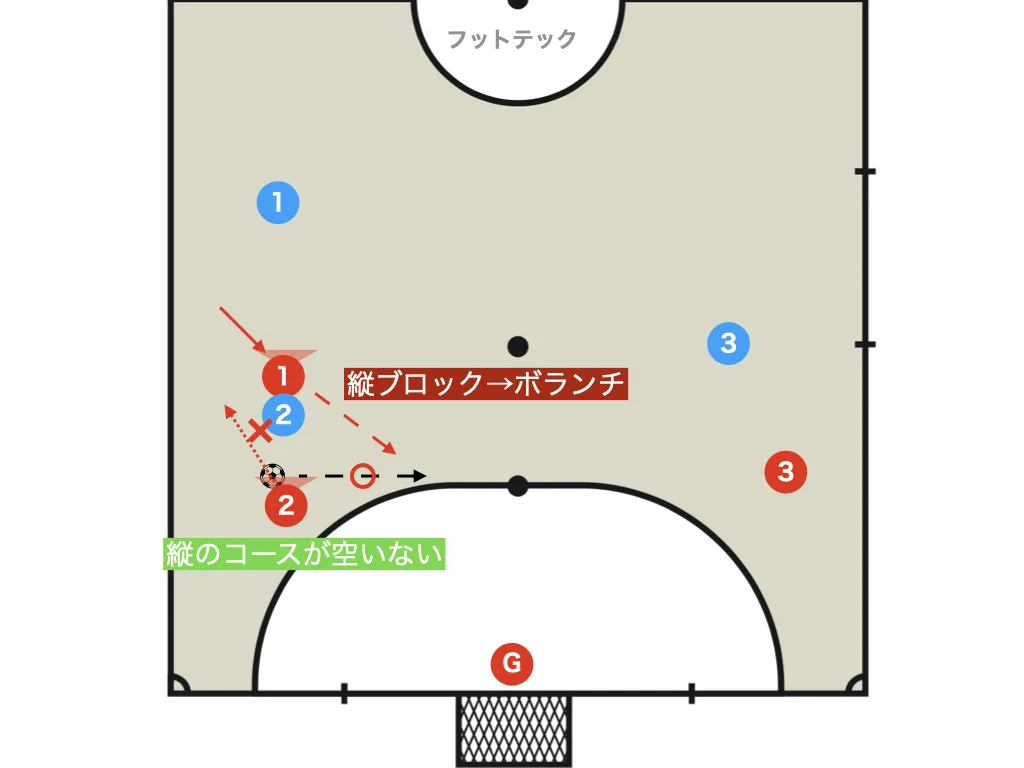
Vertical Two-Player Combination: How to Break Down the Defence with Volante, Vertical Block, and Continue
An explanation of the vertical two-player relationship in futsal when two players end up in the same…
続きを読む →Types of vertical two-player relationships
There are two patterns: the short vertical relationship (ala-fixo) and the long vertical relationship (fixo-pivo).
The long vertical relationship is an essential group tactic in systems that use a pivo.
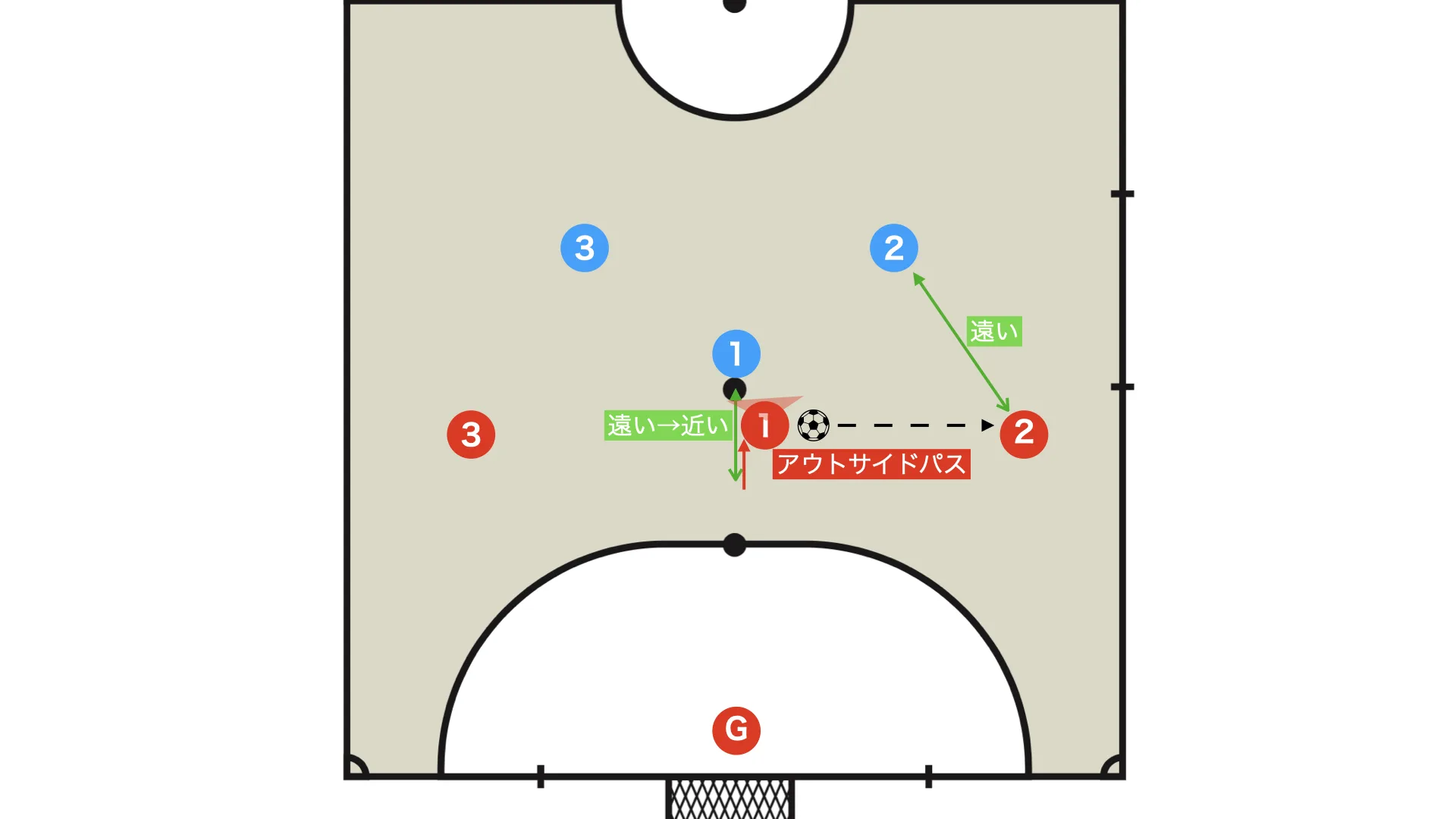
By deliberately drawing the defender in first and then running behind, the team uses the opponent's pressure against them to attack the space in behind.
When the pass is played only after drawing the defender in to the last possible moment, an outside-of-the-foot pass or a pisada is effective.
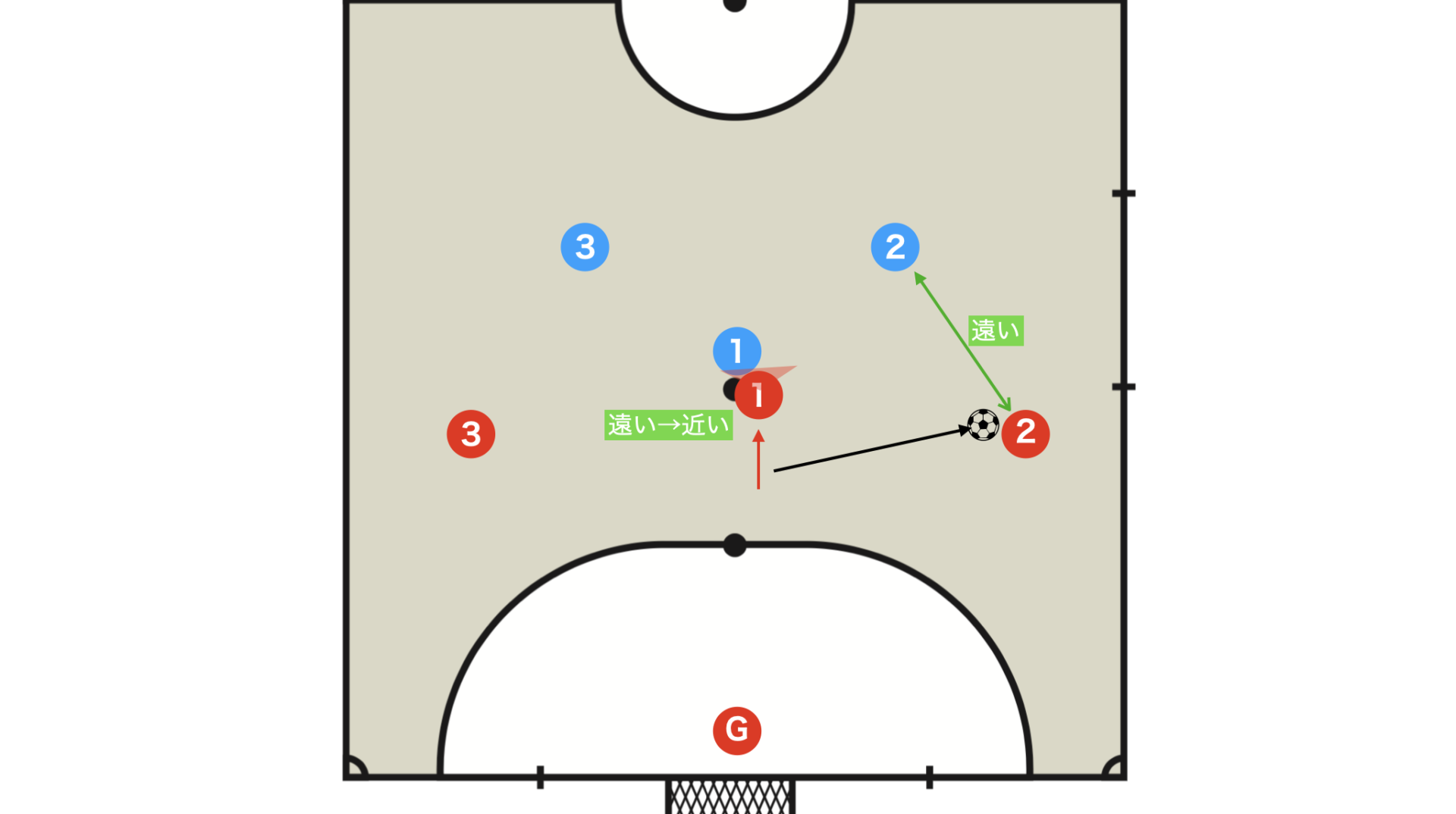
After making the pass, the player runs toward the defender, engages in the duel, and then attacks the space behind.
This is the most common pattern in futsal.
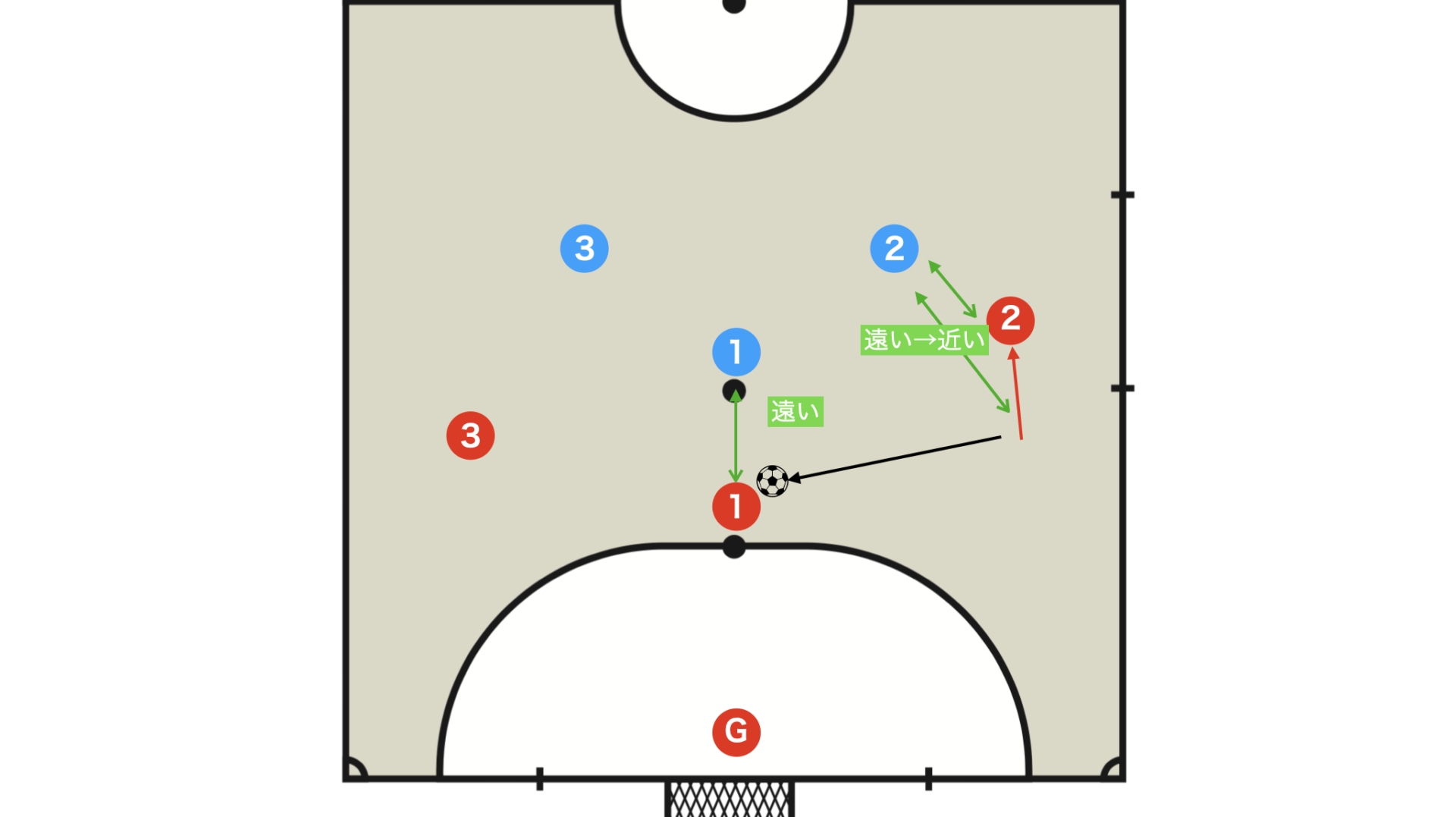
It is also possible for the ala to hold a high position and duel from there.
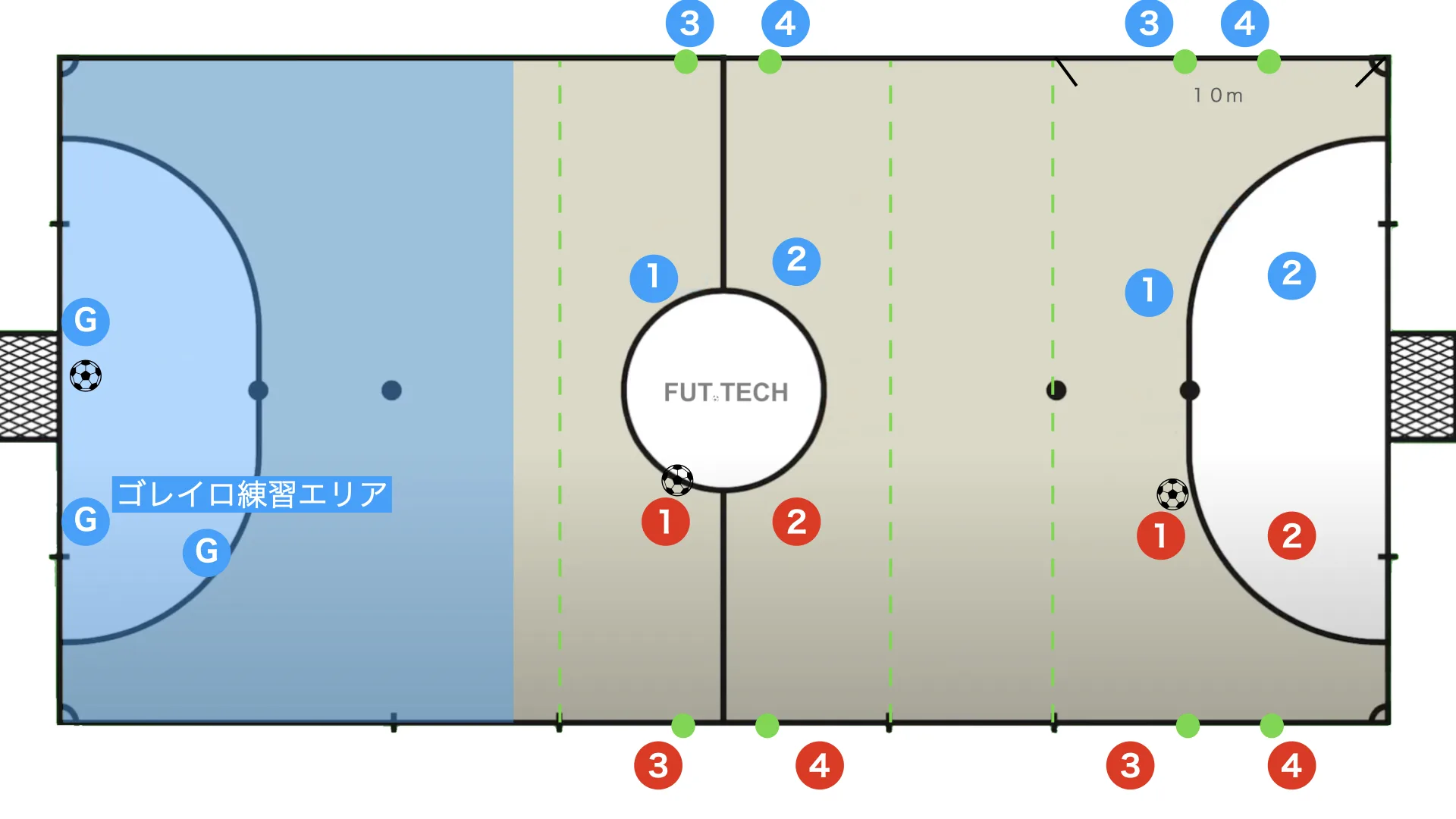
- Create several 10m x 20m vertical courts
- Use markers as goals, and if a team scores, it stays on as the winner
- If a team concedes, the next pair enters by dribbling in
- Focus on the two-player relationship
- Treat the goal as the pivo in a real match and keep looking for it
- On defence, cut the lane into the goal (the pivo)
Because this drill does not require goalkeepers, it is a standard option that works well while the goalkeepers are warming up.
In futsal, two-player combinations appear in every phase, which is why they are extremely important.
Understanding them starts with recognizing the following four situations based on the distance between teammate and defender:
- the passer is close to the defender, while the receiver is far from the defender
- the passer is far from the defender, while the receiver is close to the defender
- the passer is close to the defender, and the receiver is also close to the defender
- the passer is far from the defender, and the receiver is also far from the defender
There is no doubt that selecting the right play in each of these situations will improve your futsal.