Challenge and Cover: The Defensive Pair (1st and 2nd Defender)
Published: 2022.03.15Updated: 2026.05.04
Have you ever consciously thought about the defensive pair?
In general, when people talk about a two-player relationship, they usually mean an attacking pair, so there is a good chance you have not spent much time thinking about the defensive side.
But if attack and defence are two sides of the same coin, then the defensive pair is also full of important ideas.
In this article, I will explain the defensive pair, which forms the foundation of group defending in futsal.
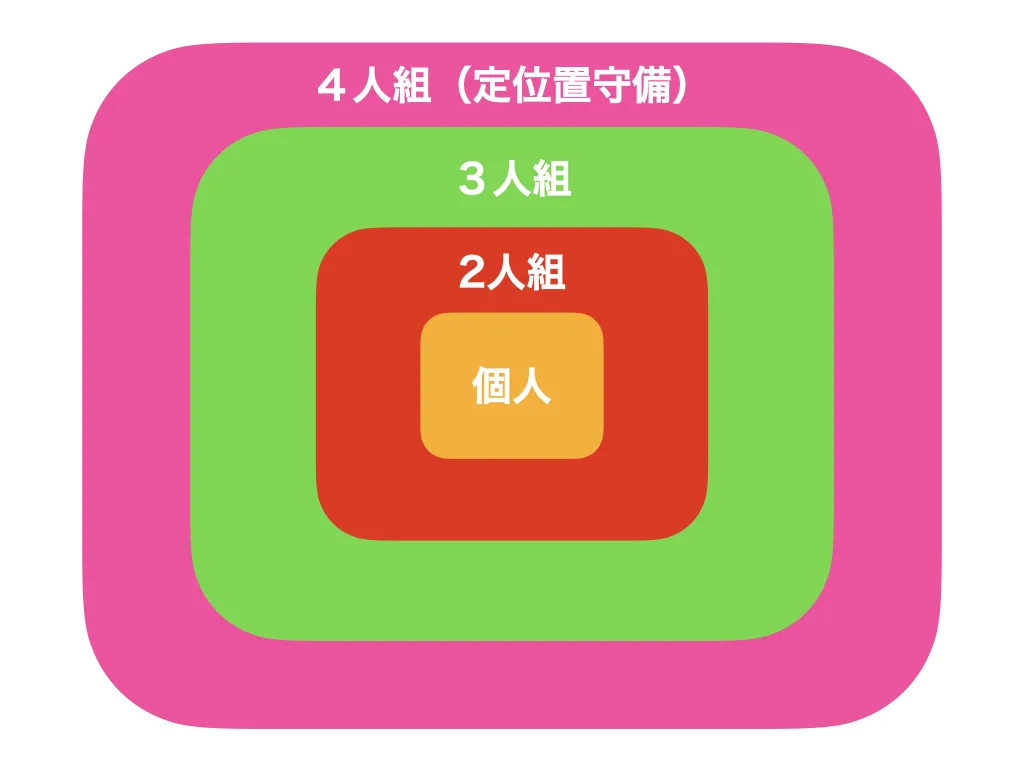
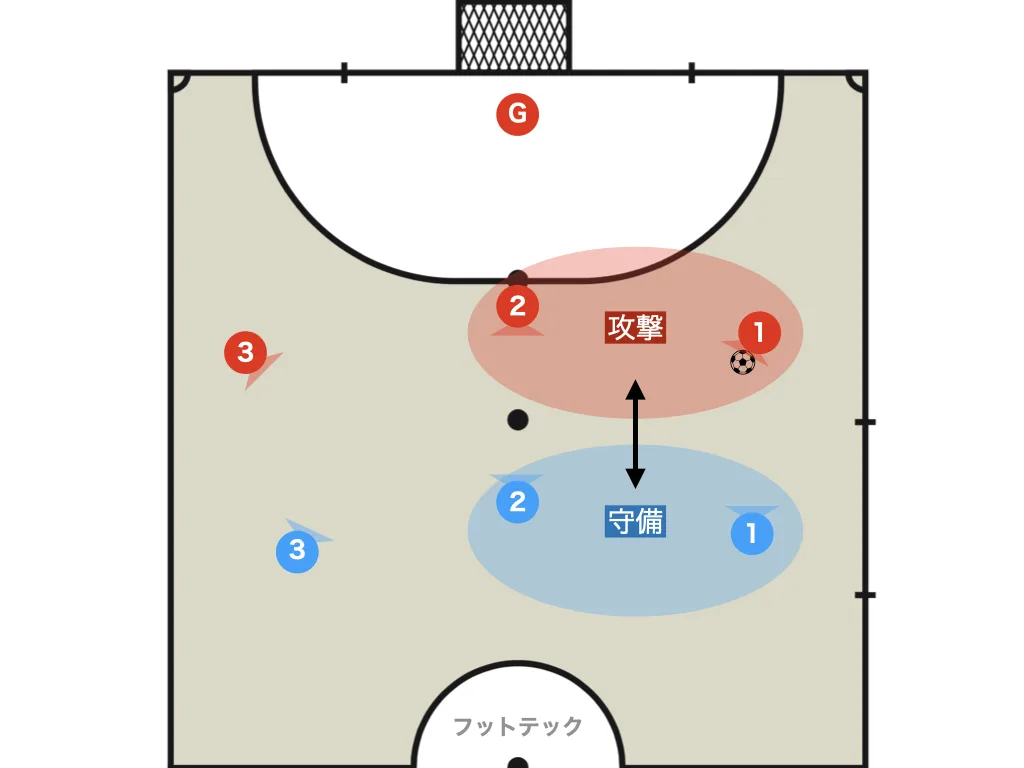
Group tactics have an inclusive relationship like the diagram above, so the key is to organize them in the order of
individual > pair > trio > four-player unit.
Even if you only work on four-player tactics as a shape, you will not defend well if each individual defender is fragile.
In football, attack and defence are inseparable, so understanding attack also leads to understanding defence.
If you understand what the attack is trying to do, it becomes much easier to see what the defence should focus on.
If you have not read the article below yet, I recommend doing that first.
関連記事
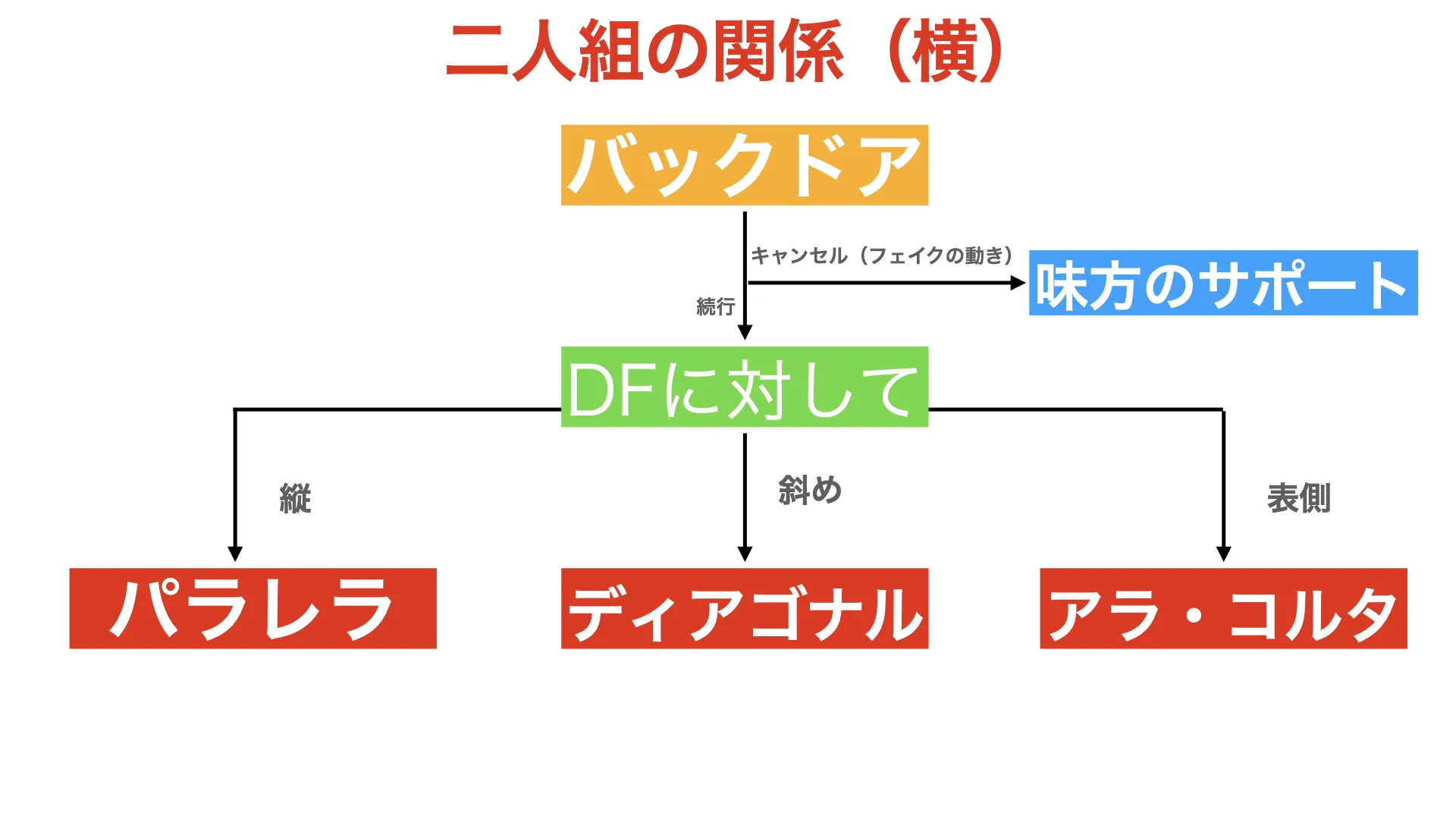
Overview: Two-Player Combinations in Futsal
An overview article explaining two-player combinations in futsal. It organizes the relationships and…
続きを読む →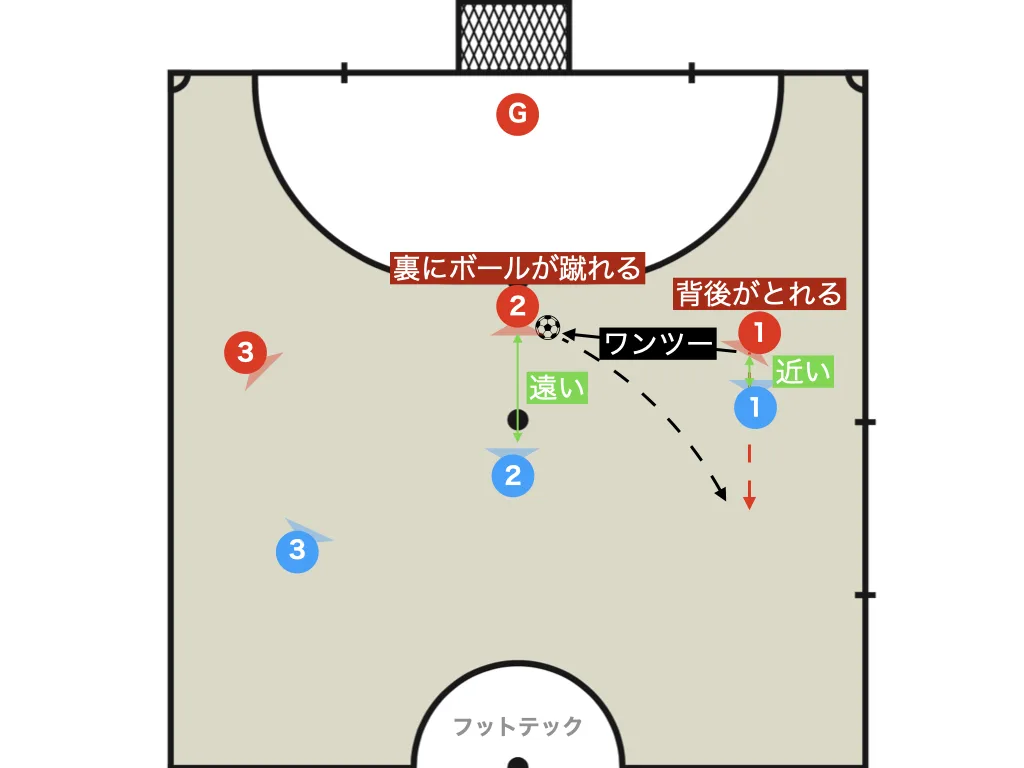
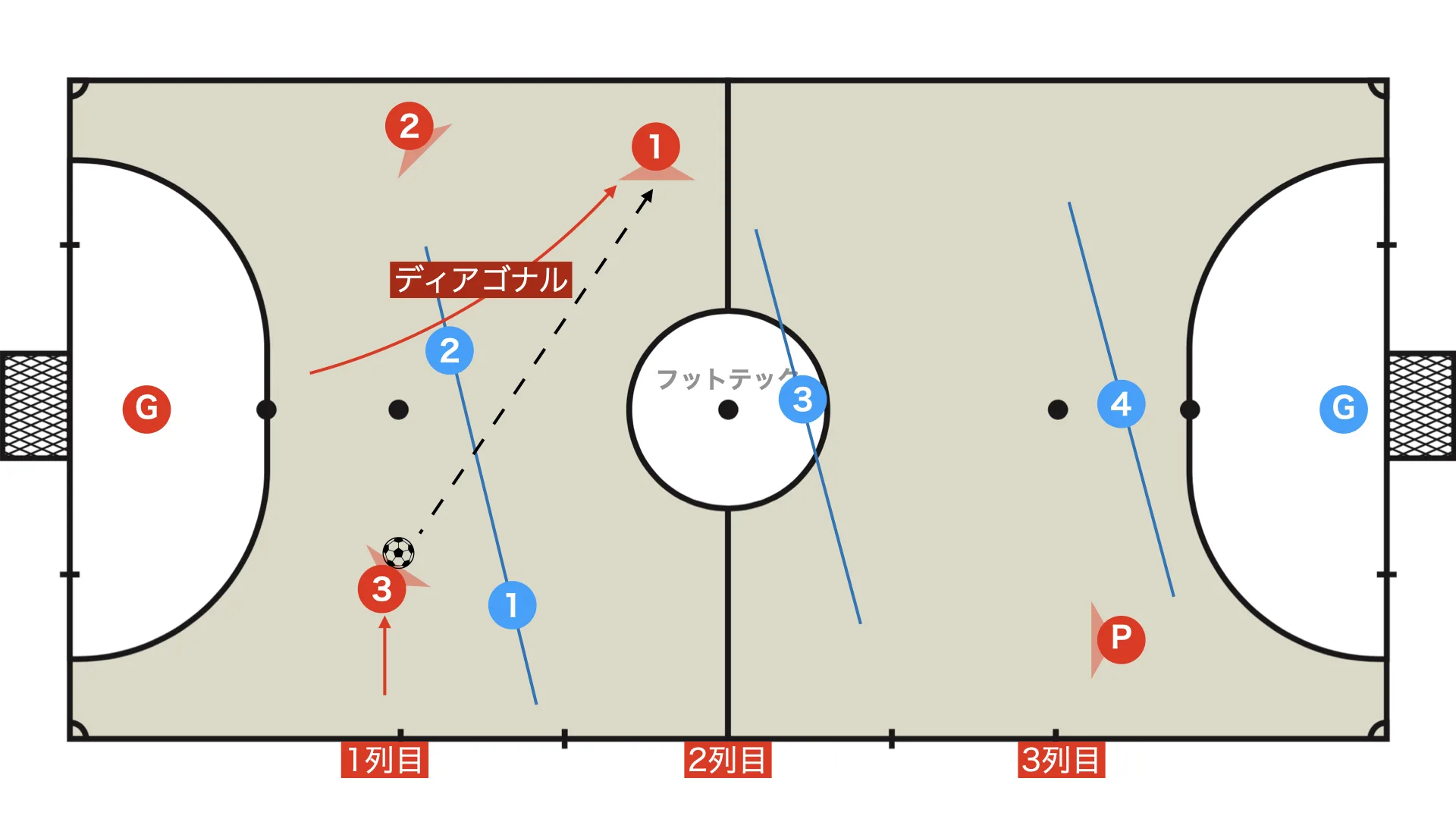
In attack, a major objective is to progress by creating a near (able to get in behind) - far (able to play the ball in behind) relationship.
Put differently, the defence must never allow this situation to be created.
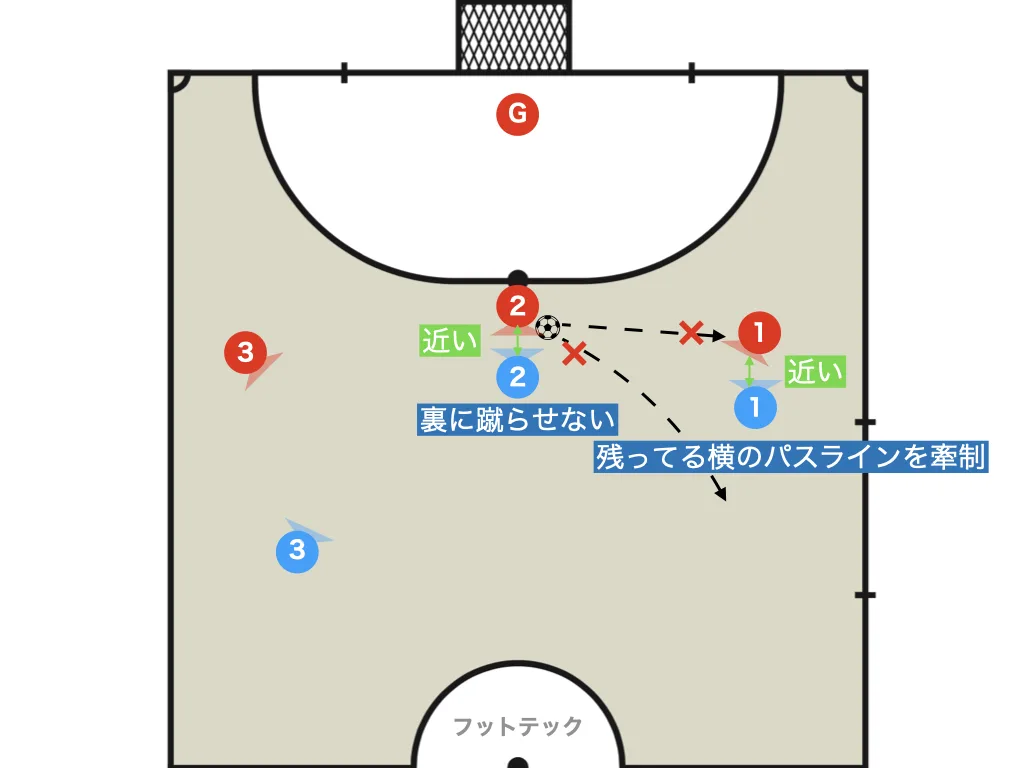
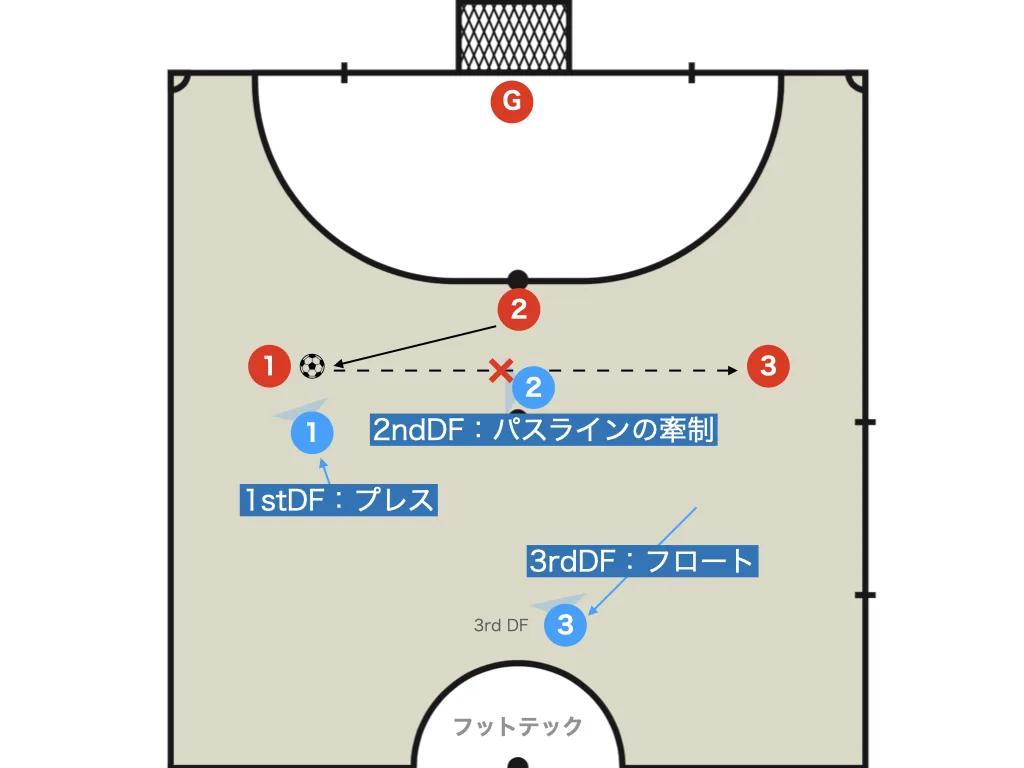
To win the ball, the defence should create a near-near relationship and focus on the following two points.
When the 1st and 2nd defenders both step forward together and press aggressively in this way, it is called challenge and challenge.
Where the defence wins the ball
- The player pressing the ball carrier (1st DF) must prevent the ball from being played in behind (force play / channel the play)
- The marker of the off-ball player (2nd DF) must screen the remaining horizontal passing lane (zonal defending)
This state of the 1st defender being "near" to the opponent generally means closing down to about one arm's length.
What does it mean to be close enough to press?
In this article, I have described pressing mainly from a physical and distance-based point of view, but there is also a mental side to it.
Even if you are not actually close enough in purely spatial terms, if you can make yourself look bigger or make the opponent feel your approach through footsteps or your voice, they will not be able to play as usual.
This phenomenon is generally described as "applying pressure."
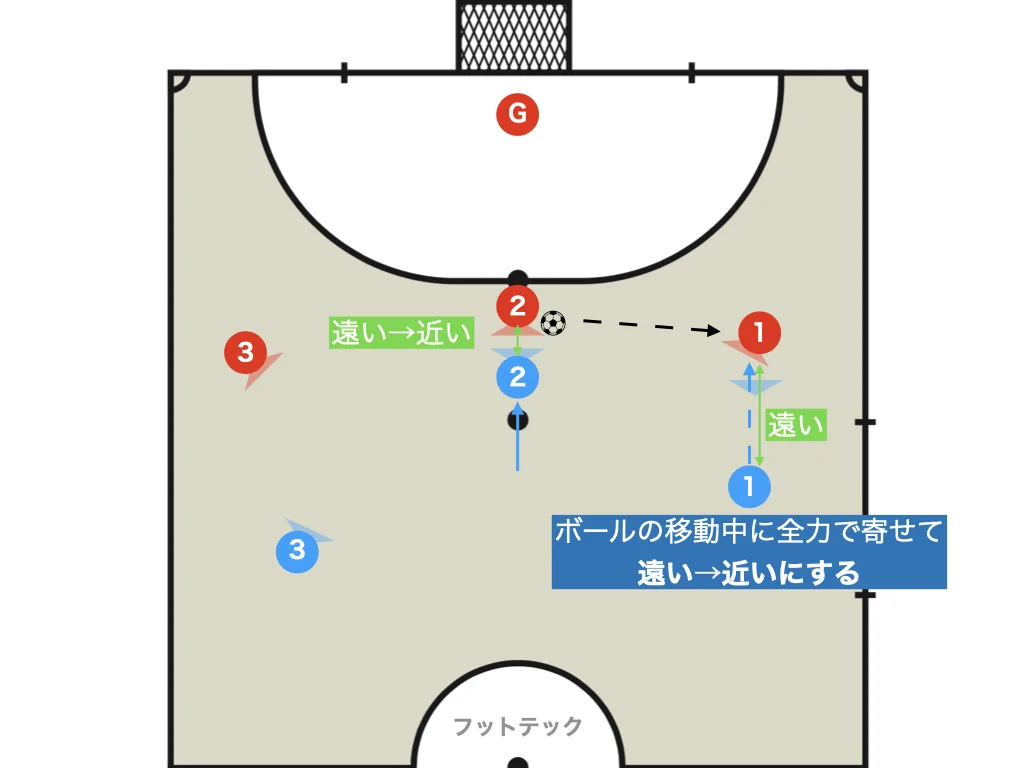
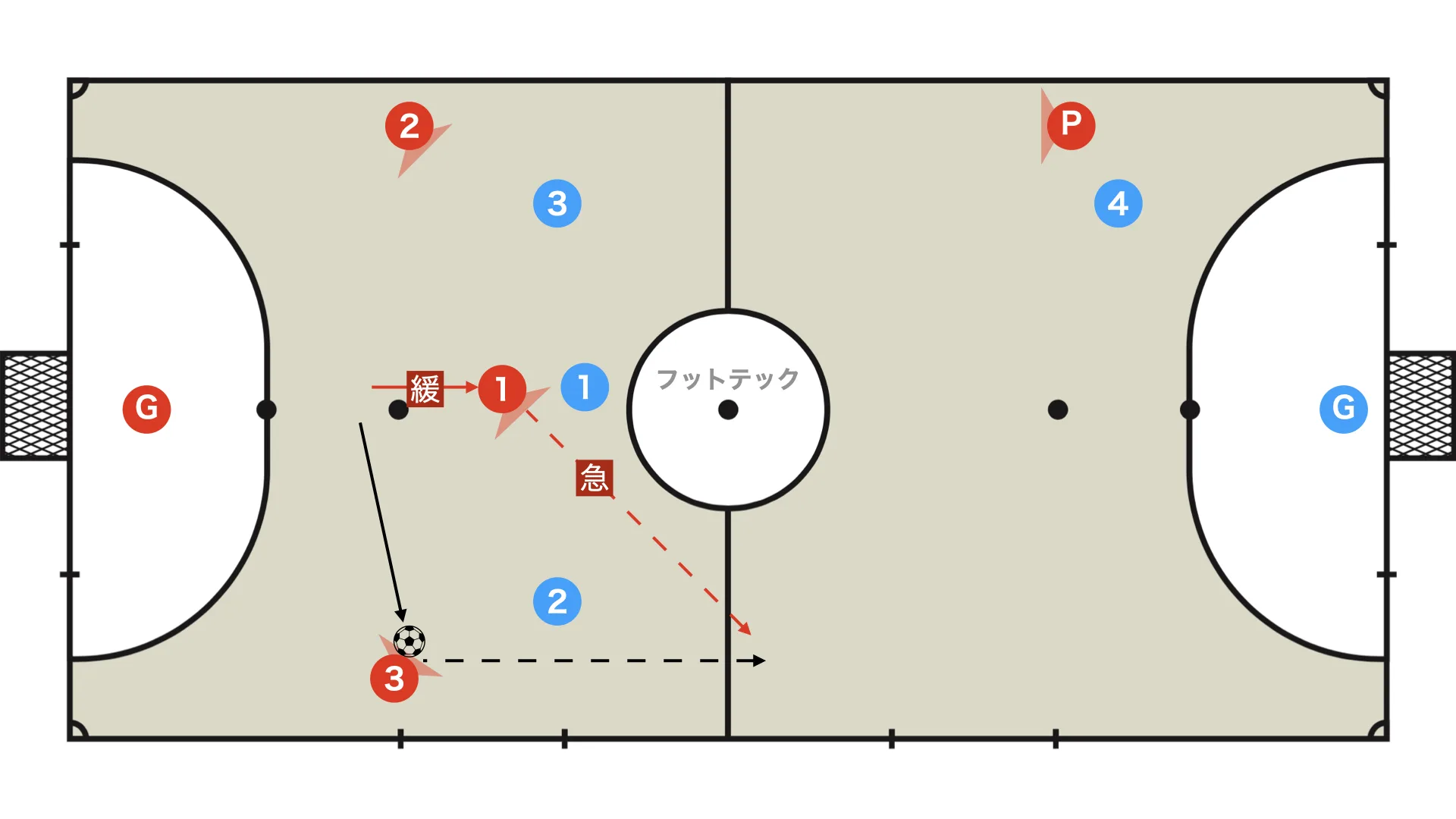
Once the 1st defender has closed down the ball carrier, it becomes important in positional defence for the next defender to coordinate and sprint in while the ball is traveling.
If this coordination does not happen, the opponent can create a near-far relationship and get in behind the line too easily.
There are many situations where the 1st defender gets close enough to press, but the 2nd defender fails to coordinate properly, allowing the opponent to create a near-far relationship and break the defensive line.
Since the aim of the attack is to create a near-far relationship and advance, it is important to stop that situation before it fully develops.
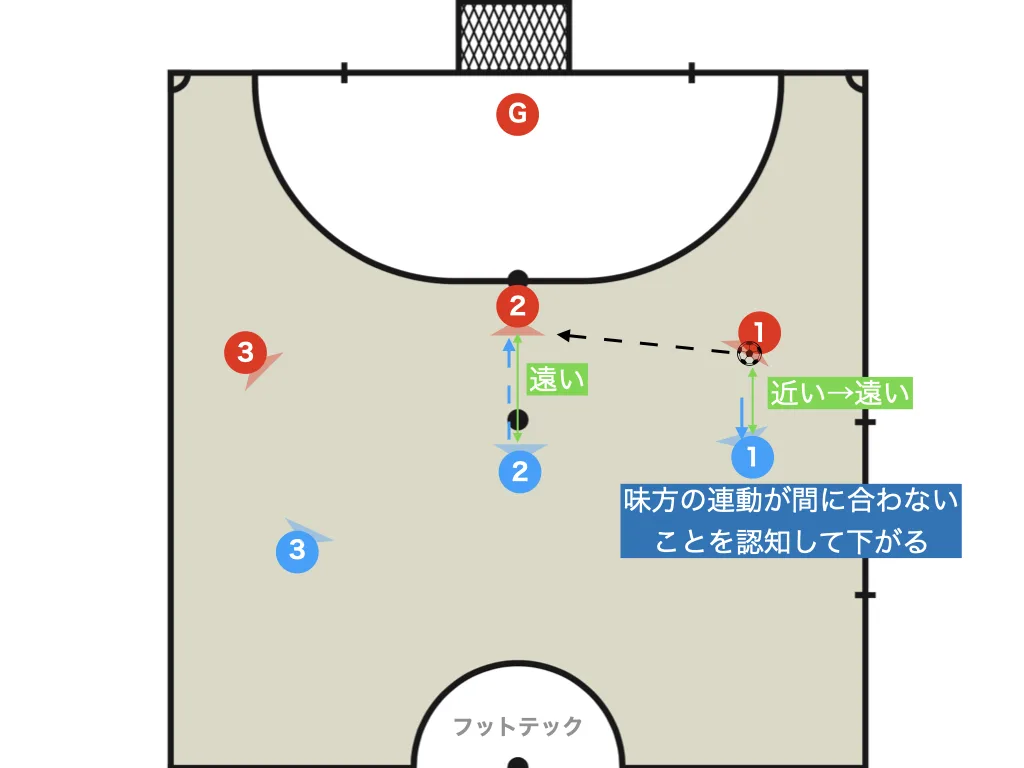
You could also describe this situation as one where only the 1st defender closes down the ball carrier.
In the first place, if teammates are not coordinating, then the 1st defender stepping in is effectively pointless.
"At what moment do we start pressing?"
"Where do we set the pressing line?"
If the team shares those answers in advance, this kind of situation becomes much less likely.
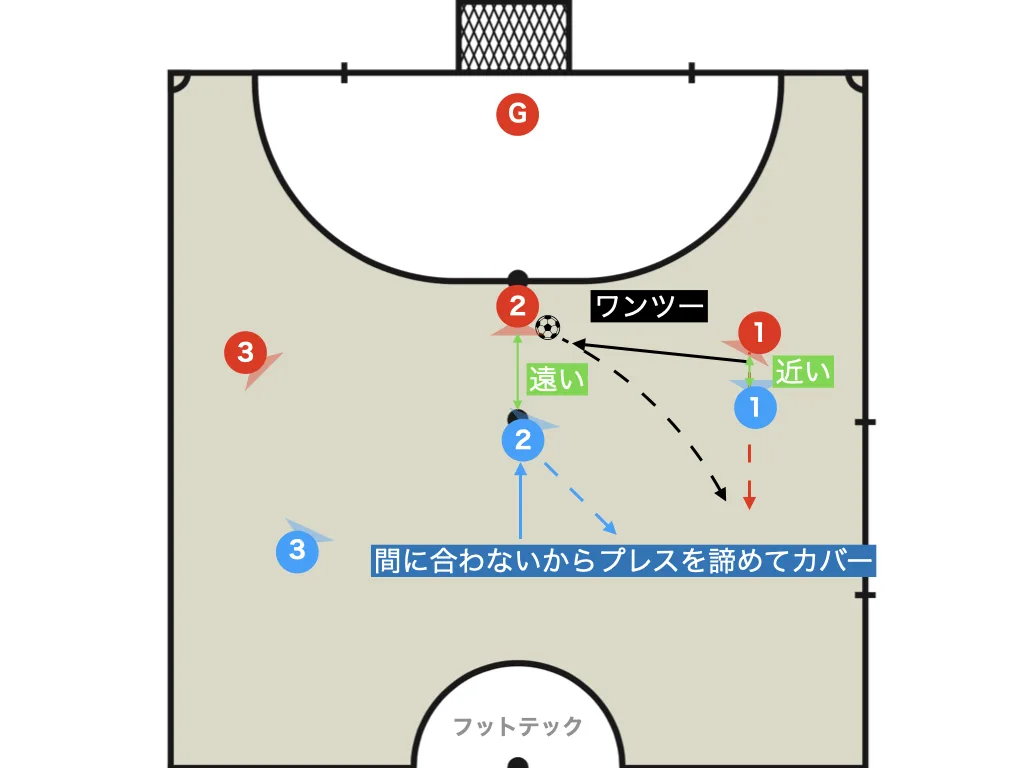
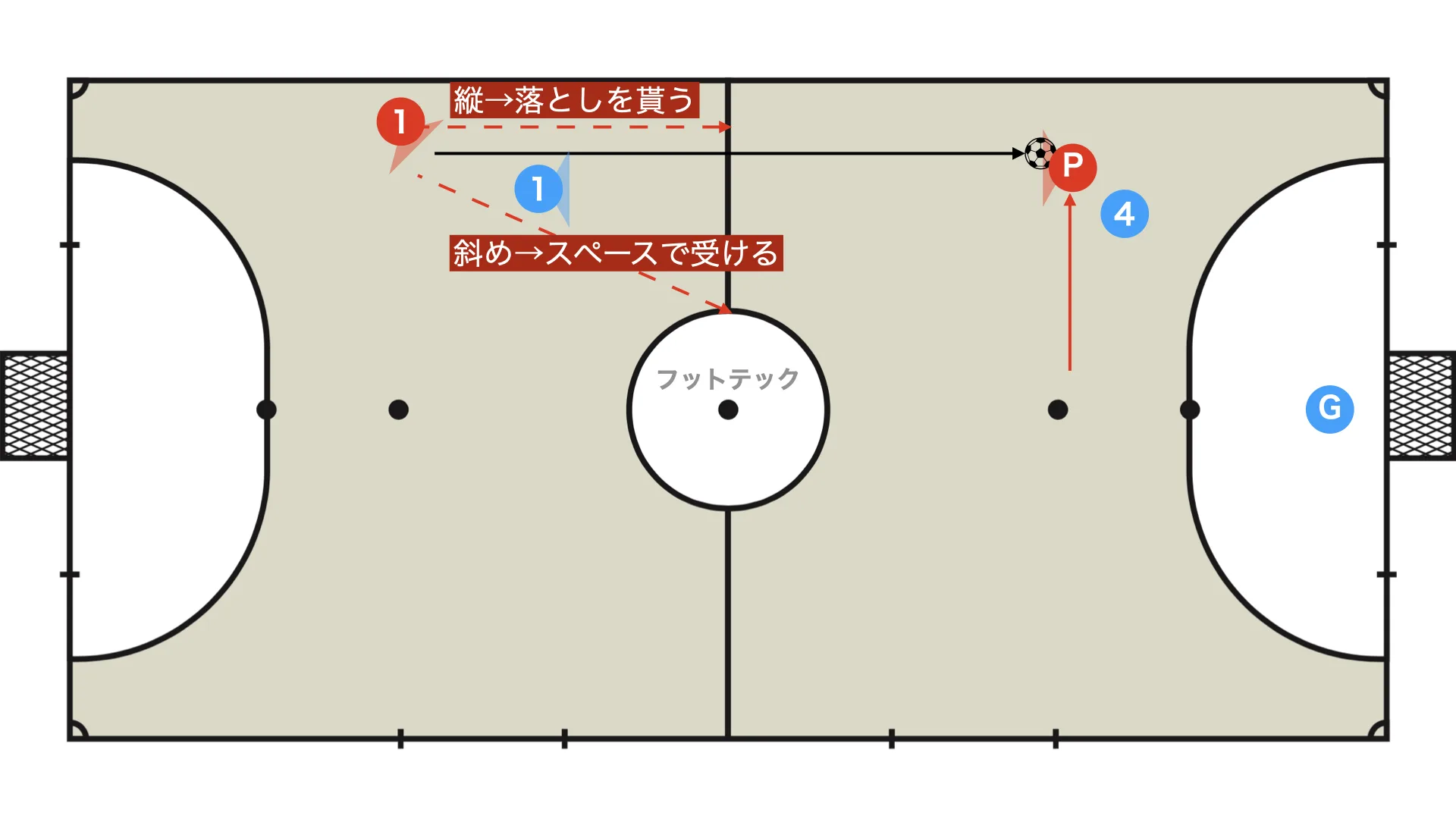
Ideally, the 2nd defender should coordinate and create a near-near situation, but if they cannot arrive in time, they should drop.
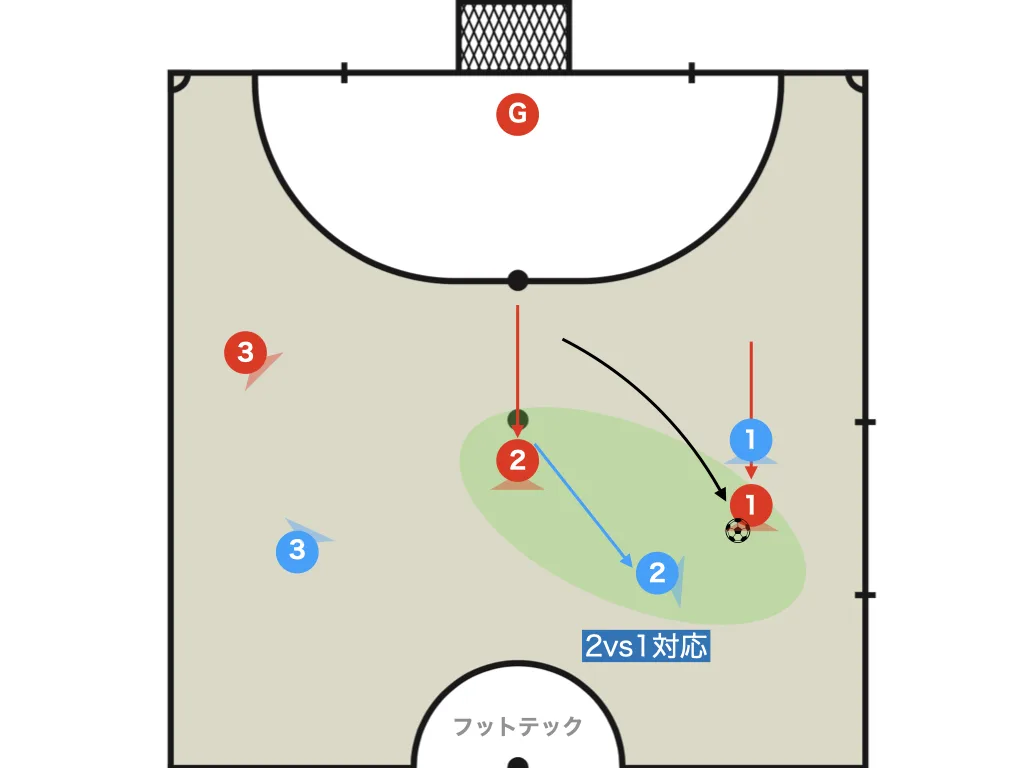
Even in a worst-case scenario that was about to become 2v2 -> 0v2 or 0v1, blue No. 2 (the 2nd defender) reads the danger and turns it into
2v2 -> 1v2 or 1v1 instead.
If they can delay the opponent effectively, blue No. 1 (the beaten 1st defender) can recover and reorganize the defence.
When one player goes to press and the other commits to covering, this is called challenge and cover.
It is a tactic often used by two center backs in football.
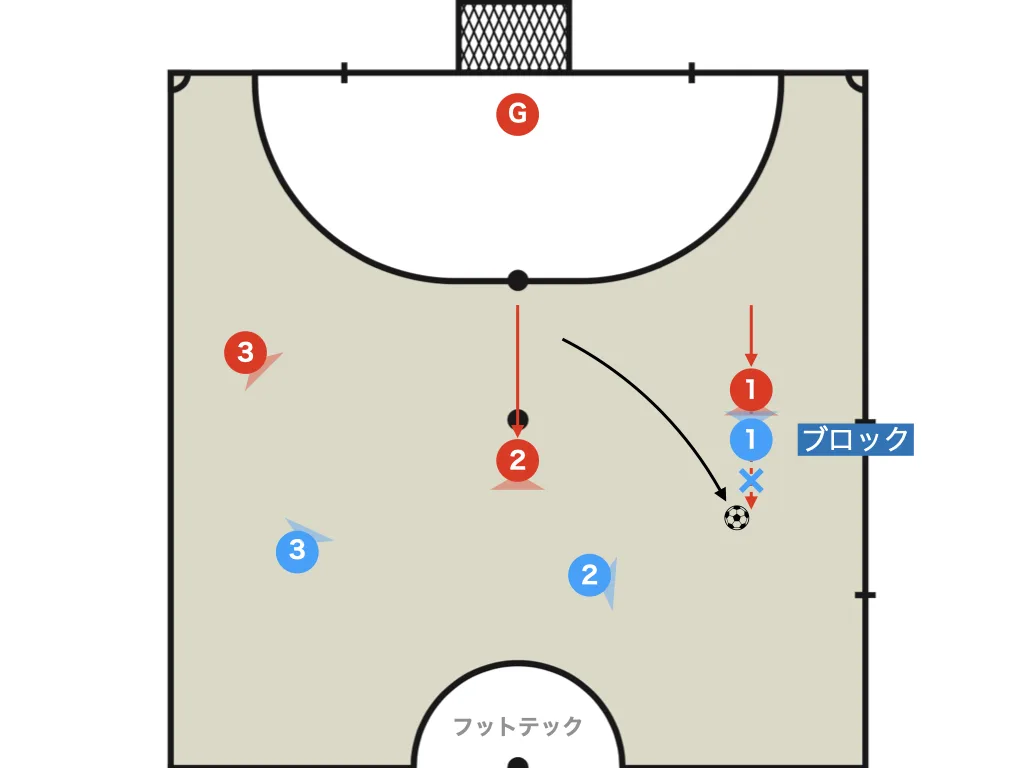
As a way to deal with a possible one-two, there is a method of blocking the opponent's path or using the hands to stop their forward progress.
Depending on the situation, it may be called as a foul, so you need to manage the risk while considering factors such as the distance from your own goal and the foul count.
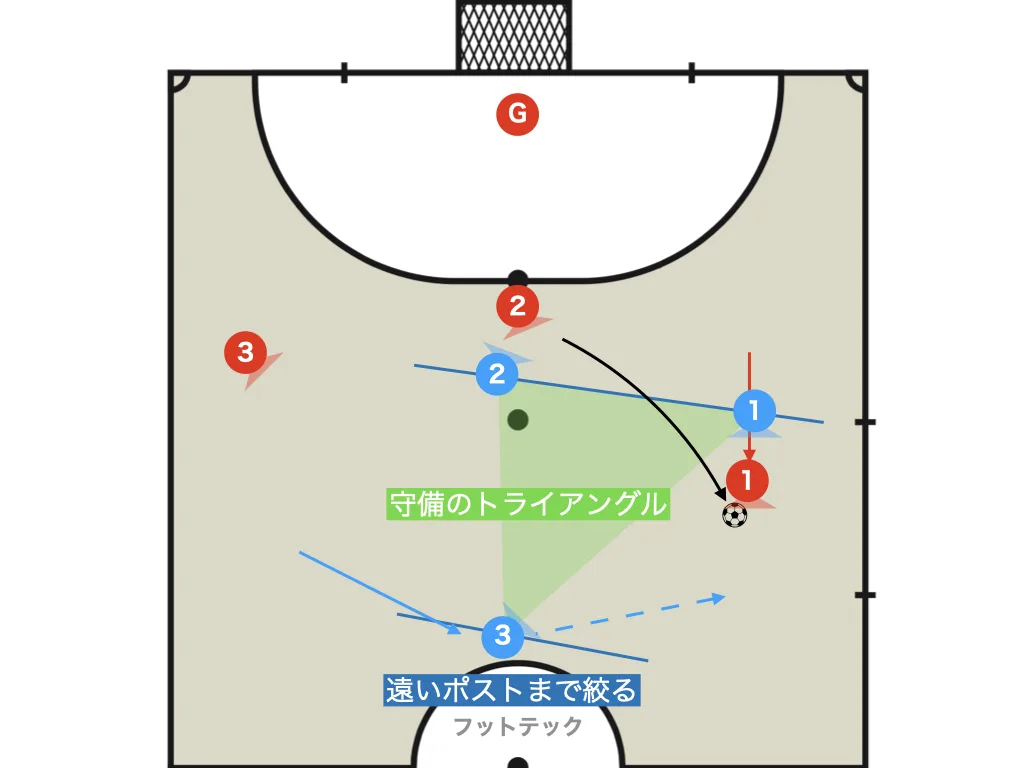
Even if two players cannot defend the situation, three can do it if the third defender (the weak-side ala) narrows in and covers with a float.
This kind of triangle defending is a well-known tactic used by many teams.
関連記事
High Pressing: The Defensive Triangle (Epsilon / Y-Shaped Zone Defence)
An explanation of the Y-shaped (epsilon) zone defence used in futsal high pressing. This article bre…
続きを読む →If you already know triangle defending, you may have thought, "A defensive pair?" But rather than relying on the third or fourth defender from the start, solid defending begins with the first and second defenders handling the situation properly.
In other words, it is always better if you can defend in the order of priority: individual > pair > trio > four-player unit.
I hope this article gives you a reason to pay a little more attention to the quality of your defensive pair.