Special Situations
Published: 2021.05.21Updated: 2026.05.04
For beginners in futsal, the term "special situations" is probably not very familiar, and you may have no idea what it actually means.
Put simply, special situations refer to red-card dismissal situations (4v3) and power plays (5v4).
A red-card dismissal situation is, exactly as the name suggests, a situation where an FP has been sent off after being shown a red card.
In futsal, when a player is shown a red card, just like in football, that player is sent off and can no longer take part in the match. (They are not allowed to remain on the bench either.)
The team with the sent-off player must play with three FPs and one GL, for a total of four players, for up to two minutes.
If they concede within those two minutes or manage to defend for the full two minutes, they are allowed to add one replacement FP.
Common misconception
Some people mistakenly think that once a team gets a red card, it has to play one player short for the rest of the match, but that is incorrect.
- A second caution (yellow card)
- An FP stops a goal with a handball when the ball would otherwise have gone in
- Deliberately moving the goal to prevent a goal
- Serious misconduct (biting, spitting, violence)
- Using offensive, insulting, or obscene language or gestures
Supplement (DOGSO and the criteria for a red card)
After the 2020/2021 rule revision, if an FP commits a foul from behind (or from the side) to stop an opponent in a 1v1 with the goalkeeper, that now results in a yellow card rather than a red card.
The reason for this change is that, in futsal, scoring in a 1v1 against the goalkeeper is not as easy as it is in football, so it is hard to classify it as denying an obvious goal-scoring opportunity.
By contrast, if a player stops an opponent with a foul when that opponent is about to shoot at an empty goal, it is a red card.
There is a fixed idea that the correct approach is to score quickly when attacking and to survive the full two minutes when defending, but depending on the scoreline and the players available, that is not always the right answer.
If your team is ahead, for example, it can be effective in attack to deliberately keep the ball moving for as much of the two minutes as possible and only score near the end, using the situation to run down the clock.
On the other hand, if your team is behind, it may sometimes be better not to desperately try to survive the full two minutes without conceding, but instead to allow a simple goal, get the extra FP back sooner, and use the remaining time to attempt a comeback.
The important thing is to assess the game situation and approach it strategically, with the whole team sharing the same understanding.
関連記事
Overview: Attacking and Defending After a Red Card in Futsal
An explanation of the key attacking and defensive ideas in futsal when a player is sent off with a r…
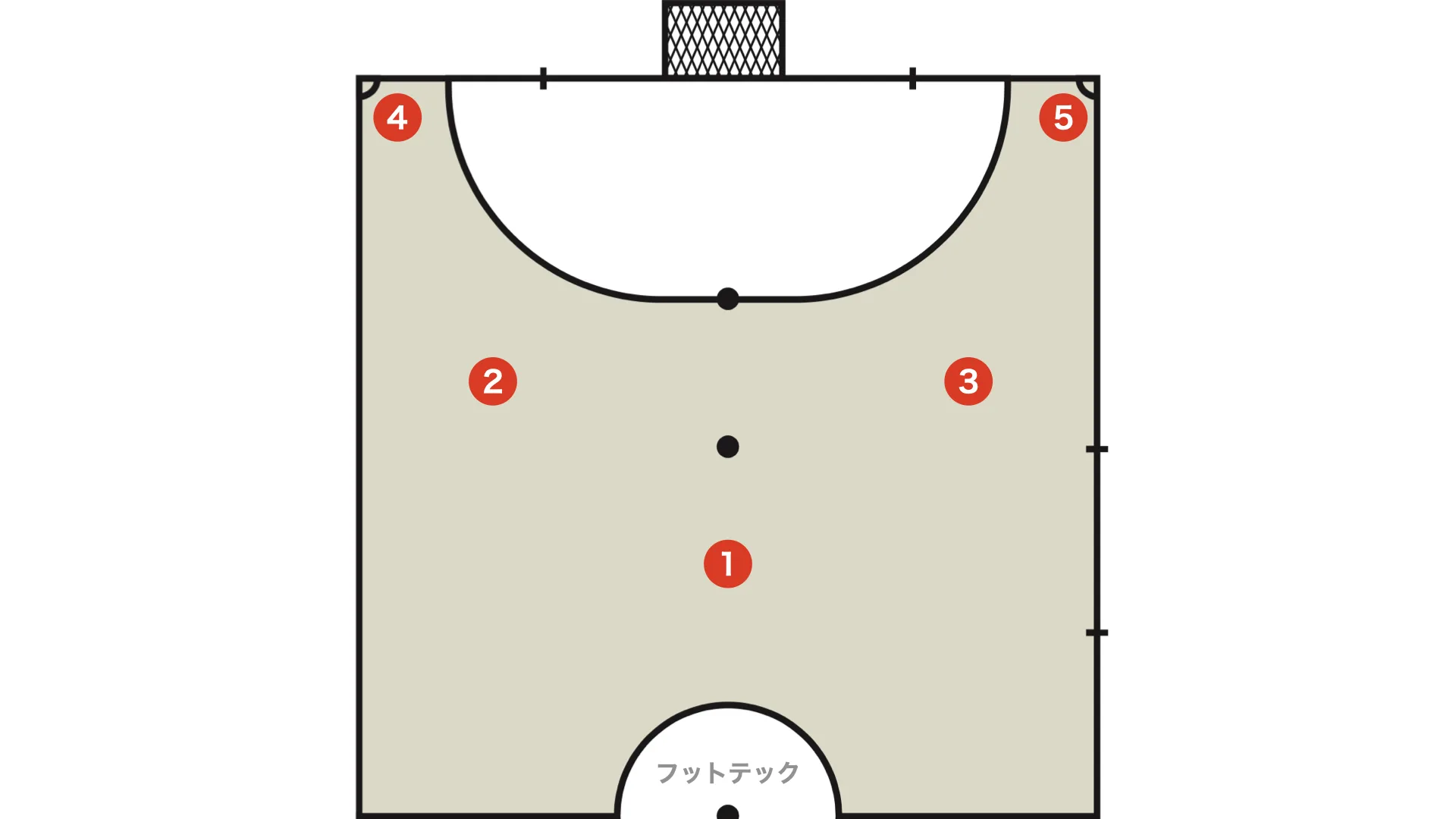
続きを読む →In football, a power play refers to a tactic where a physically dominant player such as a defender is pushed up front and the team plays long balls. In futsal, by contrast, a power play is a tactic in which the goalkeeper joins the attack and the team attacks with five players.
Because it takes the initials of Power Play, it is often abbreviated as PP.
If the goalkeeper is technically strong with the ball at their feet, they may join the attack directly, but in many cases a field player puts on the goalkeeper shirt and is substituted in only for the attacking phase.
This creates a 5v4 numerical advantage, but because the goal is left empty, losing the ball carries the risk of conceding to a shot into the unguarded net (a counter to the power play).
So in what kinds of situations should a power play actually be used?
Specifically, the following eight situations are common.
- When you are behind
- When you want to disrupt the opponent's rhythm
- When your foul count has reached 5
- When your goalkeeper is highly skilled with the ball at their feet
- When the opponent has had a player sent off
- When you do not have a goalkeeper available
- When your squad is short on players
- When you want to use up match time
This is the most common situation in which a power play is used.
In the F.League, teams that are trailing usually use a power play late in the game.
It often appears in difficult late-game moments, and power plays in those situations are extremely compelling to watch. You could even say this is where futsal shows its essence.
In principle, a power play is often used as an option to chase a goal when a team is behind, but it can also be used when a team is ahead, for purposes such as increasing possession or breaking the opponent's rhythm.
It can be especially effective against amateur teams that do not regularly practice defending against a power play.
When your foul count has reached 5 and the next foul would give away a second penalty, a team may use a power play in order to reduce the risk of committing another foul.
If your goalkeeper is good on the ball, you can move straight into a power play without making a substitution.
A kind of pseudo power play has been becoming a global trend: the goalkeeper spreads wide to help escape pressure from a kick-in in your own half, receives a switch to the opposite side, then carries the ball forward on the dribble and finishes the move.
When the opponent receives a red card and goes down to one player fewer, your team has a 4v3 numerical advantage, but if you do not score within two minutes, the other team returns to four players. Because of that, some teams start a power play to attack 5v3 when they want to finish the situation quickly, or when they still have not scored after a minute.
This is a more passive reason, but at the amateur level it is not unusual for the goalkeeper to be absent because of injury or other commitments.
In that case, a field player has no choice but to play in goal, so rather than using a standard fixed-position attack, the team can spend the whole game in power-play structure to increase possession and reduce the number of shots they face.
This is another passive reason, continuing from the previous one, but if only around five players are available on match day and there are almost no substitutes, using a power play can make sense physically.
If you keep possession, you do not need to defend, and compared with a standard fixed-position attack there is less positional movement, so you can manage the game with less running and mobility.
Defending against a power play is usually done with a set pressing line, and teams often do not press in front of that line, so it is effective for circulating the ball at the back and using up time.
Especially when there is little time left in either half, using PP to close out the game can be extremely effective.
関連記事
Power Play in Futsal: The Required Skills and 7 Formations Explained
A thorough guide to futsal power play through seven formations. This article systematically covers t…
続きを読む →Simply put, it is because these are literally special situations.
What makes them special comes down to the following two points:
- Numerical imbalance (numerical superiority or inferiority)
- Low mobility (limited movement)
Low mobility is an especially important point, and it is a key distinction between these situations and transitions, which also involve numerical imbalance.
Because of those factors, the core attacking and defensive ideas in these situations are almost the same.
For that reason, it is best to think about these two situations together: red-card dismissals and PP.
Attacking essentials
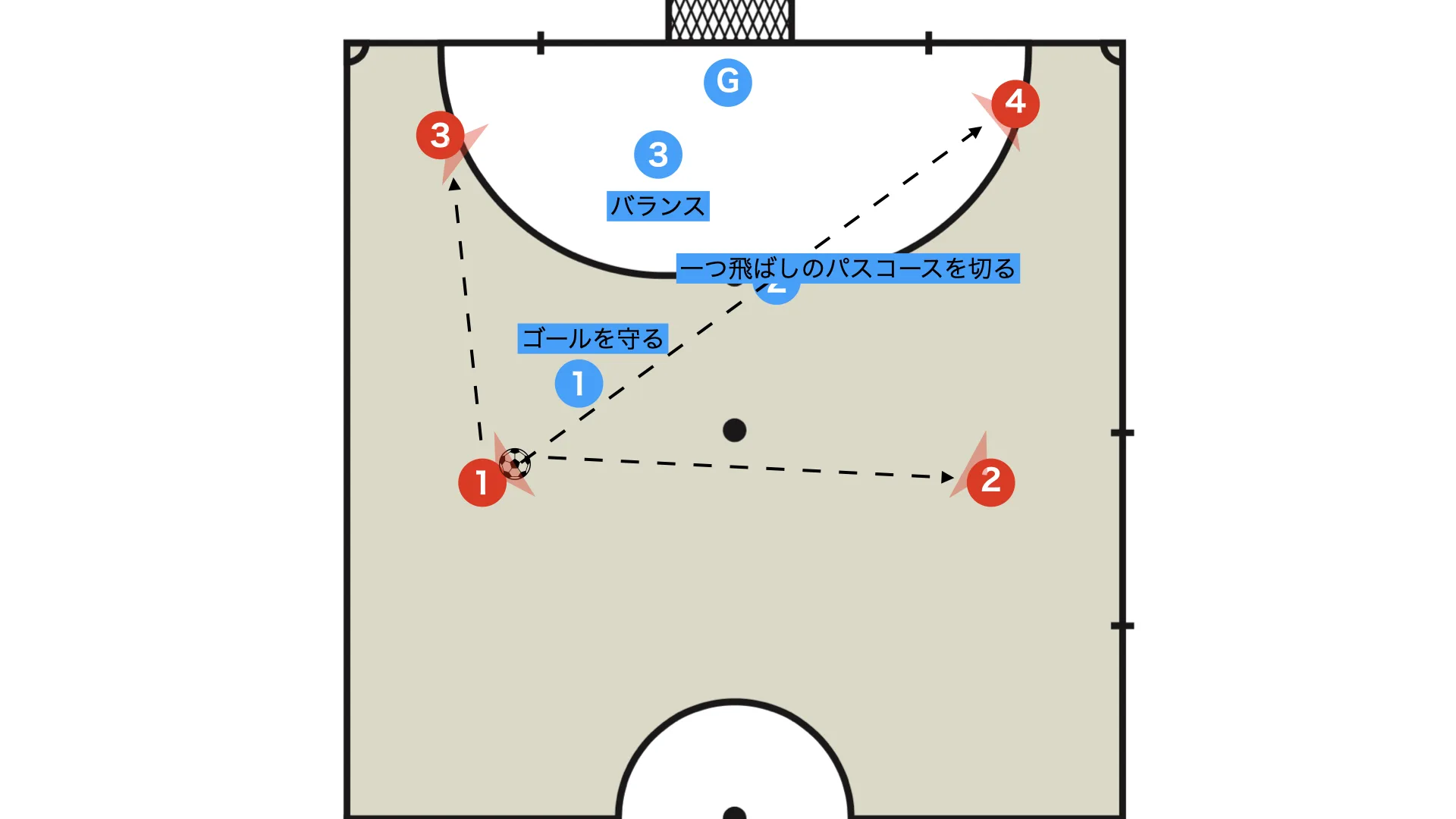
- Make the goal your first priority
- Look for skip passes
- Slow down the defence's rotation
Defending essentials
- Protect the goal first
- Cut out skip passes
- Keep the defence compact and rotating
In principle, the standard way to build your approach is to prepare different means and tactics in order to achieve those objectives.
In recent years, more teams have started using the power play for situations other than simply trailing near the end of the game, and the way people think about the power play has been changing.
Because it leaves the goal open and comes with risk, teams often hesitate to introduce it, but rather than removing it from your options without thinking, I recommend starting by practicing it little by little.
Summary
- Special situations refer to red-card dismissal situations and power plays
- In dismissal situations, a player can be restored if a goal is scored within two minutes or if the team survives the full two minutes
- There are situations where a power play should be used even when you are not behind
- Special situations are moments with numerical superiority and low mobility, so the attacking and defensive essentials are the same