What Is a Play Model?
Published: 2021.06.01Updated: 2026.05.03
In recent football, coaching through a play model has become the mainstream approach.
A play model is, literally, a model of play. It is a way of putting playing principles into words for each phase of the game and each area of the court.
Because football is a chaotic and difficult sport, giving it a defined structure makes it easier for a team to play decisively and with a shared understanding.
In Spain, players are developed from a young age within the country's play model, in an environment where restrictions are used to cultivate creativity.
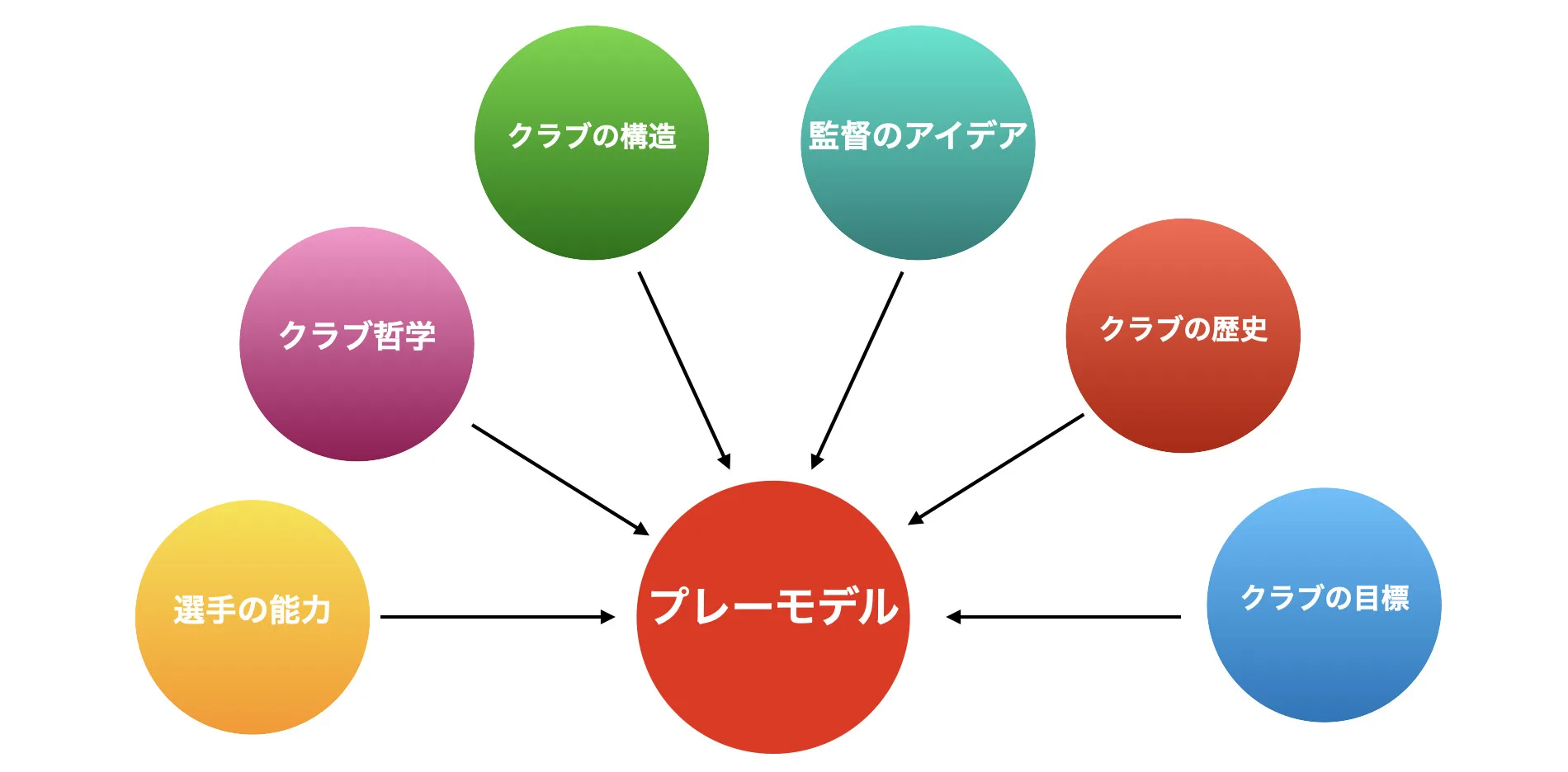
For top-category play models such as those used by European clubs, the mainstream approach is to build them by considering factors such as the club's (or country's) history, objectives, the coach's ideas, and the players' abilities, as shown in the diagram above.
Supplement
In the Futsal A License course, Japan's top-level coaching license, candidates create an original play model and then design training sessions and coach in line with it.
Up to this point, the concept of a play model may sound very difficult, but in fact, most competitive teams already have a play model in the broad sense.
Since a play model is, by definition, a pattern of play, things like 3-1 or 4-0 systems, set-play routines, and defensive guidelines such as high press or half-court block, zone or man-to-man, are all part of a play model.
In other words, even if a team has not fully put it into words, many competitive futsal teams are unknowingly already playing within set patterns. In common terms, what people call tactics are part of the play model.
This is inevitable in futsal because the court is small and the number of players is low, which means structured patterns tend to be more reproducible.
What is the difference between a play model and a game model?
Sometimes you also see the term game model in books or online. Strictly speaking, the two are a little different, but their aim is the same.
As the words suggest, a game model takes the game itself as the main point of reference, whereas a play model takes individual actions as the main point of reference. Even so, both aim to give play a clear structure.
There has long been debate over the difference between these two terms, and it is a deep and difficult topic. If that distinction is hard to grasp, there is no real problem in thinking of them as essentially the same for now.
As mentioned earlier, a play model is determined by the many factors surrounding a club or team, so each team has its own original version.
For that reason, there is generally no absolute correct answer for play in a given situation. The mainstream approach is to think in line with the team's play model.
Also, a play model is not finished once you create it. It should continue evolving constantly.
To begin with, it is not easy to create a perfect play model all at once, so it should be updated through trial and error in coaching and practice.
Of course, fundamental factors such as rule changes matter, but changes in the era and environment such as tactical trends and the available player resources also cannot be ignored.
That said, because a play model is built within the rules of futsal and works backward from the objective of winning matches, the patterns themselves can ultimately be organized to some extent.
On this blog, I explain tactical ideas and models that are widely used in an objective and systematic way.
What did you think?
Going forward, I plan to expand this article with an explanation of how to build a play model, so I would appreciate it if you visit again in a few months.