Transitions: Overview
Published: 2021.06.07Updated: 2026.05.03
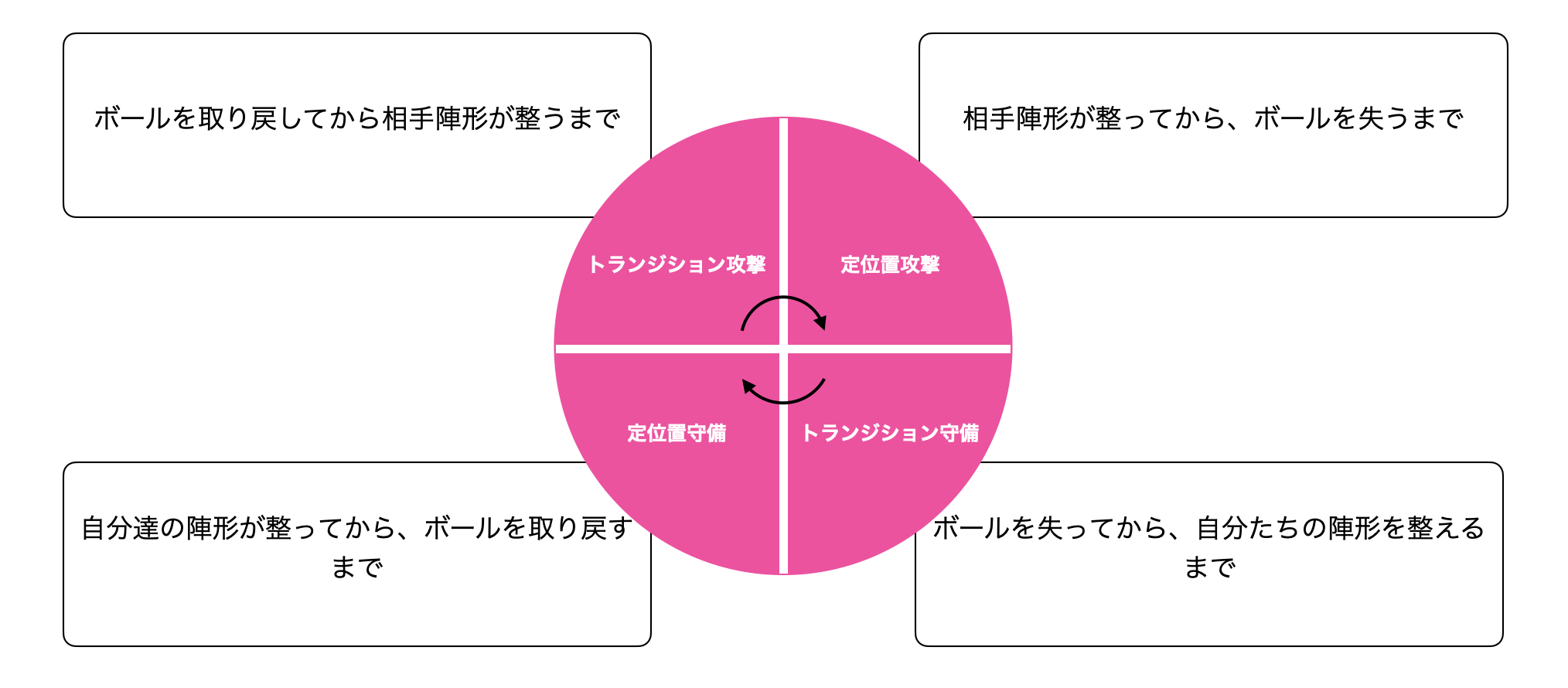
A transition is the phase that corresponds to the switch between attack and defence, sitting between positional attack and positional defence.
Ways to refer to transitions
- Transition attack = positive transition = counterattack
- Transition defence = negative transition = defending a counterattack
In futsal, it is often said that more goals come from transitions than from any other phase, and transitions are so important that people even say whoever controls transitions controls futsal.
Why are so many goals scored from transitions?
The three main reasons goals are easier to score from transitions are:
- the game is in a chaotic state and the structure is not organized
- numerical imbalances (overloads and underloads) are likely to appear
- each player is given more space
Among these, the biggest factor is often said to be the ability to exploit a numerical advantage.
The key element needed to control the transition opening is said to be the speed of the switch.
Supplement
Transitions are not always the phase that produces the most goals in futsal. In some cases, more goals may come from set plays or from positional attack and defence.
However, when data from many matches is aggregated, research shows a general tendency for transitions to produce goals more easily.
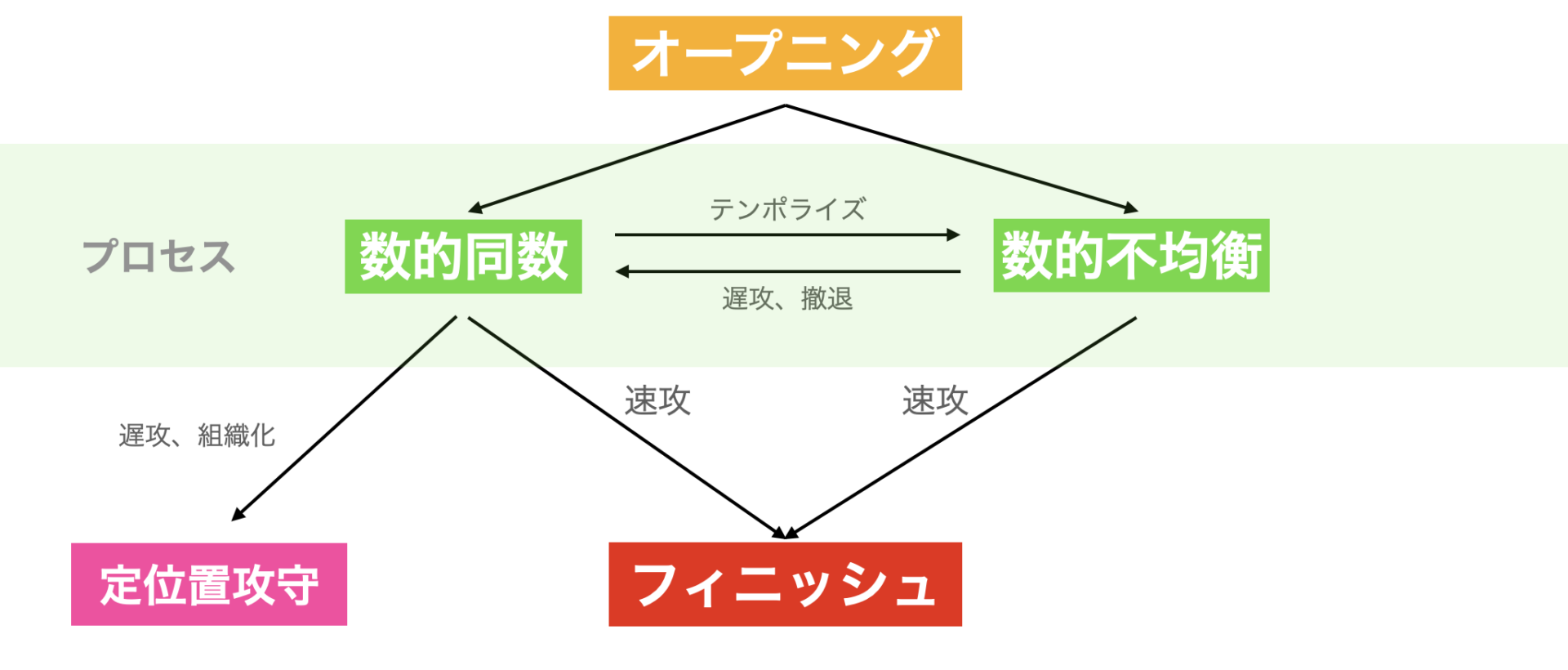
The transition phase can be broadly divided into three parts: the opening, the process (numerically even or numerically imbalanced), and the finish.
Of these, the opening is the most important. It would not be an exaggeration to say that whoever controls the opening controls the transition.
Even when possession changes during a numerically imbalanced situation, that imbalance basically remains in place while attack and defence switch roles.
The team that was in danger gets an opportunity, and the team that had the opportunity invites danger.
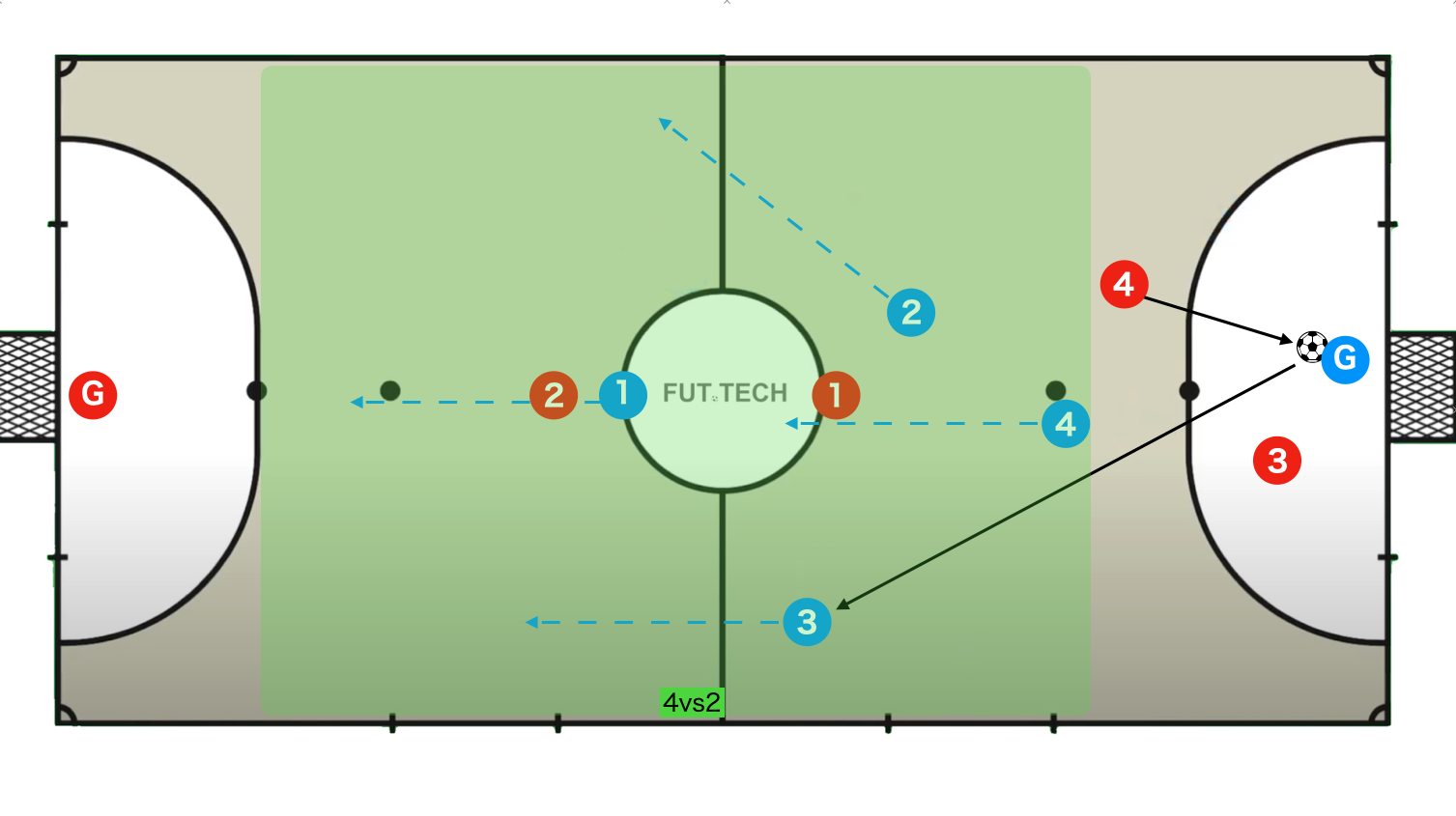
The diagram above shows an example where the attacking team takes a 2v0 situation and the goalkeeper catches the shot.
If the goalkeeper throws the ball forward, the situation shifts from 2v0 to 2v4.
That is why it is important to work on transitions with the understanding that danger and opportunity are always two sides of the same coin.
For that reason, this blog explains transition attack and transition defence together as a pair.
Most players have probably heard their team say "let's switch faster" so many times they are sick of it. But what does the speed of the switch actually mean, and what is needed to improve it?
The speed of the switch means resetting your brain for the next phase and making the right first movement (play).
If you are already in a suitable position before that phase begins, you can win the ball back without having to sprint back in a panic, or quickly turn the situation into a counterattack.
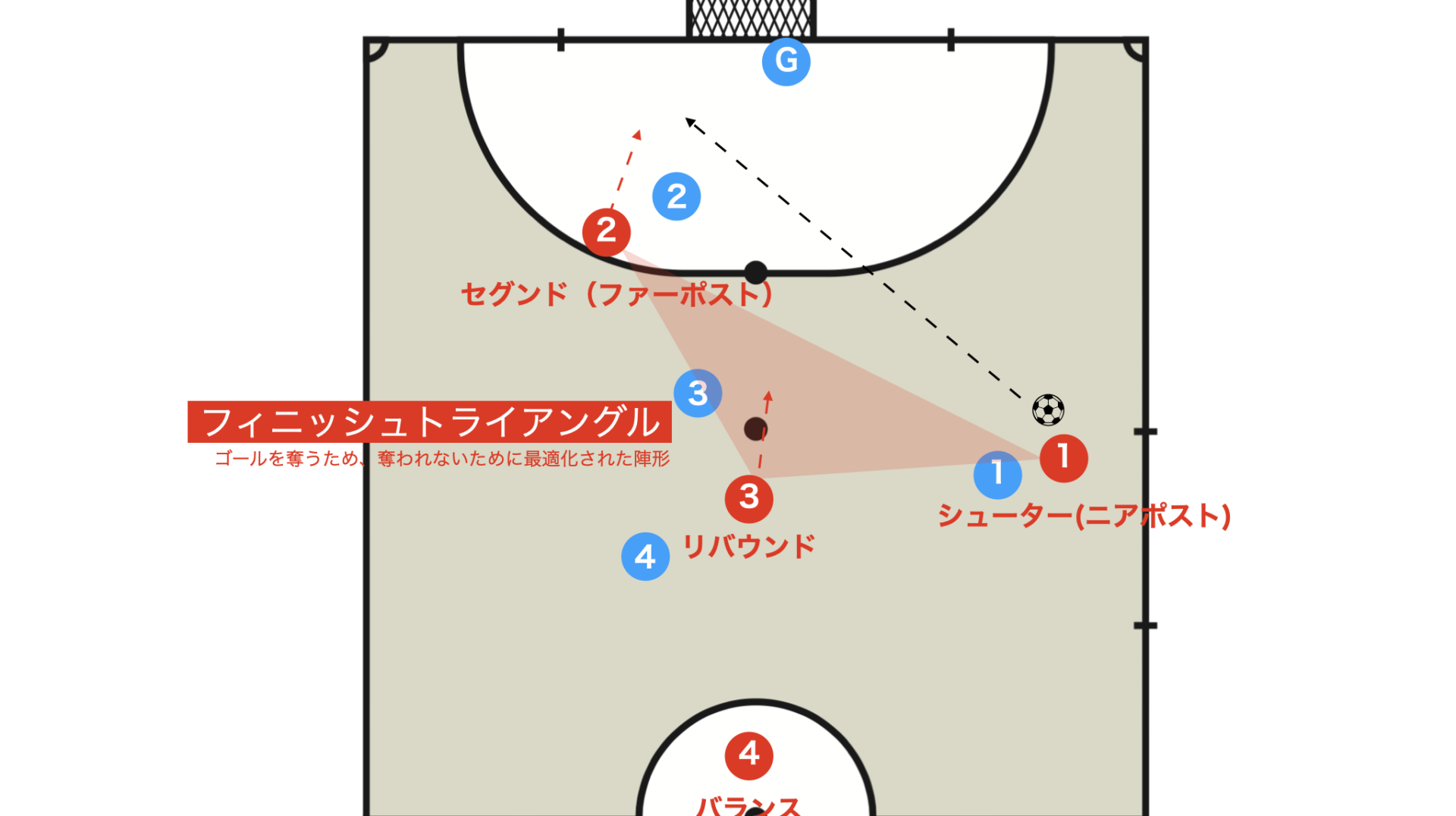
There is a concept in attacking play in the opponent's half called the finish triangle, and the player in the rebound position is especially important in controlling the opening of the transition.
More specifically, if the goalkeeper parries a shot back into the area in front of goal, both teams are unorganized and the game enters a chaotic situation, so a practical transition occurs.
Whether your team reaches that loose ball first, or can press immediately even if the opponent touches it first, depends on whether that rebound position is occupied.
It is also important not to forget to place one player at the back to provide balance.
In other words, creating the finish triangle (a triangle plus one) is extremely important for controlling the opening of transitions.
Once something becomes a habit, people tend to feel uncomfortable if they do not do it.
If you use that principle and make it a habit to drop back unless a goal has actually been scored, and immediately try to win the ball back the moment possession is lost, your body will start moving naturally and reflexively without needing conscious thought.
Transitions are extremely chaotic phases where tenths of a second matter, so if you wait to think before you move, it is already too late. That is why it is important to install a program in your body that lets you feel the moment first and react reflexively.
This is not something that happens just by saying "let's switch faster." It has to be practiced consciously every day until it becomes a habit.
Even if you build the habit of dropping back and recovering beyond your teammates, it means little if you do not know exactly where you should go.
It is important to organize each detailed game situation, understand the appropriate action for that situation, and execute it.
In other words, that means defining and applying the team's transition play model (tactical framework).
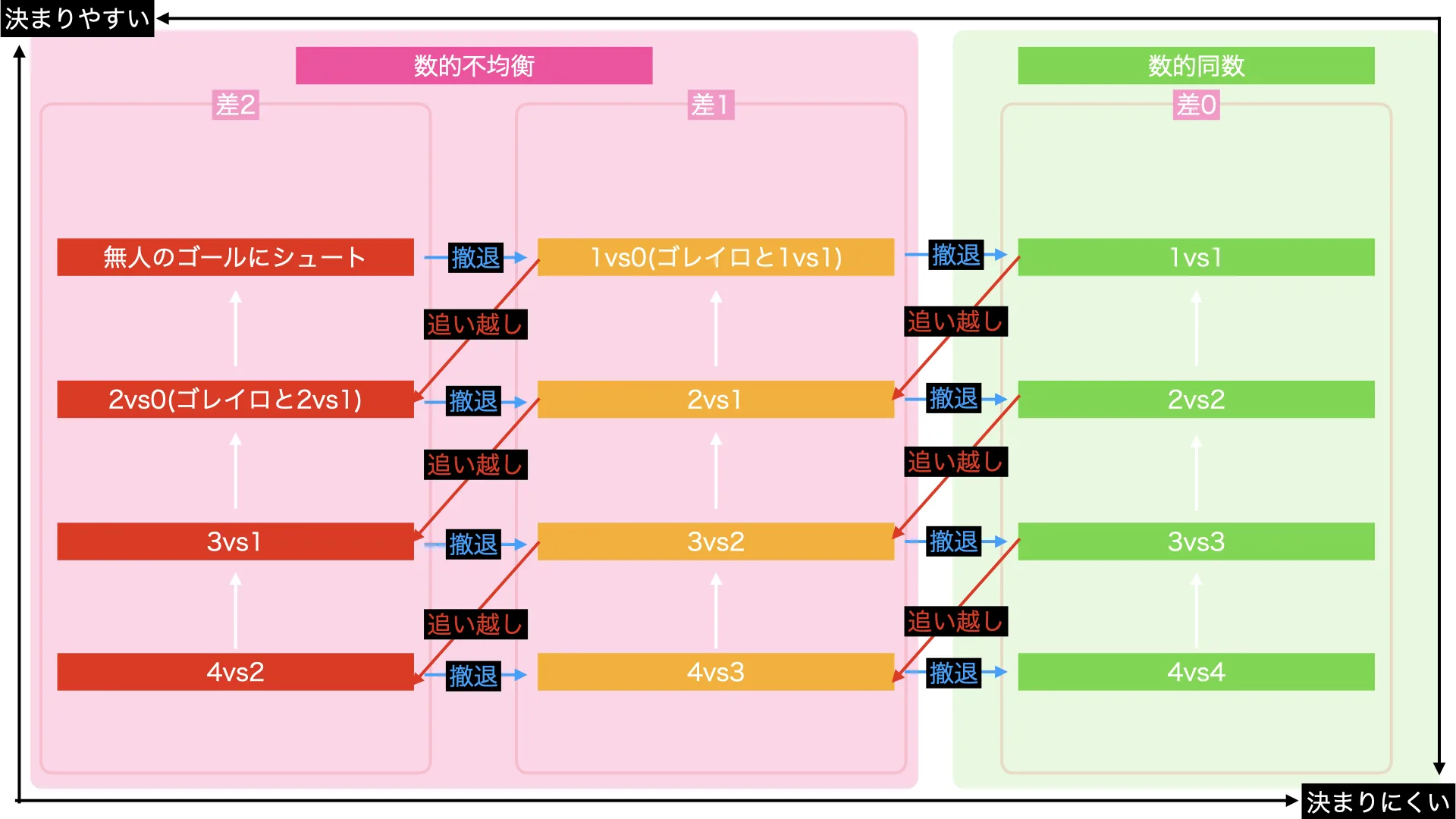
If transitions are subdivided by the number of players positioned beyond the ball line, they can be categorized as shown above.
- Numerically even (1v1, 2v2, 3v3, 4v4)
- Numerical imbalance, difference of 1 (1v0, 2v1, 3v2, 4v3)
- Numerical imbalance, difference of 2 (2v0, 3v1, 4v2)
Broadly speaking, there are three groups, and they evolve according to the opponent's recovery runs and your teammates' support runs.
In this diagram, the further you go toward the upper left, the easier it becomes to score, while the further you go toward the lower right, the harder it becomes to score.
In other words, the attacking side should aim for the upper-left situations, while the defending side should aim for the lower-right ones.
A numerically even transition is a phase where goals are very hard to score, so the team needs to decide whether to go all the way to a finish or intentionally slow the attack down.
Also, if the ball carrier waits for support from teammates (temporalize) and creates a numerically superior situation, the chance of scoring can rise dramatically.
The right decision has to be made based on the flow and context of the match.
関連記事
Transitions in Numerical Equality (1v1, 2v2): Temporizing, Fast Break, or Slow Attack
An explanation of futsal transitions in numerically equal situations (1v1 and 2v2). This article org…
続きを読む →What does temporalize mean?
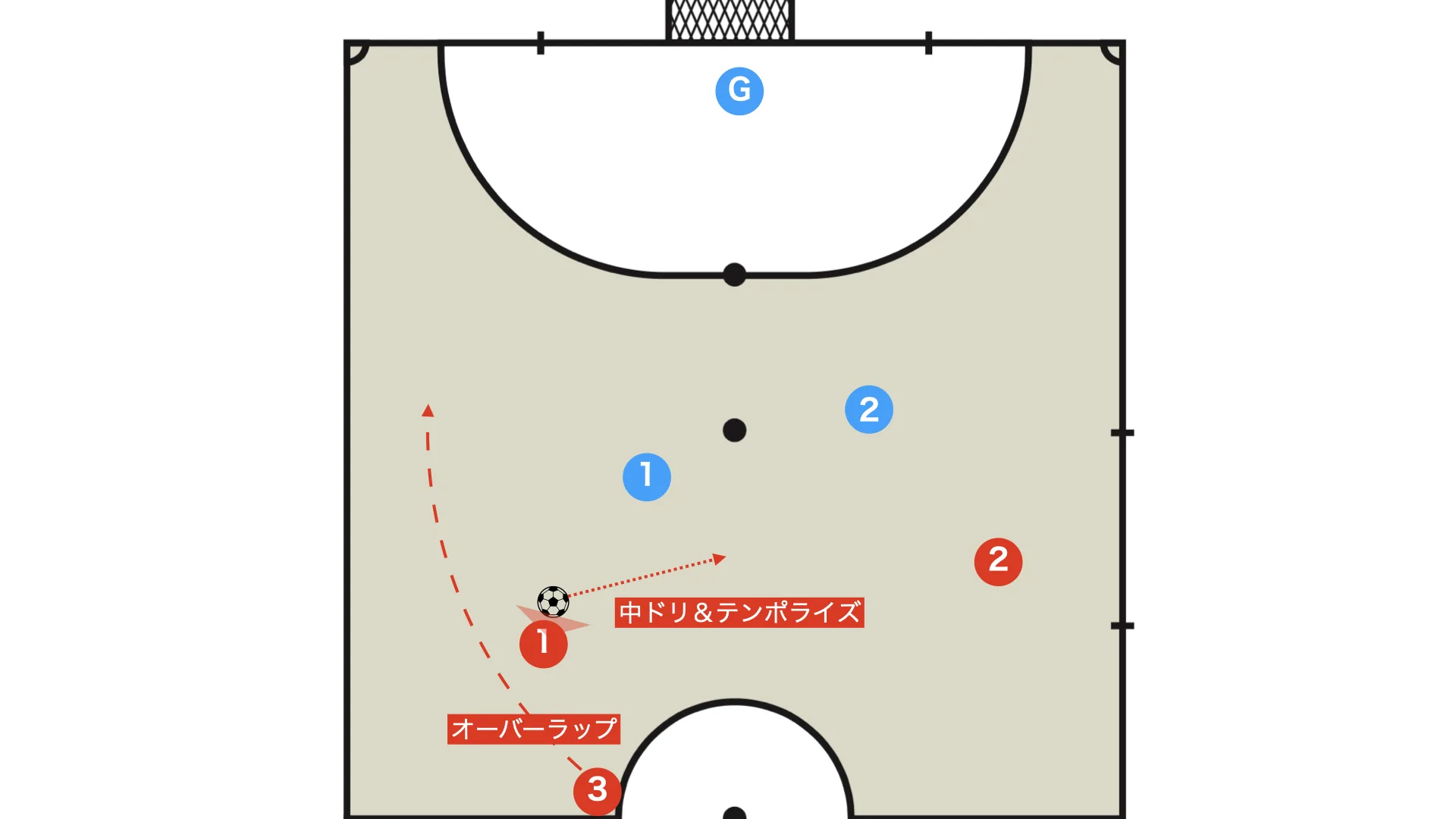
When teammates can join the attack faster than the opponent can recover, the ball carrier deliberately avoids rushing the attack and buys time so support can arrive.
That allows your team to increase the number of attackers and greatly improve the chance of scoring.
This is a phase where quality differences between teams tend to show up clearly, and it also happens frequently during matches.
If you want to focus on transitions, this is the first type of situation you should work on.
関連記事

Transition: Plus-One Numerical Imbalance (1v1 with the Goalkeeper, 1v2, 2v3, 3v4)
A systematic guide to the most common transition situation in futsal: plus-one numerical imbalance. …
続きを読む →This is a situation where the attacking side has an overwhelming advantage, but it is surprisingly deep and often underestimated.
It is not uncommon to fail to finish these situations and then concede from a counter to the counterattack.
(Because conceding this way feels like taking damage worth two goals, the mental blow is also significant.)
関連記事
Transition: Numerical Superiority by Two (2vs0, 3vs1)
An explanation of futsal transition situations with a two-player numerical advantage (2vs0 and 3vs1)…
続きを読む →