Power Play in Futsal: The Required Skills and 7 Formations Explained
Published: 2020.12.31Updated: 2026.05.03
Whereas a power play in football usually means sending an aerially strong centre-back or similar player up front, a futsal power play is a tactic in which the goalkeeper joins the attack as the fifth FP (field player), creating a 5v4 numerical advantage in possession.
Although it gives the attacking team an extra player, it also leaves the goal completely open, which increases the risk of conceding immediately on a power-play counter. For that reason, it is often used late in games by teams that are trailing, and it is often described as a double-edged sword.
Because of that, all five players involved need high-level technical quality on the ball, and in many cases the goalkeeper is substituted for a technically strong FP.
In this article, I will explain in detail what kind of personnel and ideas are needed to run a power play, and what specific formations are available.
関連記事
Special Situations
An overview of special situations in futsal, such as power play and red-card dismissal scenarios. Th…
続きを読む →Things to keep in mind when using a power play
The 4-second rule and the back-pass rule still apply, so it is important for the goalkeeper (or the FP coming on in the goalkeeper slot) to make sure they enter the opposition half properly.
Once they are in the opposition half, the goalkeeper is treated like an FP, so the back-pass rule and the 4-second rule no longer apply to them.
To run a power play in futsal, you need five players who understand the tactic to a certain level and possess the technical qualities required for it.
Since a power play only requires five players, not every player in the squad necessarily has to be able to do it.
That said, because a power play leaves your own goal wide open and carries a real risk of conceding, you need to prepare a high-quality group of five.
So when selecting the five players to use in a power play, what kind of qualities should you focus on? Specifically, the following four stand out:
- Players who can control and pass the ball accurately
- Left-footed players
- Players who can shoot from distance
- Players with a strong tactical understanding of the power play
Below, I will explain each of these four points in more detail and why those qualities matter.
It is extremely important that the players involved in a futsal power play can control the ball cleanly and pass it accurately.
How important technical quality is under pressure varies by formation, but all five players must have at least a certain standard of close control and passing.
In futsal power plays, teams often circulate the ball while exploiting the numerical advantage and waiting for an opening. At the same time, because all five players are committed to the attack, their own goal is completely unguarded.
If the players lack quality on the ball, it becomes much harder to score with certainty, while the risk of conceding from a counterattack rises sharply.
It is even better if you have a key attacking player with exceptional technical quality who can provide decisive final passes.
In futsal, whether you have left-footed players or not makes a major difference to the quality of a power play.
Ideally, you want at least one left-footed player, and preferably two.
That is because when the player on the right side is left-footed, they can create chances more effectively through a wider field of vision and more accurate passing angles.
In futsal power plays, having players who can strike from distance expands your attacking options.
Of course, if the opposition shape breaks, you want to take the open long-range shot immediately. But in power plays, there are also tactical patterns where the player in the entre lineas space sets a block and the team chooses the long-range shot.
Long-range shooters also add variety when you use set plays that combine block-and-continue actions (pick and roll), since placing a strong shooter deeper gives the attack more options.
If the opposition goalkeeper catches the ball during your power play, they can immediately score into the empty net with a power-play counter.
That means any long-range shot you take during a power play needs to be powerful and accurate enough that the goalkeeper cannot simply catch it cleanly.
The five players used in a power play need to have a high level of tactical understanding of futsal power-play situations.
Unlike many other moments in the game, when you go to a power play you are expected to score with certainty.
But the power play is one of the most complex tactical areas in futsal. If all five players are not fully familiar with the team’s power-play system, you will not score, and in the worst case you may concede from a power-play counter.
You also need the flexibility to adapt to irregular situations that fall outside the usual pattern.
There are four things you should keep in mind when using a power play:
- Use the power play at the right time
- Share the same intentions
- Play with patience
- Have multiple patterns
Let’s go through them one by one.
Just because you are losing does not mean you should start a power play recklessly.
If your settled attack is functioning well, there is no need to force a power play, so the ability to read the flow of the game is important.
It is also important to work backward from the remaining time and the scoreline, build a clear equation for what you need to do within a certain number of seconds, and share that picture across the team.
Having shared intentions within the team is important in any futsal tactic.
Through daily training, every player who will appear in games needs to understand the tactical plan and clearly picture what the team, or the set unit, is trying to do.
When you are behind and using a power play, it is easy to panic and force difficult passes or shots, but given the danger of conceding on the counter, overly risky play is not a good idea.
The standard approach is to avoid risk as much as possible, move the ball quickly with the numerical advantage, and finish decisively only when the opposition defence finally shows a weakness.
If you compare it to baseball, the idea is to stay disciplined, leave every borderline pitch alone, and swing with full commitment only when a perfect strike comes right down the middle.
There is one exception, of course: when almost no time remains.
The more finishing patterns and formations you have in your power play, the more confusion you can create in the opposition defence.
If you also have a few set plays prepared, your attack will become even more dangerous.
I will explain the types of formations below, but in general it is more disruptive to the defence if you change shapes during the game through rotations such as hedondo rather than attacking with the same formation the whole time.
There are several types of power-play systems.
At the professional level, teams do not stay fixed in a single system. They mix in set plays, change formations, and try to unsettle the defence.
Here I will introduce five representative systems.
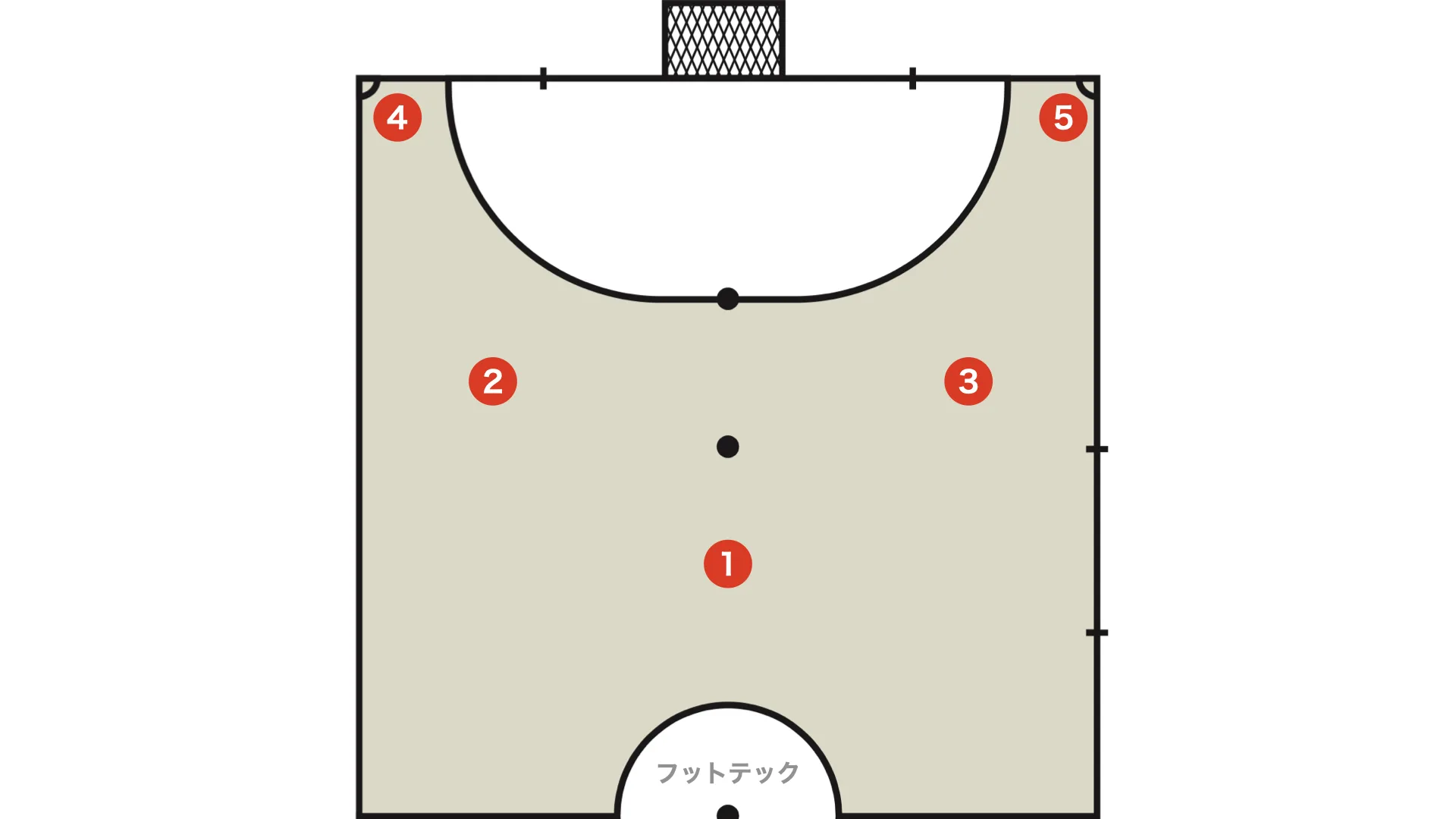
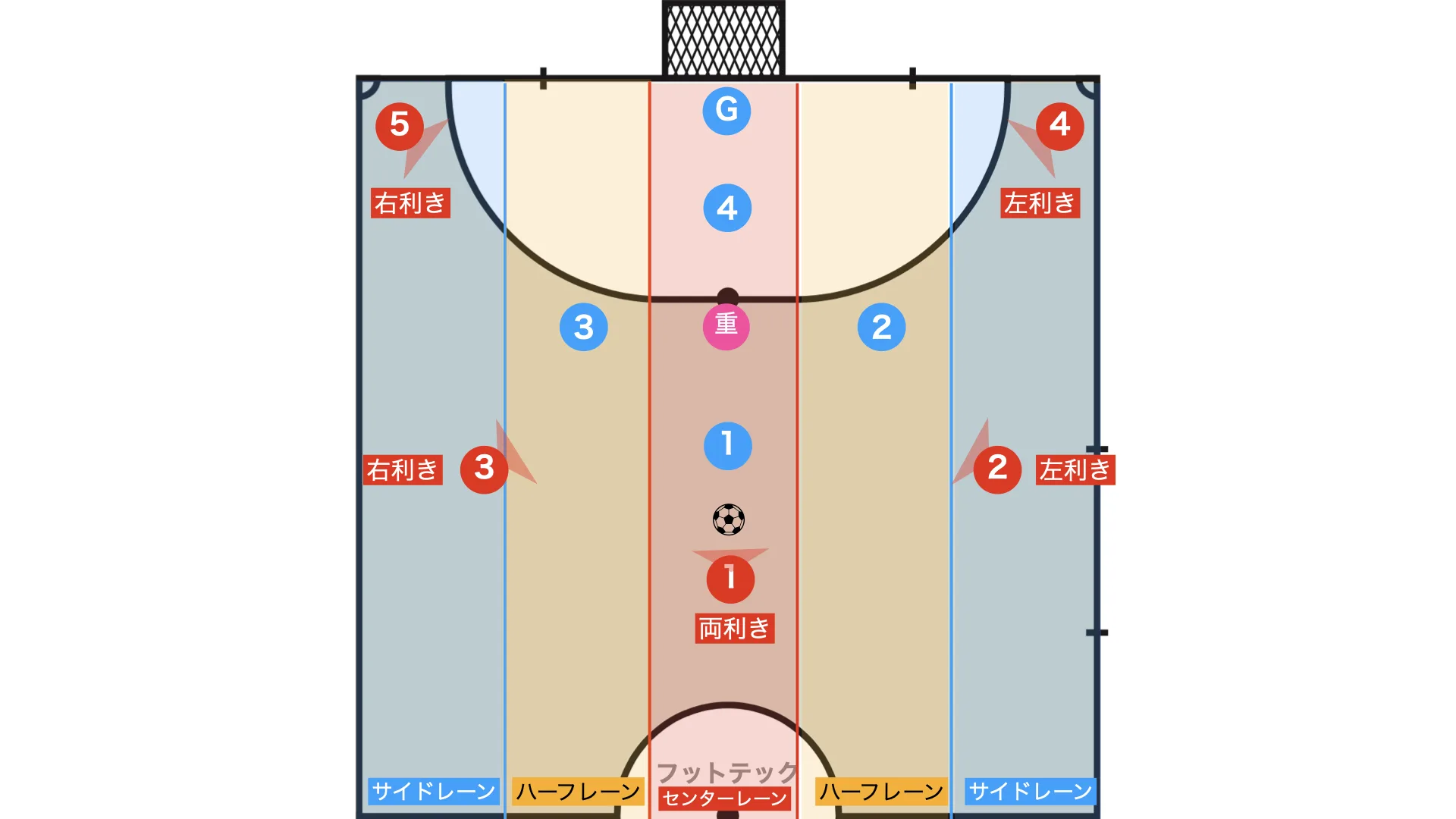
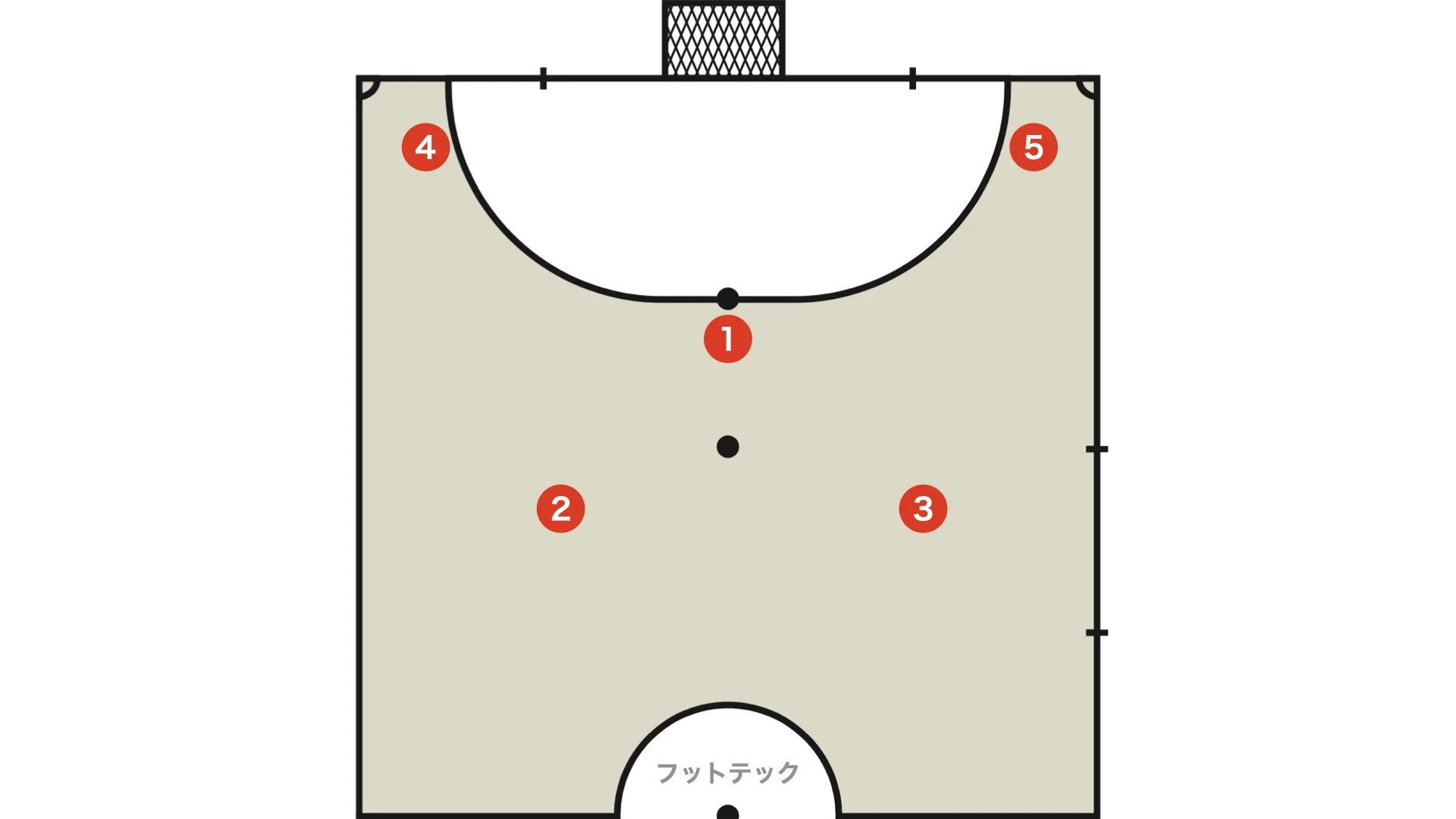
The most orthodox and standard house-shaped system.
関連記事
Power Play Basics: House Attack and Rotating Square Defence
A clear introduction to the house-shaped attack and the rotating square defence that power-play begi…
続きを読む →The back three circulate the ball while looking for skip passes.
When the ball reaches one of the front players and the opposition defence does not shift together, the typical finish is a quick pass to the far post for the opposite front player to convert.
If you are introducing power play to a team for the first time, this is probably the safest system to start with.
This system combines a 2-2 box with a player between the lines (entre lineas).
Because the central player has to operate in a tight space, this is a slightly more difficult system, requiring broad vision, strong decision-making, and excellent close control.
On the other hand, it offers many attacking variations and can become extremely dangerous when mastered.
In particular, actions where the central player sets a block from behind are highly threatening.
Another key point is that it also creates two diagonal 3 on line lanes.
関連記事
Simple Yet Powerful: The Box Power Play Shape (2-1-2)
An explanation of the box-shaped futsal power play (2-1-2). This article clearly breaks down the bas…
続きを読む →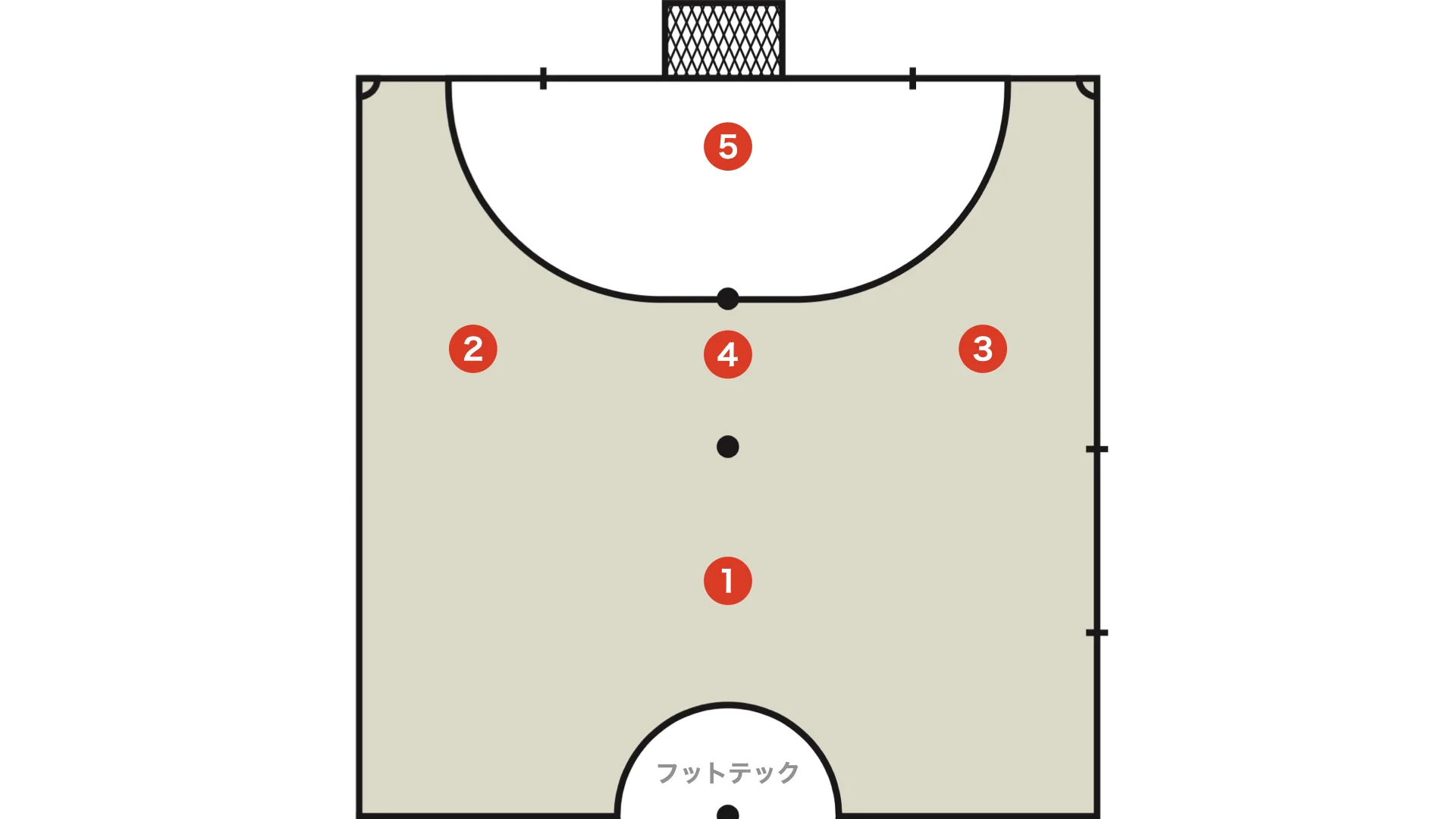
A shape that places one player between the lines at the centre of a four-player diamond.
Since it is effectively the box shape rotated by 45 degrees, it is effective to use both formations interchangeably as part of a set play.
It creates two vertical and horizontal lines against a 4-0 defence.
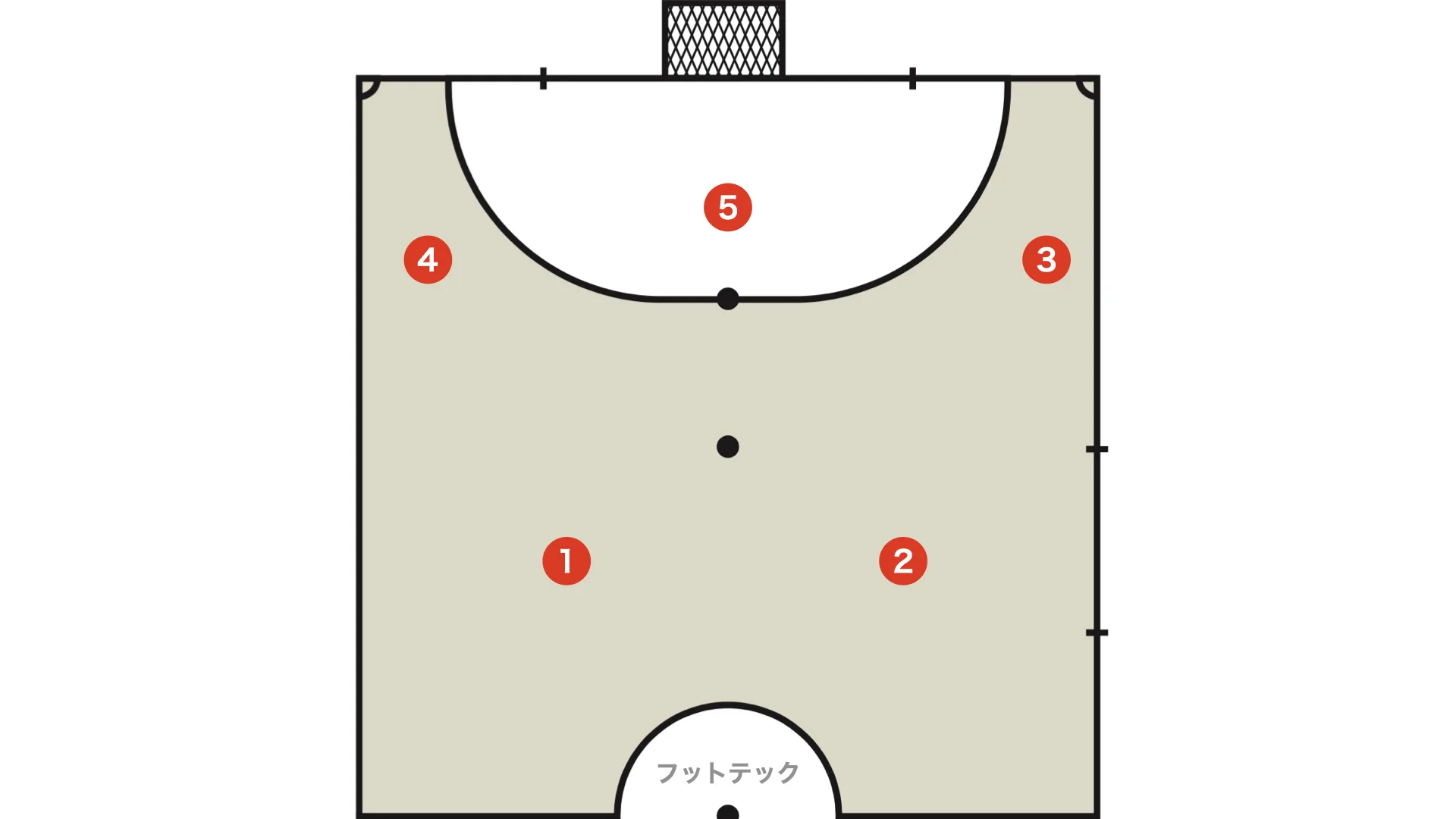
Few teams use it, but it is effective when you have a physically strong pivot who can hold the ball up.
The single front player (the top player in the diagram) is responsible not only for creating chances from pivot service, but also for disrupting the opposition goalkeeper and attacking the far post.
At times, that player can also drop into the second line, receive between the lines, and create chances from there.
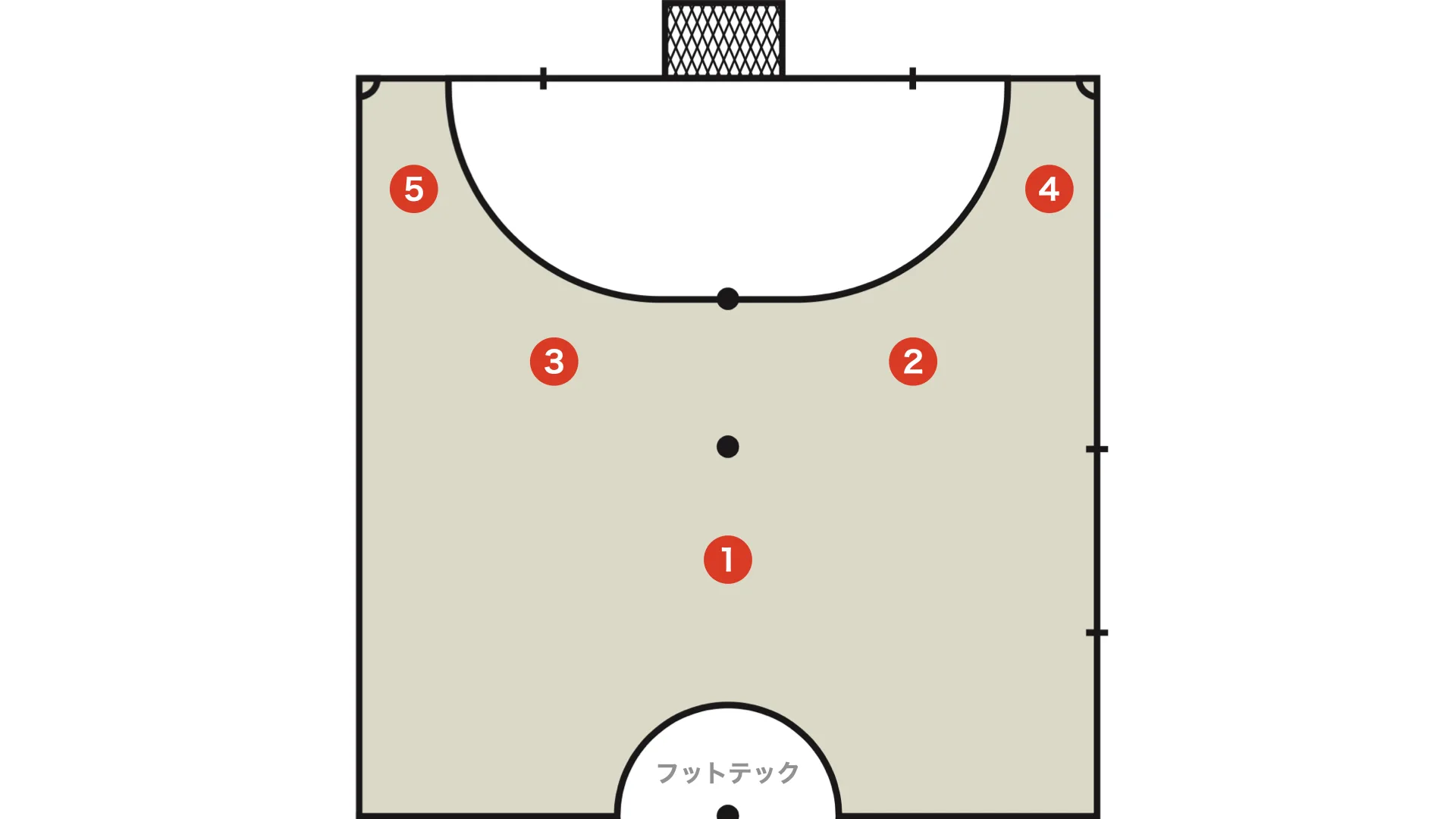
A system that spreads out in a pyramid shape around the deepest player.
Because it creates 3-on-line structures on both sides, the key is to make effective use of them.
The back triangle circulates the ball, and when the ball is played into the middle player of the 3 on line, if the opponent jumps out, you look to break between the lines with an ala corta run.
If the middle is closed, you can let the ball run through and attack with a sai nuke movement instead, which adds more variety to the attack.
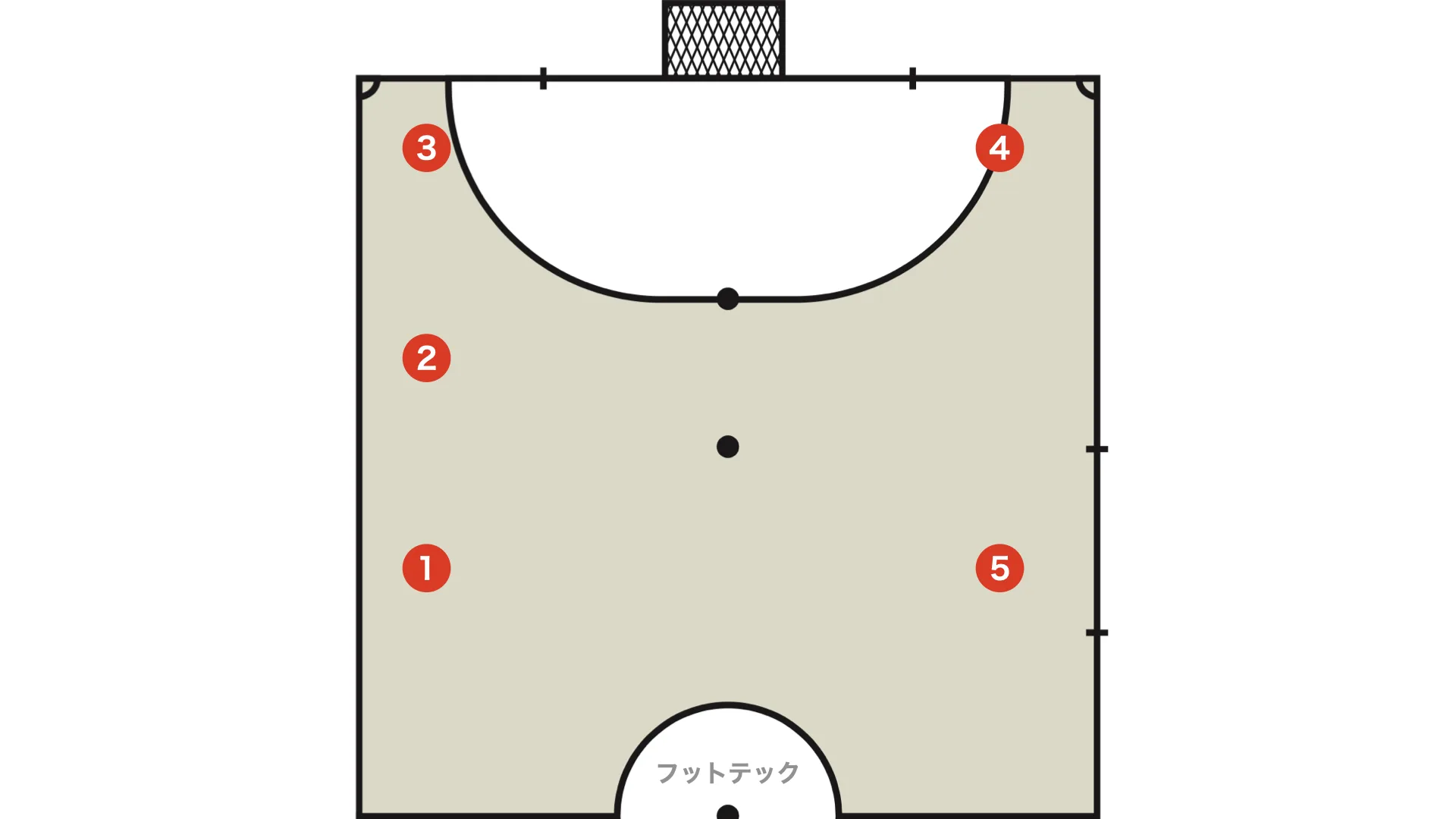
This refers to a shape that is not symmetrical from left to right, unlike all of the formations explained so far.
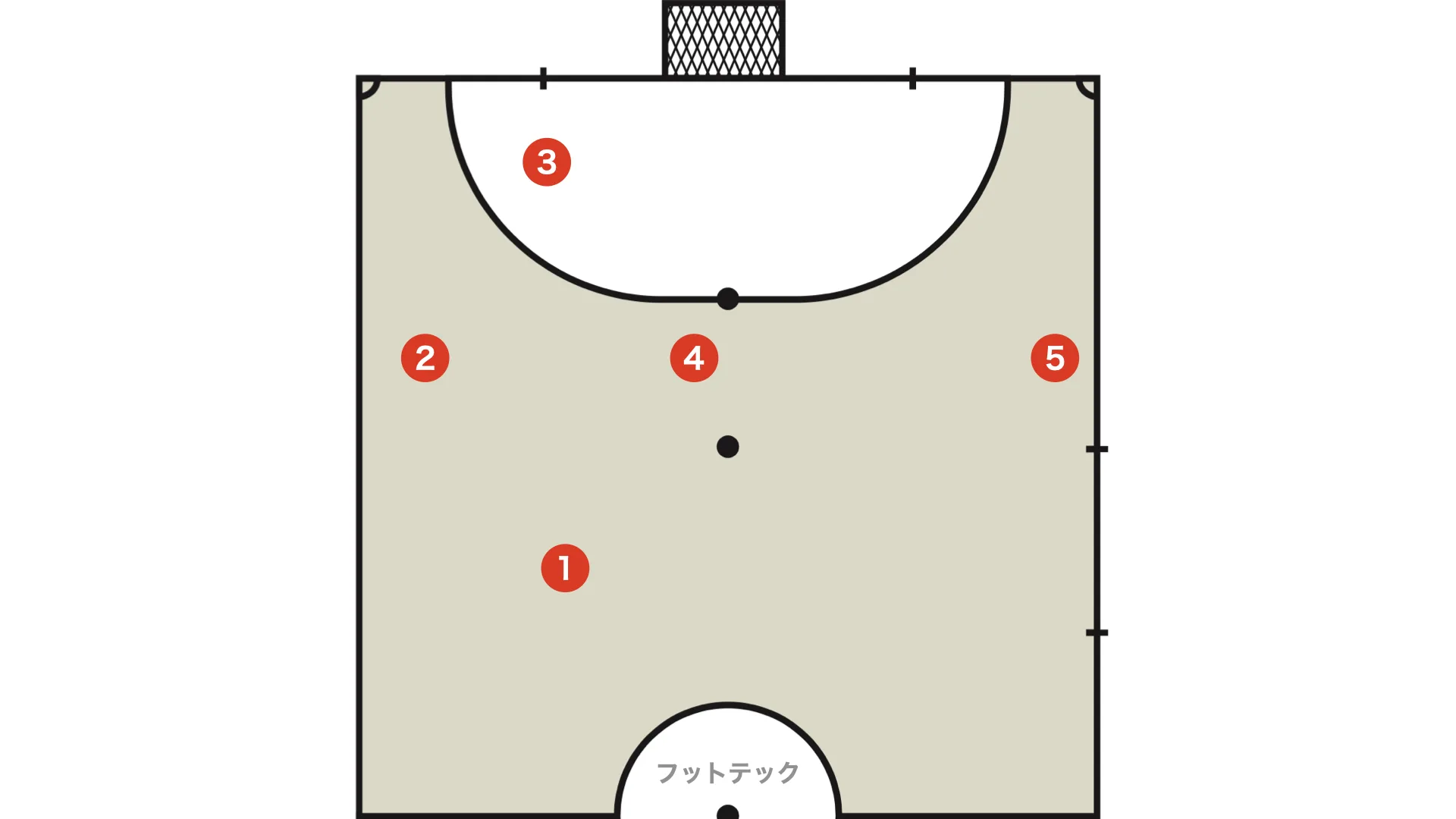
Overload is a tactic in which you intentionally concentrate players on one side, or in one area, to create space on the opposite side, or in another area, and thereby produce an isolation.
It is not often used as the initial shape. More commonly, teams create the overload through rotations and positional changes.
Because it creates a chaotic shape, it can easily disturb the defence and produce local numerical superiority, making it a very effective tactic. It is something you often see in the F League and in overseas futsal.
The futsal power play is a deep and very interesting tactic.
There is very little information online about power play, and because it is seen as difficult, many teams tend to avoid it. Quite a few teams neglect it altogether, and the lower the level, the fewer teams seem to keep power play as a real option.
Even so, having a power-play option unquestionably strengthens a team. Also, if you never practice power play, there is a danger that when the opposition uses it against you, you will not know how to defend it and may end up conceding heavily.
Why not use this as an opportunity to discuss and develop a power play with your team?
Related posts