Overview of Futsal Three-Player Relationships: 3 on Line and the Triangle
Published: 2021.01.06Updated: 2026.05.03
If you have played soccer, you have probably heard over and over how important third-player movement is in attack.
Of course, attacks involving the third player are also extremely important in futsal.
This time, I will explain the overall idea behind attacks that involve the third player.
Why is so much importance placed on attacks involving three players?
It is because they make it possible to create three different kinds of two-player relationships, which in turn allows for a wide variety of attacks.
Mathematically speaking, if you choose two players from a group of three, there are three possible combinations.
If you understand how important two-player relationships are in futsal, then the attacking possibilities created by those three combinations should feel extremely powerful.
From another point of view, an attack involving the third player is nothing more than an application of a two-player relationship.
In other words, two-player relationships can be called the foundation of all group tactics.
That is one reason every futsal coach places so much importance on two-player relationships.
There are only two kinds of attacks involving the third player: 3 on line and the triangle.
If you think mathematically about moving three points around without allowing any of them to overlap, then there should only be two possible shapes formed by connecting those three points: a case where the three points line up on a straight line (3 on line), and a case where they form a triangle.
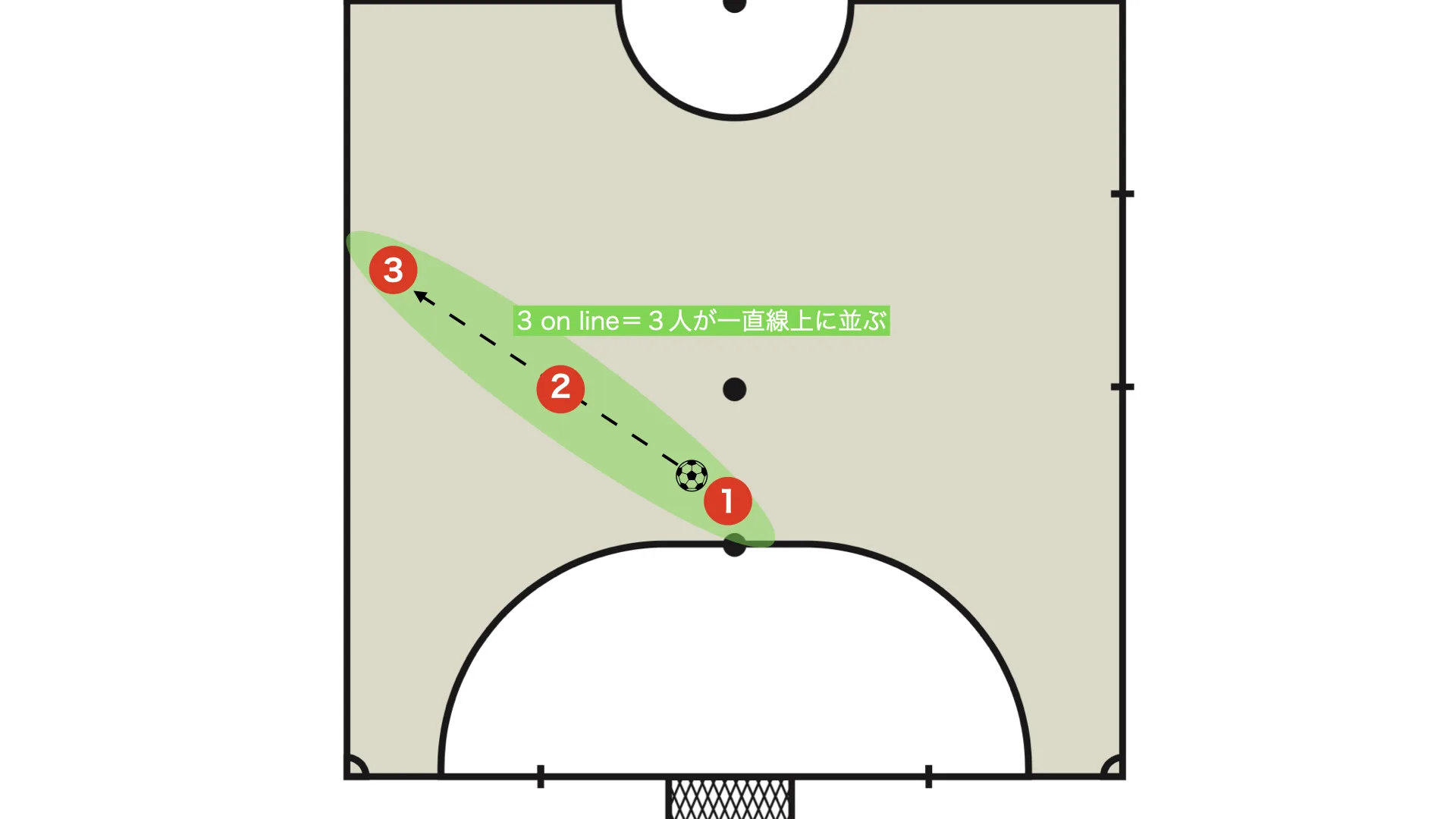
3 on line is a state in which three players are lined up on a straight line, and some people shorten 3 on line to 1-line.
The tactical purpose of 3 on line is to break the opponent's multi-line defensive structure that was built to maintain defensive balance.
In particular, in 3 on line tactics, the most common pattern is the tactic called "sai," in which the number 2 player in the middle of the 3 on line moves out.
3 on line can be divided into three types depending on the angle it makes with the goal line.
- Vertical: 60 to 90 degrees
- Diagonal: 15 to 60 degrees
- Horizontal: 0 to 15 degrees
I will introduce them one by one.
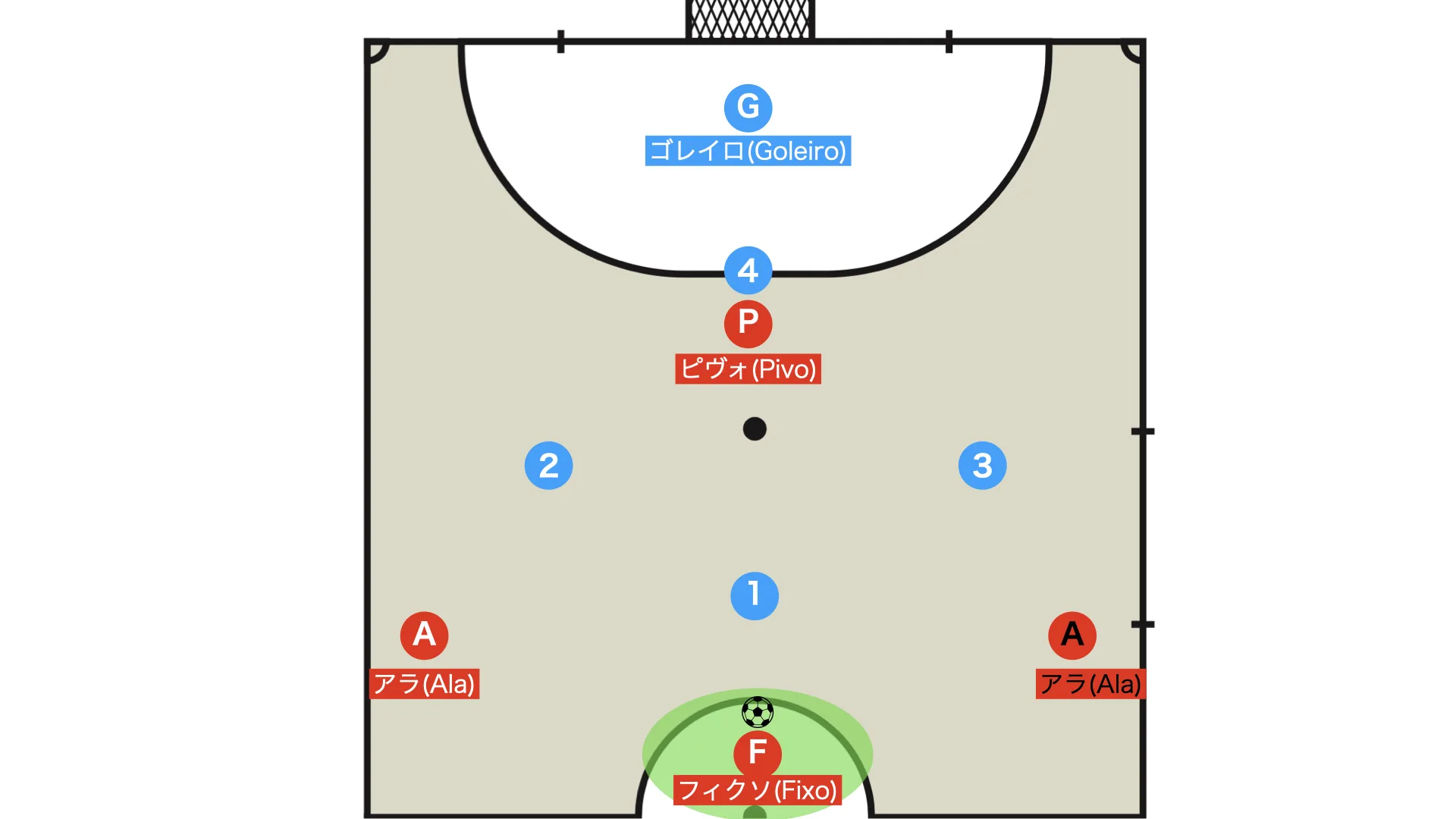
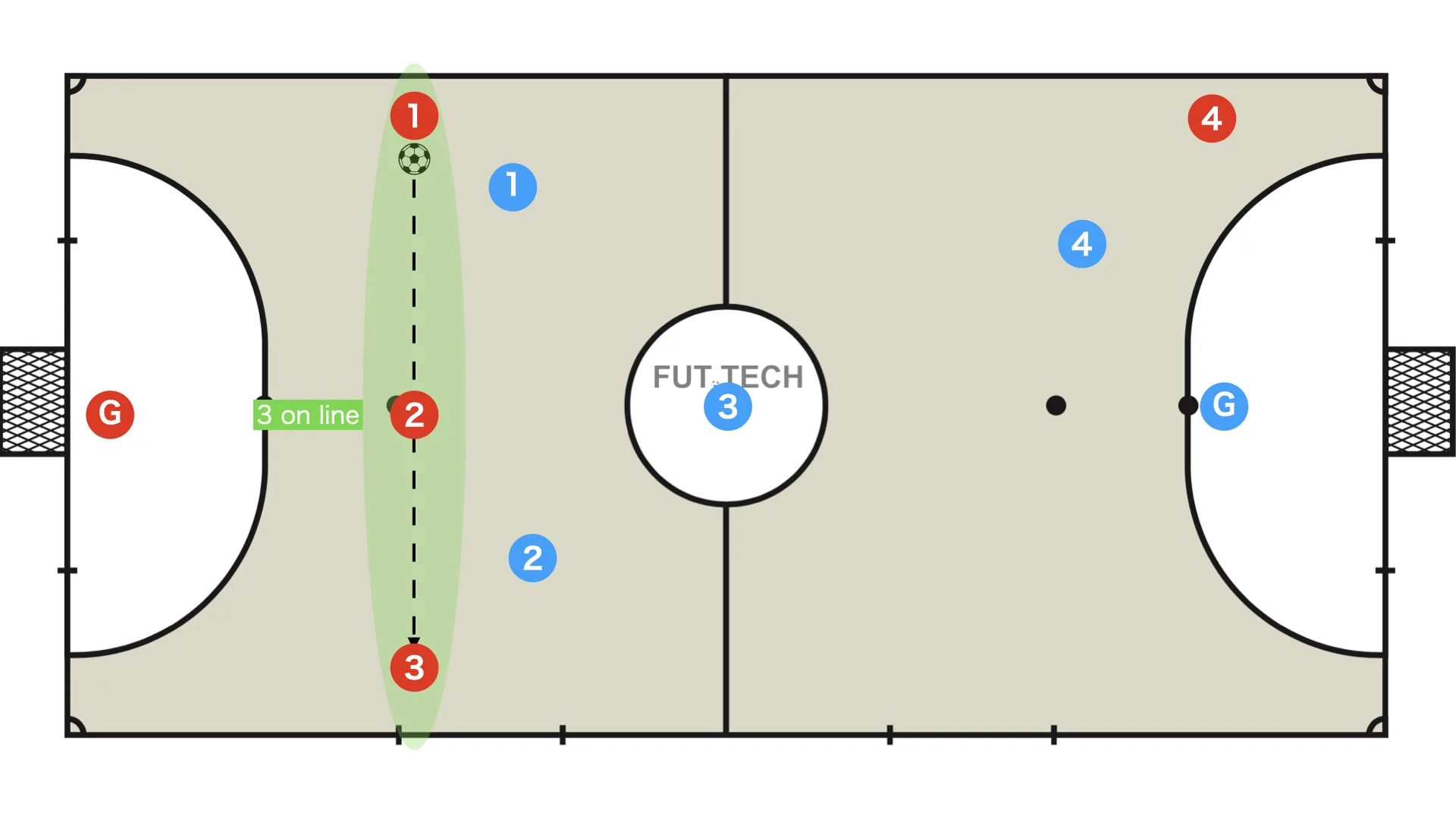
A 3 on line in which three players (fixo, ala, and pivot) are lined up vertically (60 to 90 degrees).
This shape is often seen in the L-shaped 2-1-1 formation and in a false-pivot style 3-1 setup.
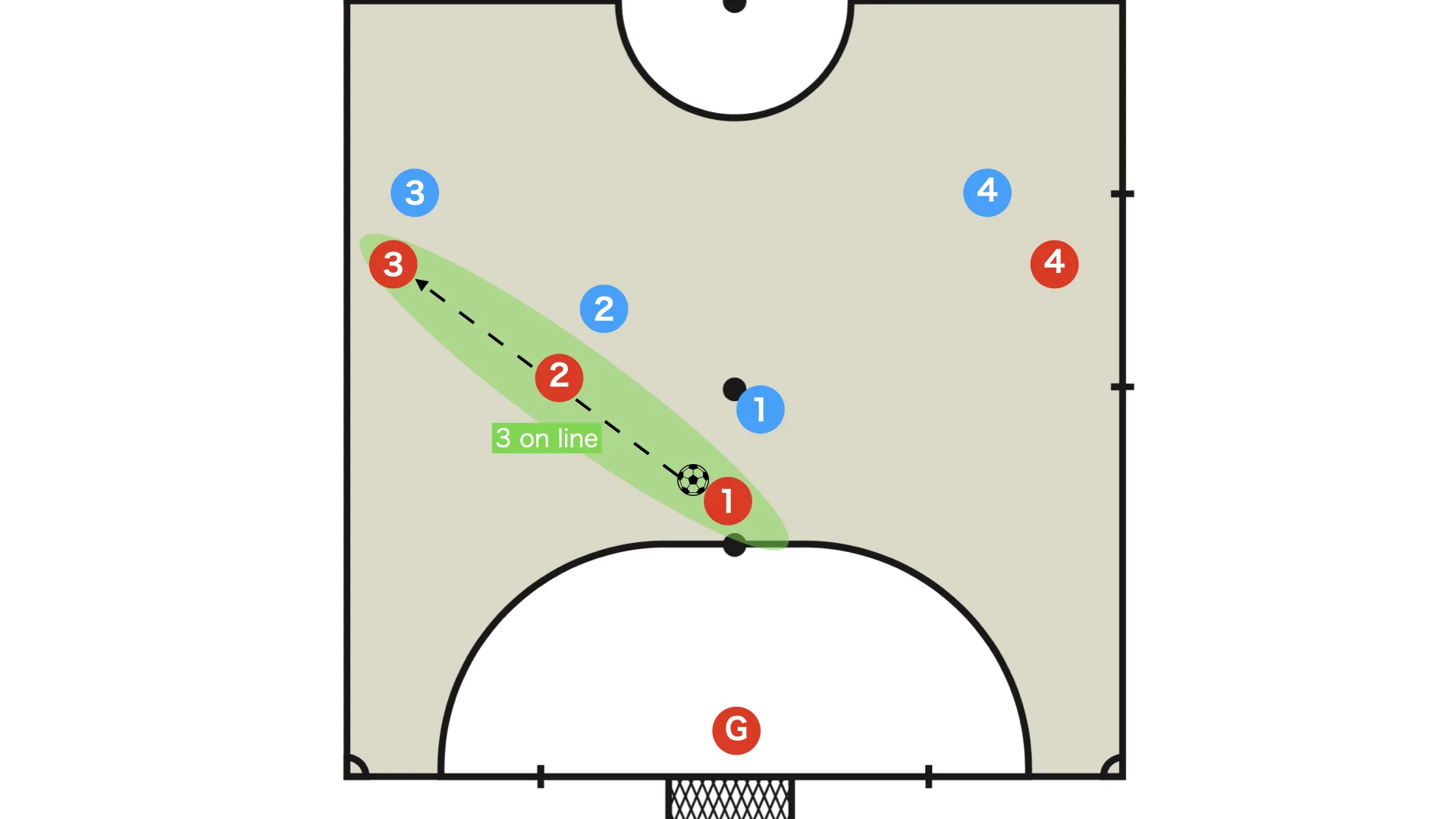
A 3 on line in which three players (fixo, fixo, and ala) are lined up diagonally (15 to 60 degrees).
This kind of 3 on line is often seen in quatro zero.
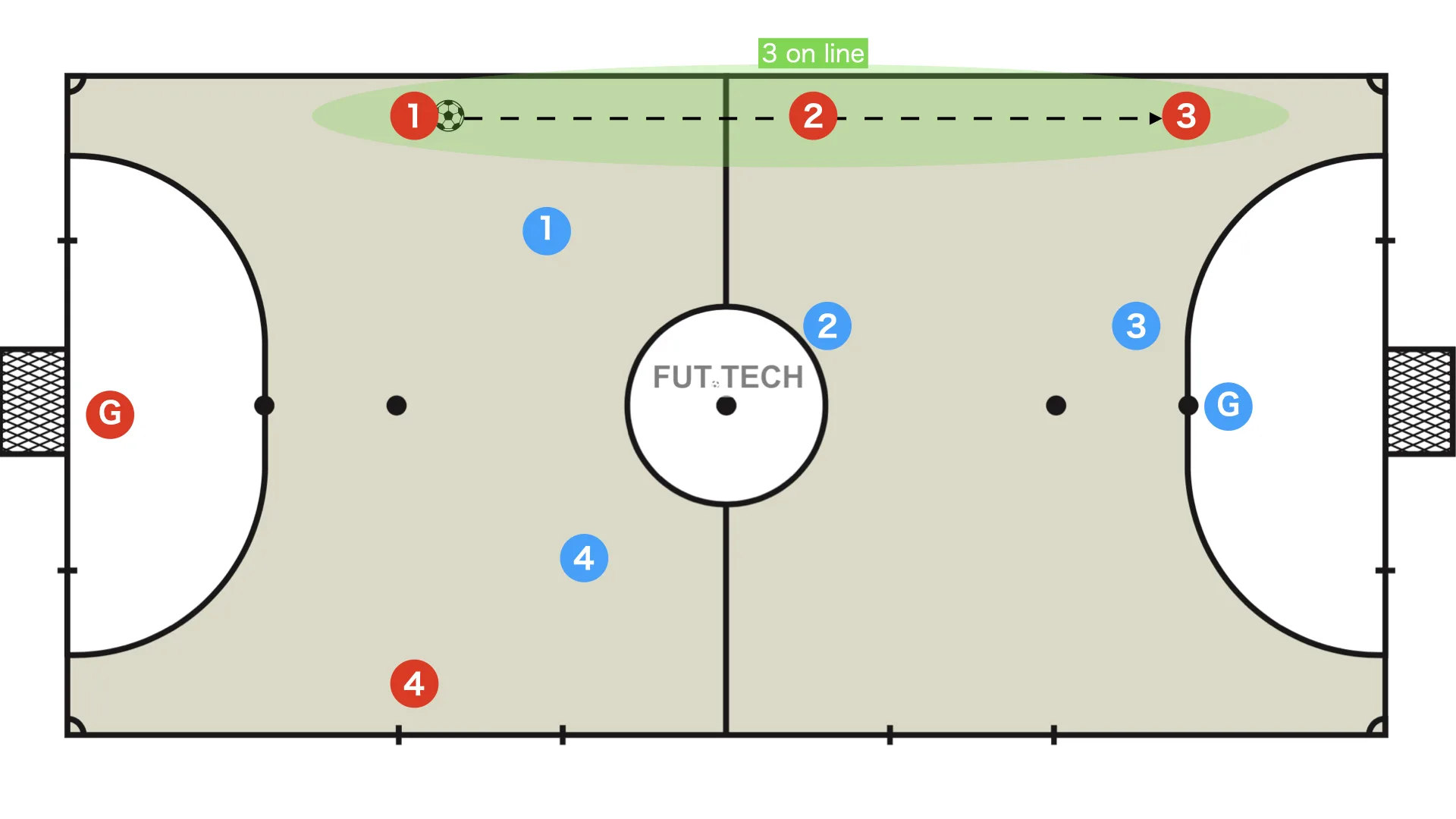
A 3 on line in which three players (ala, fixo, and ala) are lined up horizontally (0 to 15 degrees).
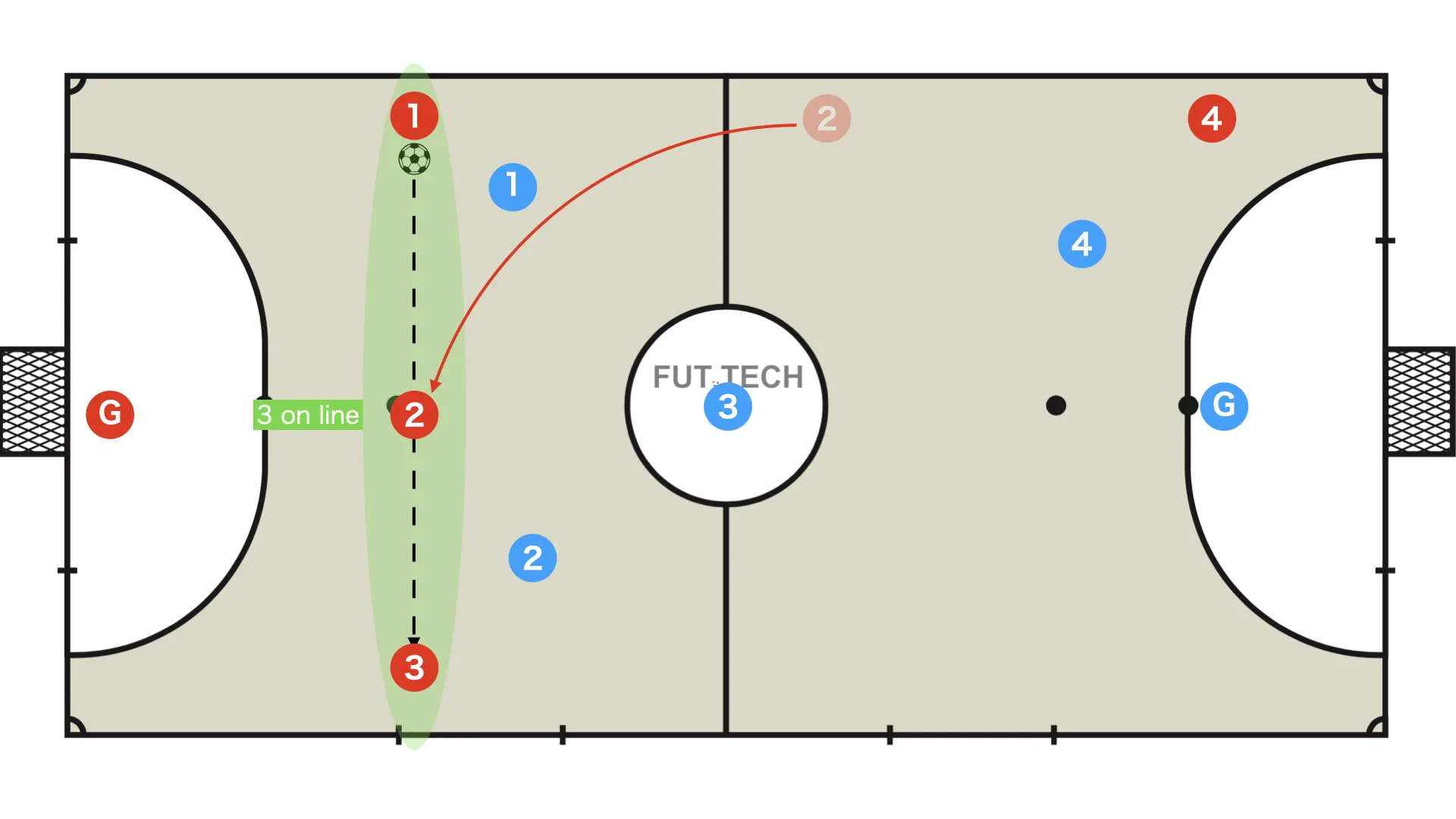
In competitive futsal, this is often created intentionally when the second-line single player in the L-shaped 2-1-1 formation drops out of the line with a line cut.
Among the three types of 3 on line, this is the only one that does not progress forward, but it is still effective as a way to break down the opponent's multi-line defence.
If no 3 on line is formed at all, how many triangles can be created?
Looking only at the field players, 4C3 = 4 triangles can be formed, and if you include the goalkeeper, 5C3 = 10 triangles can be formed.
There is no need to be aware of every triangle during a match, but it is important to know the fact that that many triangles exist on the field.
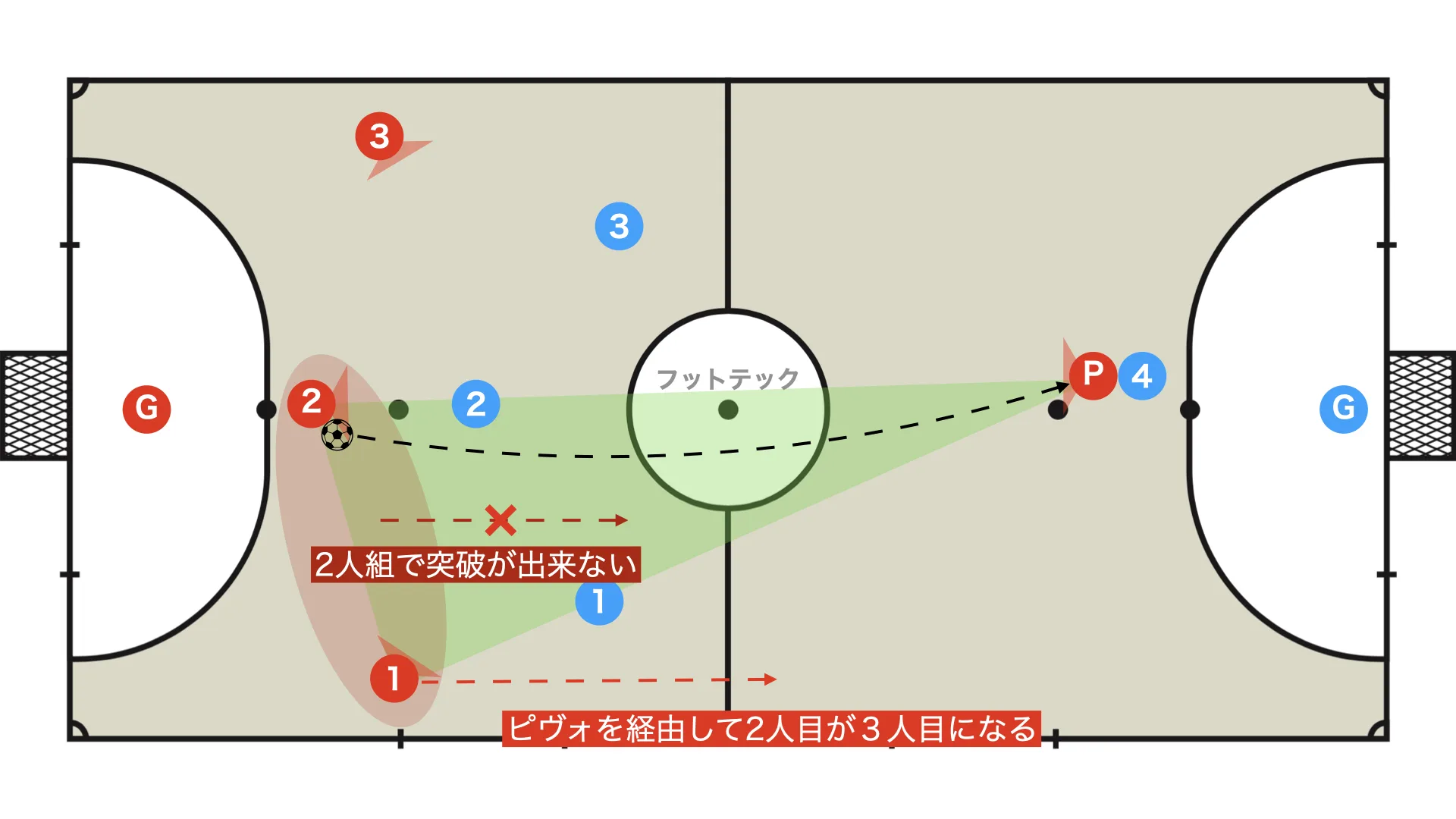
To use the pivot effectively in a tactical attack, it is important to be aware of the triangle formed by the two deeper players' relationship plus the pivot.
First, the aim is to break the defence using a two-player relationship such as a one-two or parallel, but when the pass cannot be played, going through the pivot once makes the runner the third player, which creates a more layered attack.
関連記事
Essential for 3-1: Pivo Passes and the Third-Man Run (Two-Player Unit + Pivo)
A breakdown of pivo passes and the third-man run, the core of the 3-1 system. This article clearly e…
続きを読む →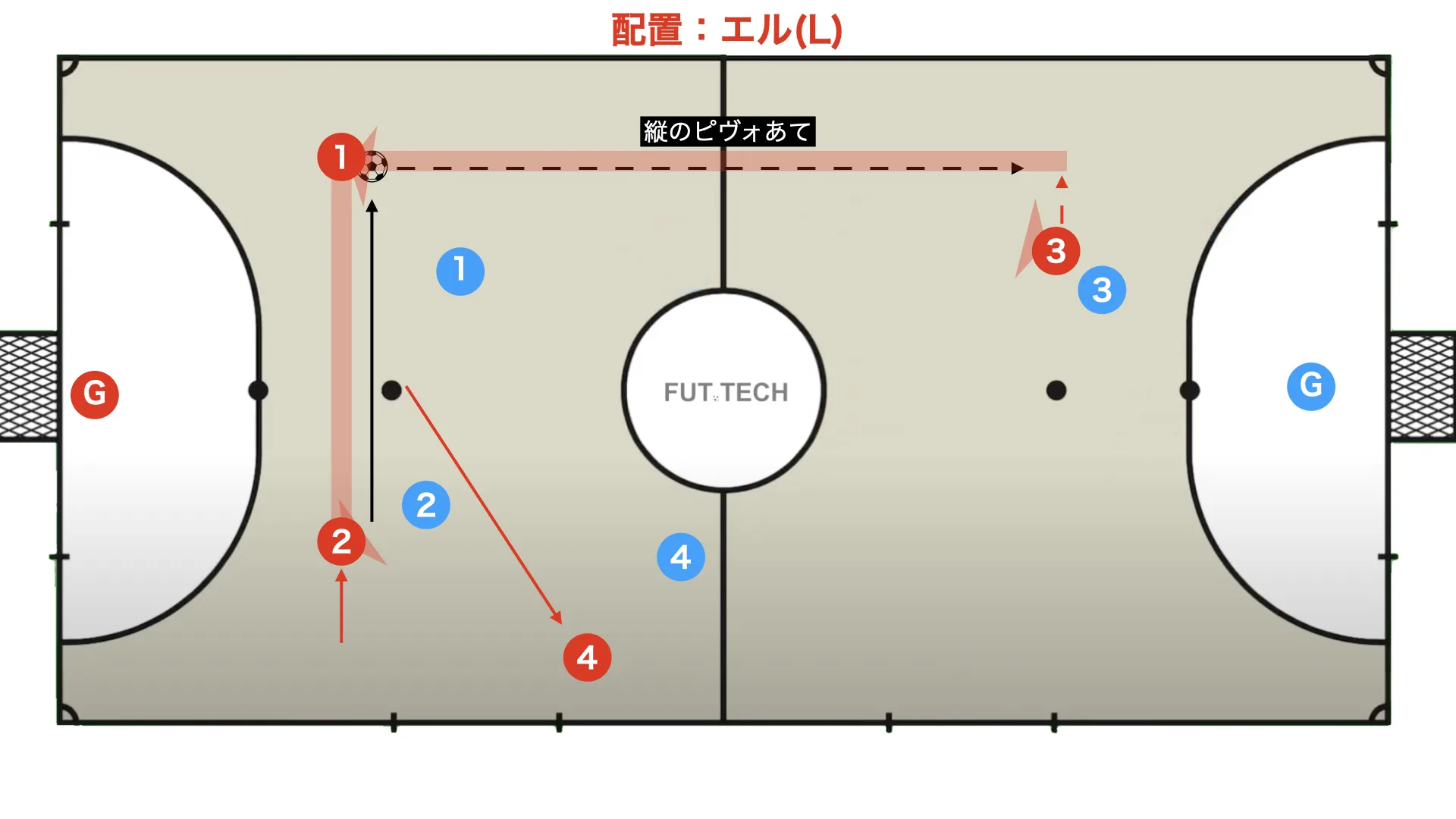
In a 3-1, there is a three-player tactic called L in which the pivot, ala, and fixo form an L shape.
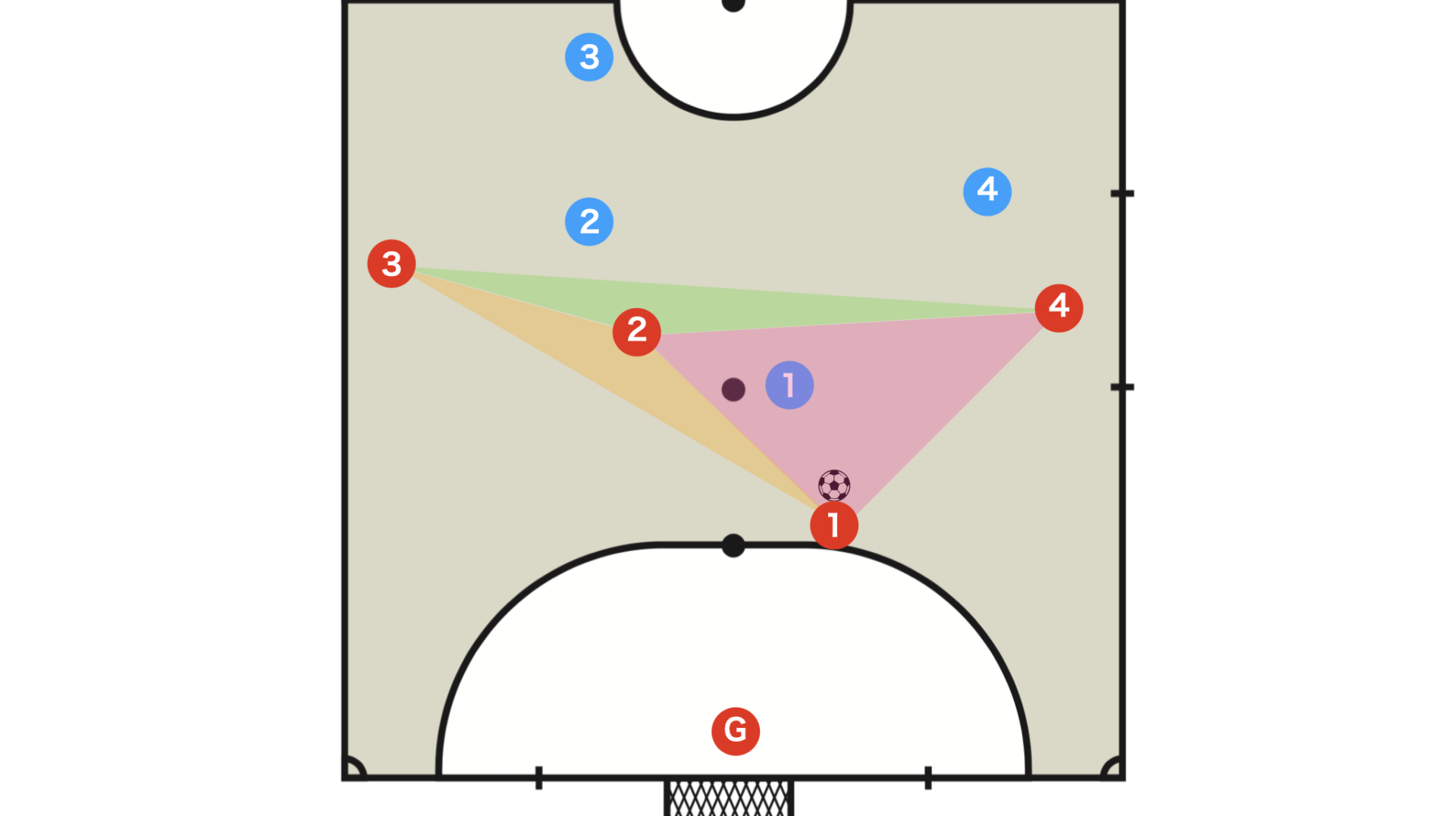
In quatro, because there is no pivot and all four players stay closer together, many compact triangles appear during the game.
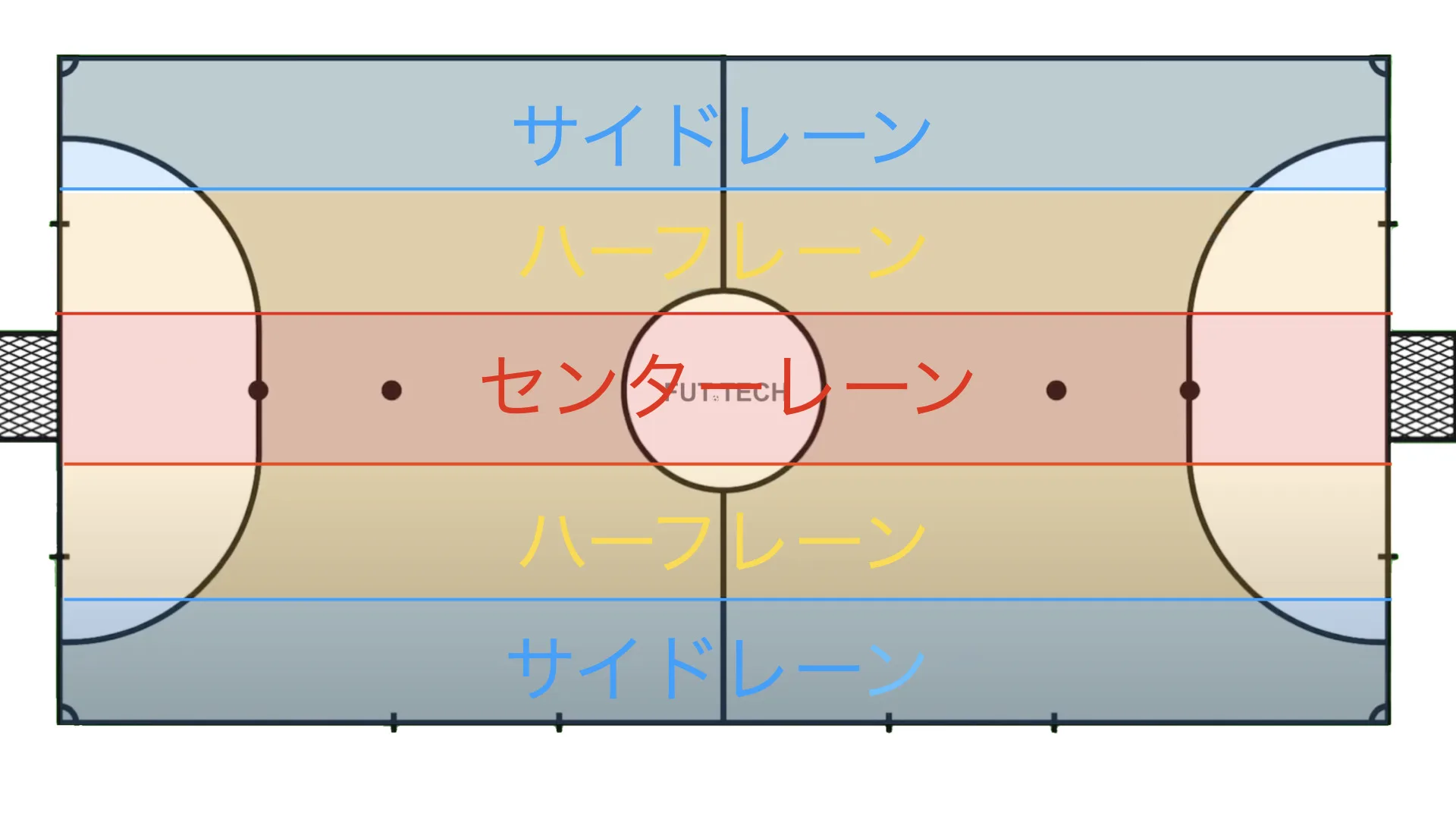
What matters here is that the four players do not stack vertically. In other words, the four players must not enter the same lane.
In principle, defenders position themselves between their mark and the goal in order to protect the goal, so if attackers line up vertically, the passing lane will inevitably disappear.
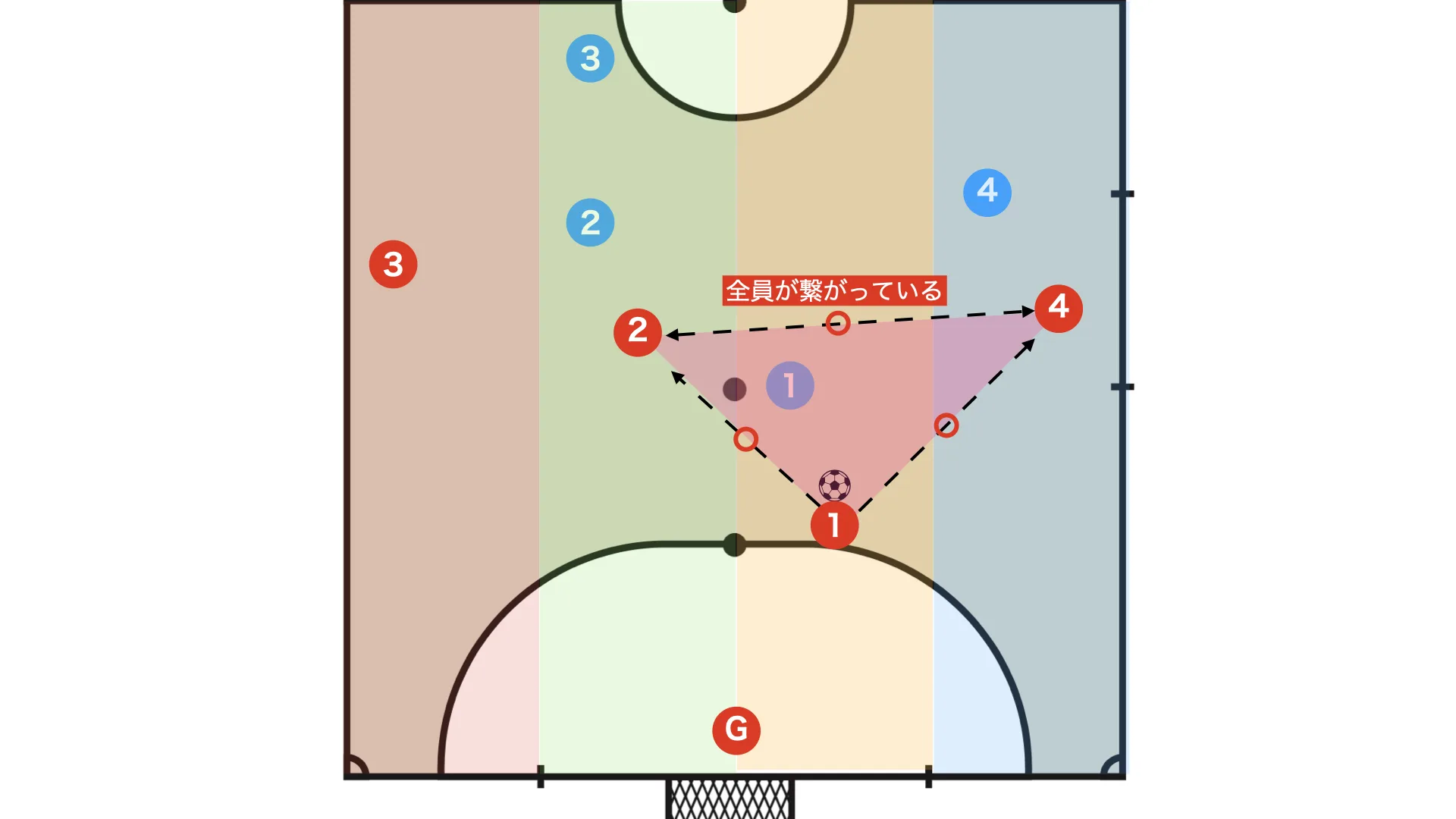
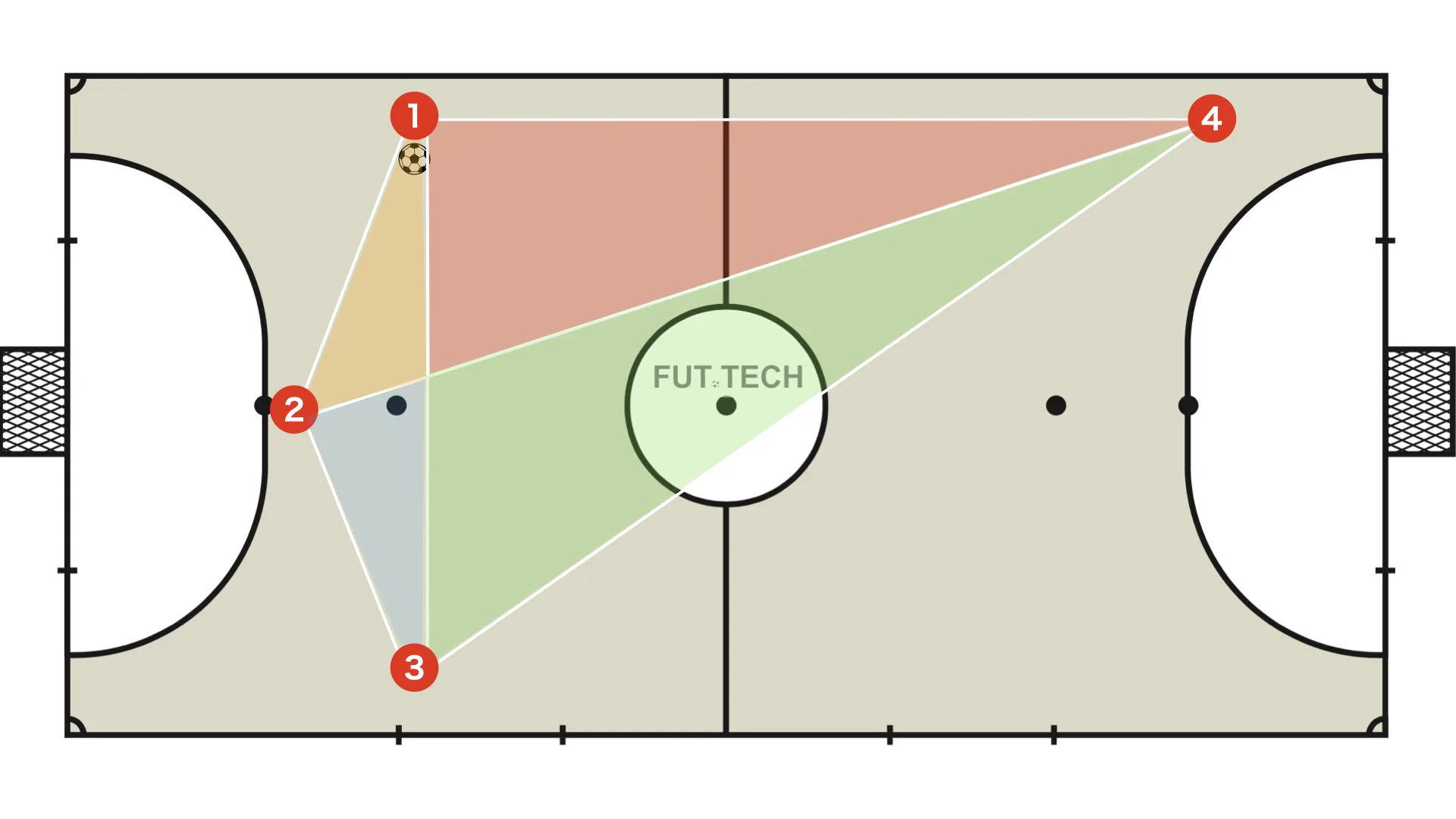
Because the three players are in separate lanes and are not stacked vertically, all three passing lanes remain open.
No matter where the ball is played, two passing lanes are always available, so the team can circulate the ball with the same feel as a 3v1 rondo.
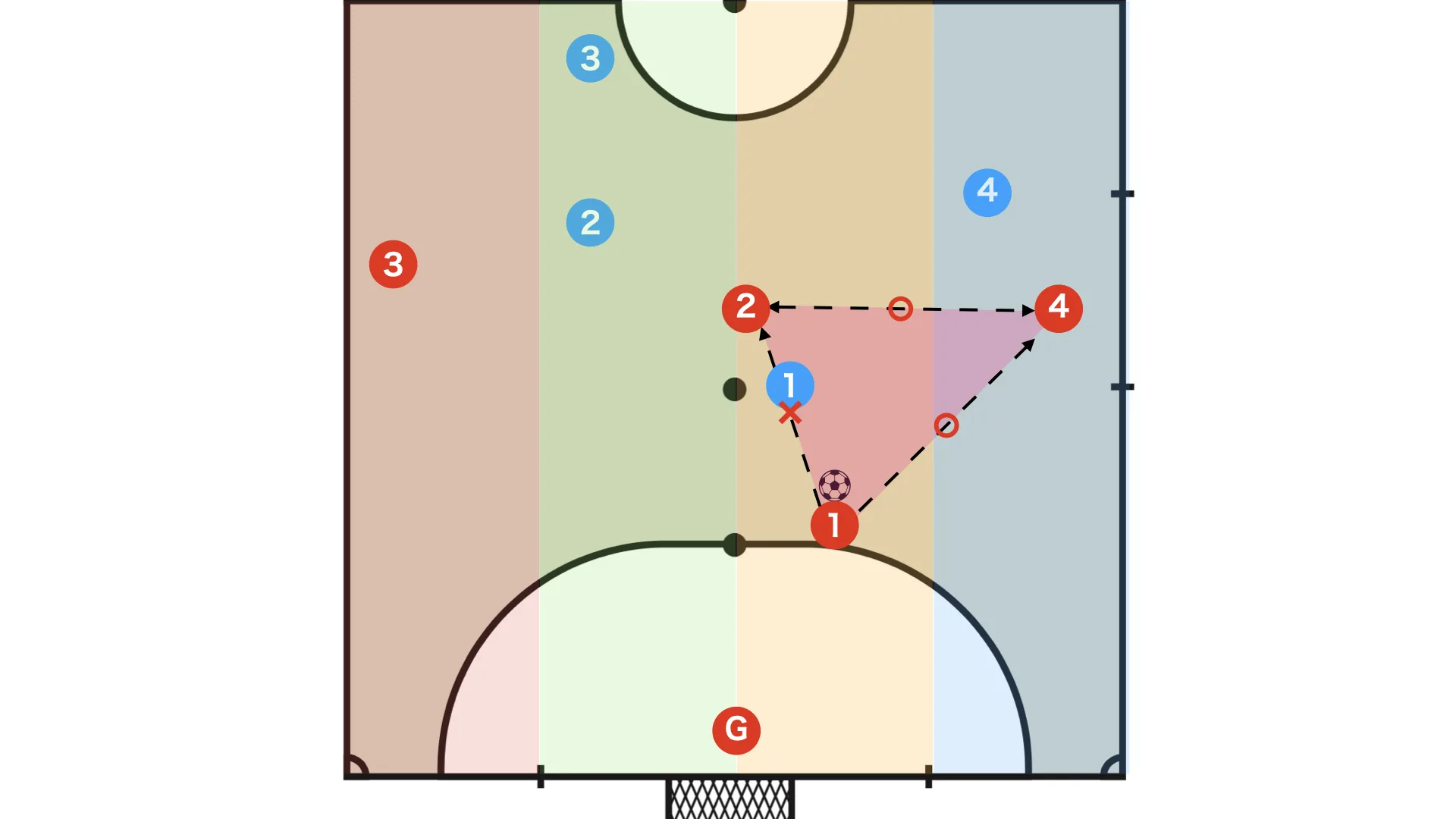
Because red number 2 moved into the same lane as red number 1, a passing lane has disappeared.
Even if the passing lane from red 1 to red 2 is gone, red 1 and red 4 are connected, and red 4 and red 2 are connected, so red 2 and red 1 are still connected indirectly.
However, the moment the passing lane between red 1 and red 4 disappears, there is completely nowhere to play the ball. Also, this situation must not happen because it makes the team easier to defend against.
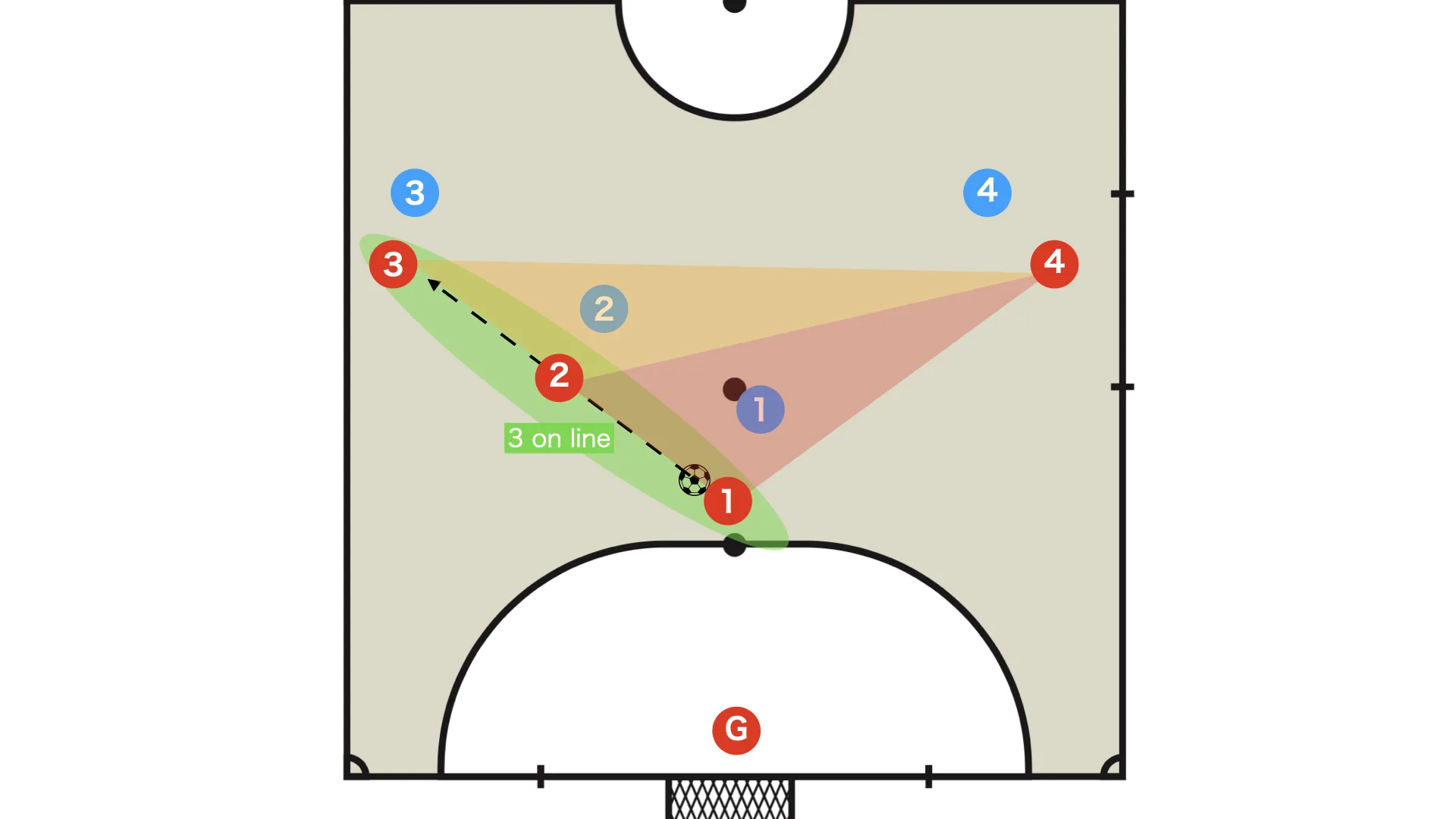
When players first start trying to use three-player tactics, they often become too rigid by focusing only on either 3 on line or the triangle, but these are basically three-player relationships that occur at the same time almost constantly.
It is necessary to develop the judgment to choose which three-player relationship to use to break down the opponent's defensive structure.
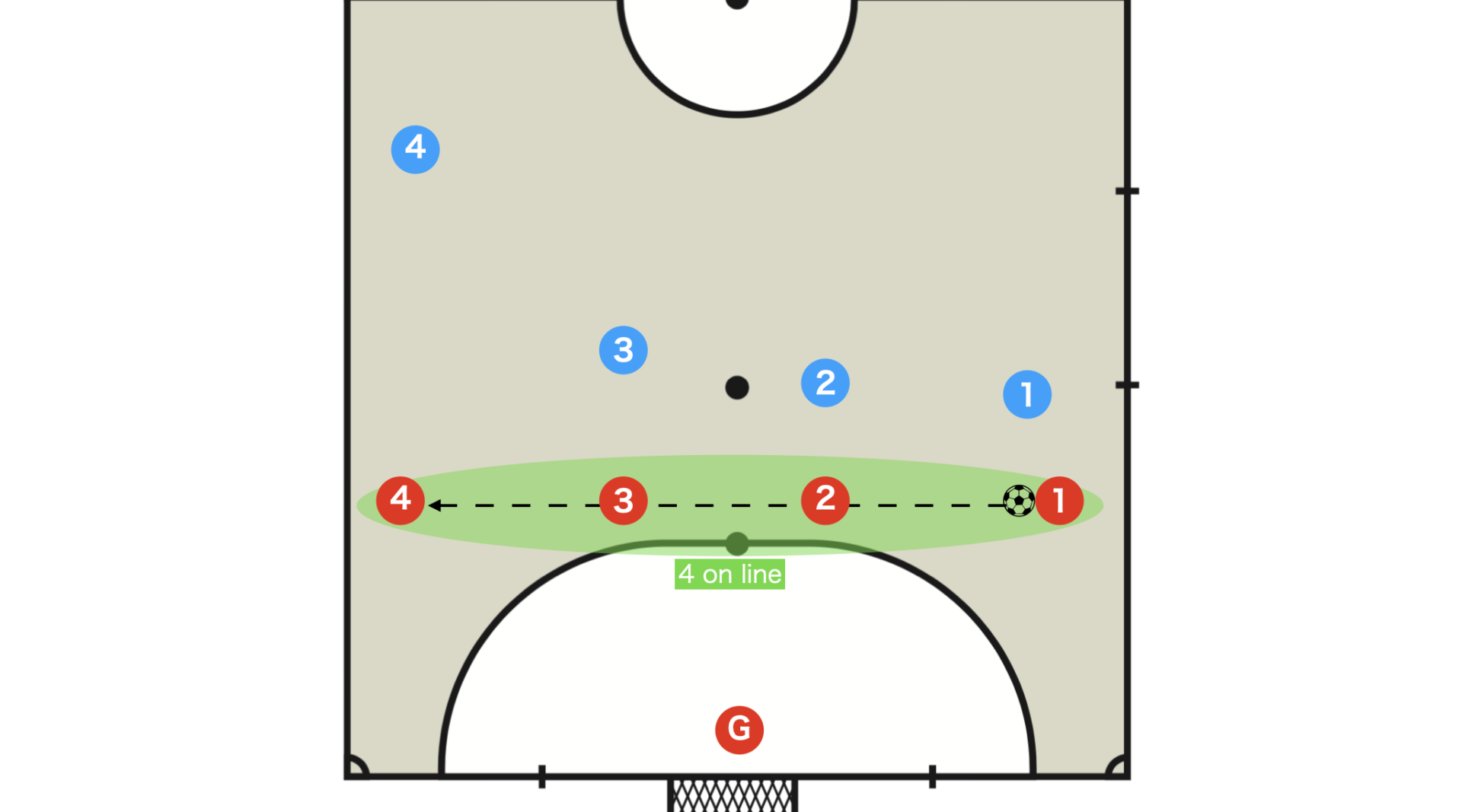
4 on line, where four players line up in a single row, is a rare phenomenon that can sometimes occur in quatro zero.
This is a very unusual shape because it is the only situation in which no triangle can be formed.
Why should 3 on line not be called 1-line?
Because 1-line includes both 3 on line and 4 on line, it does not make clear which one is being referred to. Some people occasionally call everything 1-line, but 1-line does not describe the situation accurately enough.
This time, I explained the tactics formed by three players: the triangle and 3 on line. These two concepts are critically important for anyone playing quatro, so if you use quatro, make sure you understand them well.
No matter what tactics you use, being aware of triangles is extremely important. Try to keep triangles in mind during your everyday training.
At the same time, attacks involving the third player only work because two-player relationships exist first, so rather than aiming too high immediately, I recommend focusing your training on two-player relationships first.
Finally, I will leave a video from the University of Tokyo Futsal Club about third-player movement, which I quoted several times in this article, so watch it with the ideas from this article in mind.