Set Plays (Restarts): Overview
Set plays are situations that mainly occur in the following cases:
- when the ball goes out of bounds (crosses the touchline)
- when an infringement occurs (foul, back-pass, etc.)
- when the ball hits the ceiling
- when the ball bursts
This article explains the rules and gives a simple overview of each set play.
Once the kicker is ready, the referee starts the count, and the restart must be taken within 4 seconds.
(The speed of the 4-second count varies depending on the referee.)
If more than 4 seconds pass, the set play is awarded to the opposing team.
In principle, players must stay 5 m away from the ball for most set plays, so when setting a wall in set-play defence, you need to be aware of that 5 m distance.
If the wall is set excessively close and clearly interferes with the opponent's restart, it can result in a yellow card.
If the opponents are the last to touch the ball before it fully crosses your own goal line, the restart is a goal clearance.
A goal clearance is a restart that begins with the goalkeeper throwing the ball from inside the penalty area. Because a back-pass cannot be used, it is often more effective to throw simply into the space behind the defence or to the pivot rather than forcing the ball to a nearby teammate in your own half.
A Classic Goal Clearance Pattern from a 3-1: Using the Pivo
A breakdown of one of futsal's most widely used set plays: a goal clearance from a 3-1 shape that us…
続きを読む →If the ball completely crosses the touchline, the kick-in is awarded to the team opposite the one that touched the ball last.
If the ball hits the ceiling, the kick-in is awarded to the team opposite the one that touched it last, taken from the point on the touchline closest to where it hit the ceiling.
- The ball must be stationary on the line at the point where it went out.
- A direct goal is not allowed, and play restarts with a goal clearance. (A direct own goal is also not allowed and results in an opponent's CK.)
- One foot, meaning the plant foot, may be outside the pitch. (2020/2021 law change)
Because a kick-in in your own half is far from goal, many teams use a designed play (jogada) aimed at escaping pressure.
Using the fact that one back-pass is allowed, escape patterns that involve the goalkeeper joining the attack have become popular worldwide.
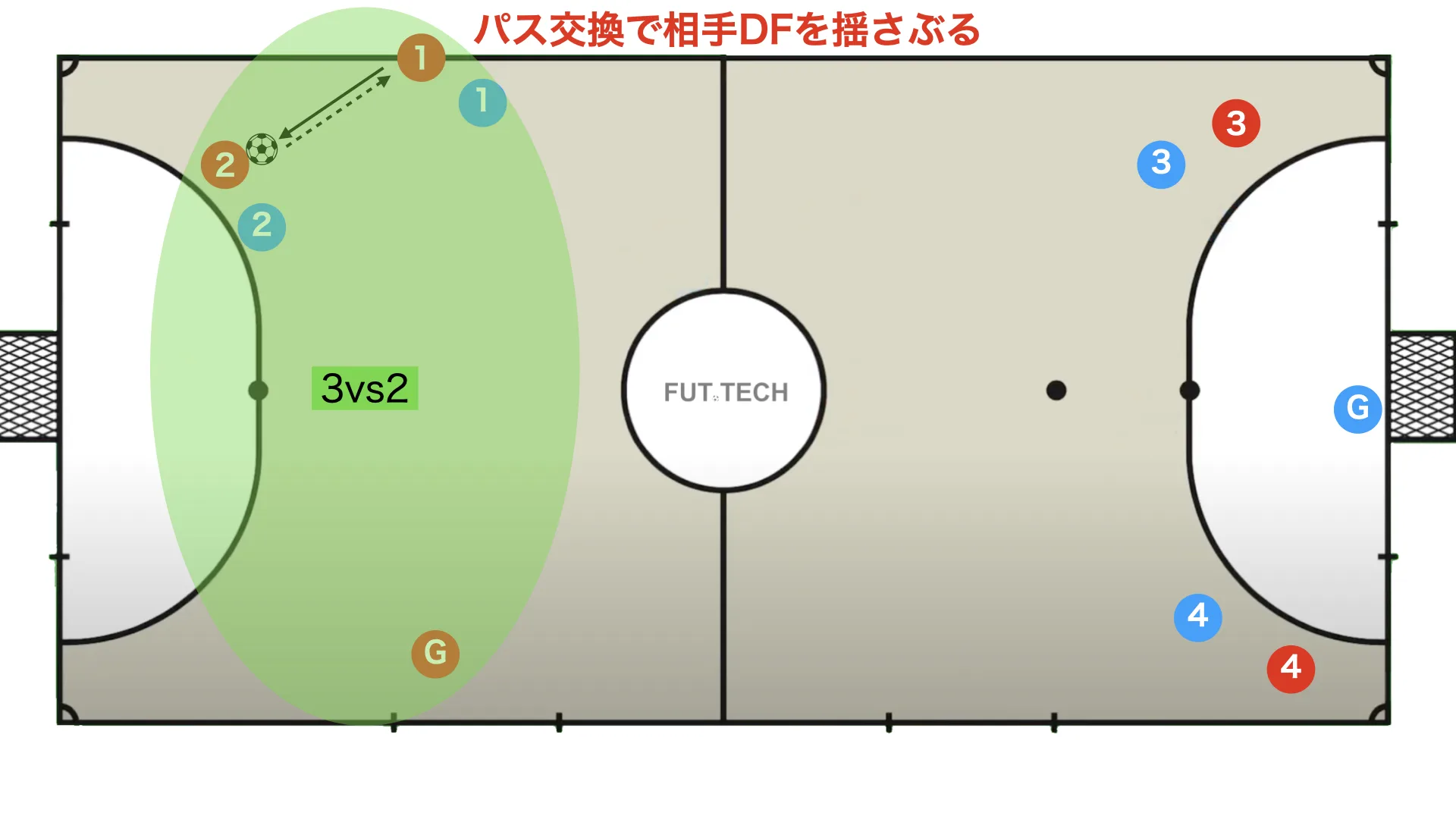
A Standard 3-2 Shape for Own-Half Kick-Ins with the Goalkeeper Joining the Attack
An explanation of the orthodox 3-2 own-half kick-in pattern used by many teams, with the goalkeeper …
続きを読む →A kick-in in the opposition half is a set play close to goal, so it allows you to threaten the goal with relatively little work.
One especially famous example is the simple but powerful chon-don, where the kicker taps the ball and the shooter strikes it. It is a set play that can be very hard to stop even when the defence knows it is coming.
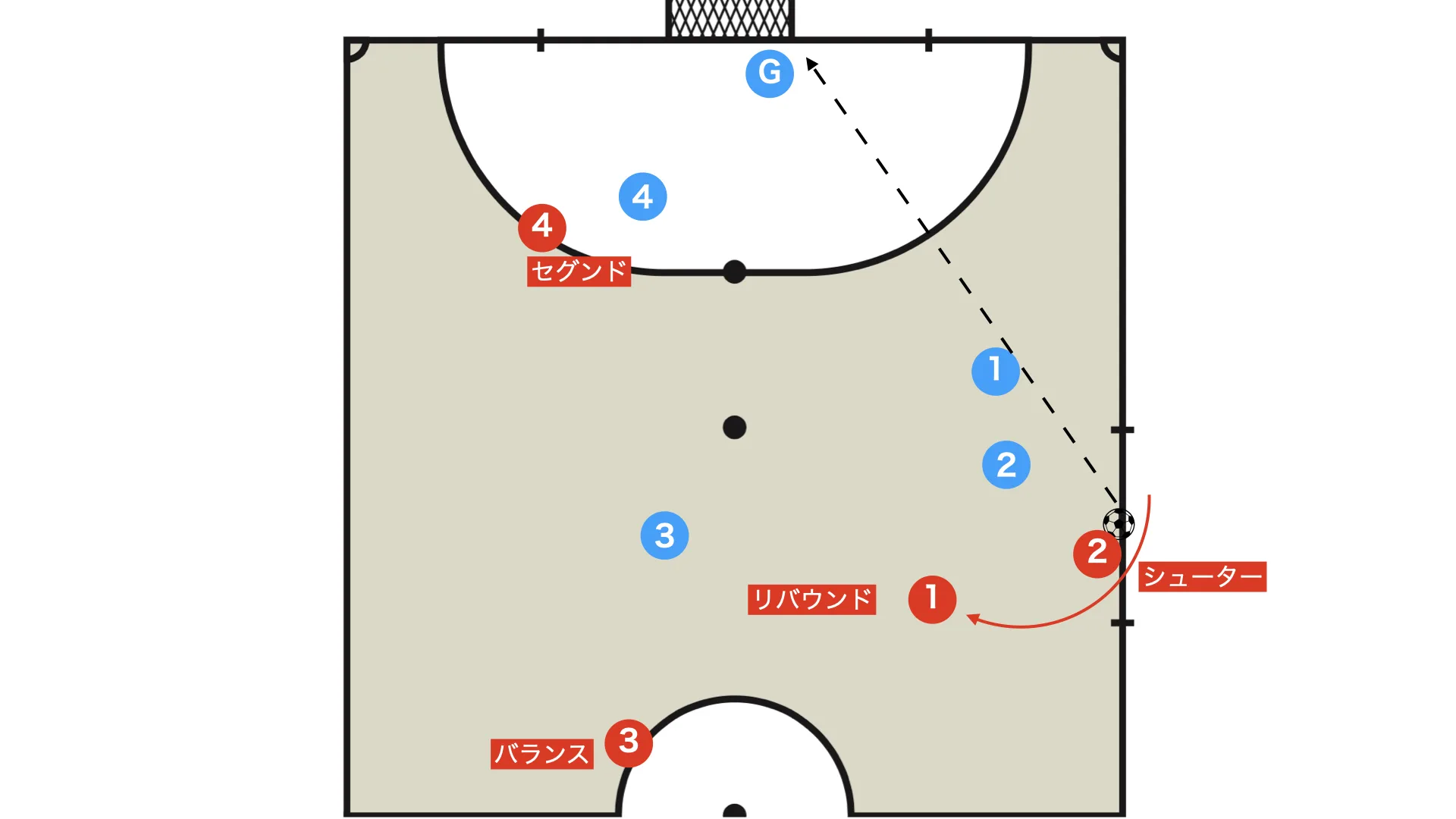
The Complete Guide to Chon-Don from an Attacking-Half Kick-In
A complete explanation of chon-don, the most famous attacking-half kick-in play in futsal. This guid…
続きを読む →If the opponents are the last to touch the ball before it fully crosses their own goal line, the restart is the corner kick taken from the nearer of the two corners.
- The ball must be placed inside the corner area (arc).
- A direct goal is allowed. (A direct own goal is not allowed and results in an opponent's CK.)
- The 4-second rule applies.
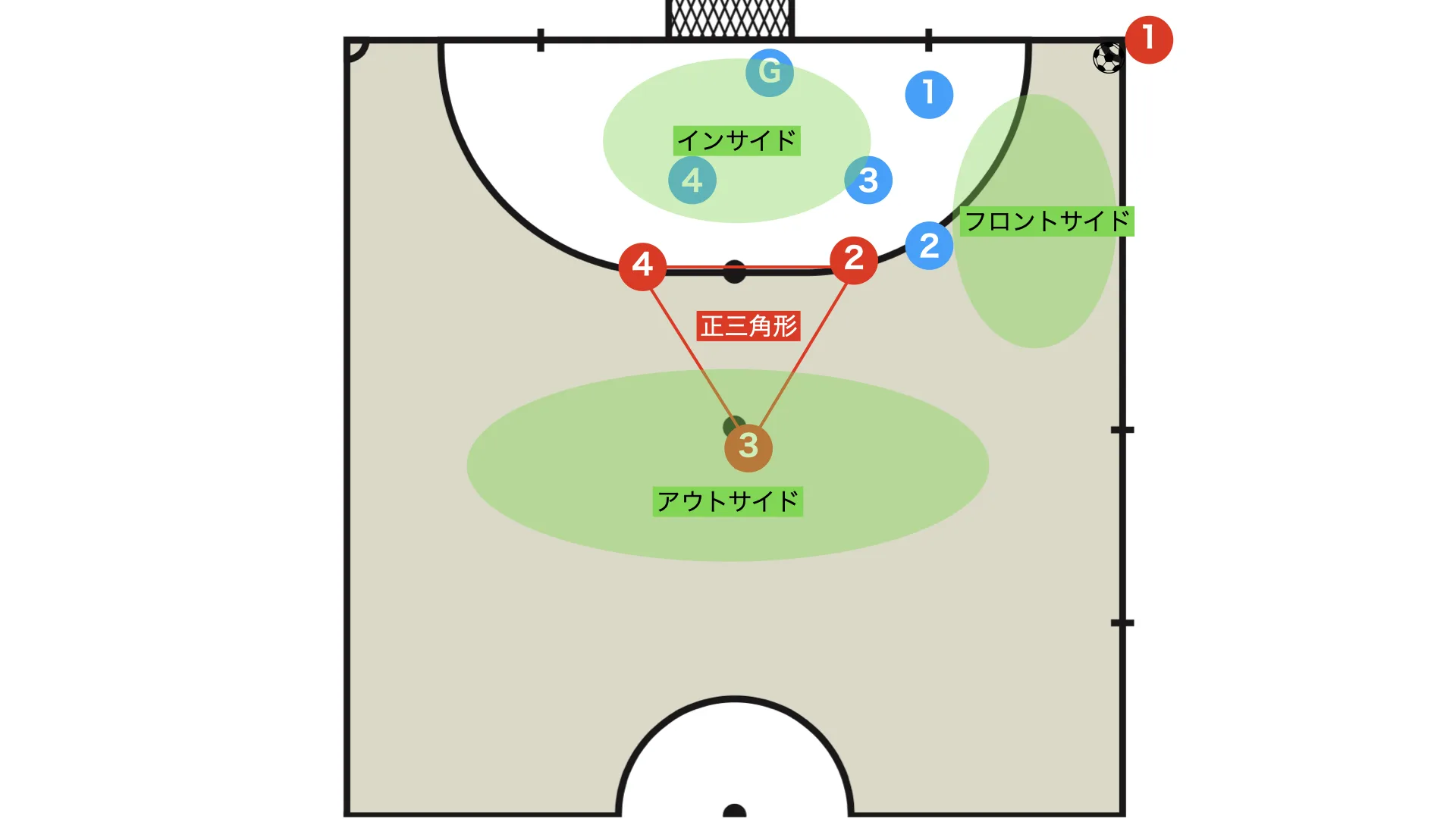
The Standard Futsal Corner Kick: Triangle Setup and 3 Attack Options
A complete guide to the most standard triangle corner-kick setup in futsal. From the basic structure…
続きを読む →After one team scores, the other team takes the kick-off.
- The ball must be stationary on the center mark, and once it is kicked and clearly moves, it is in play.
- Until the ball is in play, opponents must stay at least 3 m away from the ball. (They may not enter the center circle.)
- A direct goal is allowed. (A direct own goal is not allowed and results in an opponent's CK.)
- Only the kicker, meaning the player who first kicks the ball, may be in the opposition half. All other players must remain in their own half.
Due to the 2020/2021 law revision, it became legal to kick the ball backward.
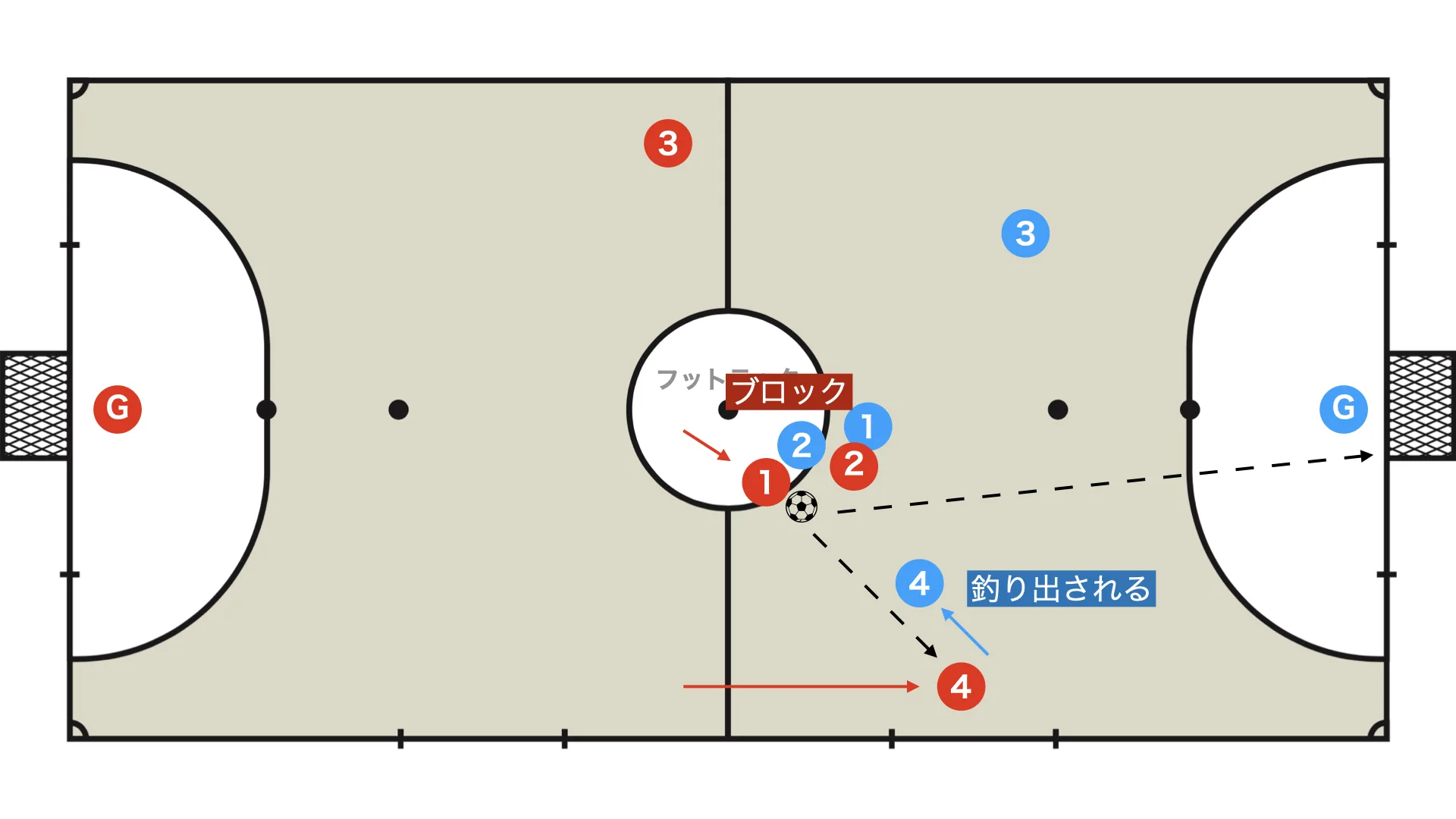
Kickoff Tactics for Futsal: Set Play Ideas Every Team Should Have
A practical guide to futsal kickoff set plays. This article introduces several unique tactical patte…
続きを読む →The 4-second rule applies.
The referee and second referee indicate an indirect free kick by raising one arm above the head and keep this signal until the kick is taken and the ball touches another player or goes out of play.
If one or both referees fail to raise a hand to indicate that the free kick is indirect and the ball is then kicked directly into the goal, the indirect free kick must be retaken.
A direct FK is awarded for fouls such as the following:
- handball
- charging, tackling, tripping, etc.
- biting another player or spitting at another player
- violent conduct or throwing an object
If excessive force is used and an opponent is put in danger, the player is shown a red card and sent off.
If the ball goes directly into the goal without touching an opponent, the restart is the opposing team's goal clearance. (A direct own goal is also not allowed and results in an opponent's CK.)
An infringement for a back-pass results in an indirect FK.
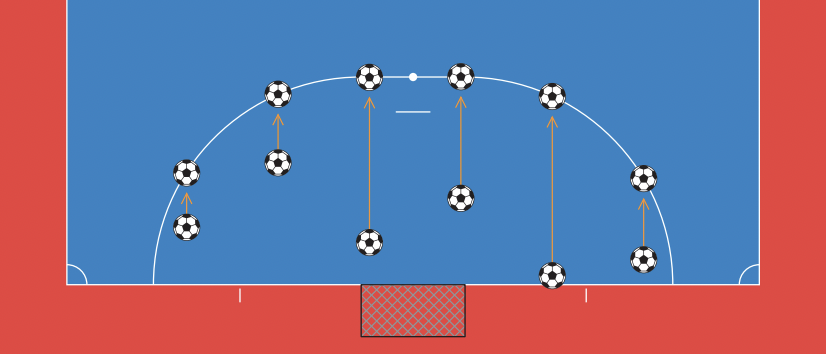
The kicker must be clearly identified.
Until the ball is kicked, the defending goalkeeper must face the kicker and stay on the goal line between the posts, without touching the goalposts, crossbar, or goal net.
All players other than the kicker and goalkeeper must be positioned as follows:
- inside the pitch
- at least 5 m away from the penalty mark
- behind the penalty mark
The foul count accumulates with each foul, and once it reaches 6, the opposing team is awarded a second PK.
The foul count is reset at half-time.
If a foul is committed inside the penalty area, the opposing team is awarded a PK.
In cup competitions (tournaments), if the match is still tied within normal time, including extra time, each team takes 5 penalties to decide the winner.
If both teams are level on goals after 5 kicks each, it goes to sudden death.
The 2020/2021 revision to the Laws of the Game changed the number of penalty takers from 3 to 5.
In futsal, set plays are an important phase where goals are especially likely, second only to transitions.
Before working on finer tactical details, I recommend first getting the rules firmly into your head.