What Are the Positions in Futsal? Explaining the Roles of the Pivo, Ala, Fixo, and Goleiro
Published: 2021.01.04Updated: 2026.05.03
Have you ever thought, "I want to start playing futsal, but there are too many positions and I do not really understand them"?
In futsal, there are four positions: pivo, ala, fixo, and goleiro, and their names and roles are very different from those in soccer. Just knowing which position suits you can greatly reduce the hesitation in your play.
In this article, I will explain each position's role, movement patterns, and the traits of players who are suited to it with easy-to-follow diagrams. Once you understand the positions, deepen your understanding with the detailed articles for each one: Pivo and Fixo.
The basic positions in futsal are the following four:
- Pivo (PIVO)
- Ala (ALA)
- Fixo (FIXO)
- Goleiro (GOLEIRO)
In this article, I will explain the names and roles of futsal positions, as well as the types of players suited to them, in a way that is easy for beginners to understand.
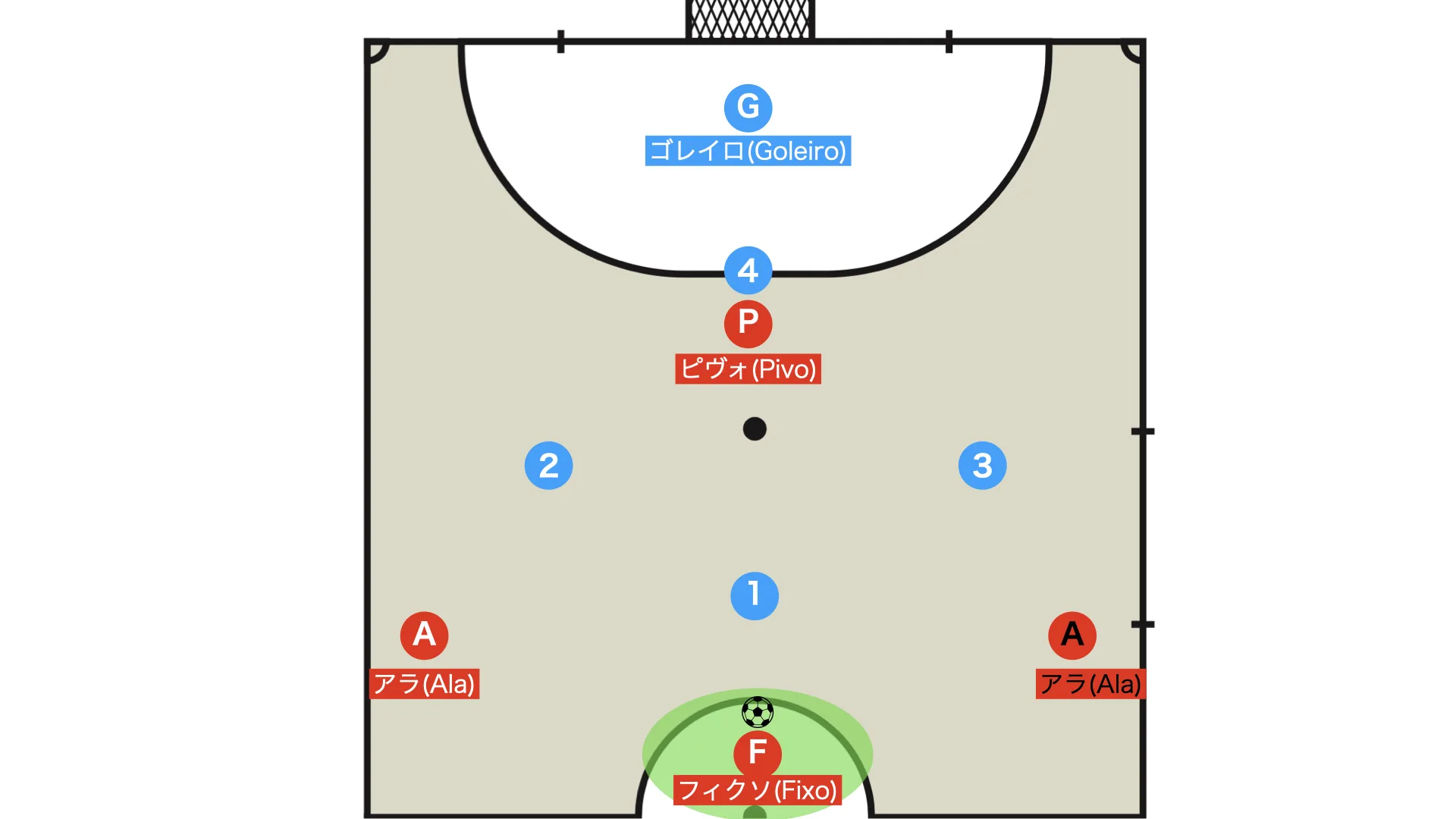
- Pivo: The attacking focal point at the front, receiving the ball under pressure and creating shots or lay-offs
- Ala: The wide player, supporting both attack and defence through 1v1s, link play, and constant up-and-down movement
- Fixo: The defensive anchor at the back and also the starting point of the build-up, like an on-court organizer
- Goleiro: Involved not only in shot-stopping but also in distribution and communication throughout the match
Before thinking about which position suits you best, it is important to first get a broad sense of how the roles differ.
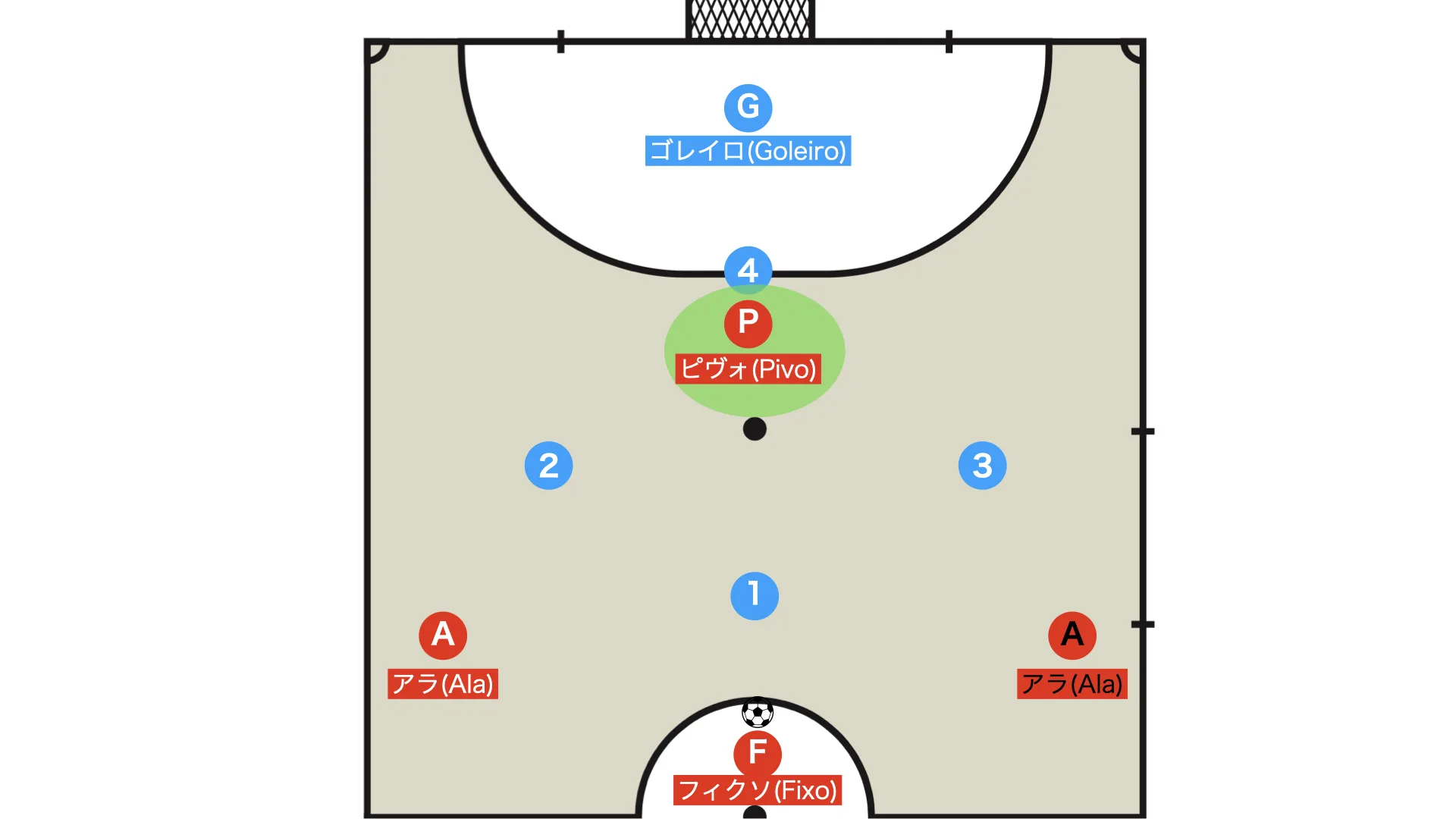
In Portuguese, pivo means "axis, center, or tip," and it refers to the field player positioned furthest forward.
The pivo is expected to receive the ball with a defender on their back, then either shoot or connect play to teammates, serving as the attacking focal point.
Broadly speaking, there are two main types: the fixed pivo, who stays mostly central and plays with a defender on their back, and the fluid pivo, who moves all over the pitch and can also play wide or deeper.
There is also the role or tactical idea of the false pivo, who looks like a pivo but drops into the second line, creating space on the weak side or supporting between the lines.
There is also a detailed article explaining the futsal pivo, so if you are interested, take a look.
From here, I will introduce three key characteristics of the pivo.
The pivo, who plays at the front, is the position among field players that sees the most physical contact.
You cannot play there unless you can keep possession without losing the ball even while holding off a defender.
One of the most common scoring patterns for a pivo is receiving with a defender on their back and then turning to shoot.
Being able to turn and get into a shot is one of the defining traits of an excellent pivo.
An important part of the pivo's job is scoring goals.
Whether playing with a defender on their back or facing forward, being able to strike a powerful and accurate shot is a major weapon for the team.
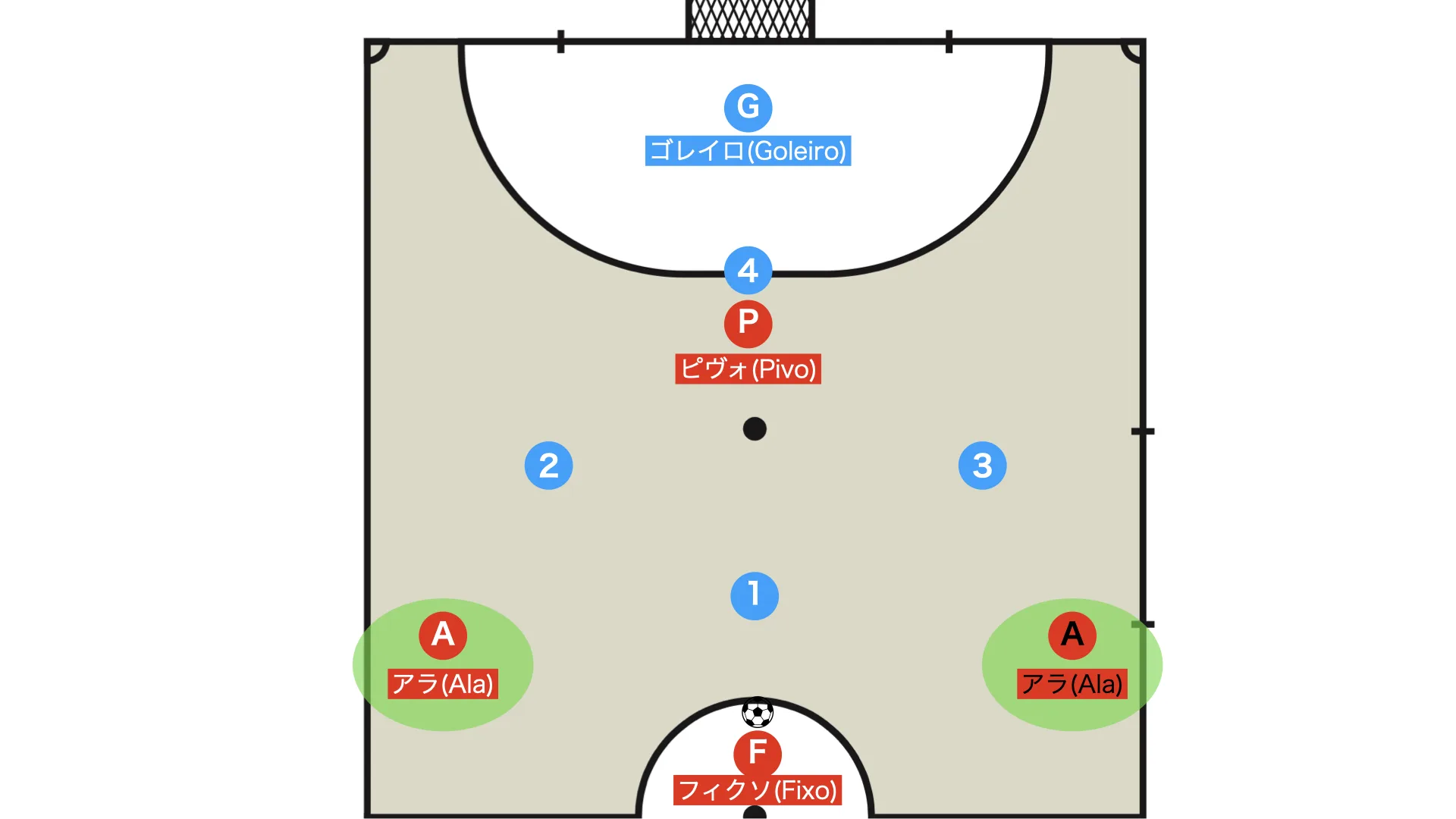
In Portuguese, ala means "side."
There are many different types of ala.
Some are excellent at taking players on with the dribble, some are energetic runners who keep the team moving, and some build the game mainly through passing. Different alas bring different strengths.
It is no exaggeration to say that a team's style changes depending on the combination of its alas.
Players whose base position is ala but who can also perform pivo-like actions are called ala-pivo, while more defensive players are called ala-fixo.
From here, I will introduce four characteristics of the ala.
In attack, alas are expected to create a good relationship with the pivo, whether by passing into the pivo or receiving again after the pivo gets on the ball.
One of the ala's jobs is to take on 1v1 dribbles when receiving the ball out wide.
If a player is especially strong in 1v1 situations, the team may even isolate them on purpose to make it easier for them to attack.
Maintaining the team's overall balance is one of the ala's important roles.
Ideally, an ala should have the tactical awareness to read what is happening on the pitch and judge what needs to be done in that moment.
Speed in transition is essential, whether that means pressing and covering after losing the ball or breaking forward after winning it back.
In Portuguese, fixo means "steering" or "the one who directs the team."
The fixo plays deepest among the field players and is often the one matched up against the opponent's pivo.
To stop the opposing pivo from playing freely, excellent anticipation and strong 1v1 defending are essential.
When on the ball, the fixo does more than anchor the defence. They also play an important attacking role, whether by setting the rhythm of the game with passes or threatening goal with mid-range shots.
Here are four characteristics of the fixo.
The first job is to mark the pivo, who is the focal point of the opponent's attack.
The physical strength to battle with a pivo and the ability to defend in coordination with the goleiro are absolute requirements.
Because the fixo generally plays as the deepest field player, they must judge the situation correctly, deciding when to step forward and when to stay back while reading the team's balance and the flow of the match.
The fixo, who often has the ball in deeper positions, also takes on the role of playmaker.
If the fixo can play a vertical pass into the front-line pivo, the team can create chances from a simple pattern.
The fixo, positioned at the back, is relatively likely to be left unmarked.
If they can shoot from distance when receiving the ball in deeper areas, it expands the team's attacking options.
関連記事
What Is the Fixo in Futsal? Role, Positioning, and How the Game Starts from the Back
A complete guide to the fixo, the player who anchors the futsal court. This article explains how the…
続きを読む →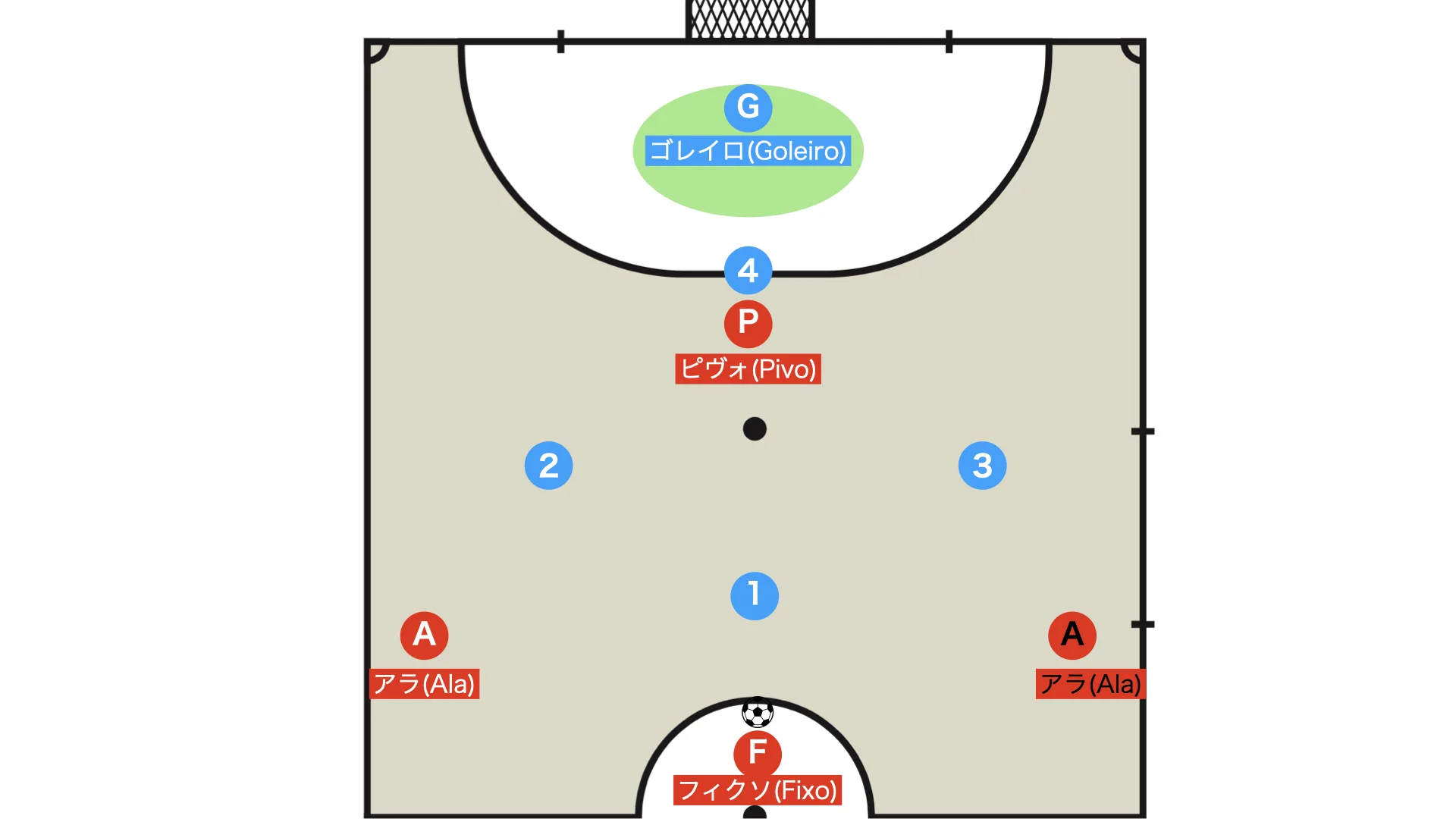
In Portuguese, goleiro means "goalkeeper."
Just like a goalkeeper in soccer, the biggest job of the futsal goleiro is to stop the opponent's shots.
At the top level, people even say that "50% of the result is decided by the goleiro," which shows how much influence the position has.
The goleiro is also frequently involved in attack through throws and long distribution, and it is not unusual for a goal-creating pass to come from the goleiro.
They are also expected to come outside the penalty area to provide cover.
At times, the goleiro may even join the attack in a power play and end up scoring.
Here are four characteristics of the goleiro.
More than anything else, the goleiro is expected to stop shots.
With correct positioning, they must stop shots using not only their hands but also their feet.
The goleiro must coach teammates and increase the team's chances of stopping shots.
To give accurate instructions, they need an understanding of futsal tactics and experience as a goleiro.
For a goleiro, being able to make accurate throws and long distribution is extremely important.
In particular, a throw after catching an opponent's shot can easily lead to a counterattack.
Some teams also have the goleiro join the attack on kick-ins in their own half.
When necessary, the goleiro must come out of the penalty area and provide cover.
They must stay alert and make the right decision at all times, not only when facing shots.
This time, I introduced the four futsal positions: pivo, ala, fixo, and goleiro.
The names of the positions are always used when talking about futsal tactics, so if you still have not learned them, make sure you do.
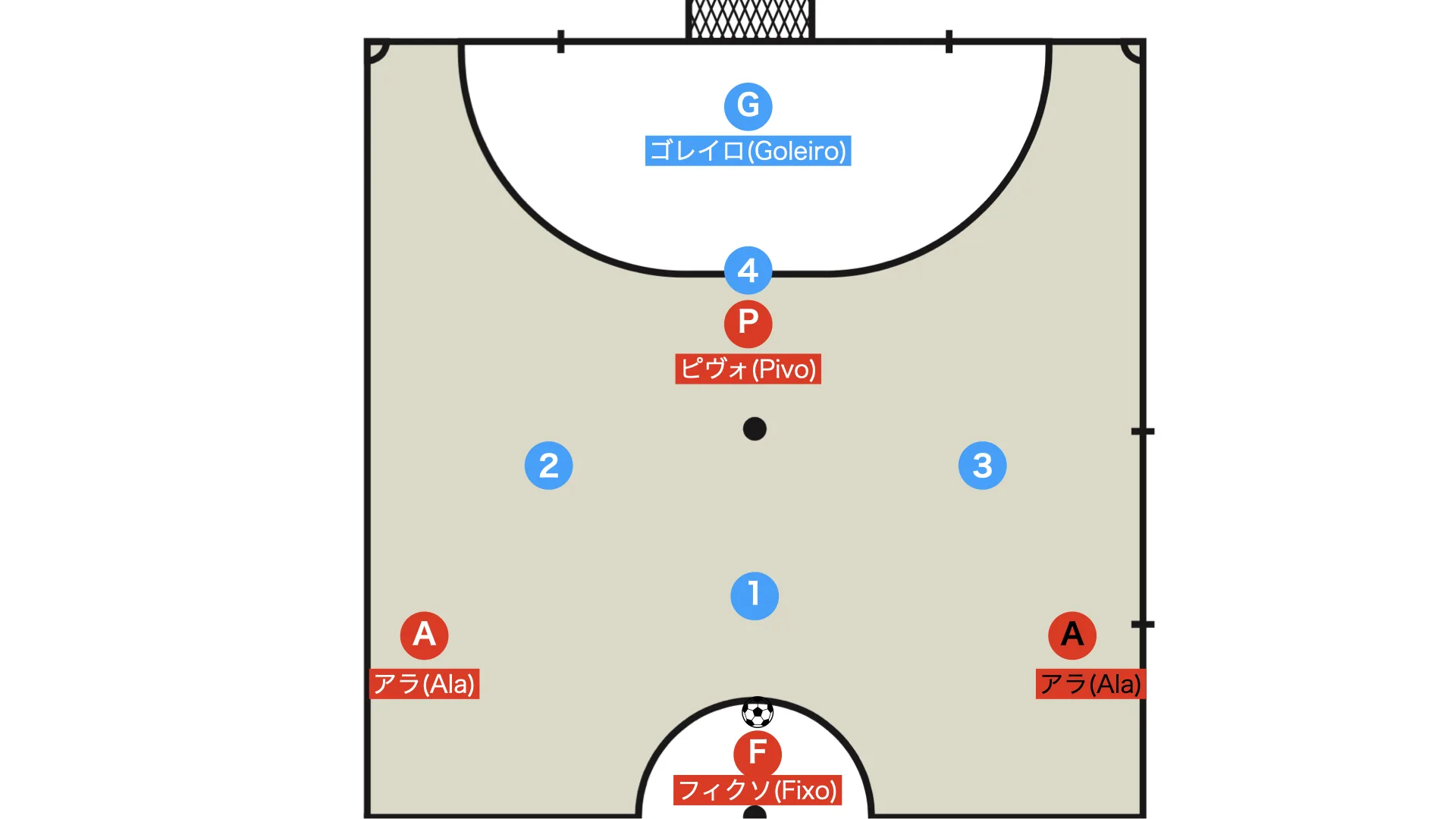
This article used positional diagrams from the 3-1 (3-0-1), the most common shape in futsal, but in other systems the roles and positions change, so if you have time, think about that as well.
Also, playing in a position that suits you is very important for performing at a high level, so at first you should try different positions and look for the one that fits you best.
Parts of this article quote from Futsal Tactical Training Design by former Shriker Osaka coach Mr. Kogure.
It is a very informative book for coaches because it explains training methods in detail, so if you are interested, it is well worth reading.
I also quoted a position-introduction video from the University of Tokyo Futsal Club (Sanpachi Sensei).
They post highly educational videos, so take a look if you are interested.