What Is Tonpa (Contrapie) in Futsal? How to Do It and When to Use It Instead of Inward Dribbling
Published: 2021.01.05Updated: 2026.05.03
"They played the ball attack for me, but I hesitated between tonpa and inward dribbling and messed it up." If that has happened to you, this article is for you.
Tonpa (contrapie) is a move where you beat the defender to the outside, taking the ball in the opposite direction from inward dribbling. Once you really internalize when to use each one, your options in 1v1 situations increase dramatically.
This article explains how to do tonpa, the key points, and the mistakes players often make. If you want to deepen your individual technique further, also see Dribbling Theory.
In this article, we will cover these five points:
- what tonpa (contrapie) is
- how it differs from ball attack and inward dribbling
- how to do tonpa (contrapie)
- how to choose between tonpa (contrapie) and inward dribbling
- practice drills that help you use it in matches
To state the main point first, tonpa is not a standalone technique. It is an individual tactical action used to take the defender the wrong way after first showing ball attack and inward dribbling.
Because the futsal court is small, when the opponent presses aggressively it is important not to stop the ball under your feet, but to move it with your first touch. Directing and moving the ball with your first touch is called control orientado.
- It is a move that takes the defender the wrong way after they have stepped in expecting inward dribbling.
- It is especially effective when used after changing your receiving position with a ball attack.
- The basic idea is to push the ball outside with your first touch as you receive.
- The key is not to force "tonpa only," but to create a two-way choice together with inward dribbling.
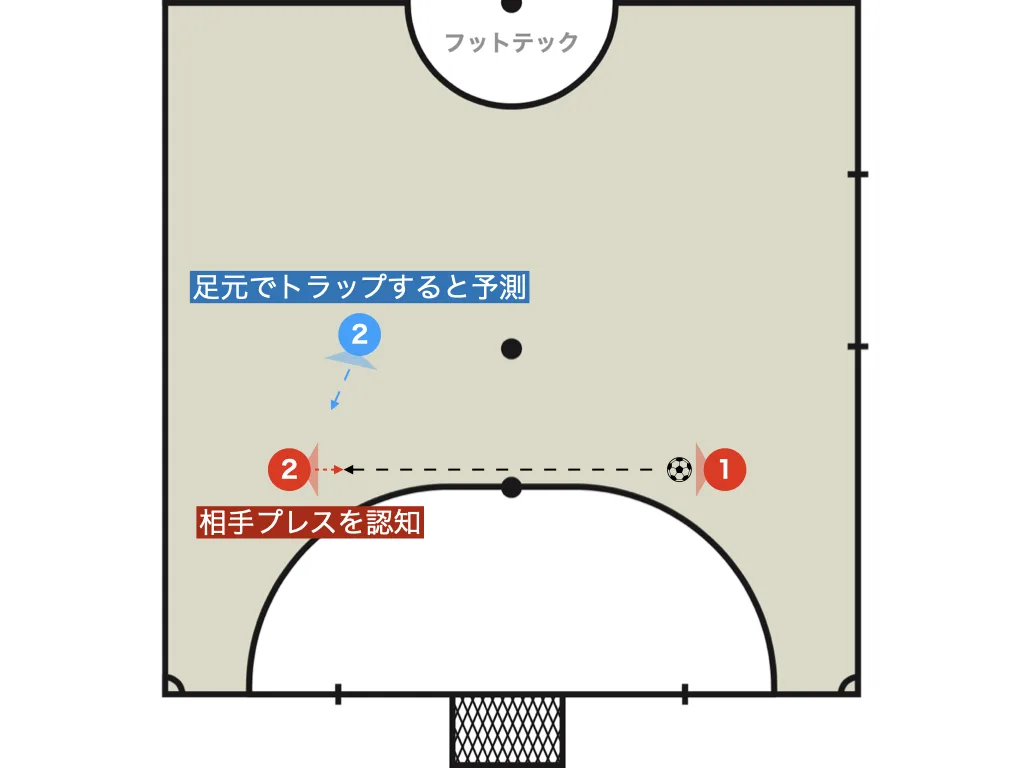
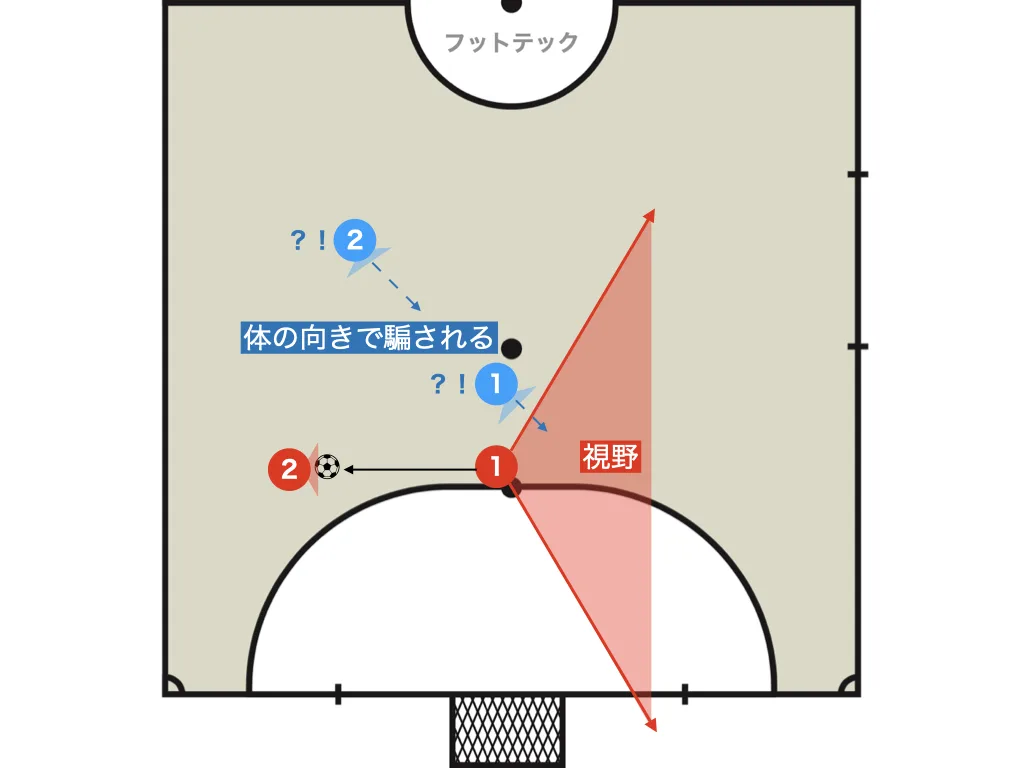
In futsal, a ball attack means moving toward the passed ball yourself and receiving it in a different place from where you were originally standing.
Taking the ball toward the inside of the court is called inward dribbling.
By combining a ball attack, where you go meet the ball, with inward dribbling on the first touch, you can avoid intense pressure from the opponent.
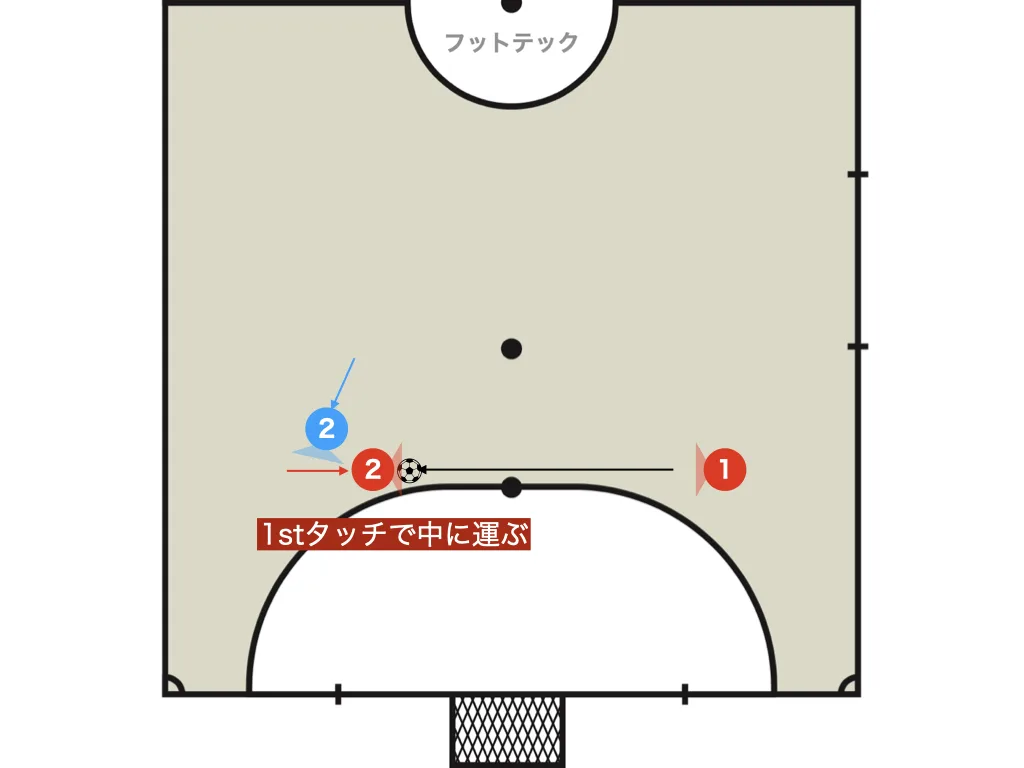
When the defender's pressure is strong, trapping the ball at your feet exposes it to the opposing defender and makes it much more likely that you will lose possession.
But by using a ball attack, you can receive the ball in a different spot from the one the defender expected. As shown in the diagram above, that lets you avoid the pressure from the moment you receive.
And if you choose inward dribbling with the first touch after the ball attack, the ball moves to a spot the defender cannot reach, which lowers the risk of losing it.
This movement of going to meet the ball and changing the place where you receive the pass in order to shake your marker is also called atacar el balon.
If you can fully beat your marker with ball attack and inward dribbling, you can create a local numerical advantage. From there, attacks such as passing to the far ala and breaking through with a parallel become effective.
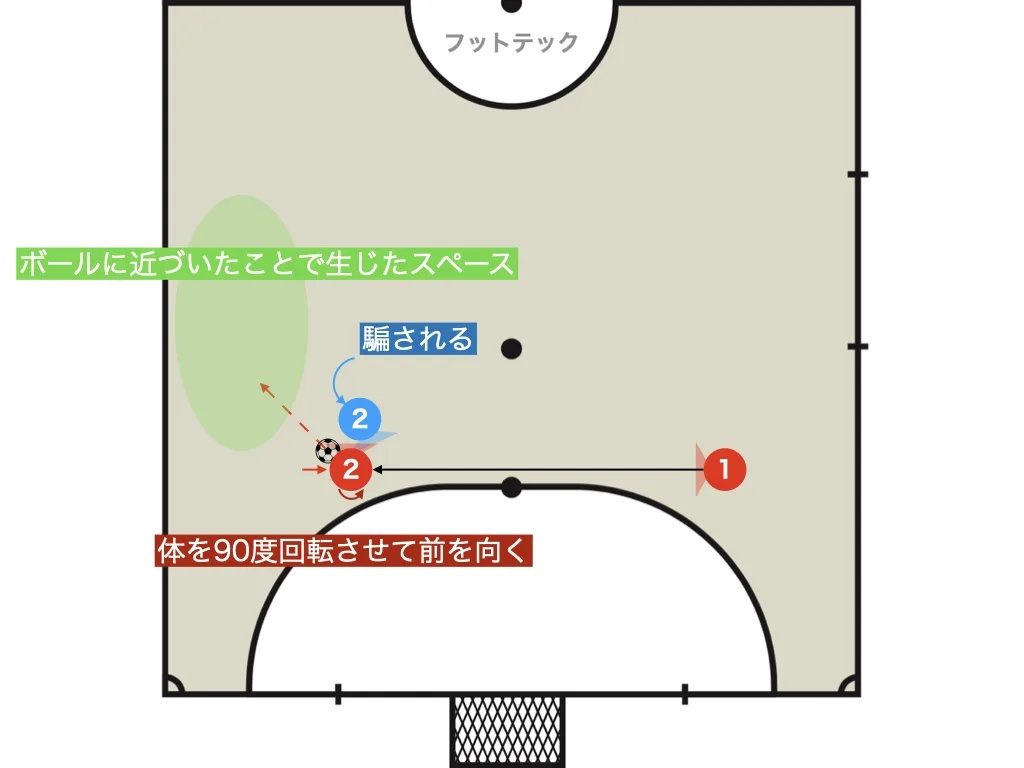
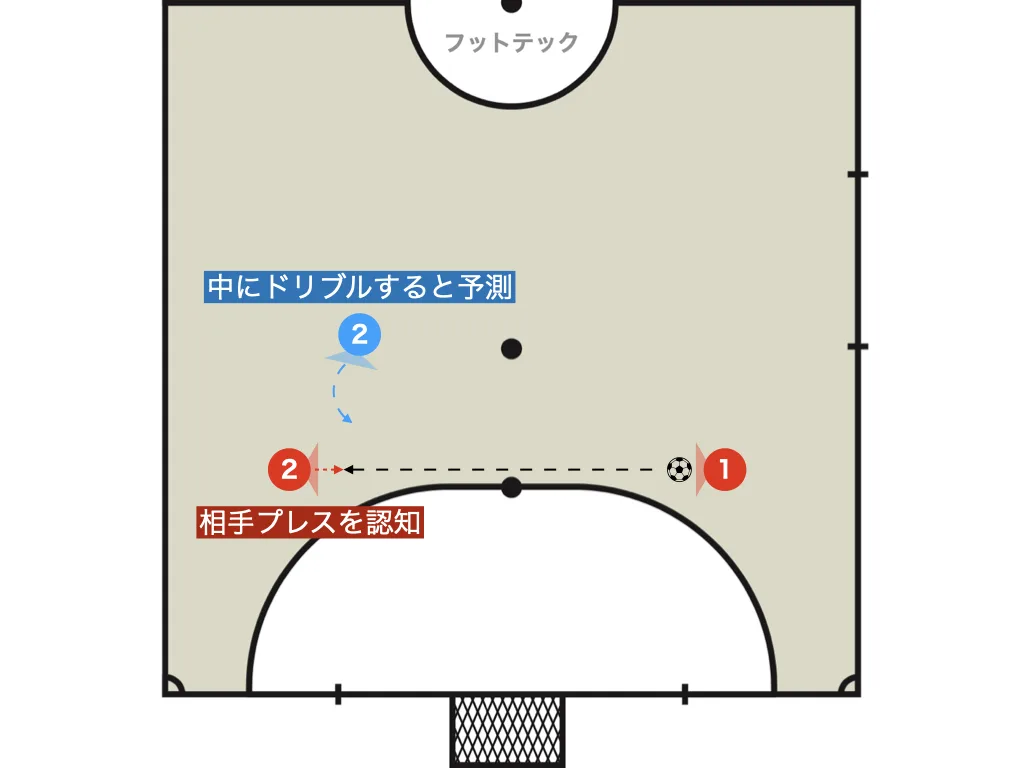 In futsal, tonpa (contrapie) is a move where, after a ball attack, you take the ball outside instead of using inward dribbling.
If you keep using ball attacks, there is a chance the opposing defender will begin to anticipate them and look to jump them.
Tonpa (contrapie) goes in the opposite direction from ball attack and inward dribbling, so it is effective against defenders who are expecting that pattern.
Contrapie is a Spanish term meaning to take the opponent the wrong way. It is also called tonpa because you stop the ball with the sole of your foot on the "ton," then place the foot back on the floor on the "pa."
The basic way to perform tonpa (contrapie) in futsal can be broken down into five steps:
- Go meet the passed ball in the same way you would for a ball attack.
- Read the defender's movement and decide that tonpa (contrapie) is a better option than ball attack plus inward dribbling.
- Use the sole of the foot closest to the pass (for example, your right foot if the pass comes from the right) to stop the ball in place.
- As you trap the ball, turn to face forward and shape your body so you can go in the opposite direction.
- Use the trapping foot to carry the ball away in the opposite direction.
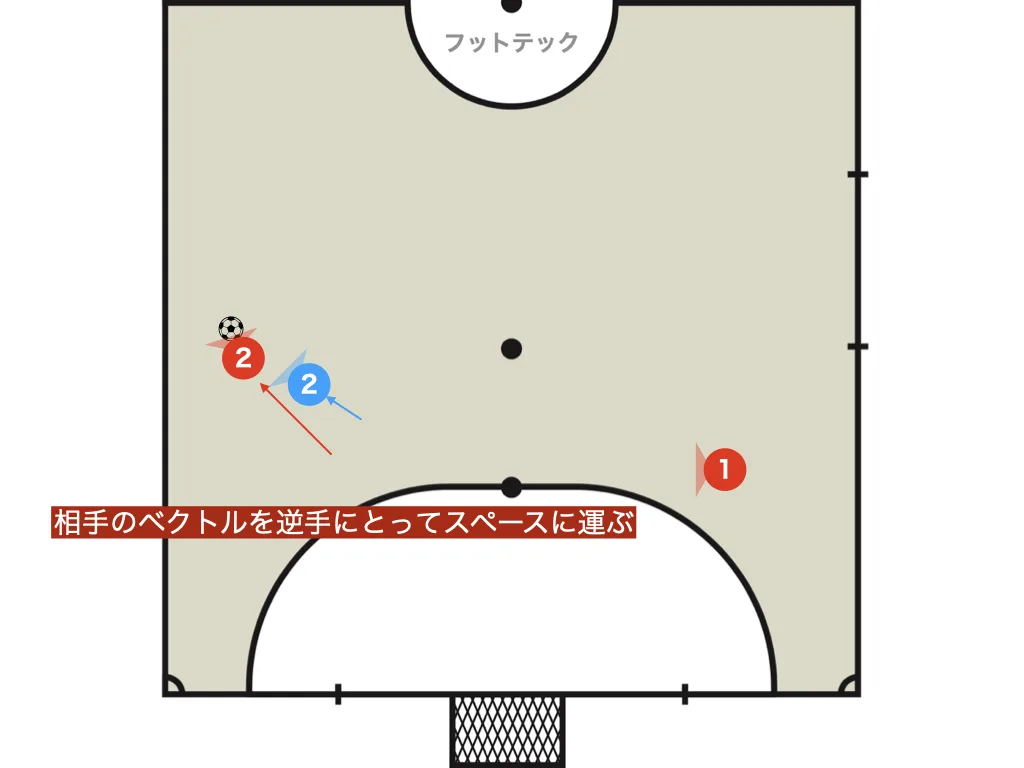
Because the ball attack has created space toward the sideline, you are able to carry the ball forward there.
If you receive the ball near the touchline without making a ball attack, the side space is too tight, so tonpa (contrapie) becomes much harder to pull off.
There are also slightly irregular variations of tonpa (contrapie) in futsal.
One of them is the opposite-side tonpa.
In the standard version of tonpa (contrapie), you trap the pass with the foot closest to the ball.
That means that on your strong-foot side, you would normally need to trap with your weaker foot. In that situation, using your strong foot to make the trap for a tonpa (contrapie) is called opposite-side tonpa.
Among futsal tonpa (contrapie) variations, the one that uses a double touch is called double-touch tonpa.
It is especially effective when the opponent's pressure is intense and it feels like they may get a touch on the ball.
If you make the double touch slightly backward, it becomes even harder for the defender's foot to reach the ball, lowering the chance of losing possession.
This one is a bit advanced, but in futsal there is also a tonpa (contrapie) that uses a behind trap (heel).
Here too, it is important to first suggest that you are going to use ball attack and inward dribbling, then step your body in front of the defender and trap the ball with your heel.
How should you decide between tonpa (contrapie) and ball attack?
Basically, tonpa exists on top of ball attack and inward dribbling, so you should not separate them completely.
In other words, ideally, ball attack plus inward dribbling and tonpa should look almost exactly the same right up until the trap.
A common bad habit is wanting to do tonpa too much, neglecting to really go meet the ball, and then trying to force a vertical breakthrough.
If you start preparing visibly for tonpa, the defender will read it and target it.
Think of tonpa as an extension of the ball attack. First go meet the ball, then keep reading the defender's movement until the very last moment and decide whether to dribble inside or use tonpa.
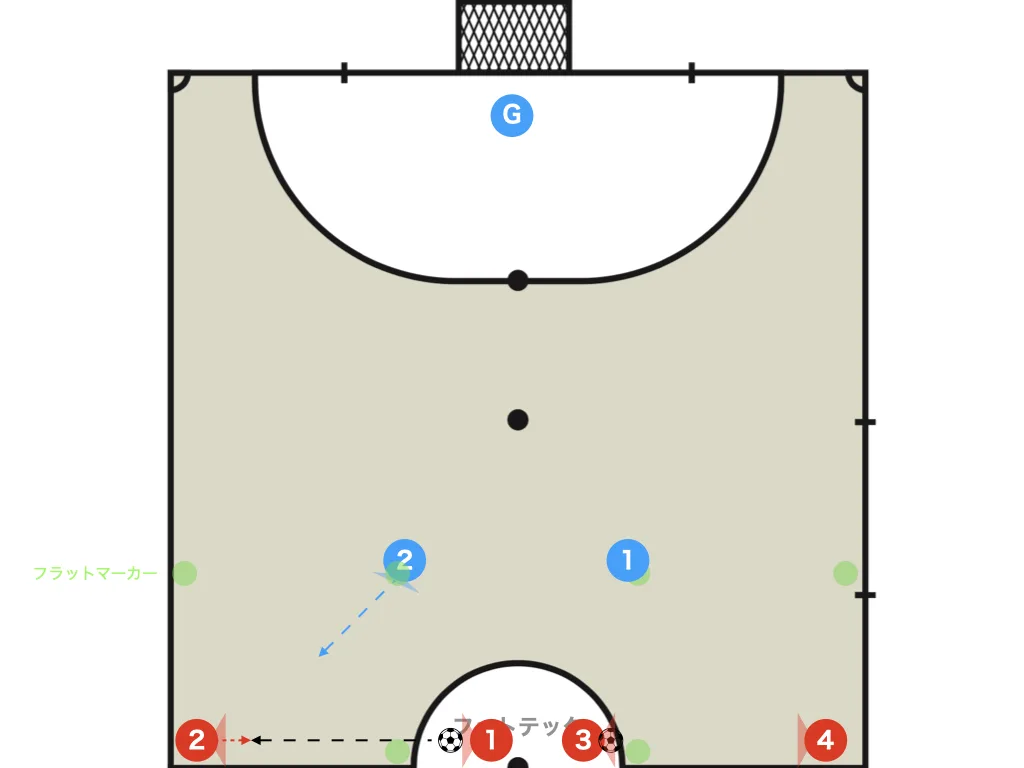
- Set up a box with flat markers as shown in the diagram above
- Play 1v1 inside the box (the defender cannot defend beyond the box)
- Place the defender at the flat marker on the diagonal
- Start when the ball is played from the center circle
- The defender should focus on the intensity of the 1st defender's press (go all out to win the ball)
- The attacker should focus on the first touch (ball attack or tonpa)
- After attacking, switch to defending
This time, we explained ball attack, inward dribbling, and tonpa, which are important individual tactical ideas in futsal.
The key points from this article are:
- Ball attack and inward dribbling are effective when the opponent's pressure is intense.
- Tonpa (contrapie) is a move that takes the defender the wrong way when they are looking to stop ball attack and inward dribbling.
To be able to use ball attack, inward dribbling, and tonpa (contrapie) in actual matches, it is important to practice from face-to-face passing situations while imagining a defender in front of you.
Tonpa in particular is difficult if you are not used to it, so I recommend first practicing it without pressure.