Most Players Miss the Point: A Complete Breakdown of the L Pattern, Pivot Passes, and the Third-Man Run
Published: 2021.06.10Updated: 2026.05.03
The L is probably the second most famous pattern that futsal beginners are taught, after the Eight.
So here is a question:
"Can you clearly explain what the L is?"
Very few people can give a complete answer. Many understand only the shape, but not the essence of it.
This article takes a thorough look at the L, one of the most famous futsal patterns built around the pivot.
- penetration into the opposition half and forward progression
- creating positional superiority -> losing your marker, forcing an own goal
After the pivot receives the ball, the attacking side can face the goal while keeping both the defender and the ball in the same field of vision. By contrast, it is difficult for the defending side to retreat while keeping both their mark and the ball in the same field of vision. In other words, the attacking outfield players other than the pivot can gain positional superiority over the defence.
That makes it easier for the attacking side to lose their markers or force own goals.
Here, the essential ideas behind pivot-pass play are divided into attack and defence.
How to support the pivot after the pivot pass
If you work backward from the idea of forming a finish triangle, it is best for three players, including the pivot, to complete the attack, while the remaining player covers near the center circle to provide balance.
That decision should ideally be based on the positioning at the moment of the pivot pass, such as the distance from each player to the pivot, body orientation, and relation to the defenders, as well as each player's traits such as strong foot, shooting ability, and pace.
Defending after the pivot receives
Stay with your mark in man-to-man fashion and retreat to the ball line.
Because it is hard to keep both the ball and your mark in the same field of vision at that moment, make a conscious effort to scan regularly.
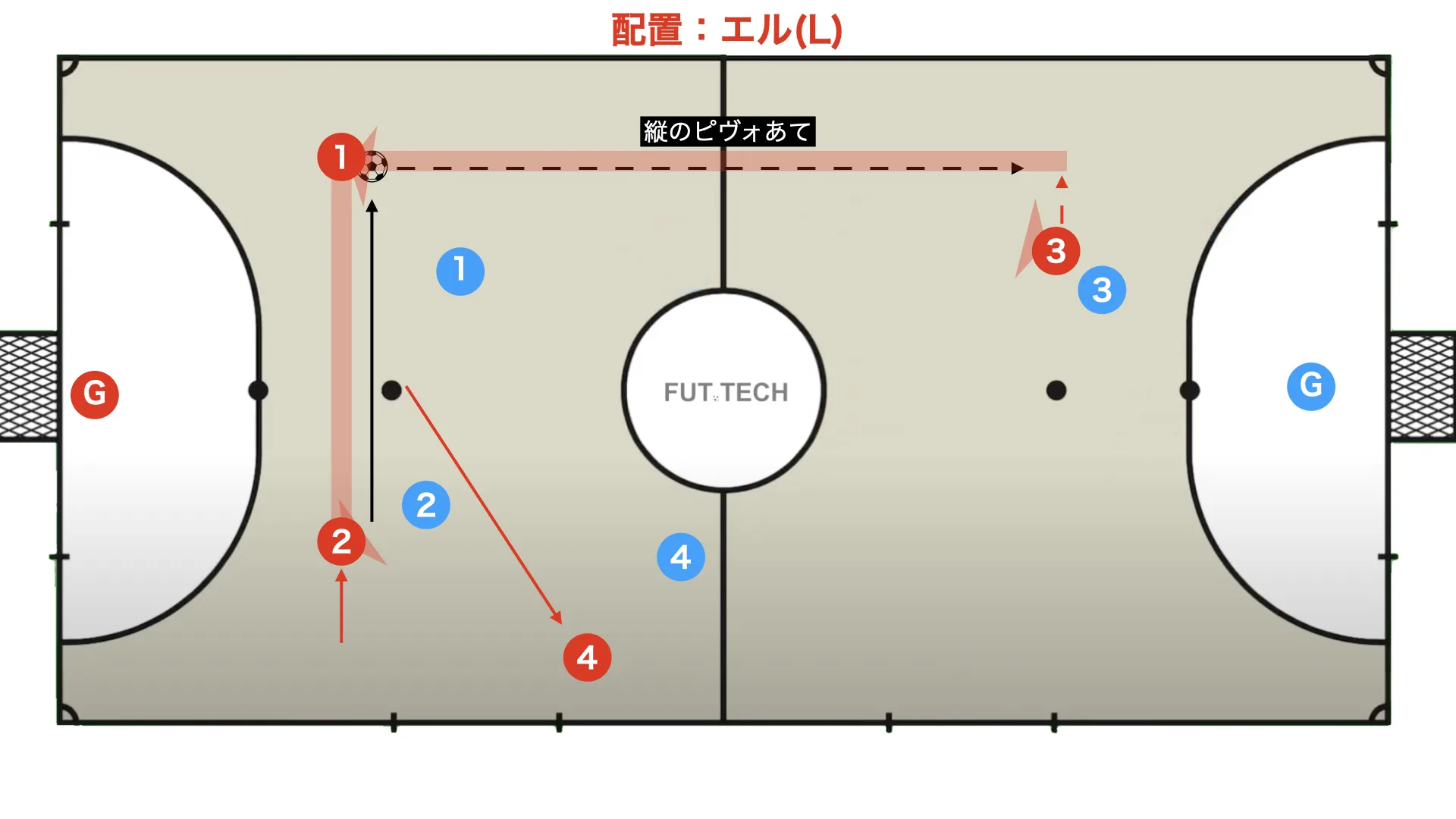
The name of the pattern comes from the fact that the positioning at the moment of the pivot pass forms an L shape.
When people talk about the L, they often treat it as a full sequence that starts with a right-angle pivot pass and continues all the way to the finish. In reality, though, there are three pivot-pass patterns:
- right-angle pivot pass
- pivot pass from ala corta (when the fixo moves wide toward the ala)
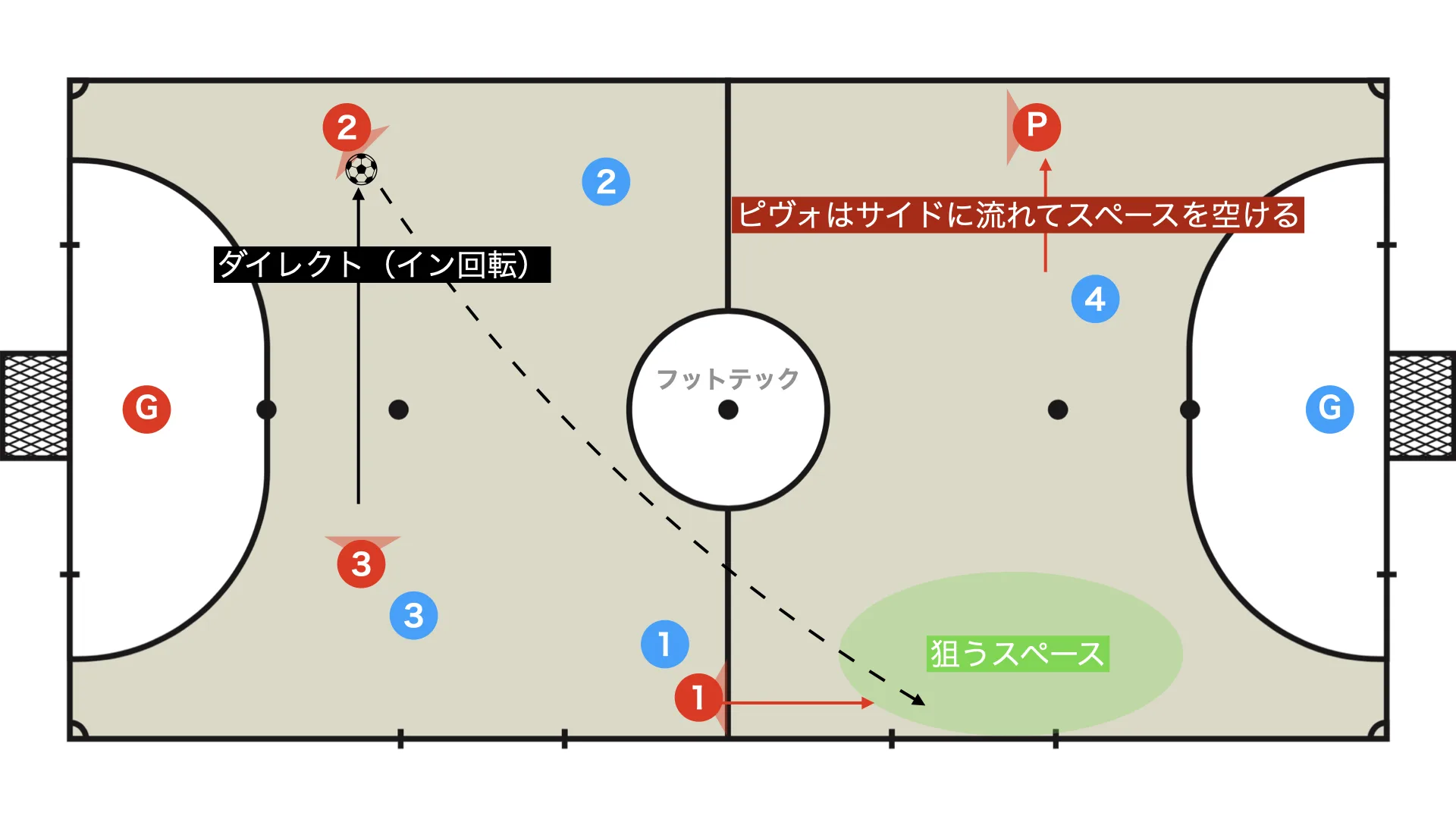
- pivot pass after the ala dribbles inside
All three are common situations when beating a 3-1 defence.
Because most players are right-footed, the explanation below assumes a pattern where the pivot creates the reference point on the left side.
If you want to create the reference point on the right side, you can simply flip everything left to right.
Red 1 wants to play the pivot pass before the defender closes that lane, so the whole sequence from the trap to the pass should be kept as short as possible.
That is why the ideal option is a first-time grounded pass into the pivot.
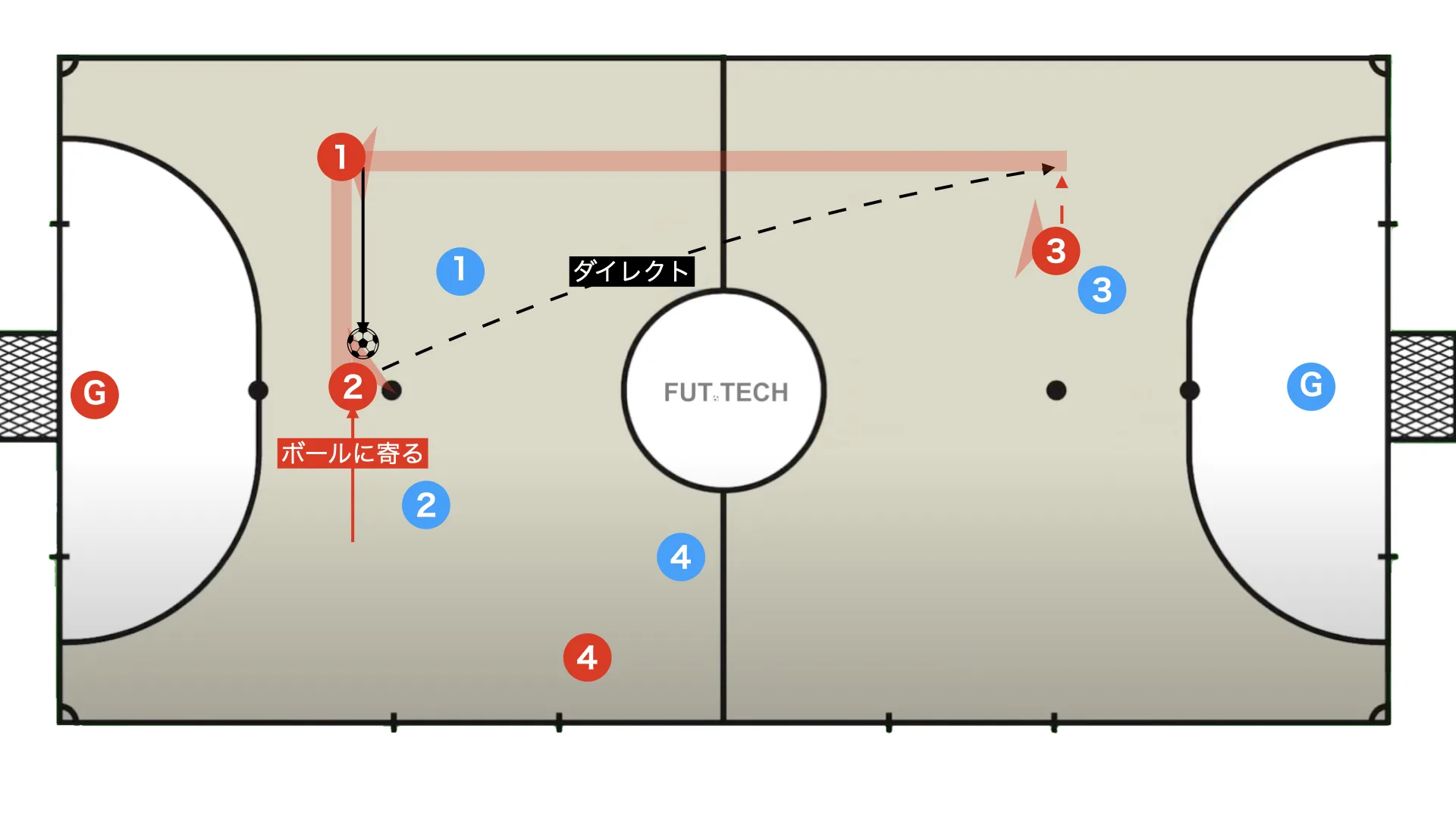
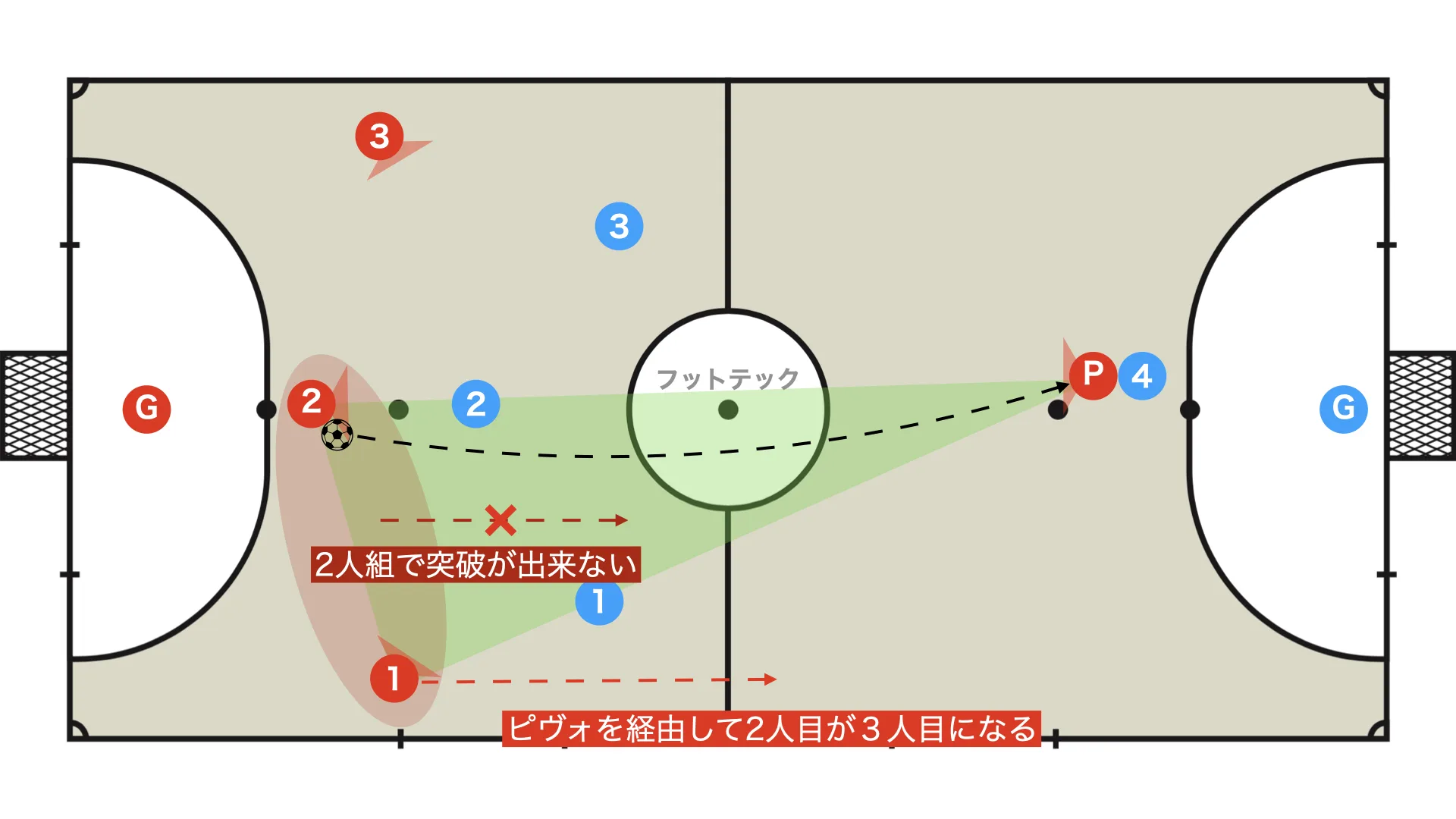
One very effective method is for the ala to play a short pass into the fixo, who moves toward the ball and then hits the pivot first time. It works well because it can temporarily shake off the defender's press.
However, this pivot pass is difficult unless the passer (the ala) and the receiver (the fixo) are perfectly in sync.
Isn't ala corta an ala-specific tactic?
When people hear ala corta, many probably imagine the ala moving toward the ball and trapping it with the sole in a sliding motion.
But etymologically, it comes from the Spanish expression a la corta, so it is not a tactic limited to the ala.
A la corta means moving toward the ball, so it also includes actions where the fixo moves toward the ball, not just the ala.
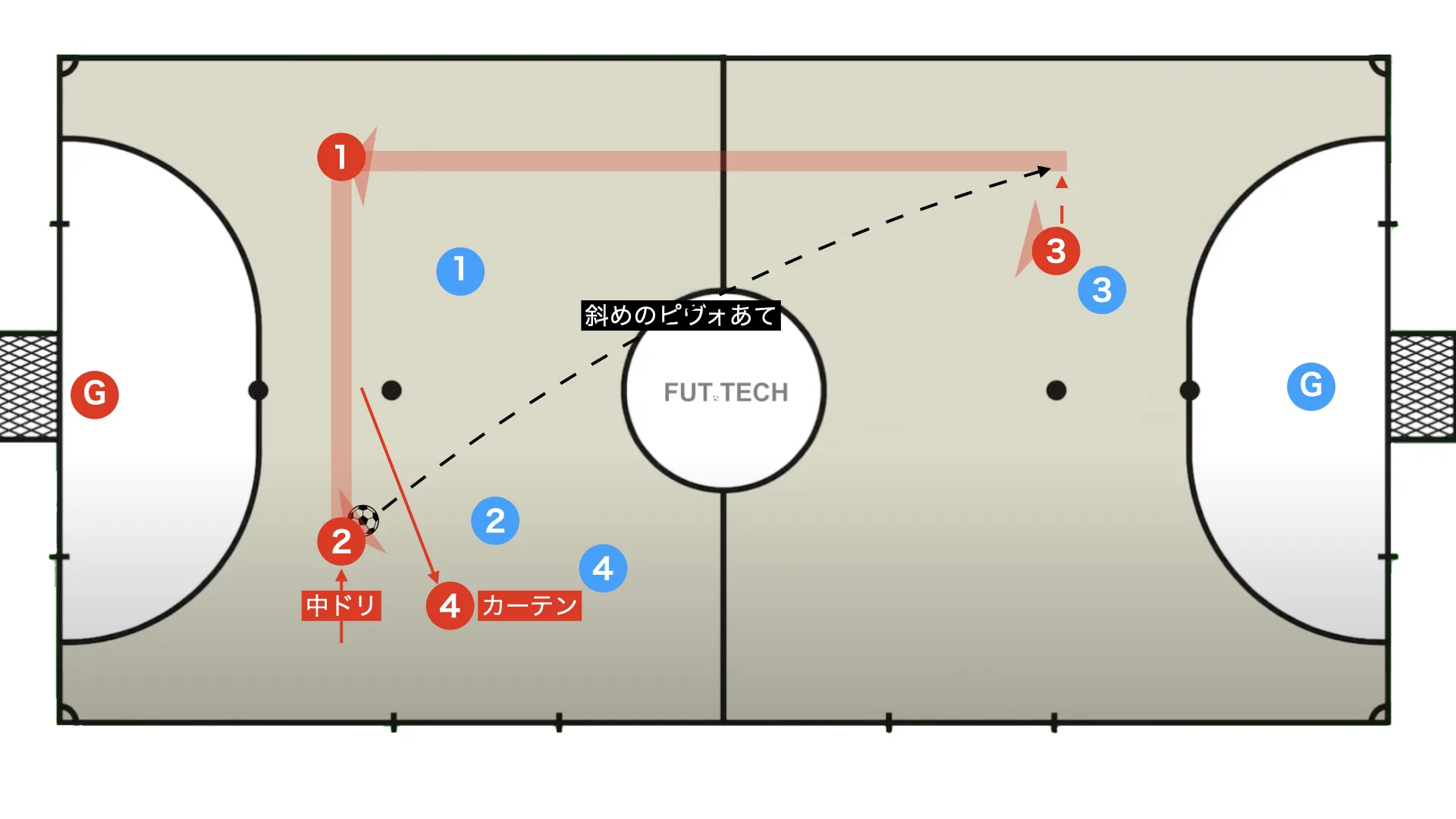
This is the kind of pivot pass commonly seen in the pattern often referred to as the Eight.
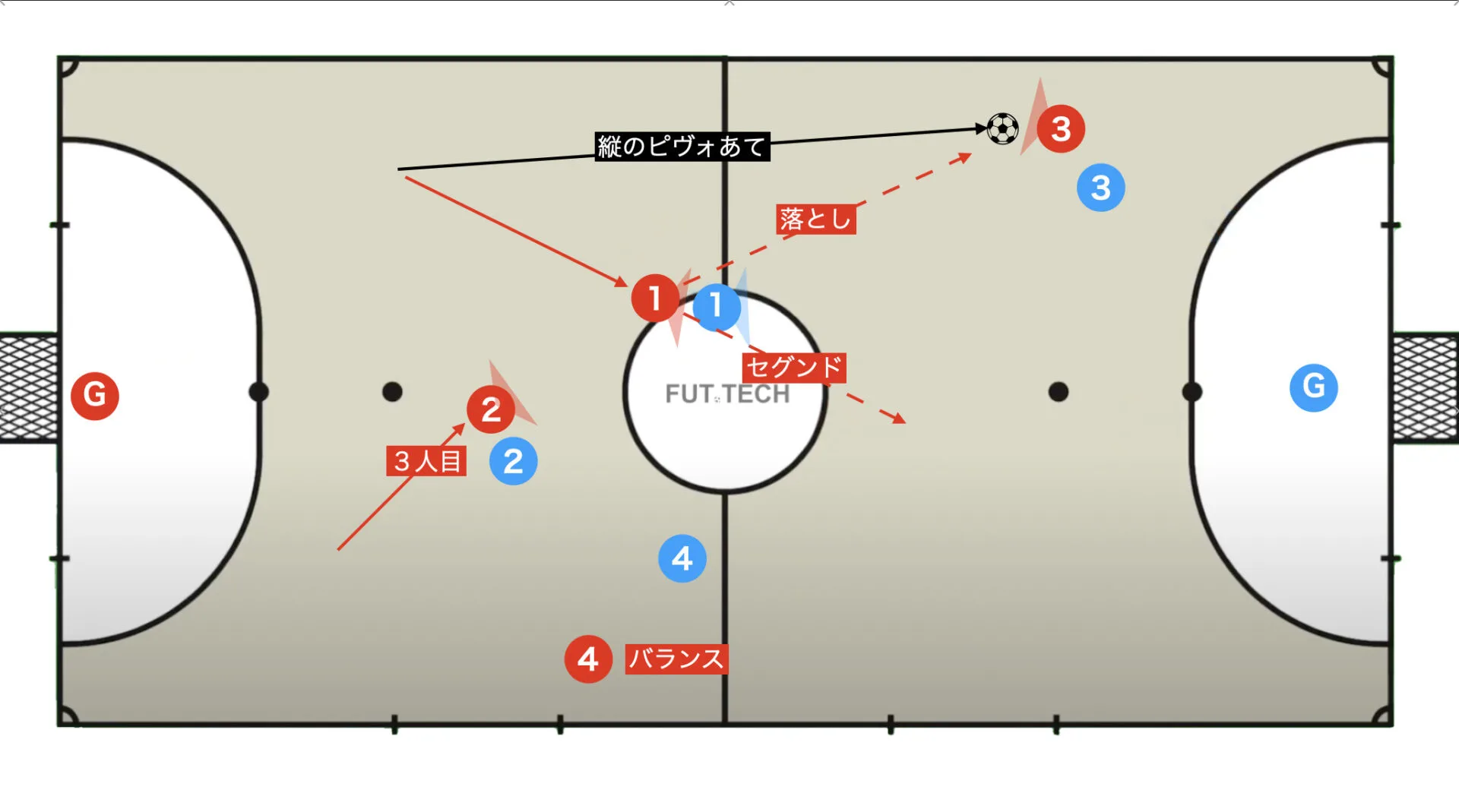
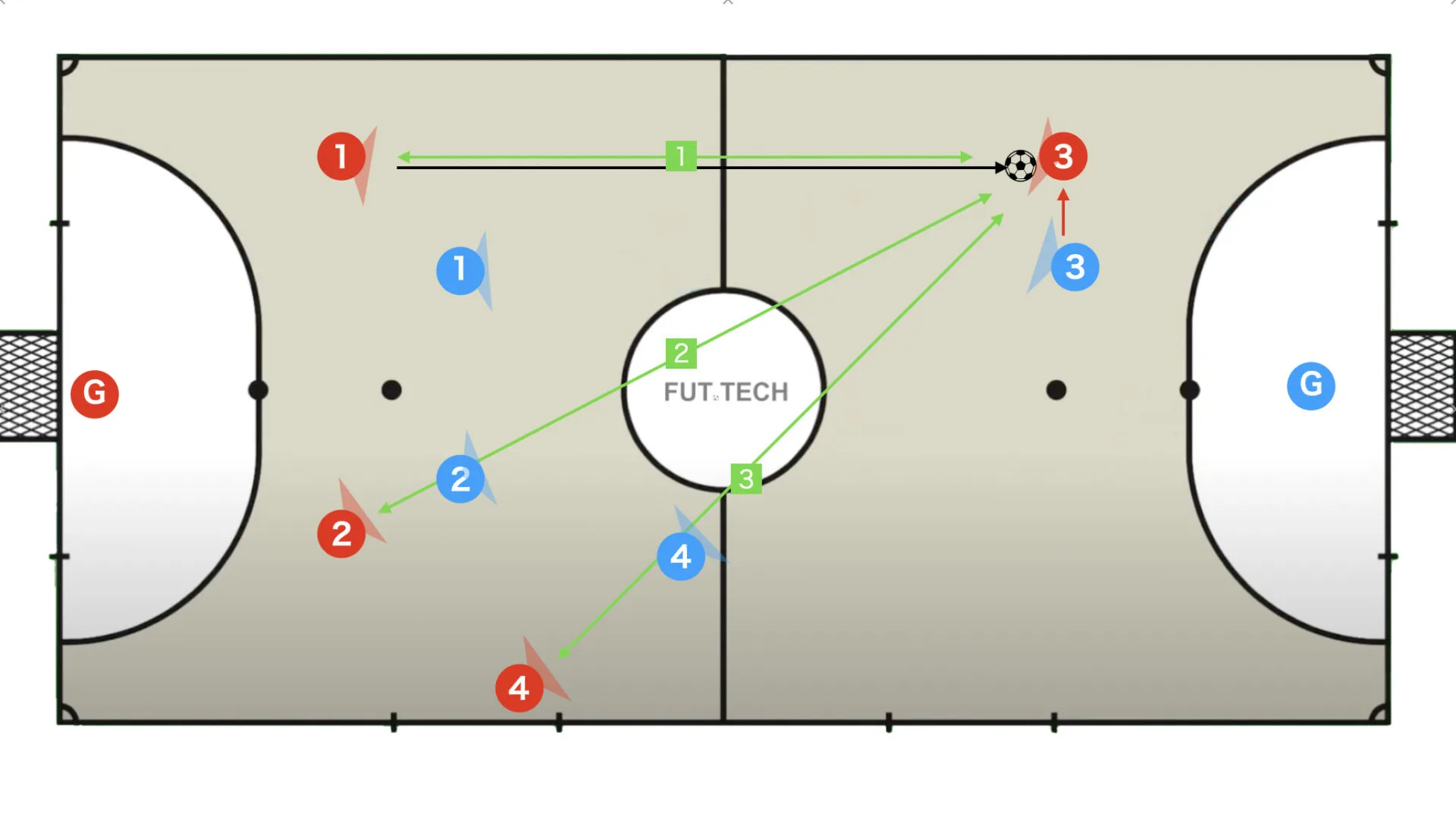
When the pivot pass is played, especially if there is not much difference in ability among the players:
- the player closest to the pivot (red 1) breaks toward the segundo
- the second-closest player to the pivot (red 2) gets involved as the third man
- the third-closest player to the pivot (red 4) stays deepest and provides cover
At that moment, red 1 plays a game with the defender between breaking to the segundo and checking to receive the layoff.
Blue 1 is facing in a way that does not allow them to see both the ball and their mark (red 1) at the same time, which makes this difficult to defend. That is one of the aims of the L.
In some situations, red 4 may be closer than red 2, so teams can adjust and choose a different third man when needed.
The key point is to finish before the defence has time to recover, so the support for the pivot has to arrive as quickly as possible after the pivot pass.
That is why it makes sense to decide who gets involved based on distance to the pivot.
From here on, the examples use the first pattern mentioned above, breaking down the defence from a vertical pivot pass. But the ideas behind the finish are exactly the same for the other two pivot-pass patterns as well.
関連記事
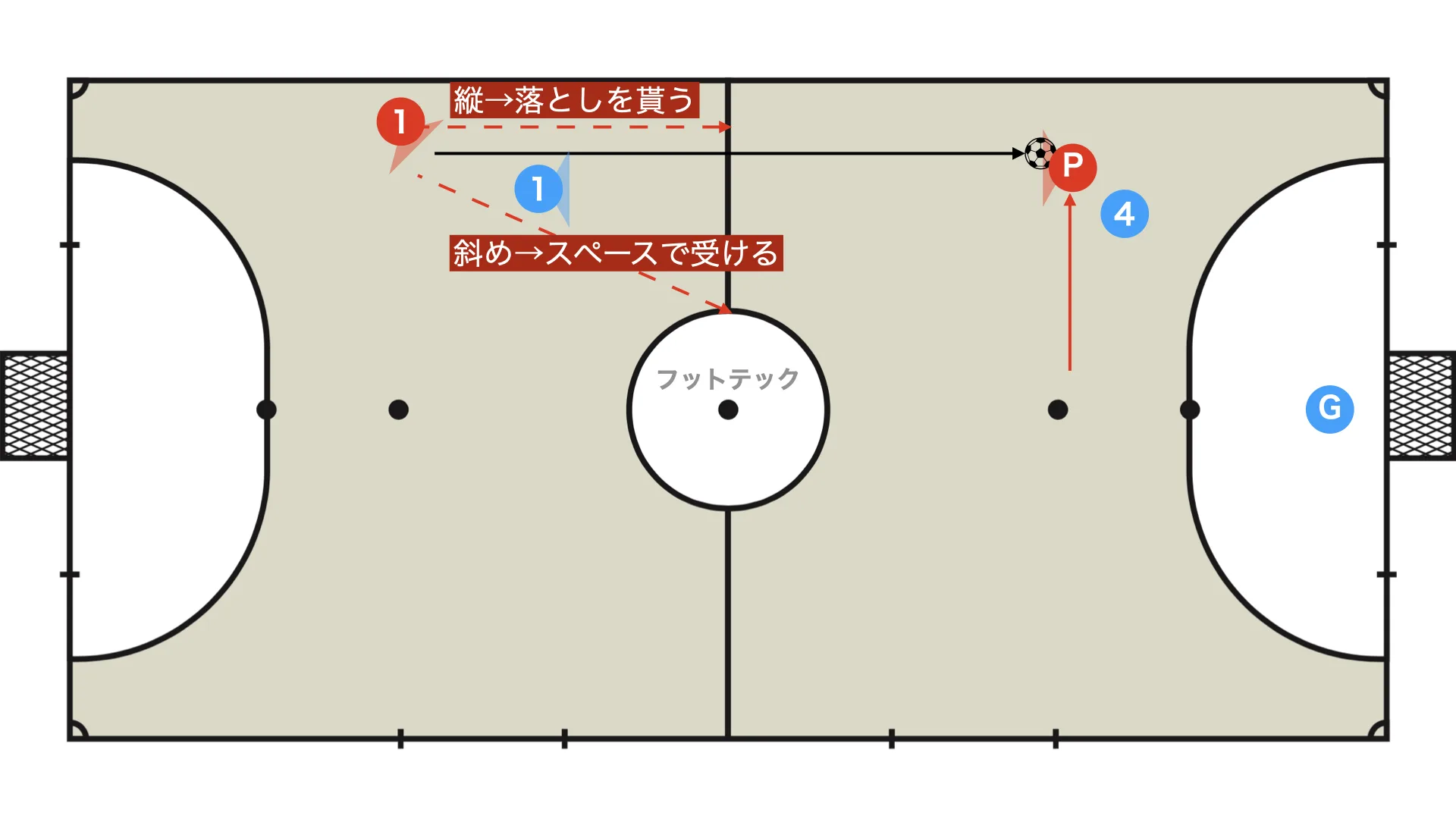
Targeting the Pivo and Losing Your Marker: The Vertical Two-Player Combination (Fixo-Pivo)
An explanation of the vertical fixo-pivo two-player combination. This article organizes when it is e…
続きを読む →If red 1, the player who played the vertical pivot pass, has already completely lost their marker at the moment of the pass, there is also a pattern where they go directly to receive the layoff from the pivot.
What matters is not getting trapped by a fixed shape, but choosing the attack by working backward from the finish.
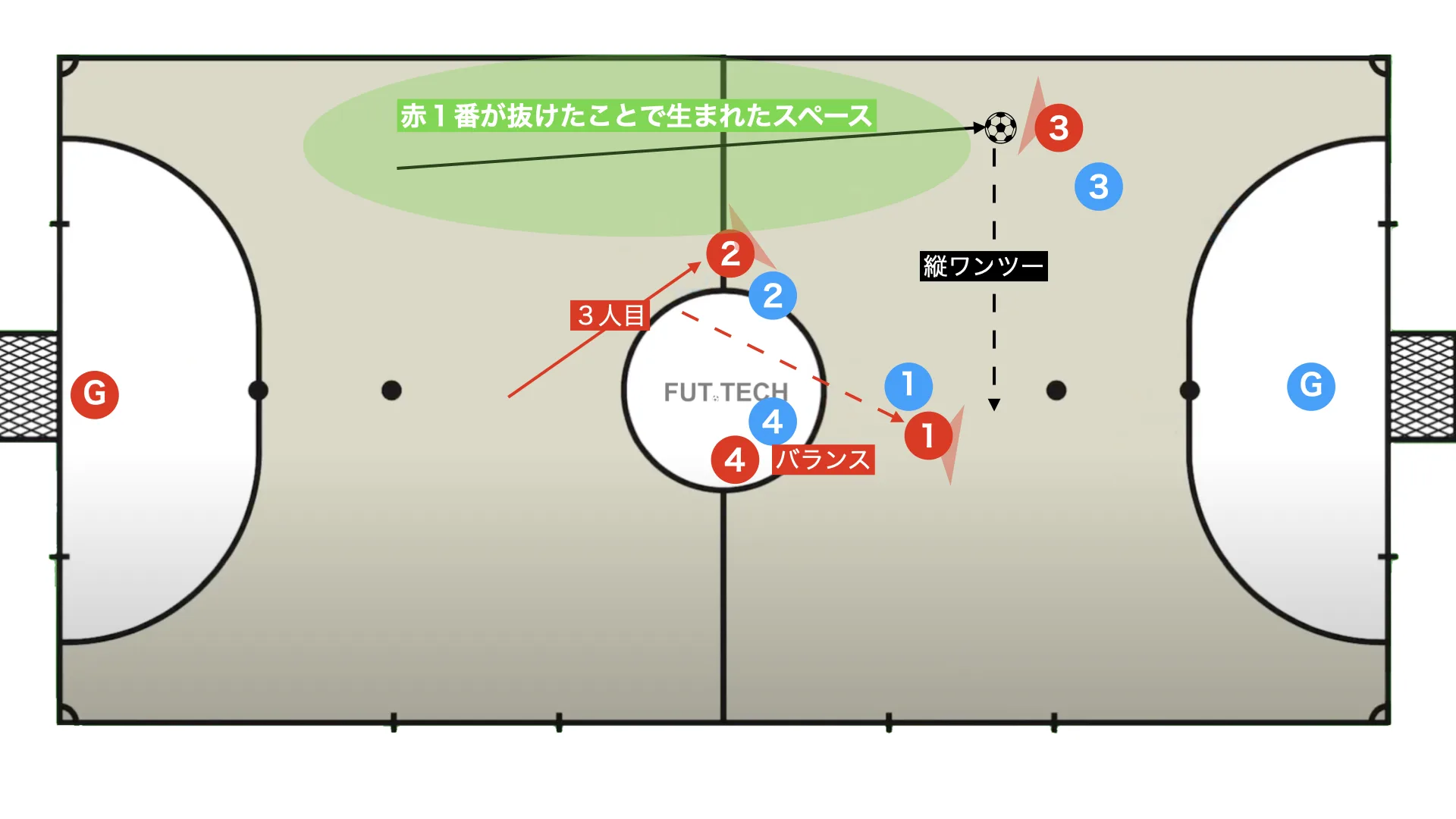
If red 1 has beaten the defender, a through pass into the space in front of goal can create a 1v1 with the goalkeeper.
Tactical purpose of the L: creating space
As shown above, another tactical aim is that the third man can run into the space created by the segundo run and get involved freely.
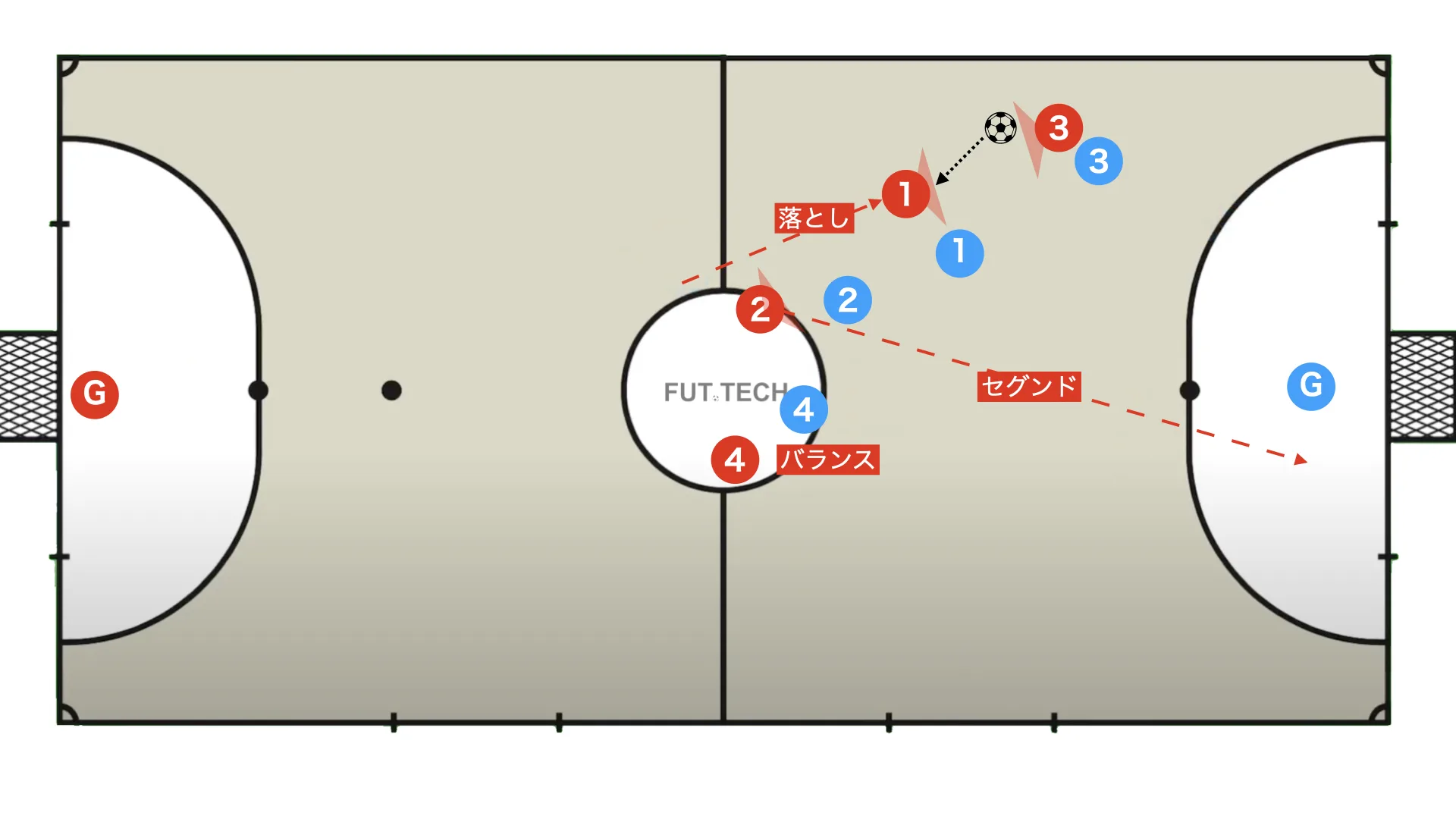
If you fake the run to the segundo before checking for the layoff, it becomes easier to lose the defender.
In this case, it is preferable for red 2 (or red 4) to make the run to the segundo.
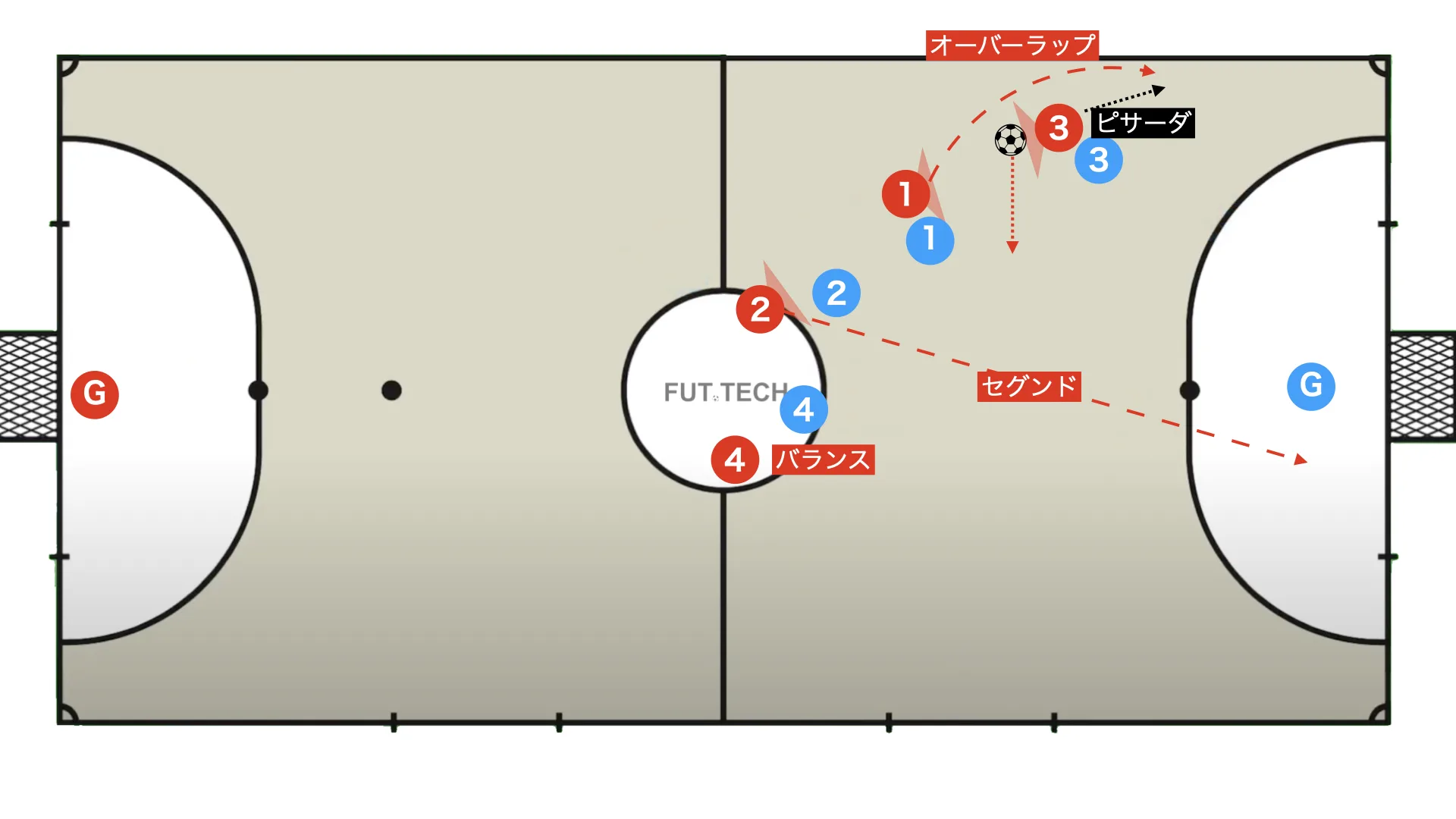
If red 1 does not look able to receive the layoff from the pivot, they can continue their run on an overlap around the pivot and create the duel through the combination of the pisada and the pivot's turn inside.
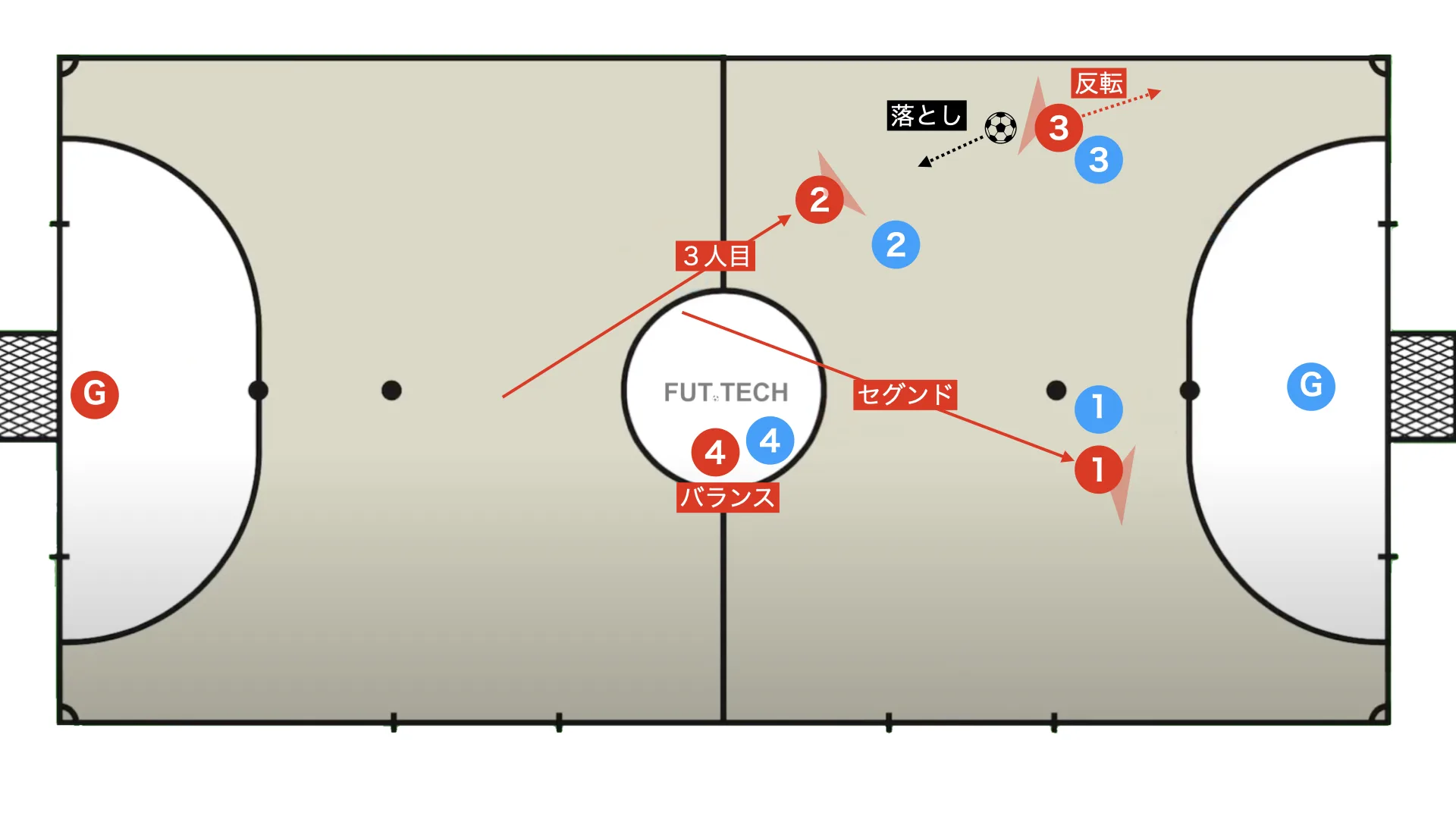
- If red 1 cannot lose the defender, they continue their run to the segundo.
- The third man (red 2) runs into the space created by red 1's movement.
- Red 4 holds near the center circle to provide balance and cover.
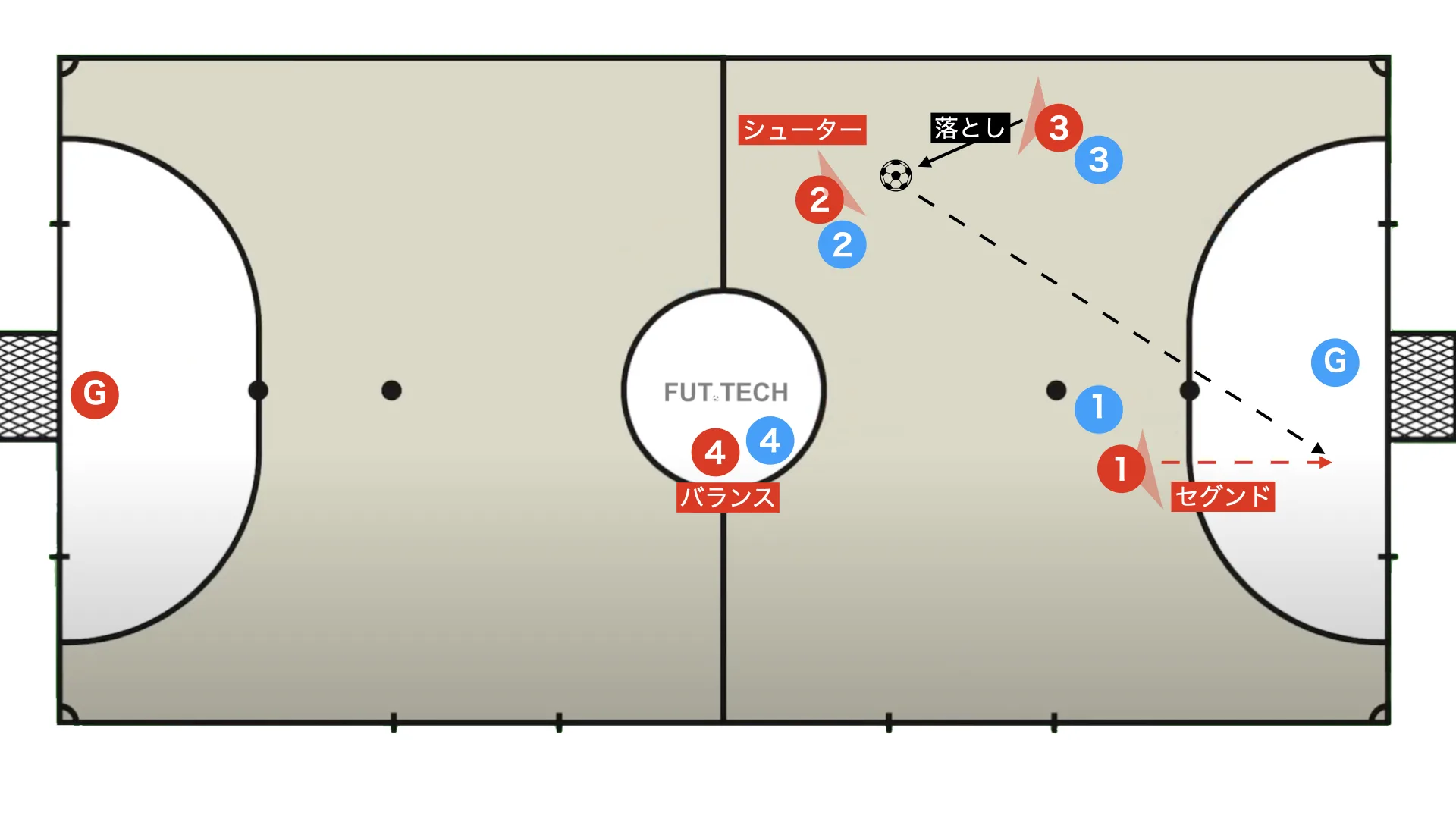
This simple finish is probably the most common version people picture when they think of the L.
The shooter aims either near post or the segundo.
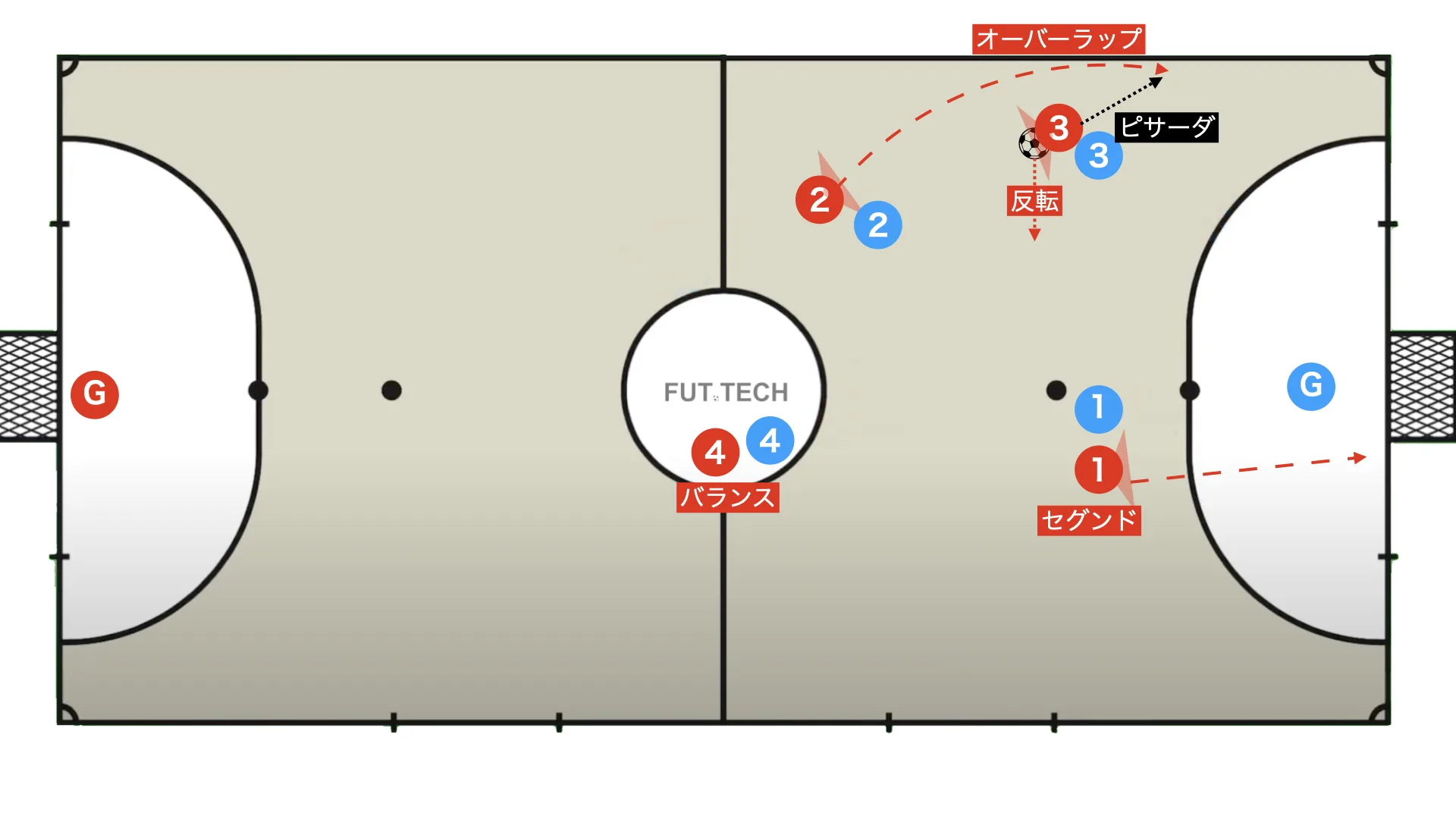
Just as above, if it does not look likely that the layoff can be received, the overlap is the better choice.
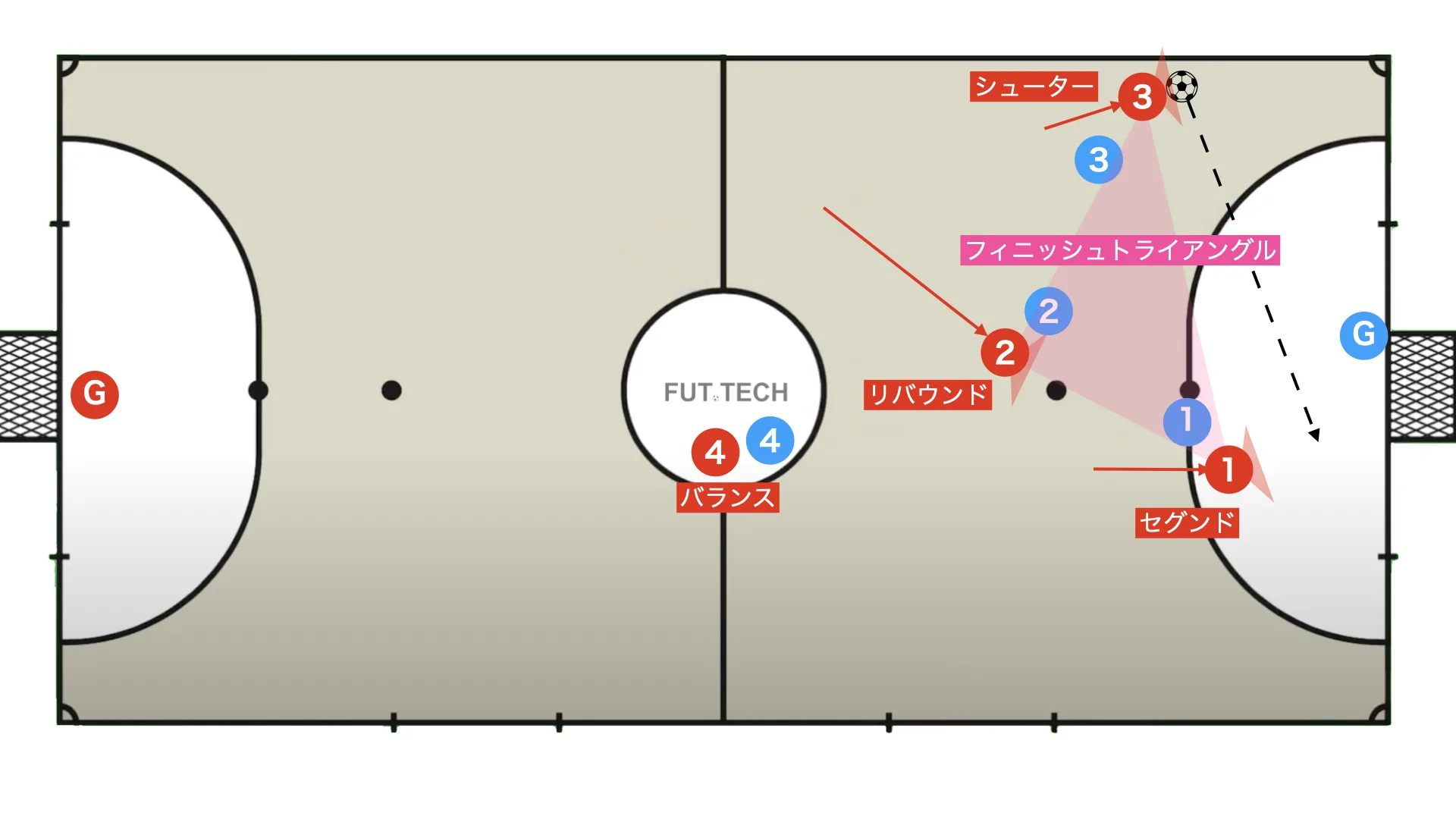
Once the pivot recognizes that the segundo has reached the goal area, they turn, while red 2 takes up a rebound position to form a finish triangle.
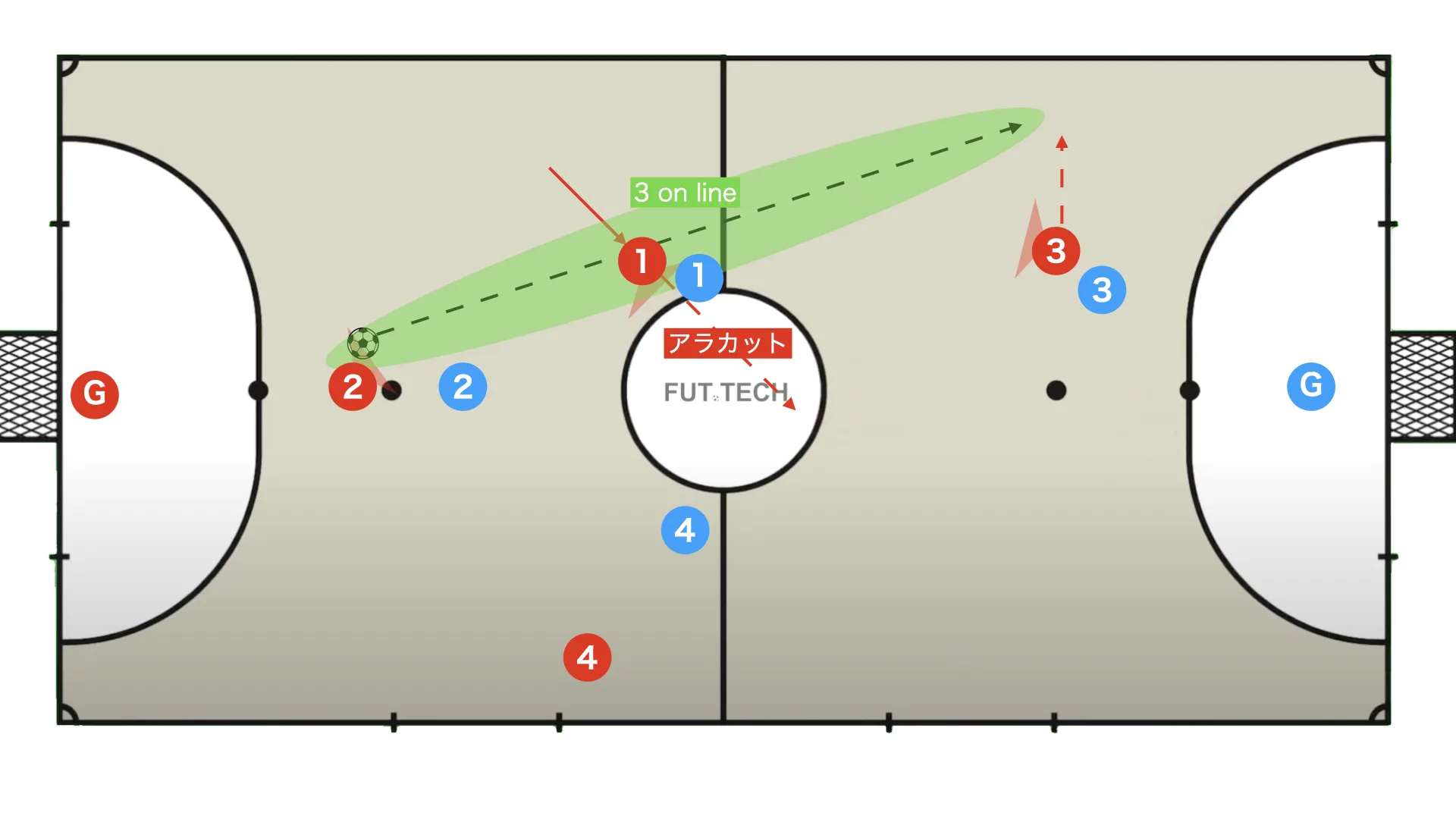
This moves away from the typical L shape, but the exact same patterns explained in this article also apply to pivot passes that begin with an ala cutting first to open the passing lane into the pivot.
After that, the pattern has red 1 running to the segundo and red 2, the player who made the pivot pass, joining as the third man. Since that overlaps with the same ideas already covered in the L, I will not repeat it here.
関連記事
Futsal Sai: Pivo-Ala and the 3-on-Line Pattern
A thorough explanation of the futsal tactical term "sai." This article breaks down how sai works as …
続きを読む →The L pattern explained here is only one part of the broader set of tactics built around the pivot, but it is a highly effective one as part of a positional attack model that uses a pivot.
It is not only useful in 3-1, but can also be applied in 2-1-1 and 2-2. Among all pivot-pass patterns, this is one of the absolute basics, so make sure to master it.
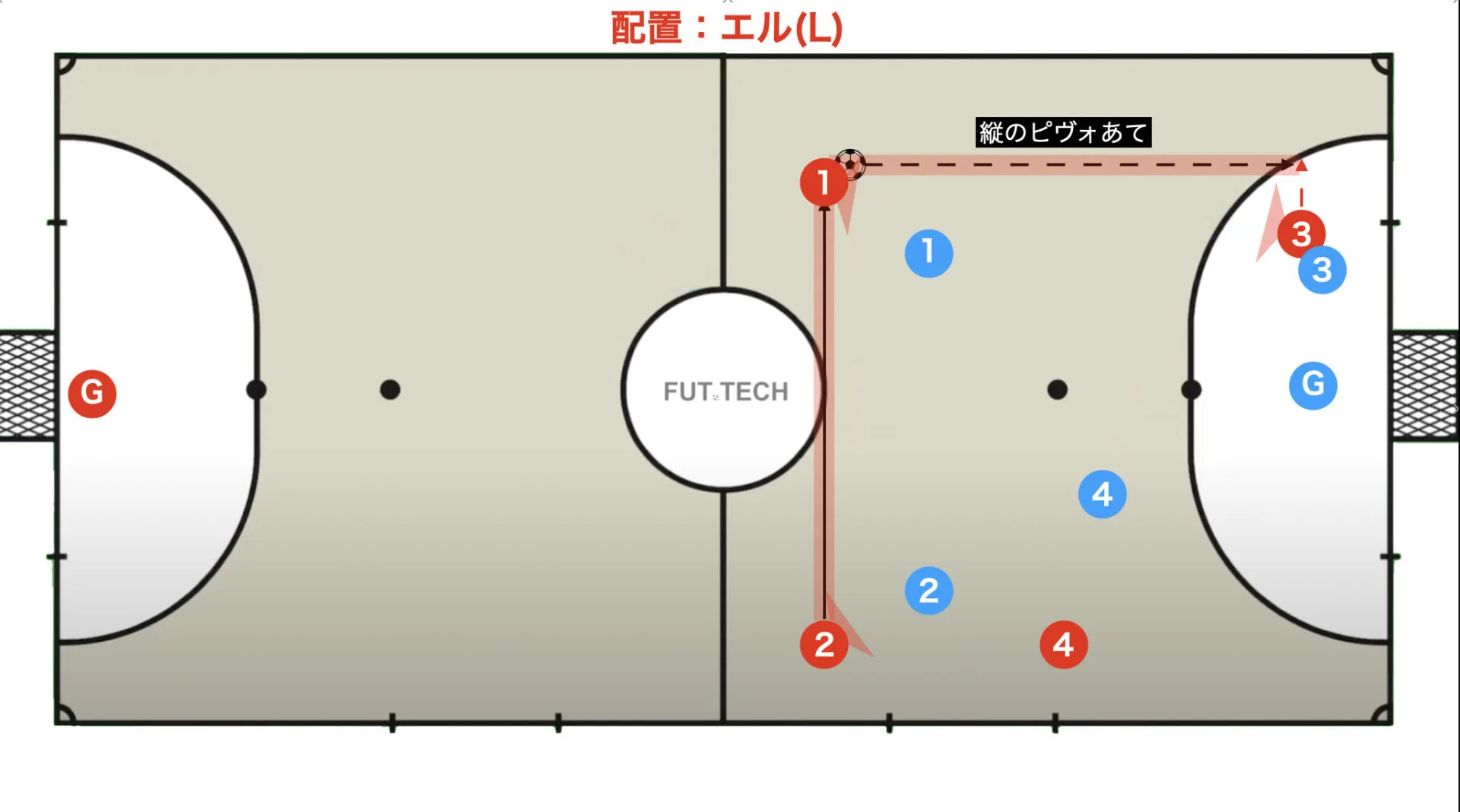
This article focused on breaking pressure from your own half, but as shown above, the same way of thinking also applies to the L in the opposition half.