Learning from Chess: Three Advantages Behind Strong Side and Weak Side
Published: 2021.02.25Updated: 2026.05.03
If you have played futsal for a while, you have probably heard phrases like "switch the ball to the weak side" or "build the strong side" from time to time.
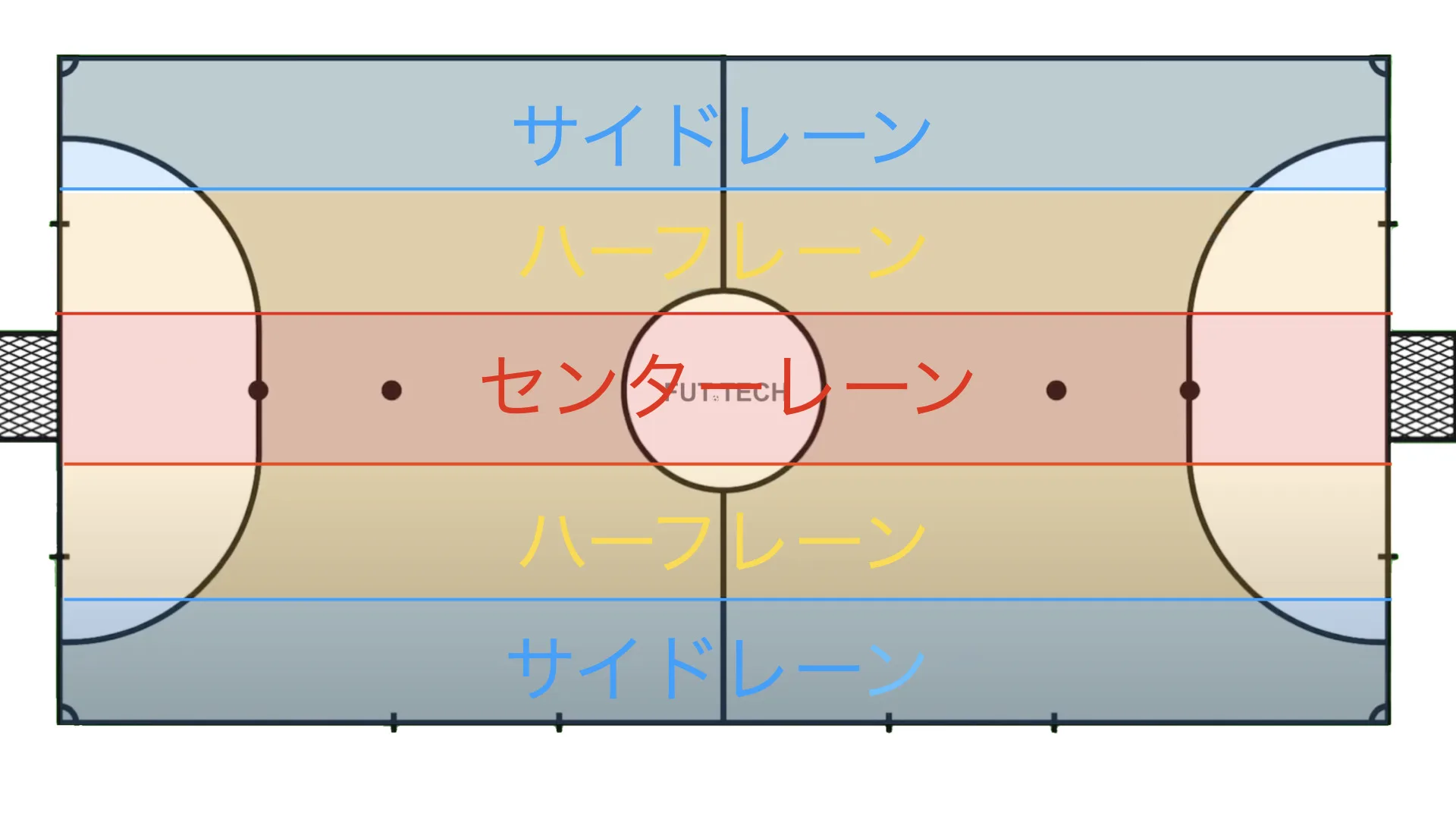
Put simply, the side that is advantageous for a given team is generally called the strong side, while the disadvantageous side is called the weak side.
However, what counts as advantageous or disadvantageous depends on that team's point of view, so it cannot be defined in a completely strict way.
In this article, I will explain two key concepts for thinking about the strong side and weak side: positional play and the three advantages.
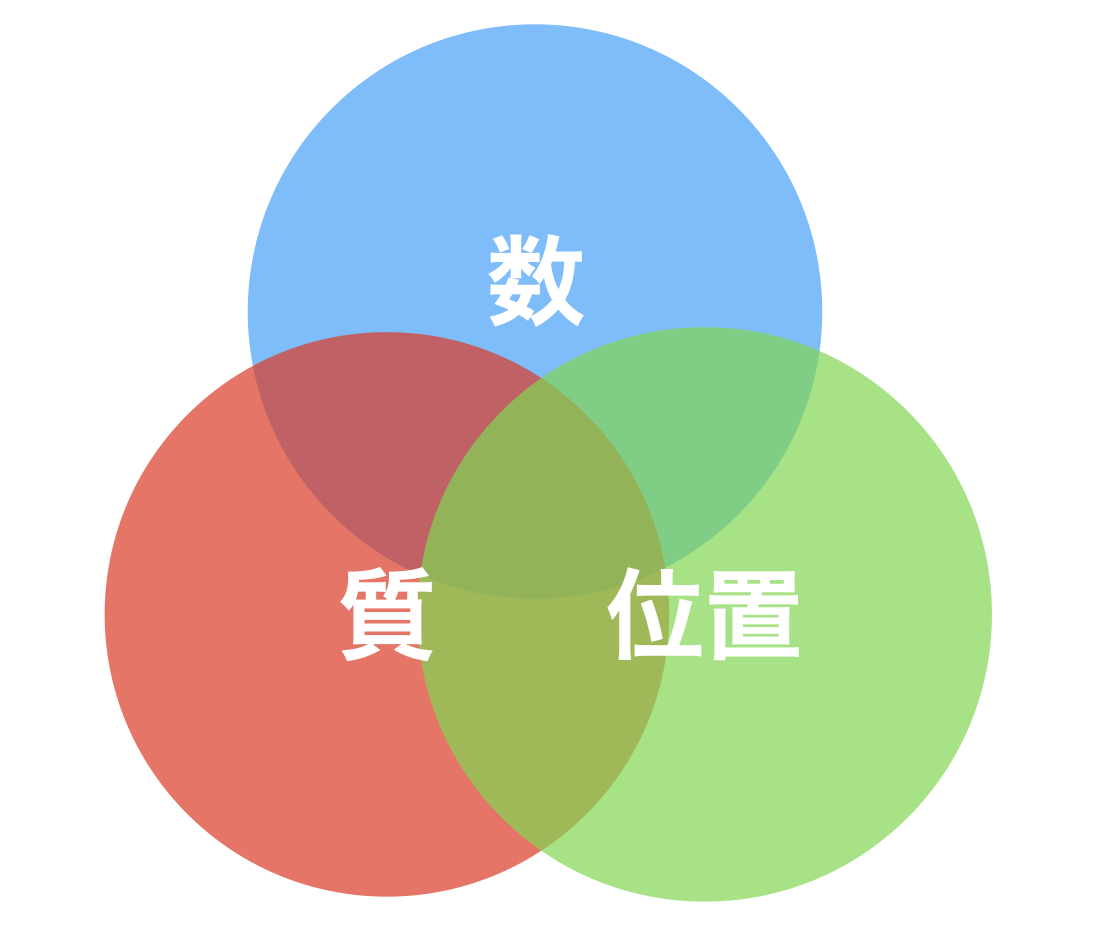
In chess, a long-standing idea called positional play became established. It treats tactics as something that emerges from three kinds of advantages created by the arrangement of the pieces in each position, and those advantages often decide the outcome of the game.
In recent years, this way of thinking has also been applied to football (soccer), and naturally it can be applied to futsal as well.
Let us go through those three advantages one by one.
- Numerical superiority
- Qualitative superiority
- Positional superiority
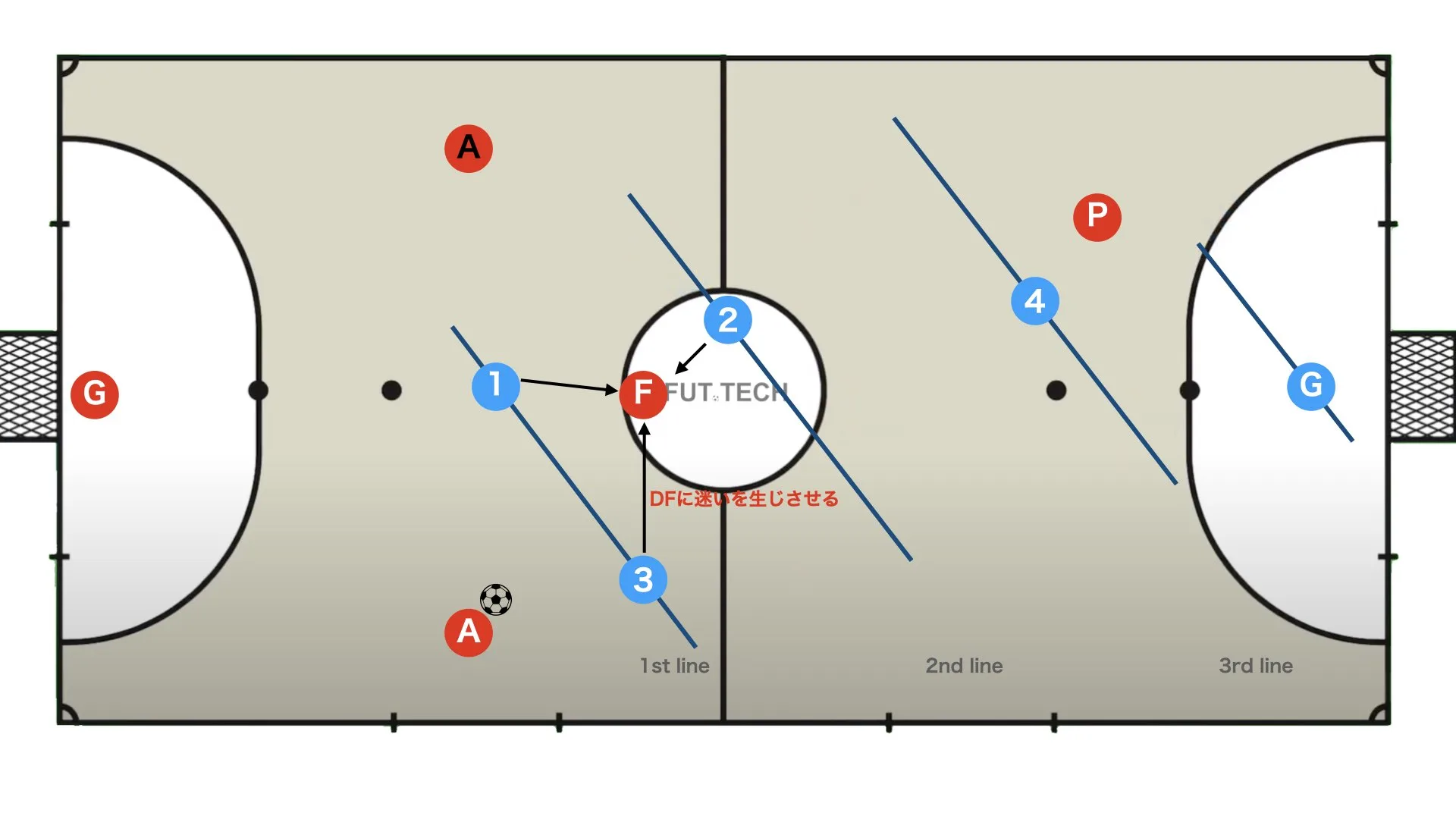
Numerical superiority is exactly what it sounds like: your team has more players than the opponent in a certain zone, creating an advantage. In chess, this is often called material superiority.
It appears especially clearly in transition moments and in power-play situations.
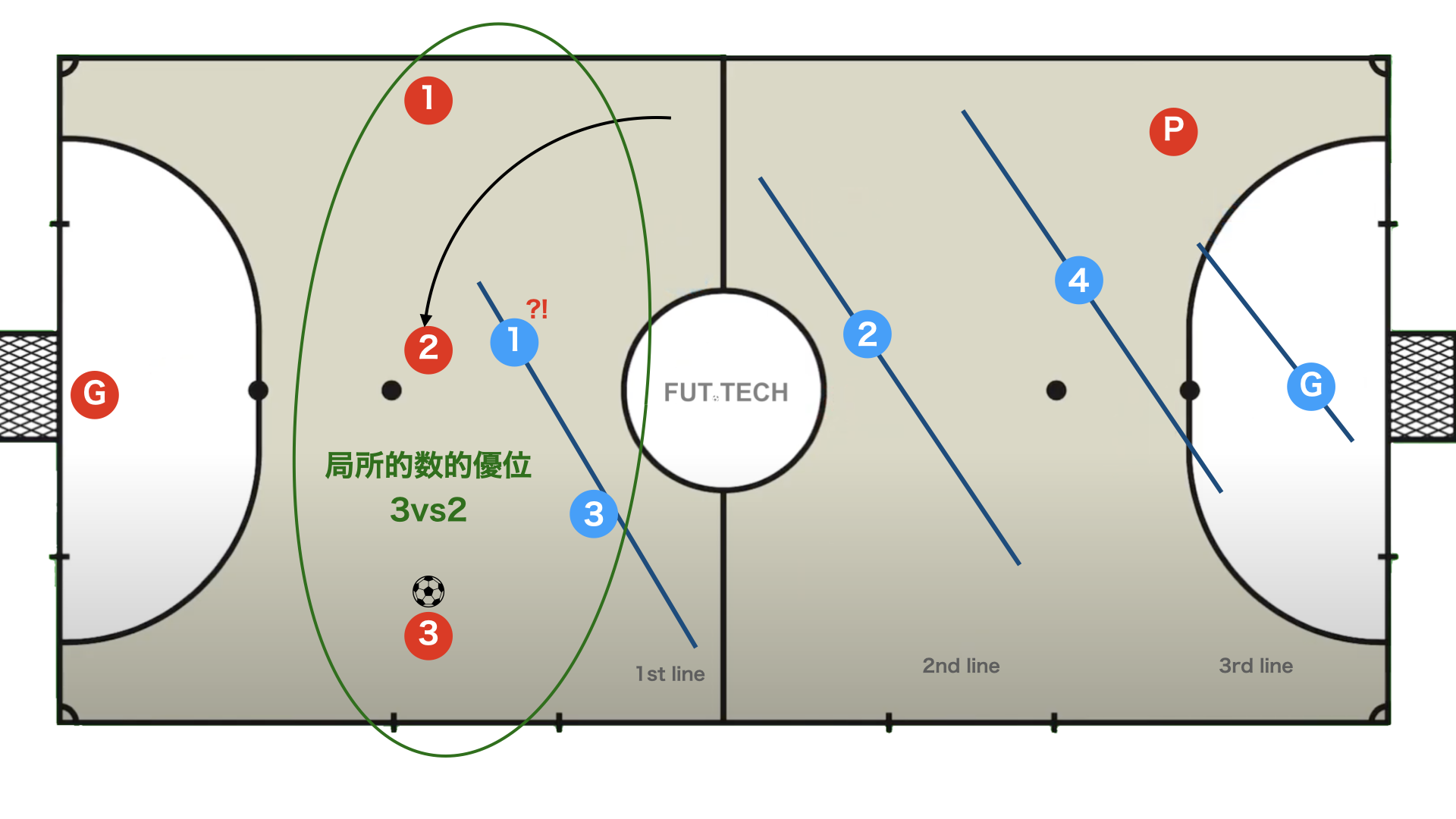
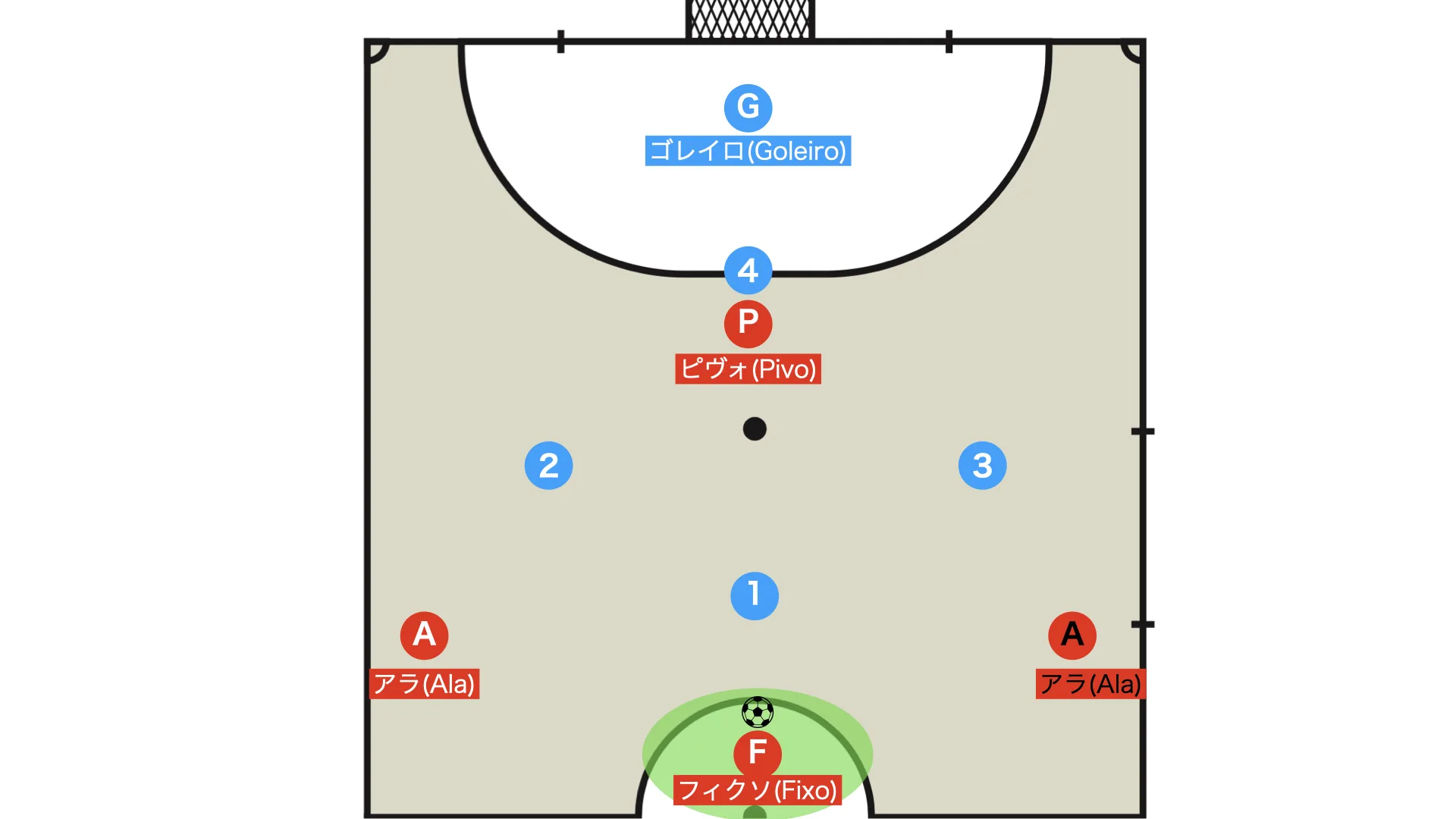
Even in set positional attacks, there are cases like the diagram above where a second-line player makes a line cut and creates numerical superiority in a certain zone (the first line).
When numerical superiority appears in a specific area like this, it is called local numerical superiority.
関連記事
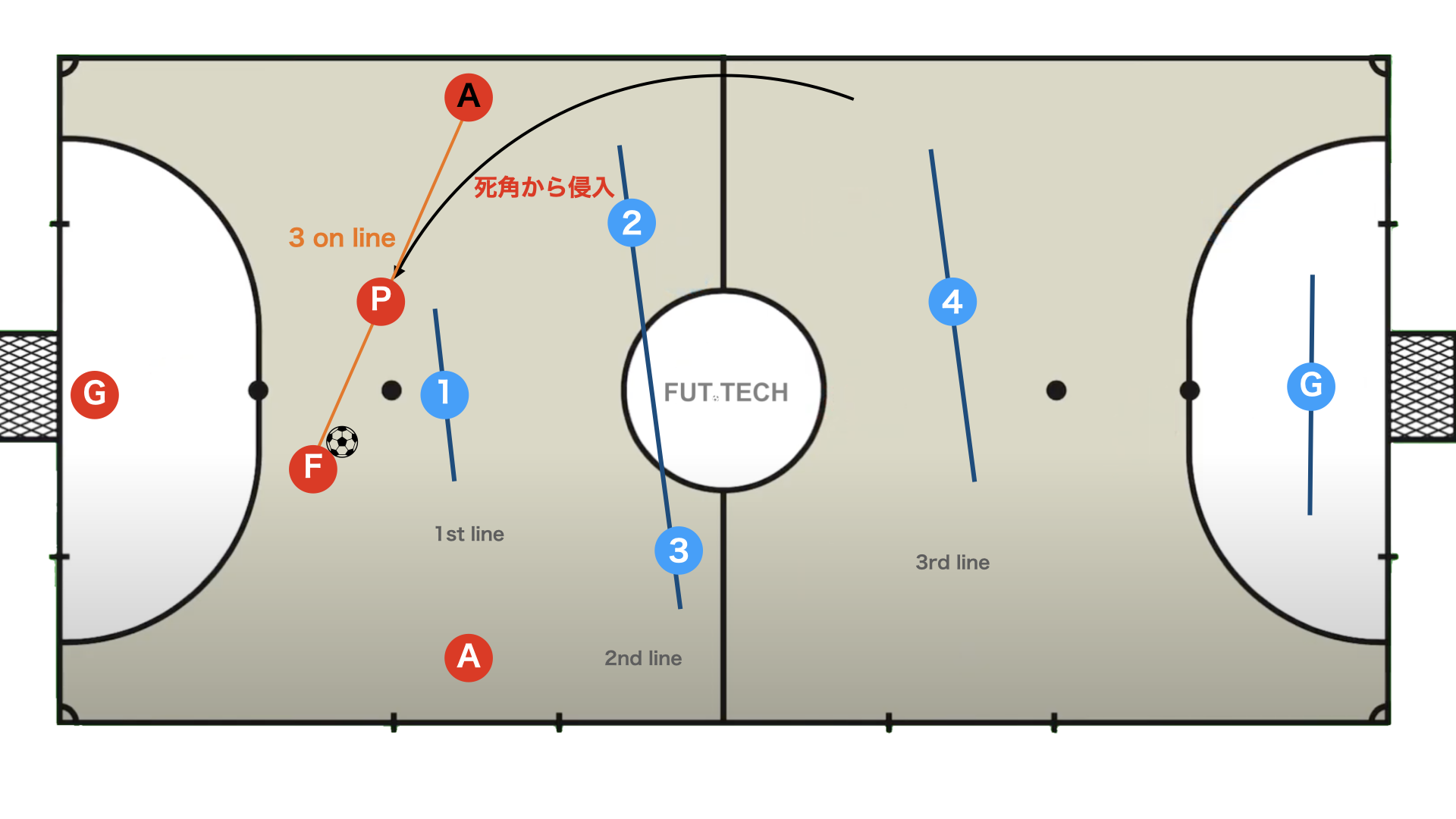
The Tactical Intent of the Line Cut: Three Advantages and Disadvantages
A tactical explanation of the line cut in futsal. This article organizes its definition, three advan…
続きを読む →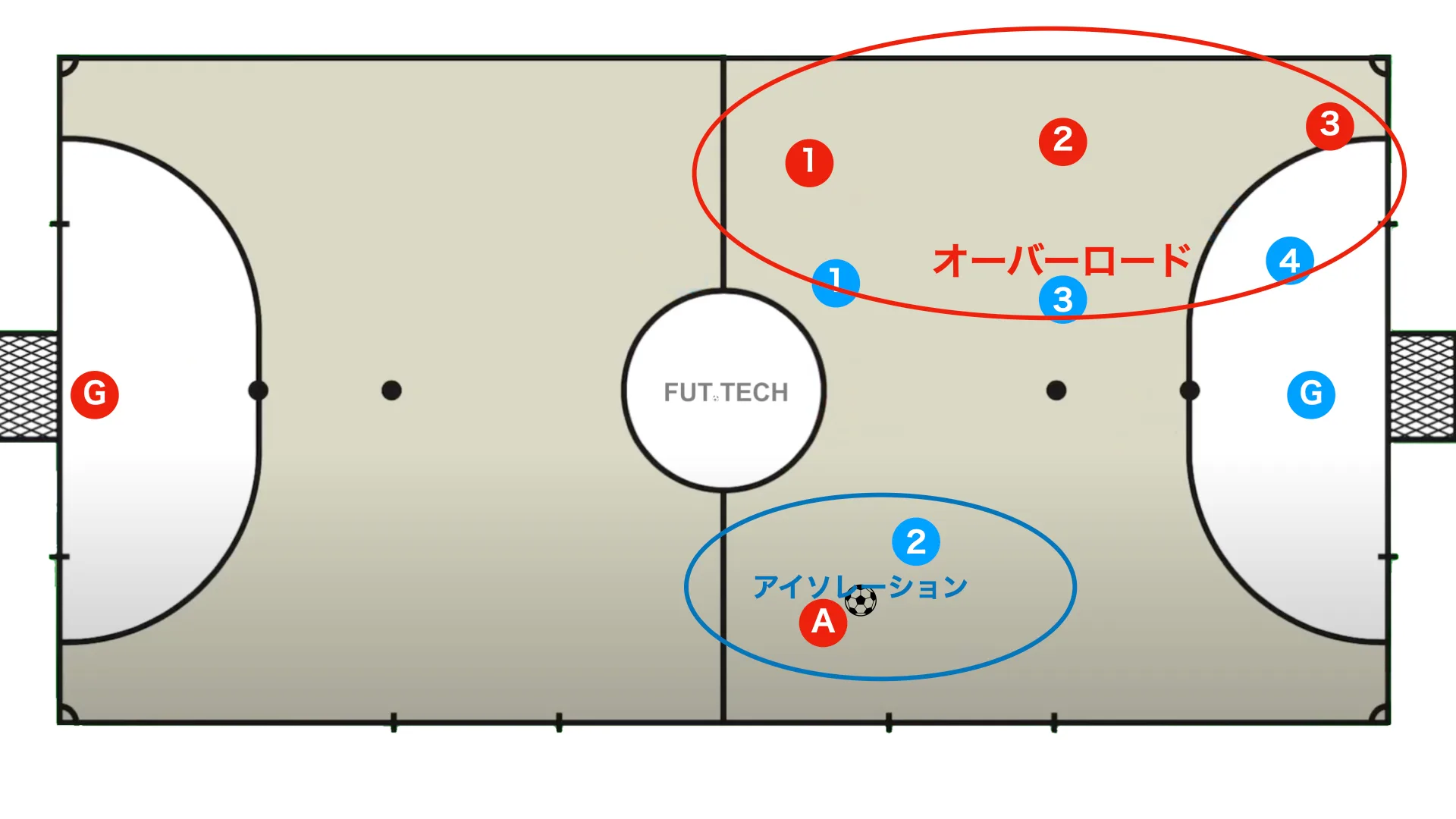
Qualitative superiority means having an individual advantage over the opponent in terms of ability.
Isolation tactics, where you leave a strong dribbler in a 1v1 situation, are a good example of a tactic that makes use of this qualitative superiority.
関連記事
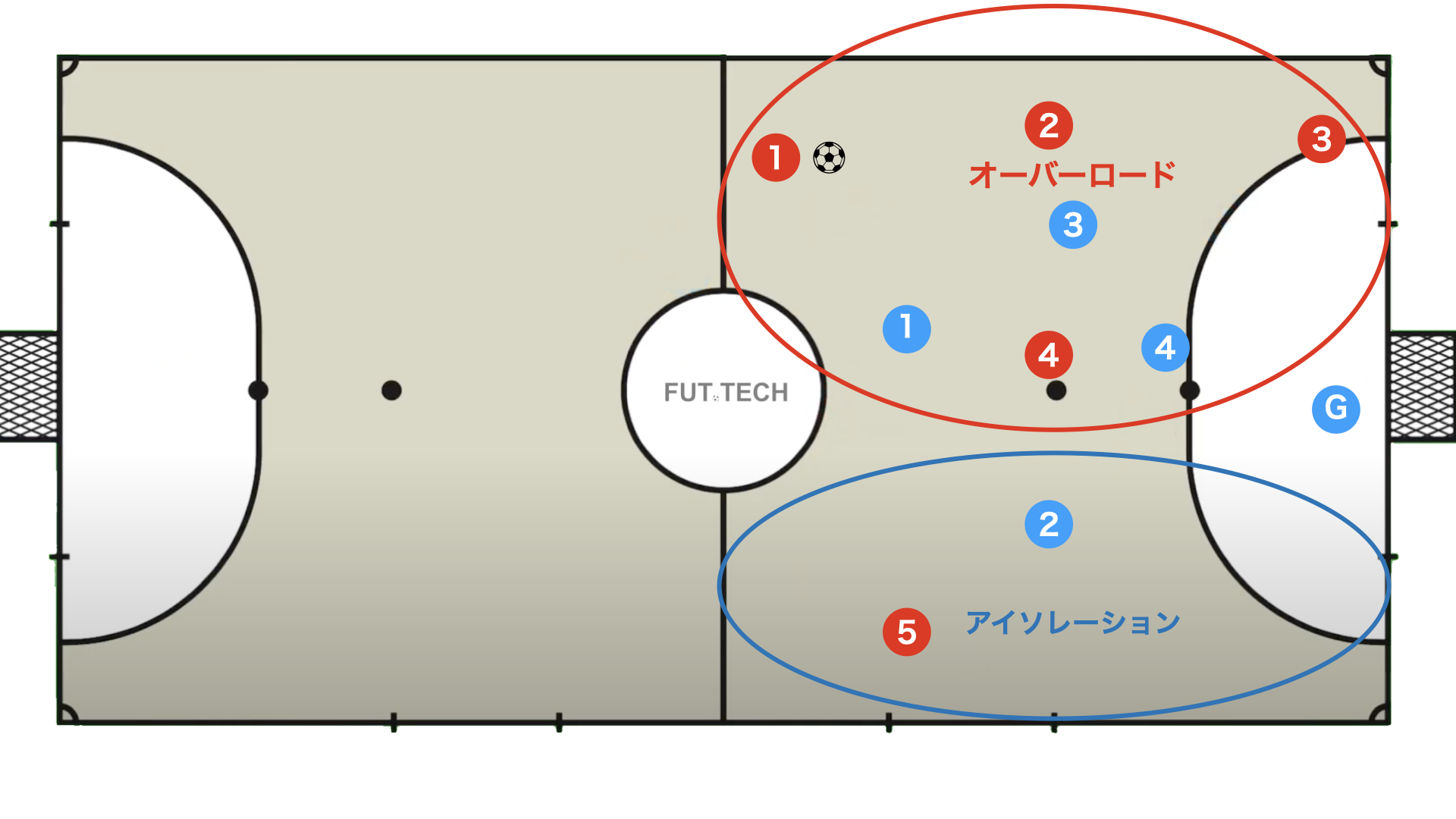
Futsal Tactics: Overload and Isolation
An explanation of two key futsal concepts: overload and isolation. This article clarifies the differ…
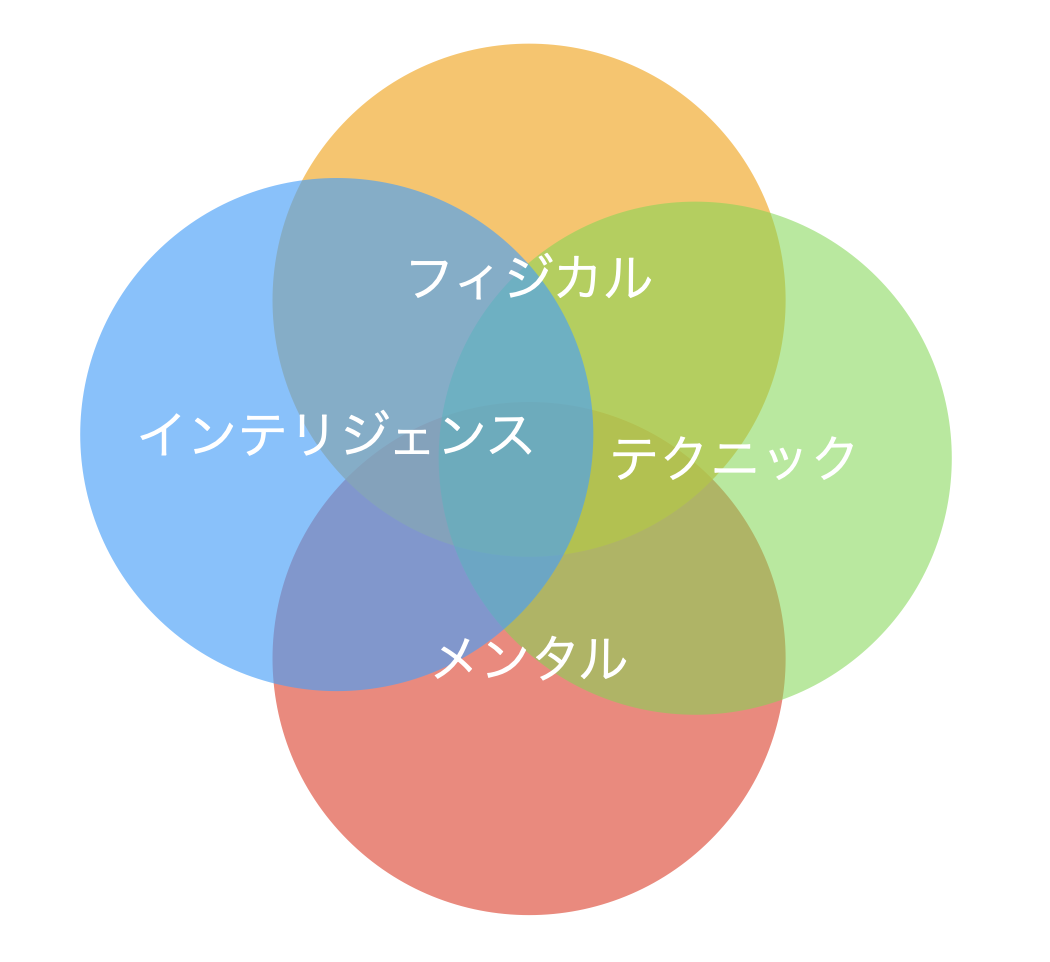
続きを読む →The individual qualities that contribute to qualitative superiority can broadly be divided into the following four categories.
- Technique
- Physicality
- Intelligence
- Mentality
Technique refers to an individual player's technical ability on the ball.
- First touch
- Passing
- Dribbling
- Shooting
It is important to understand each technical skill theoretically and then ingrain it into the body through repetition. Sometimes, thinking in terms of physical laws can even help you understand technique more simply.
Technique is also influenced by the physical qualities explained next.
Physicality refers to the player's bodily and physical attributes.
- Speed (speed, agility, explosiveness)
- Power (body weight, inner muscles, outer muscles)
- Limb length and height
Body weight may be undervalued more often than people expect, but the conclusion is that being heavier is generally better, as long as it is within reason.
If you think about Newton's second law of motion, ma = F, it is clear that a heavier body can transfer force with less acceleration.
That is why heavier players tend to have stronger shots and be stronger in physical duels for the ball.
At the same time, body weight and agility often have an inverse relationship, so you need to be careful not to gain too much weight.
Intelligence refers to cognitive ability: thought processes, IQ, eyesight, and related factors. In practical terms, it means tactical understanding and decision-making ability.
This includes not only understanding and expressing the team's play model, but also perceiving situations quickly and making the right decisions in a short amount of time.
The ability to perceive is not determined only by the brain. It is also influenced by vision itself, including dynamic visual acuity and static visual acuity, so some clubs separately train players to expand their field of view.
Mentality refers to a player's psychological state.
At first glance it may seem similar to intelligence, but it is worth separating because mentality is heavily affected by factors such as that day's condition, the atmosphere in the venue, and the match situation, and it can even affect physicality and intelligence.
Compared with the other three factors, mentality is probably the hardest to improve, and it is heavily influenced by a person's past experiences and upbringing.
Some professional players even work with dedicated counselors who specialize in psychiatry or sports psychology, which shows how important mentality is when trying to perform at the limit of your abilities.
In recent years, meditation that focuses on the present moment, or mindfulness, has also started to be used as mental training in sport.
Positional superiority is the advantage created by taking positions that make the opponent hesitate or dislike what they are facing, and by the orientation of the body.
In futsal terms, this means things like moving in the opponent's blind side or behind them, or positioning yourself so you can receive the ball between the opponent defenders' lines.
Even if you receive the ball in the same spot, the level of advantage changes depending on your body orientation.
In many cases, positional superiority ultimately leads to numerical superiority.
関連記事
How to Use the Space Between the Lines to Break Down Zone Defence
A guide to using the space between defensive lines in futsal to attack zone defence. This article ex…
続きを読む →Guardiola, who has managed Bayern and Manchester City, applies the idea of positional play to football (soccer) as a way of producing these three advantages.
Positional play is the concept of deciding who should be placed where and in what body orientation. The idea is to use that awareness to increase the three advantages and gain a broader tactical advantage.
What matters especially here is the idea of "who are you placing there?"
For a concrete example, in a 3-1 setup in futsal, it makes a huge difference whether the front 1 is a strong player who can receive with their back to goal and hold off defenders, or a smaller player with great close control.
That is why it is important to think carefully about who you place in each role.
The definition of positional play differs from person to person.
In soccer, some people use the term positional play to mean the overall set of positioning and actions that increase positional superiority and make the opponent defenders hesitate. Definitions vary, but on this blog, positional play means the concept of thinking about who to place where and in what body orientation.
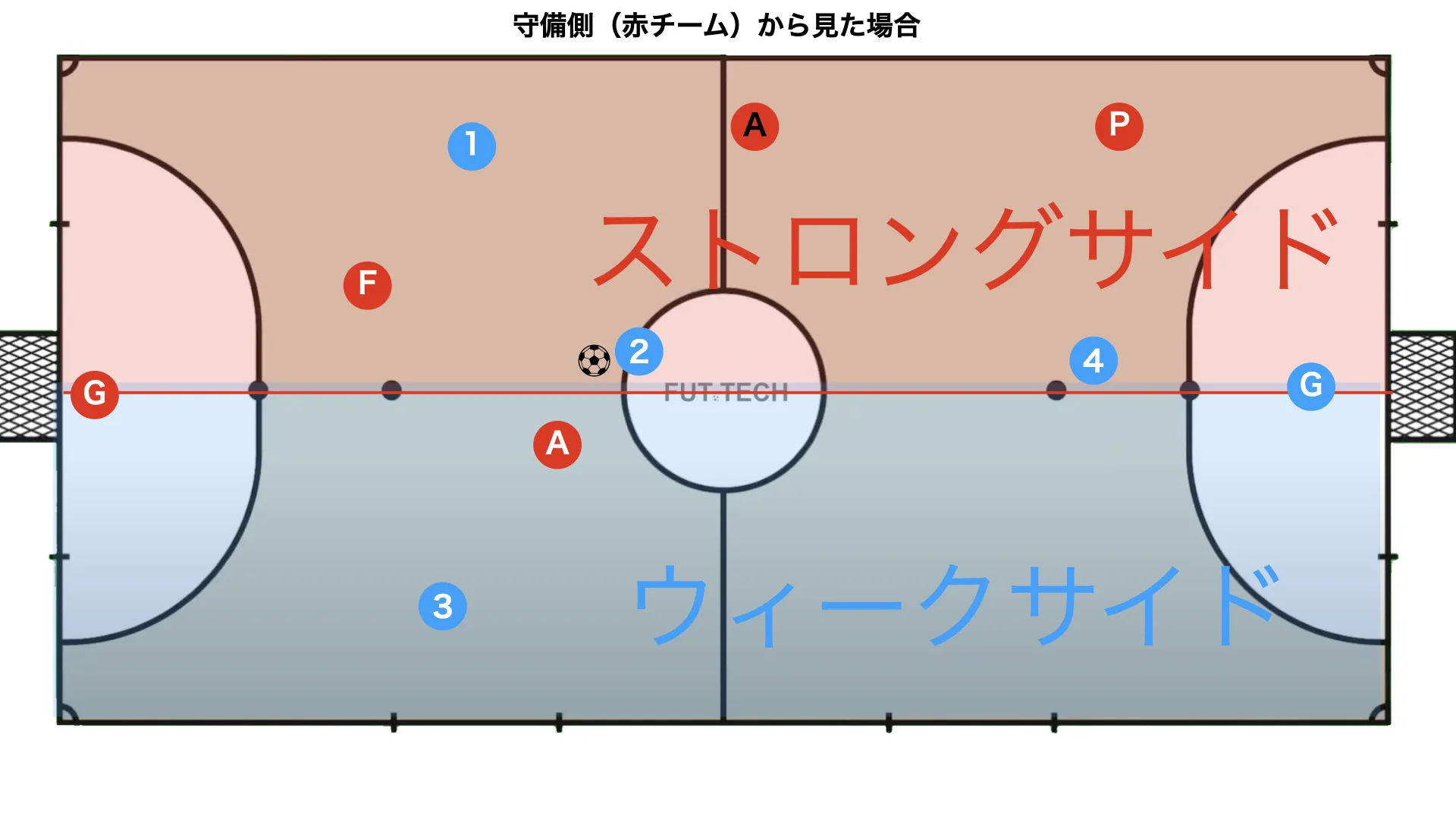
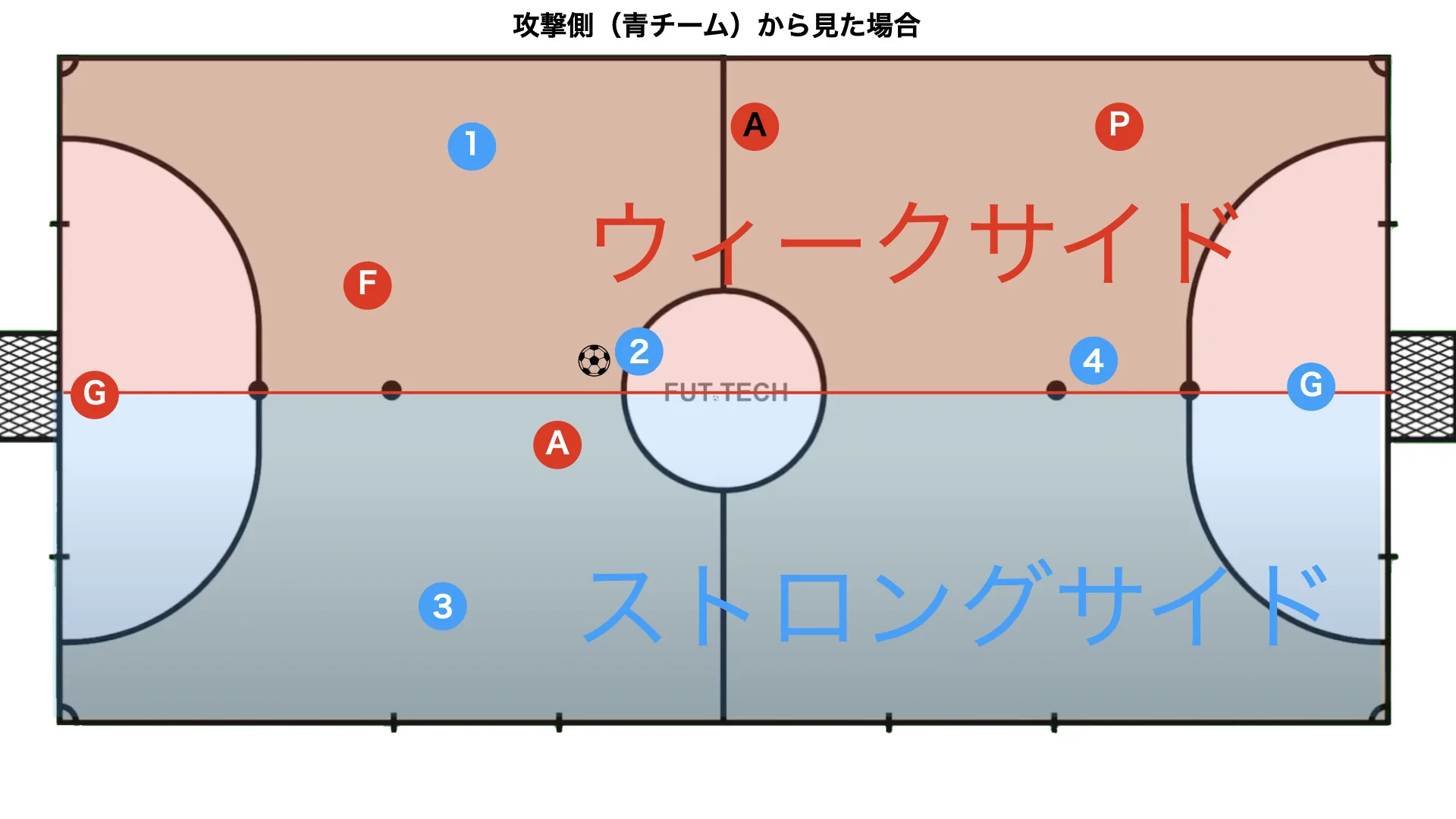
The strong side and weak side are sides, or zones, defined subjectively by one team. So if you switch your perspective between attack and defence, or between your team and the opponent, the strong side and weak side reverse.
In other words, the strong side for the attacking team can become the weak side for the defending team, and conversely the weak side for the attacking team can become the strong side for the defending team.
If you do not keep this in mind, it becomes unclear which side someone means when they say strong side or weak side, so this is extremely important.
This way of thinking matters especially in transition phases, so I will show diagrams from a transition context below.
This time, I explained the three important advantages you need to understand when thinking about the strong side and weak side.
It may have felt a little abstract and difficult, but these are important concepts when thinking about a play model or analyzing a game, so they are worth understanding.
Summary
When thinking about the strong side and weak side, it is important to consider the three advantages: numerical superiority, qualitative superiority, and positional superiority.
The strong side and weak side are two sides of the same coin.
I hope this article gives you a hint that helps your team score more goals, or in other words, find more checkmates.