The Tactical Intent of the Line Cut: Three Advantages and Disadvantages
Published: 2021.02.03Updated: 2026.05.03
You hear the term "line cut" all the time, but when you actually try to explain it, it can be hard to put into words. A lot of people probably feel that way.
A line cut is an off-the-ball movement that crosses the opponent's defensive line, and it is an essential concept for breaking down a zonal defence. Whether or not you understand this movement has a major impact on the range of attacking options available to you.
In this article, I will explain the definition of the line cut, its three advantages, its disadvantages, and the situations where it can be used effectively.
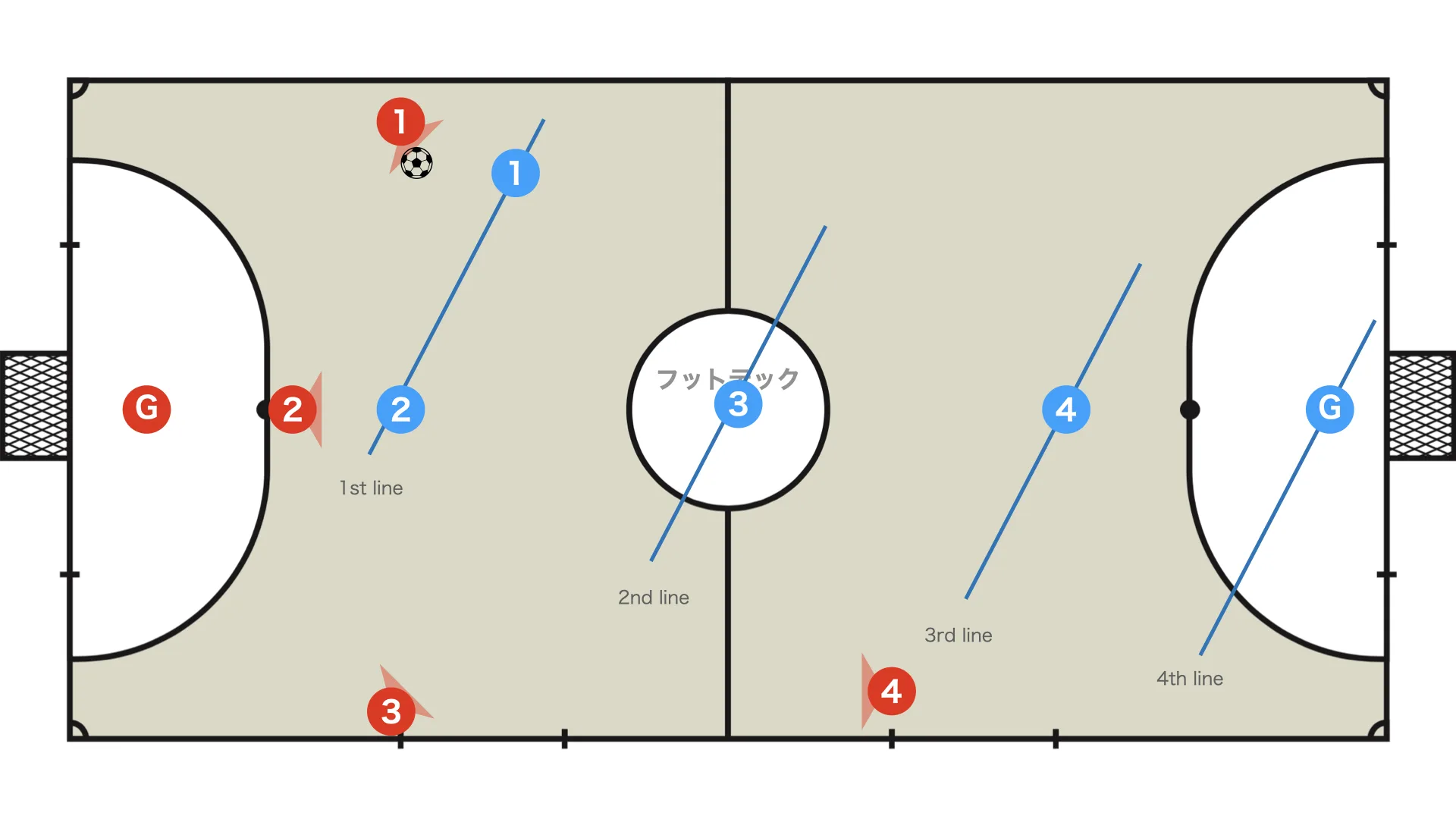
A line cut is a movement that crosses (breaks through) the opponent's defensive line.
When a team uses zonal defence in futsal, the basic idea is to build multiple defensive lines. A movement that crosses one of those defensive lines is called a line cut.
If you are not yet familiar with the idea of multiple defensive lines, I recommend reading the article below first.
関連記事
Zone Defence Basics: Building Multiple Defensive Lines and the Ala-to-Ala Pass
A guide to a core concept in futsal zone defence: building multiple defensive lines. This article ex…
続きを読む →From here on, I will explain things on the assumption that you already understand the concept of multiple defensive lines.
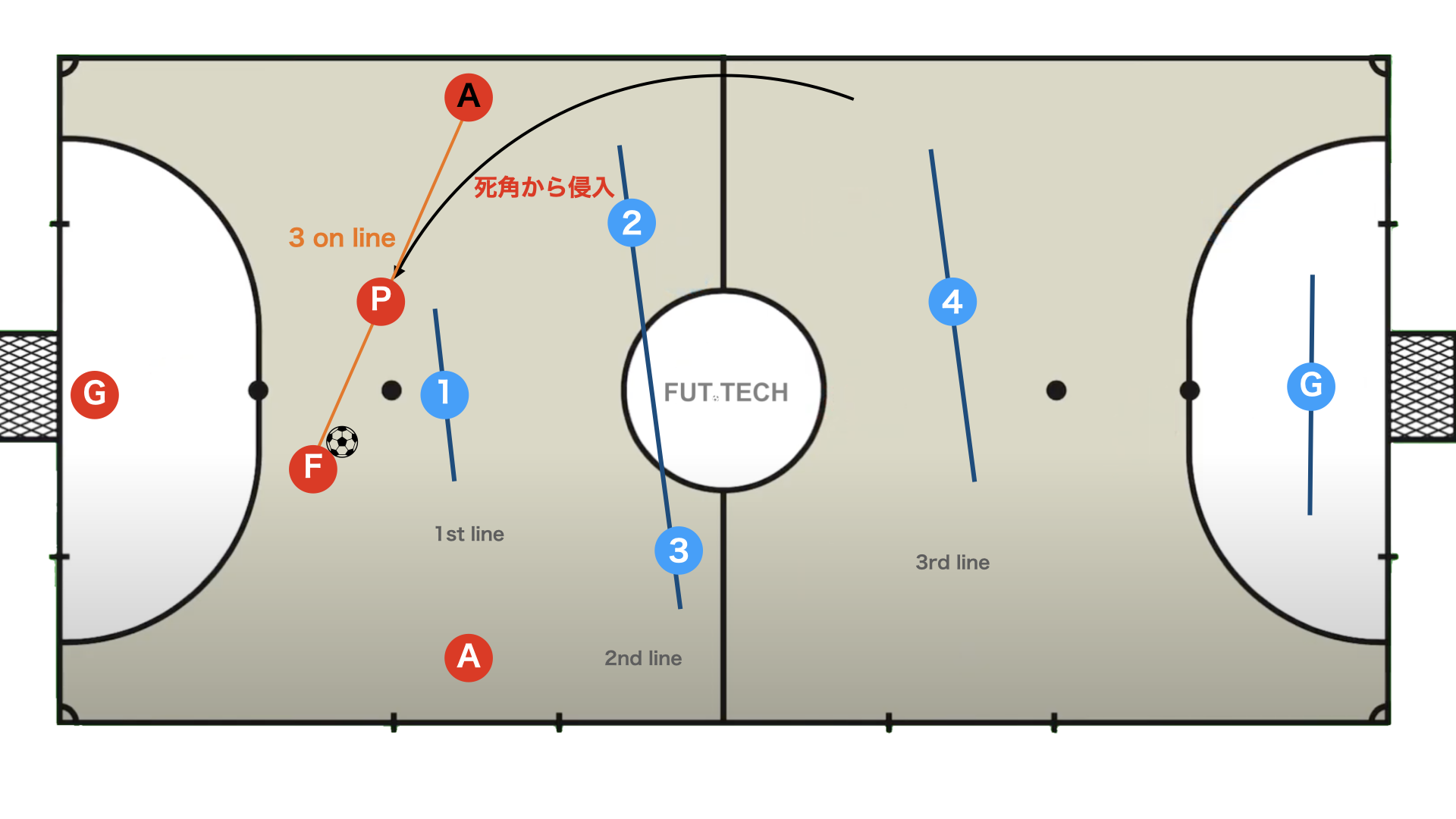
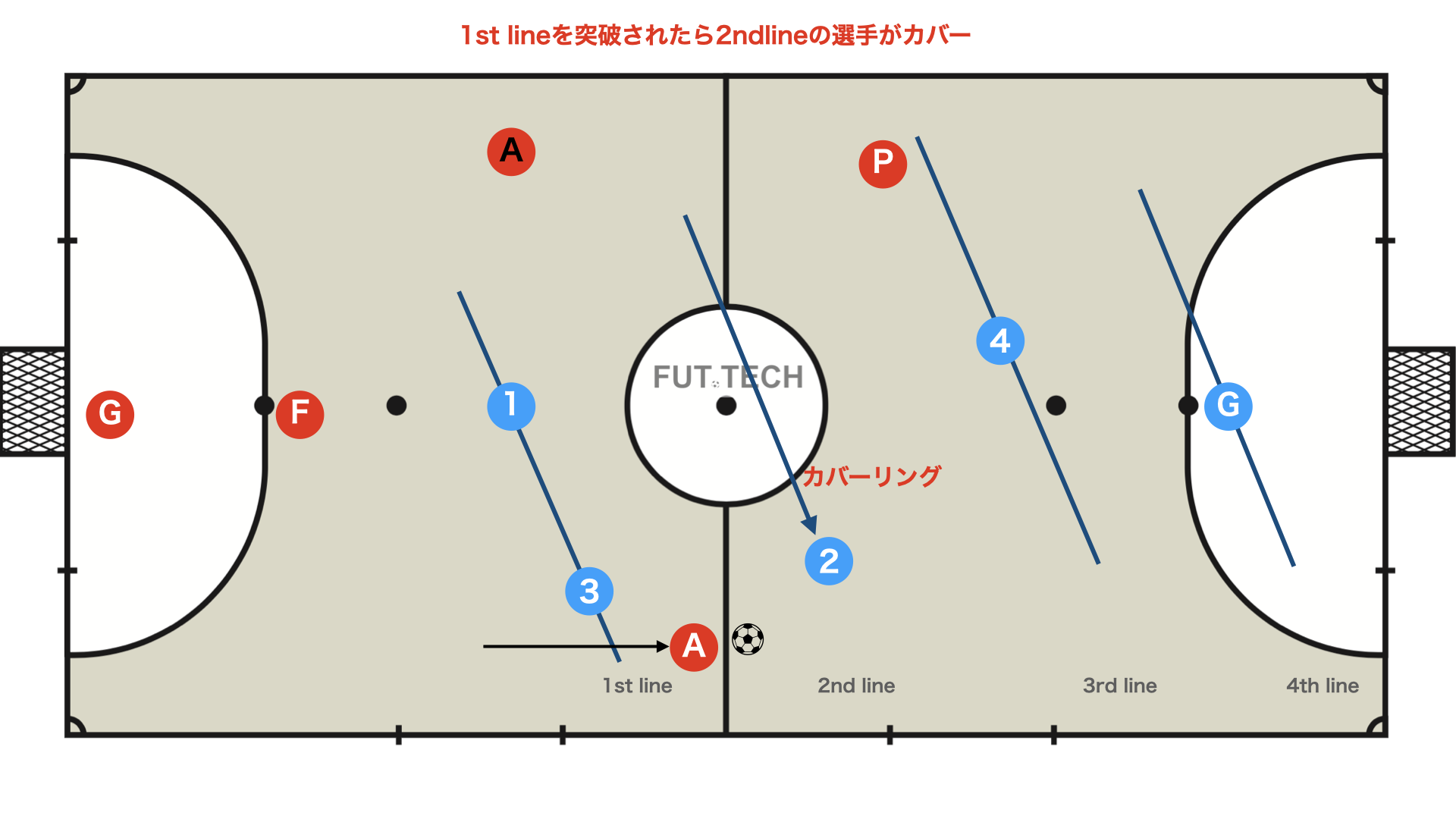
As shown by the pivot in the diagram above, a line cut is when an attacking player makes a movement that crosses the defending team's defensive line.
In futsal, this usually refers to a line cut where a player drops into a deeper line, but a movement into a higher line is also a line cut.
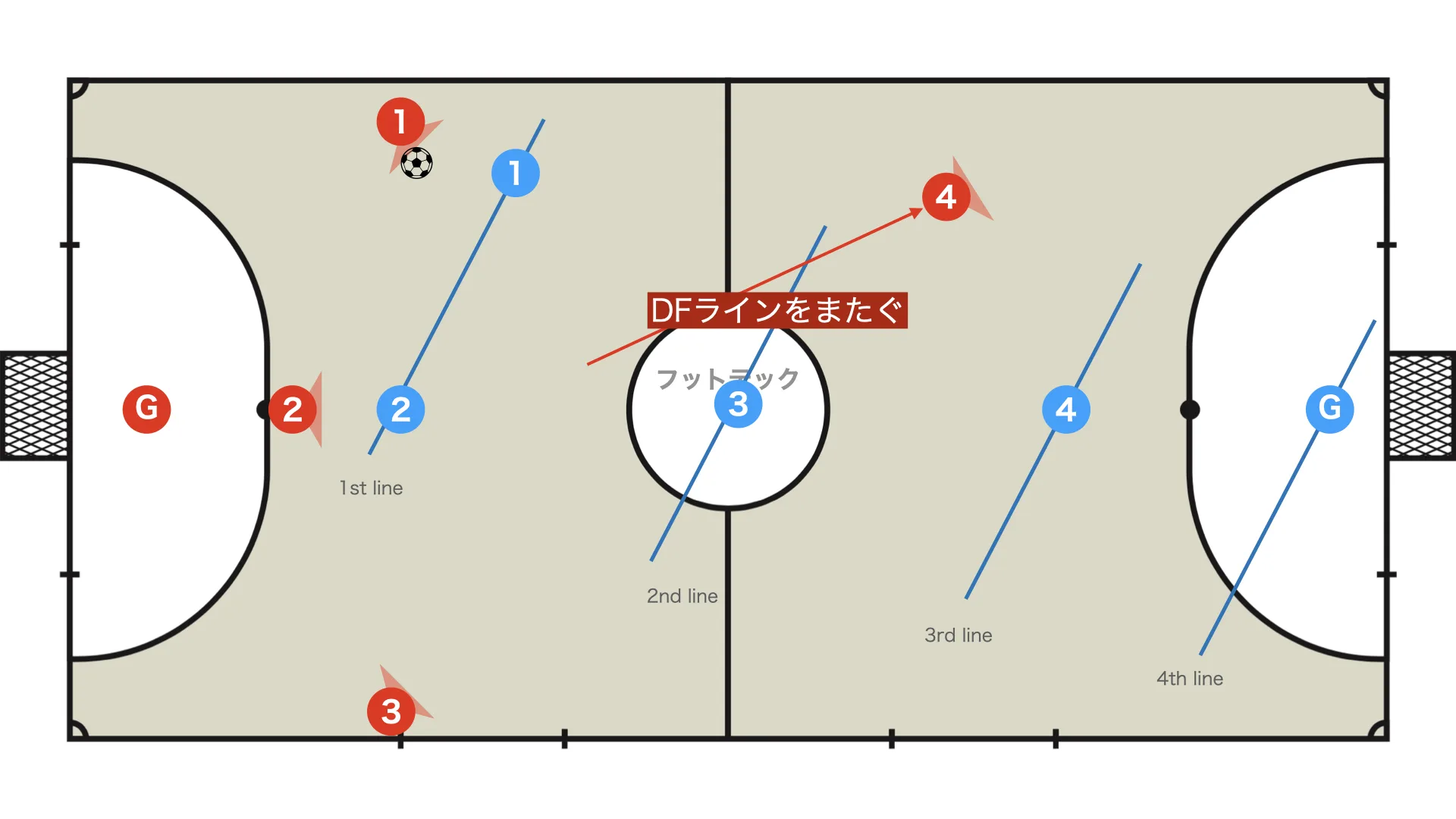
The movement in the diagram above is often called a run in behind, but because it also crosses the defensive line, it is one type of line cut.
That said, in general, "line cut" usually refers not to a run in behind, but to a movement that drops into a deeper line.
This article focuses on the line cut that drops into a deeper line.
In Spain, where futsal is especially developed, there are around eight different terms for line cuts, and there is even debate about whether the terminology should be standardized. At Pescadola Machida, for example, a line cut is called a remonte.
The tactical intent of the line cut can be summarized in the following points.
- Change the formation from 3-1 to 4-0
- Create a local numerical superiority
- Force the opponent's multiple defensive lines to collapse into one
Let’s look at each one in detail.
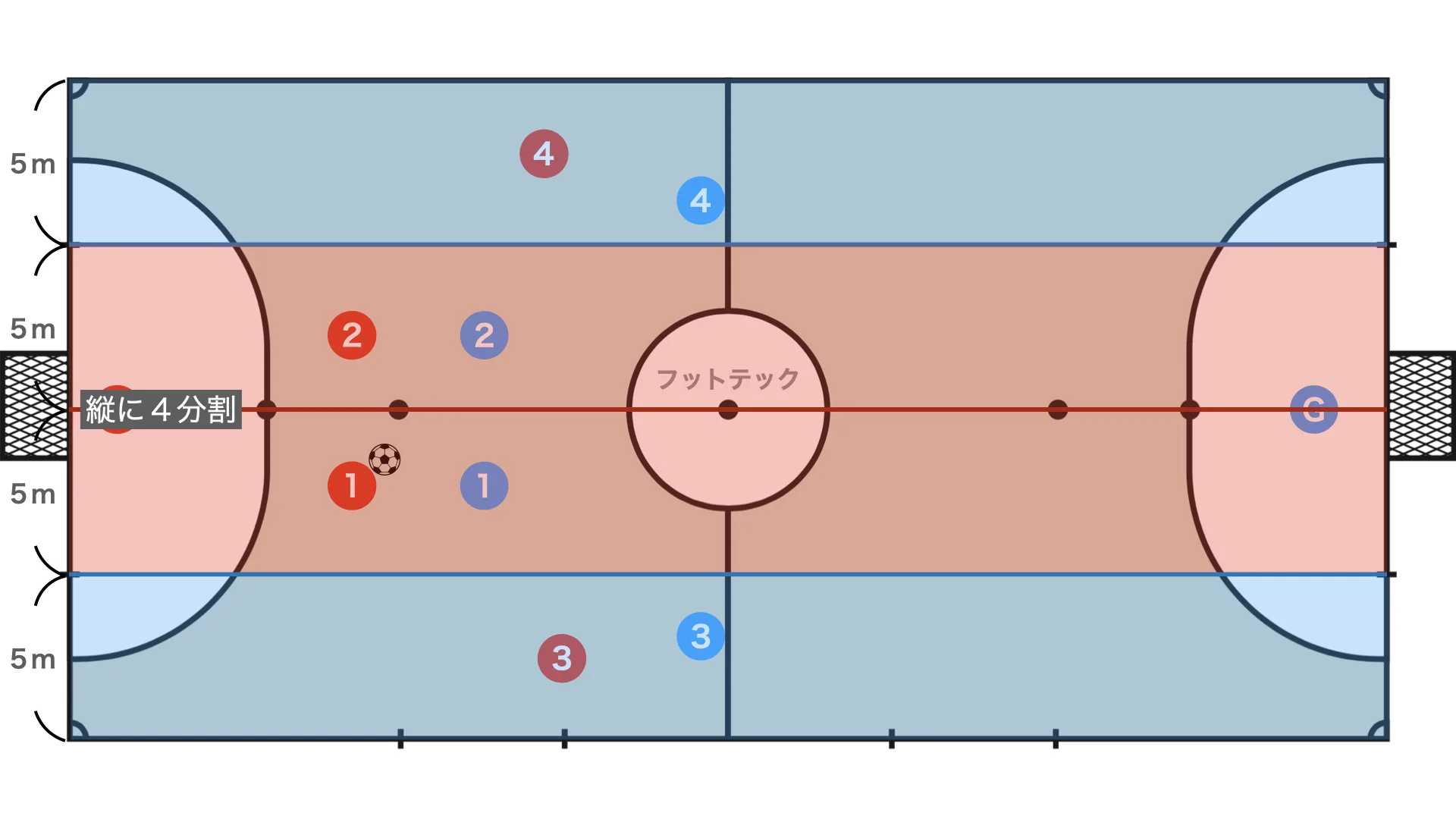
One tactical use of the line cut is a formation change from a false pivot (3-1) into a quatro (4-0).
When the pivot simply drops from the side and the team shifts into a 4-0 like this, it creates confusion for the opposing defence.
If you watch Spanish teams, many of them switch naturally between 4-0 and 3-1 by using line cuts.
関連記事
The Complete Guide to Quatro (4-0) in Futsal: Purpose, Movement, and Training
A complete explanation of the 4-0 (quatro) rotation in futsal. From four-lane theory to 2-player, 3-…
続きを読む →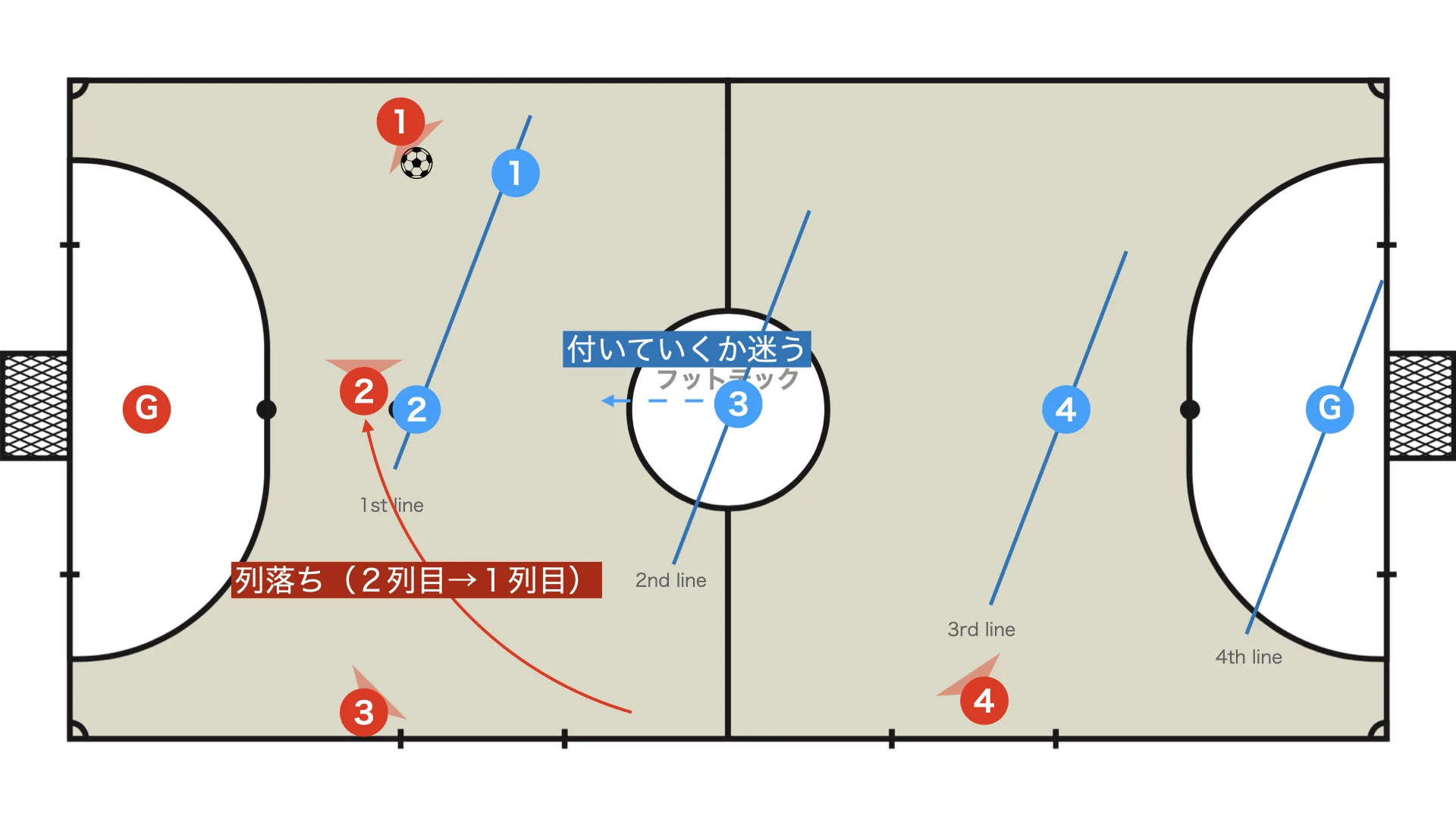
Local numerical superiority means having more players in a limited area of the court.
When the attack is not functioning well, a higher player can drop into the first line, creating a local numerical superiority in the back and making it easier to build the attack.
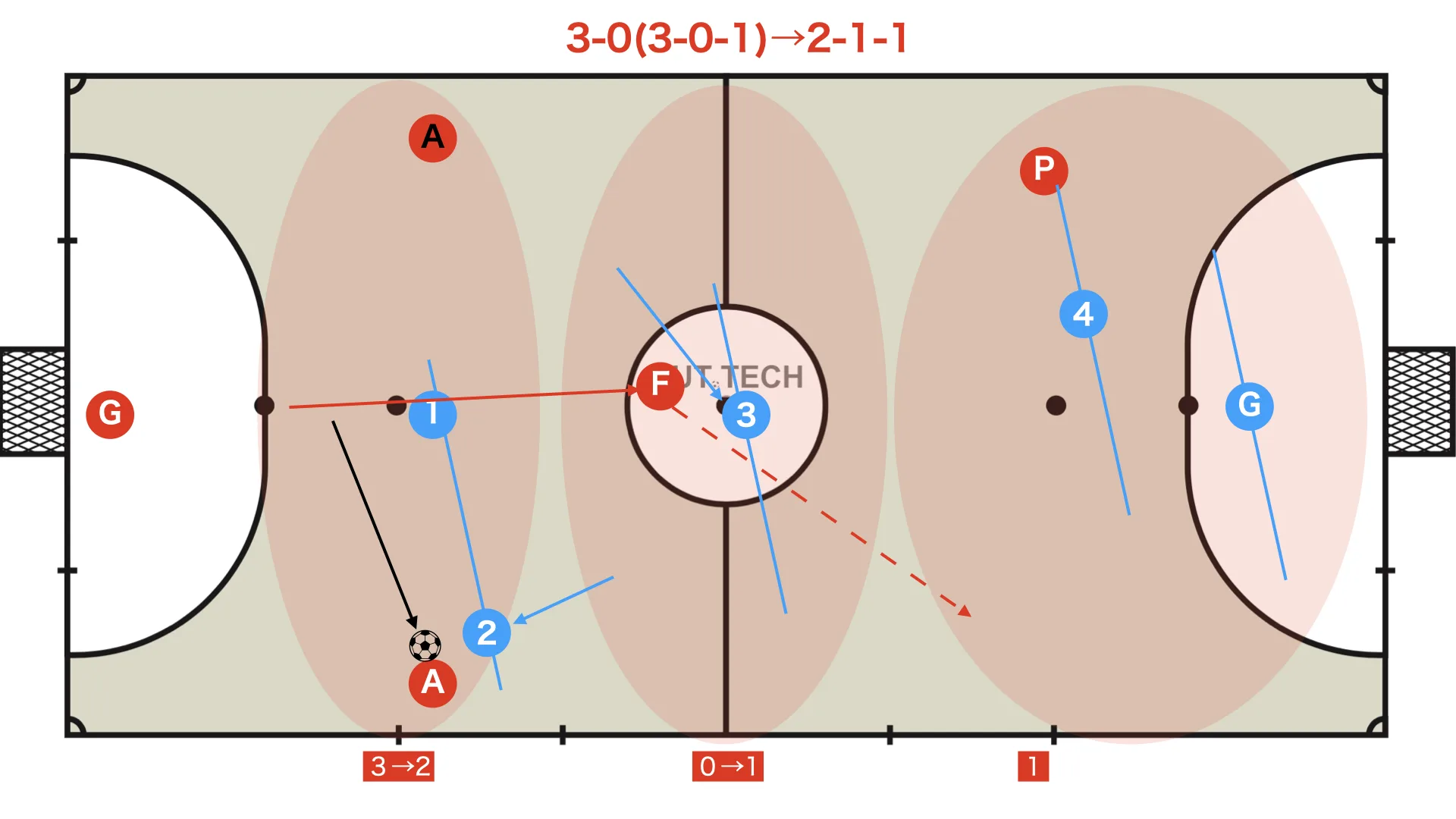
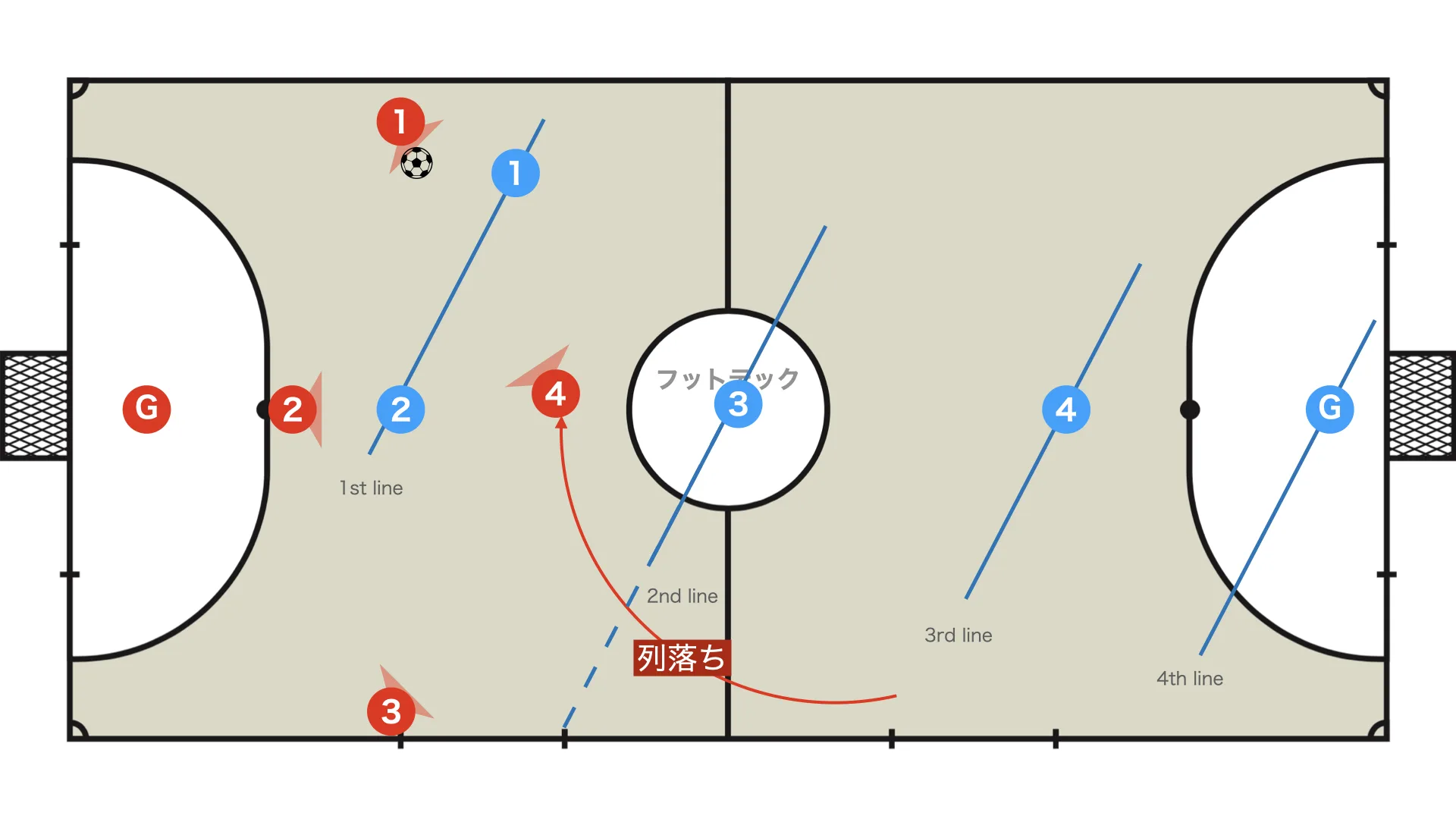
In the diagram above, the player from the second line drops from a 2-1-1 formation, changing the shape into a 3-1 (3-0-1).
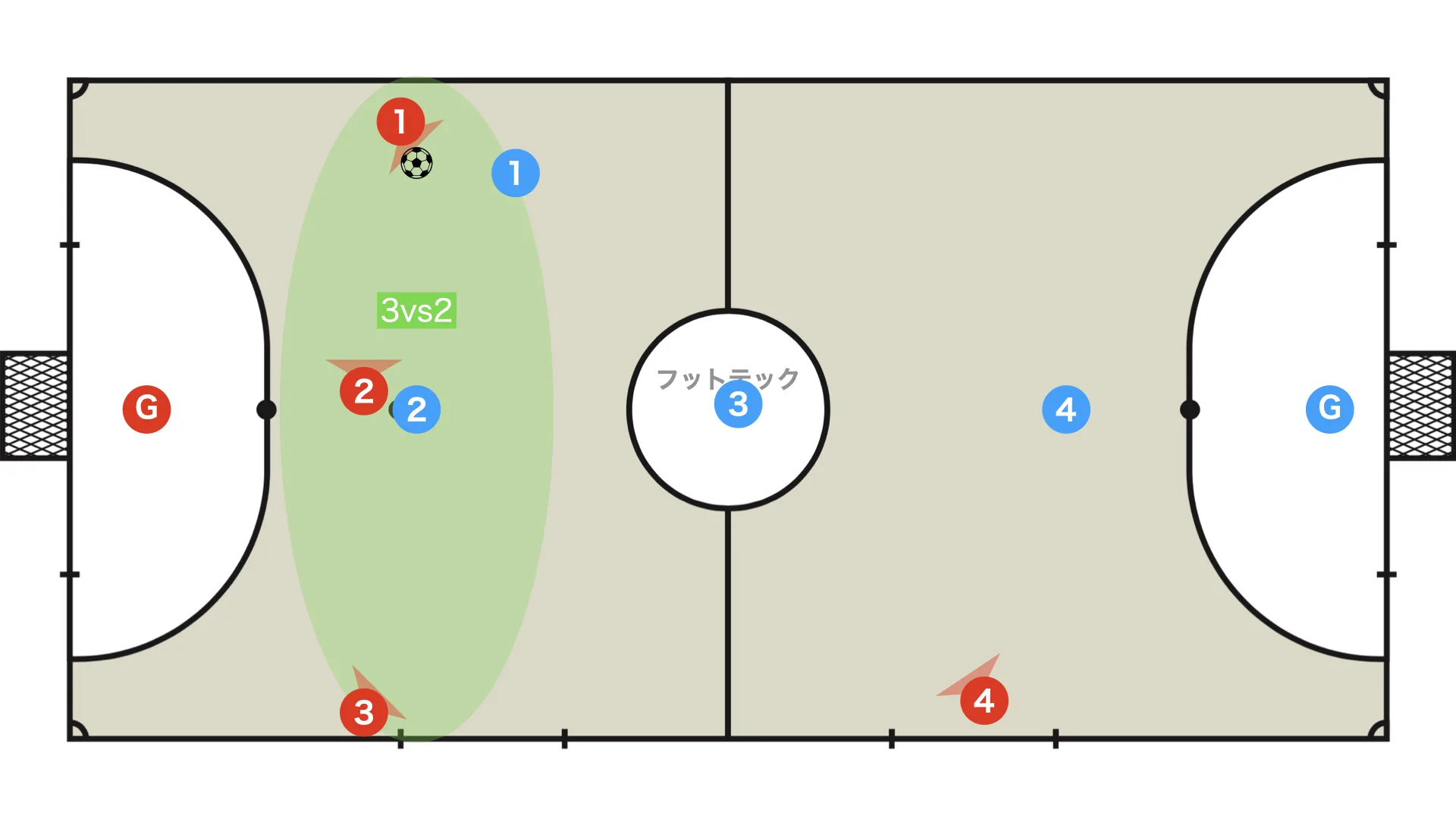
Because the second-line defender (blue no. 3) did not follow the player who dropped, the attacking team creates a 3v2 numerical superiority in the first line.
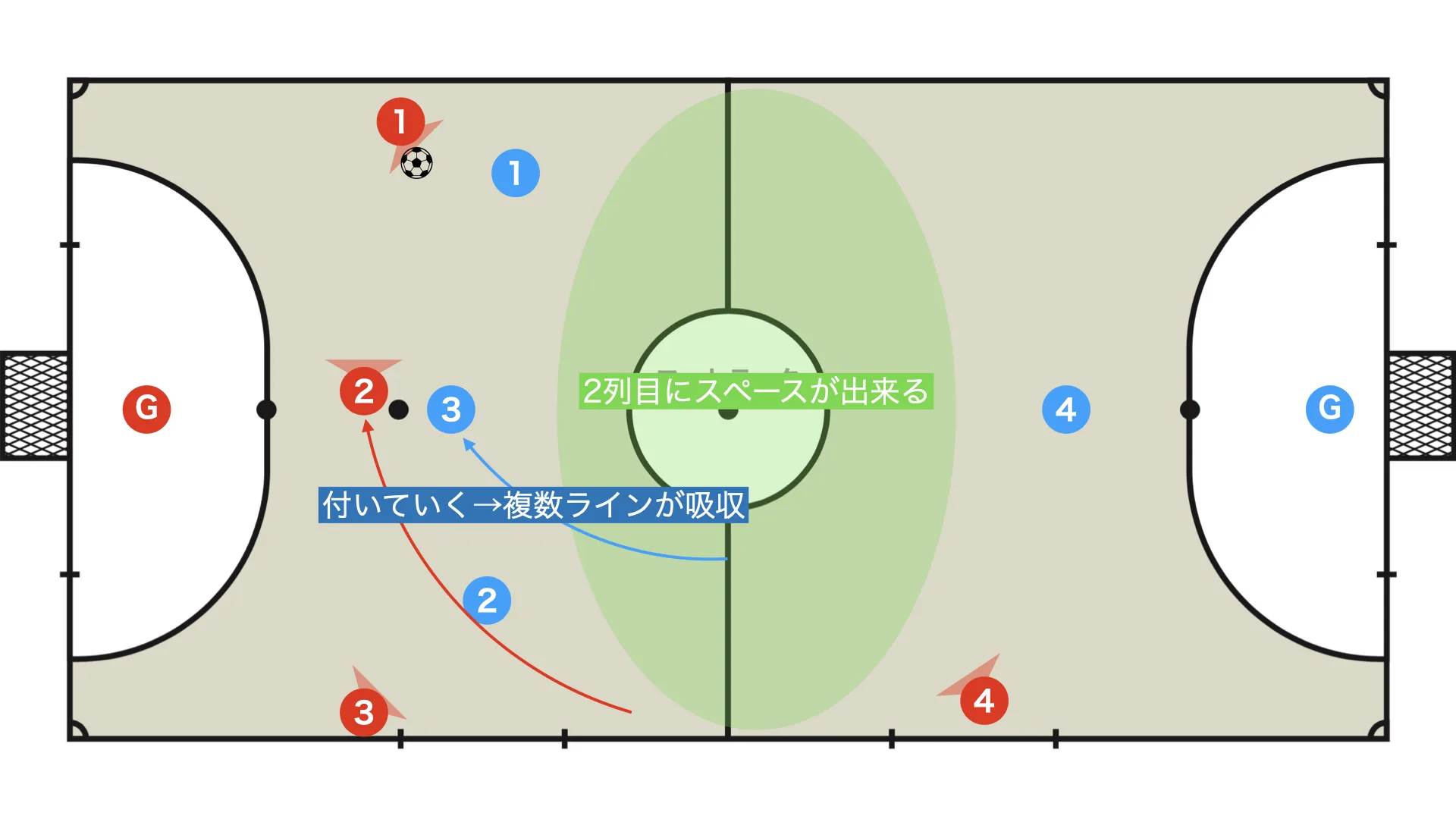
On the other hand, if an opponent follows the player making the line cut in man-to-man fashion, the multiple defensive lines get absorbed into each other and flatten into a single line, opening up space in the second line.
In that kind of situation, you can exploit the free space with simple two-player relationships such as a one-two or a parallel.
関連記事
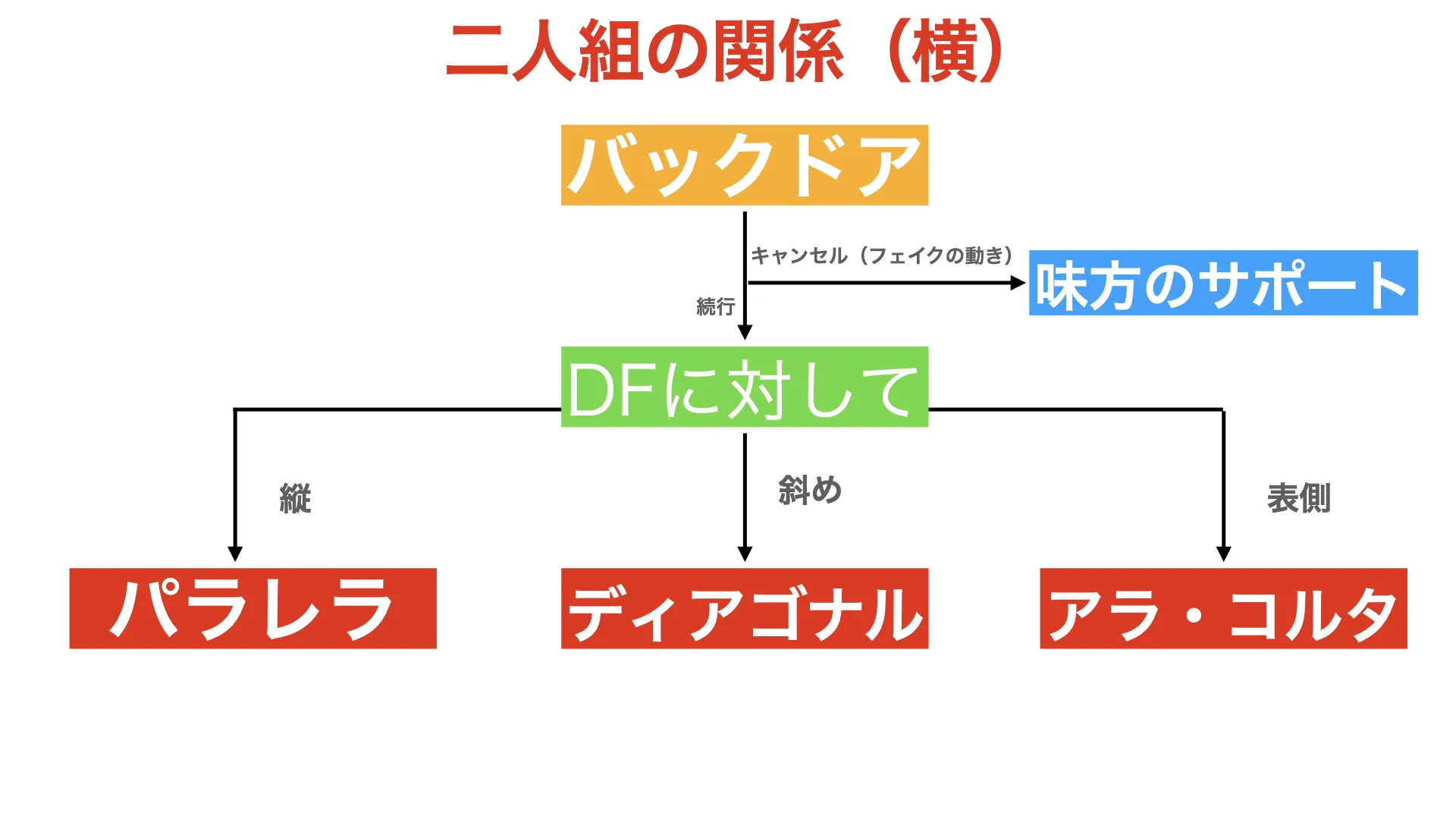
Overview: Two-Player Combinations in Futsal
An overview article explaining two-player combinations in futsal. It organizes the relationships and…
続きを読む →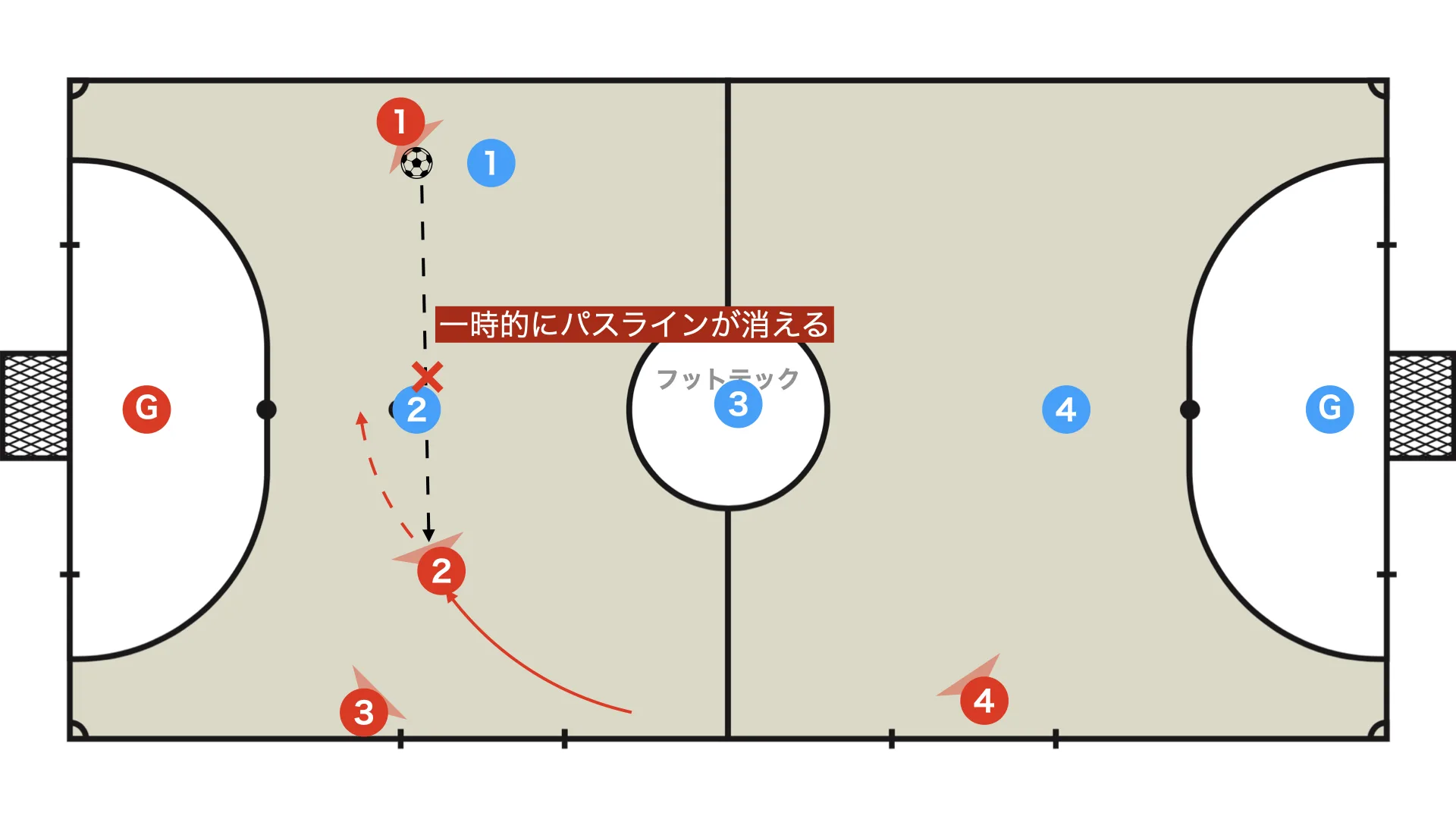
The disadvantage of the line cut is that the passing lane from the ball temporarily disappears.
For that reason, there are quite a few coaches in Spain who do not like line cuts.
Also, if players use a line cut without understanding its tactical purpose and without a shared understanding across the team, it can easily create confusion among teammates.
The rotation in a 3-1 is, in practical terms, the same phenomenon as a line cut from a 2-1-1. For that reason, this article explains it through the better-known 3-1 rotation.
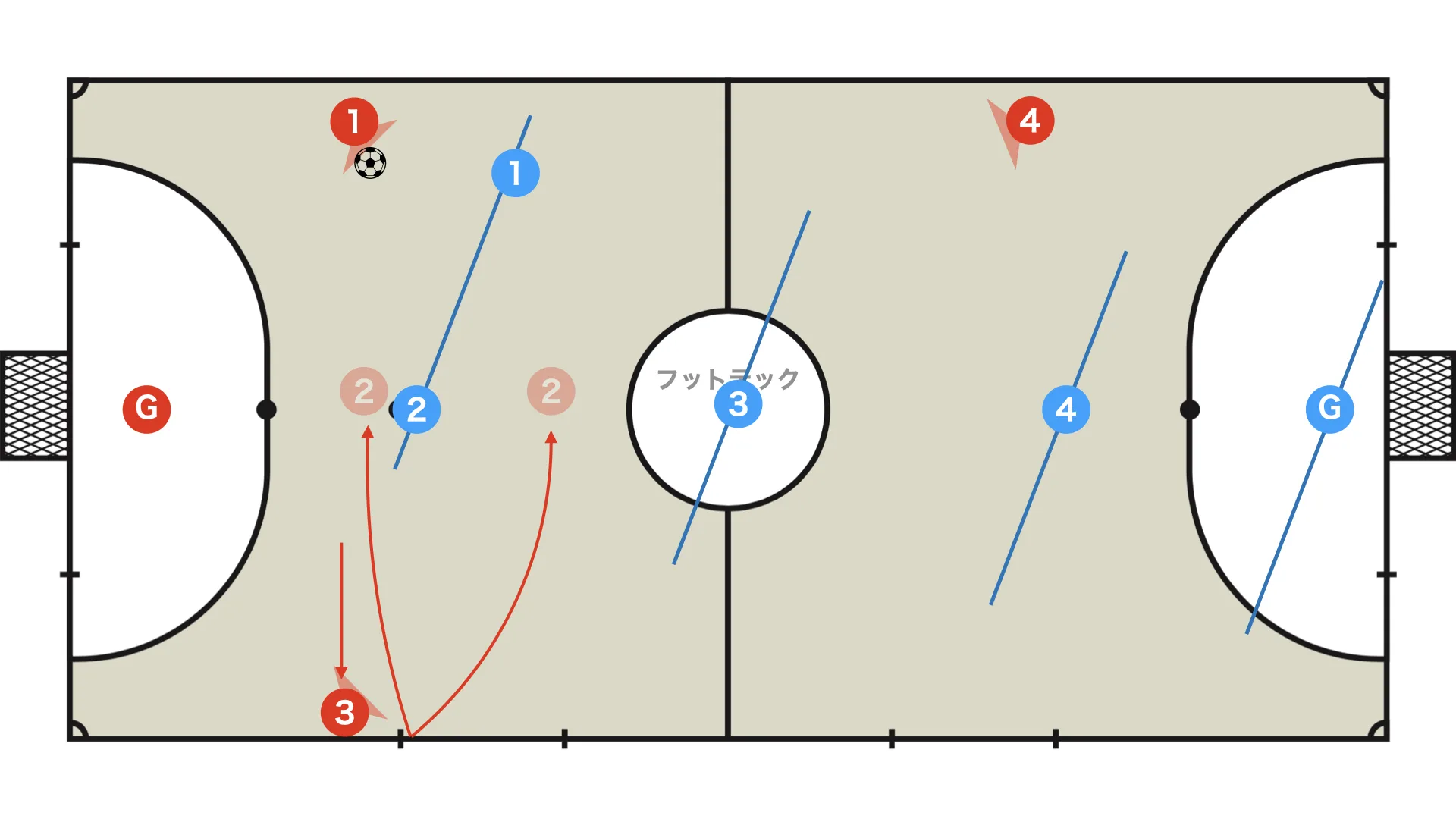
There are two patterns in the rotation: one uses the front side of the 2nd defender (blue no. 2), meaning the first line, and the other uses the back side, meaning the second line or the space between the lines.
Because a rotation that uses the space between the lines goes beyond the focus of this article, I will leave it out here.
If you are interested, read the article below.
関連記事
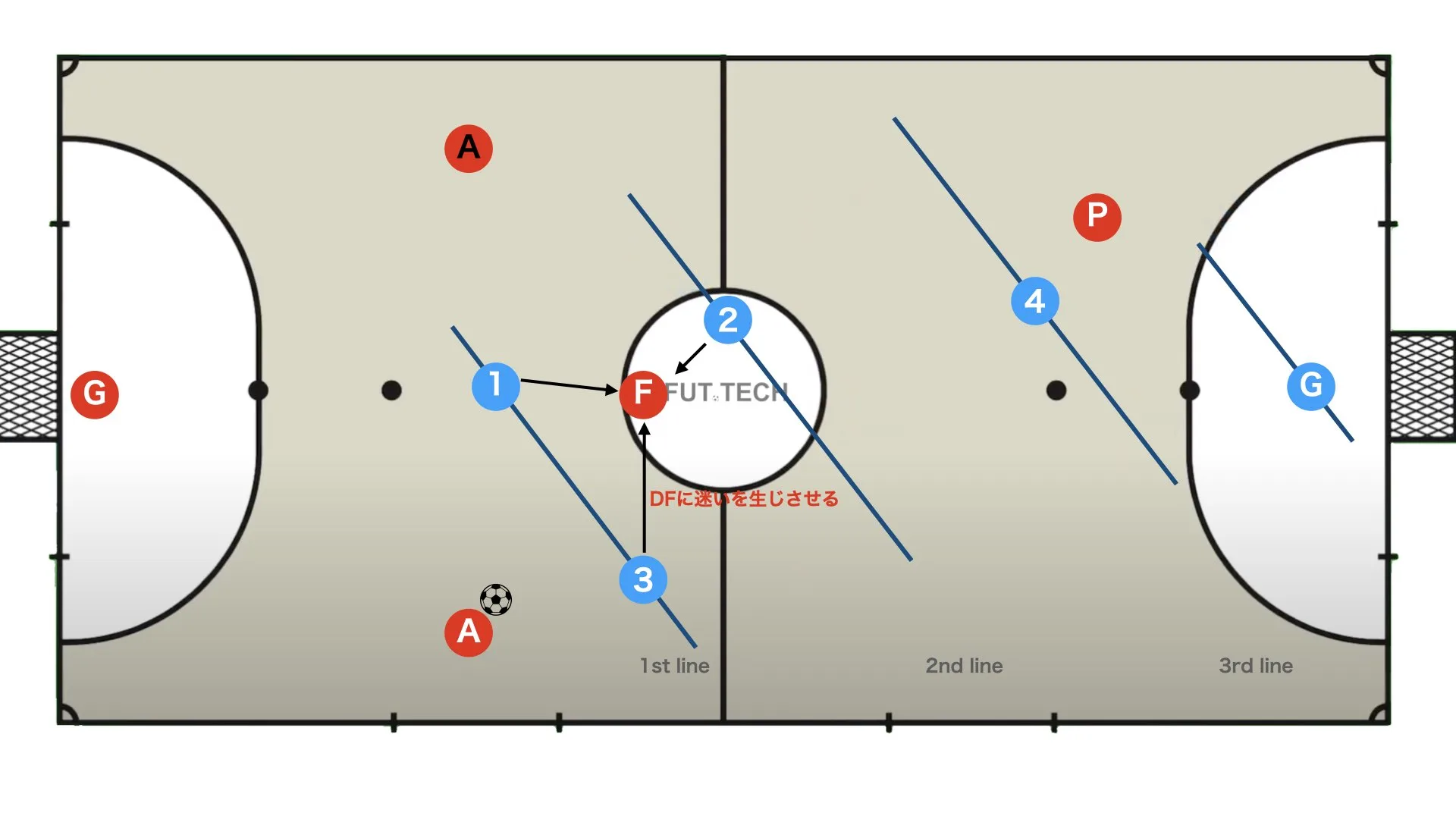
How to Use the Space Between the Lines to Break Down Zone Defence
A guide to using the space between defensive lines in futsal to attack zone defence. This article ex…
続きを読む →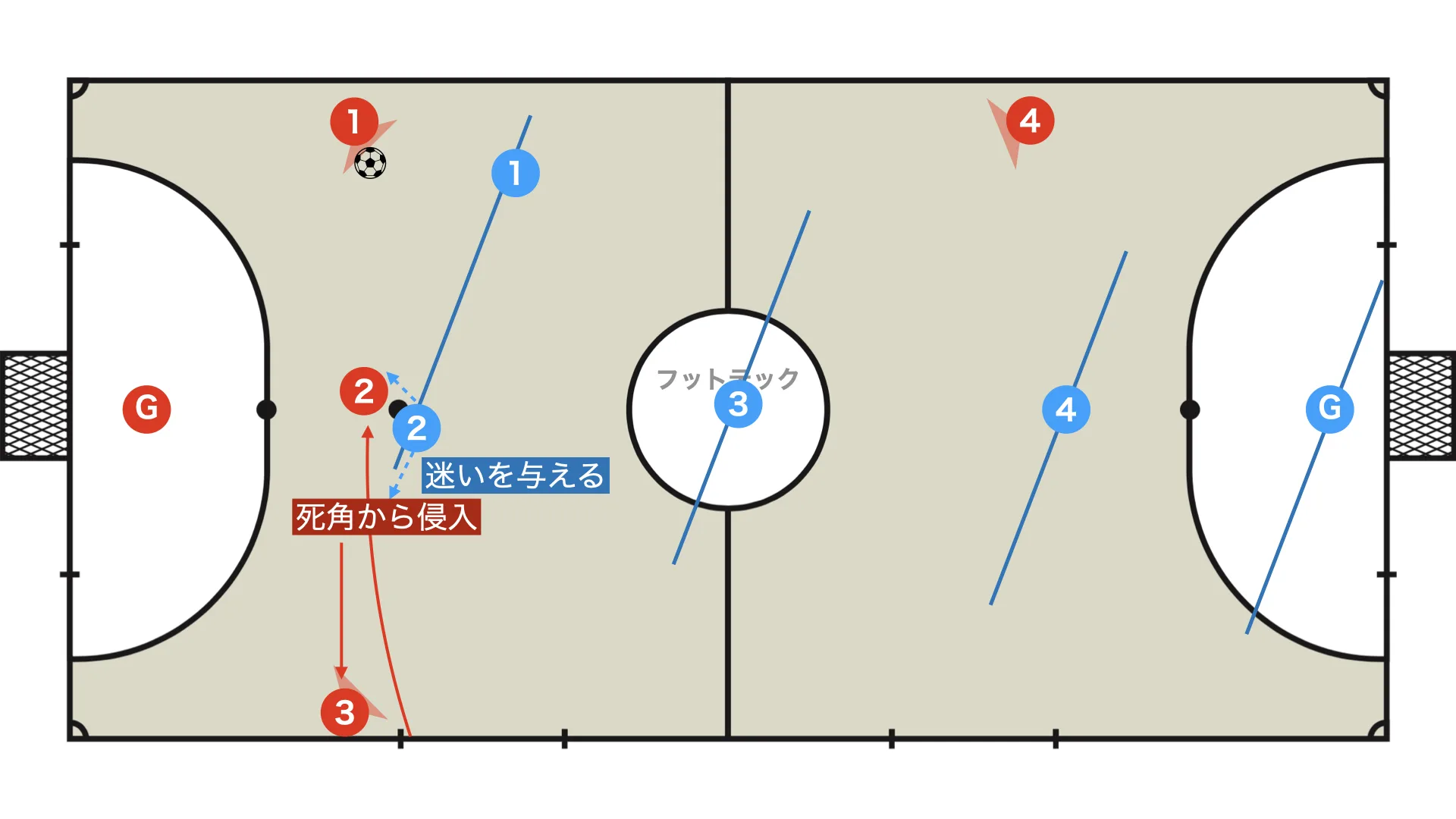
By entering from the 2nd defender's blind side, the attack can make the defender hesitate over whether to protect the inside or the outside.
The attacking team then chooses its next action based on how the 2nd defender reacts.
I will explain each option one by one.
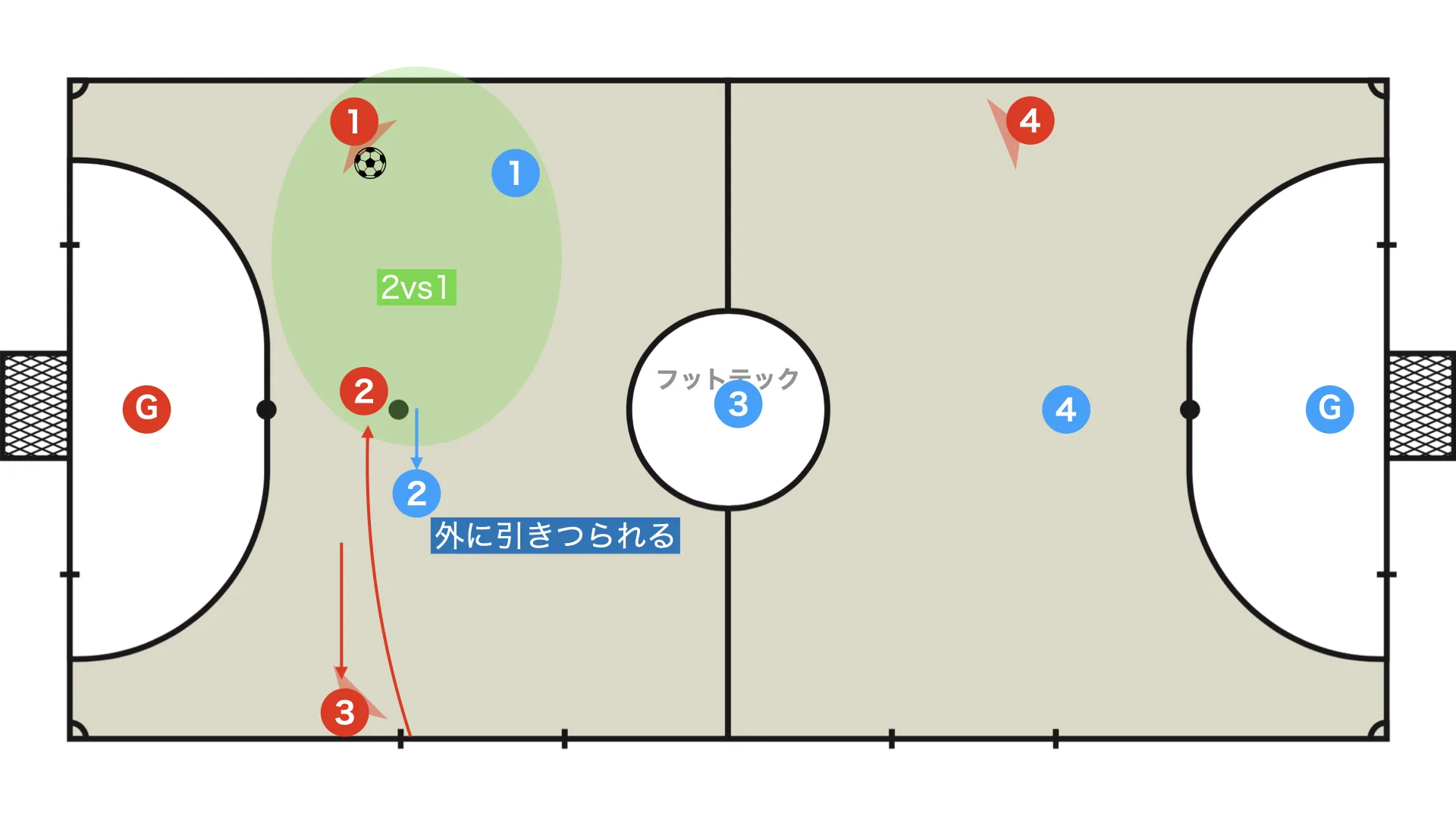
If the defender bites to the outside, a local 2v1 numerical superiority is created, so the attack can progress using a two-player relationship plus the pivot.
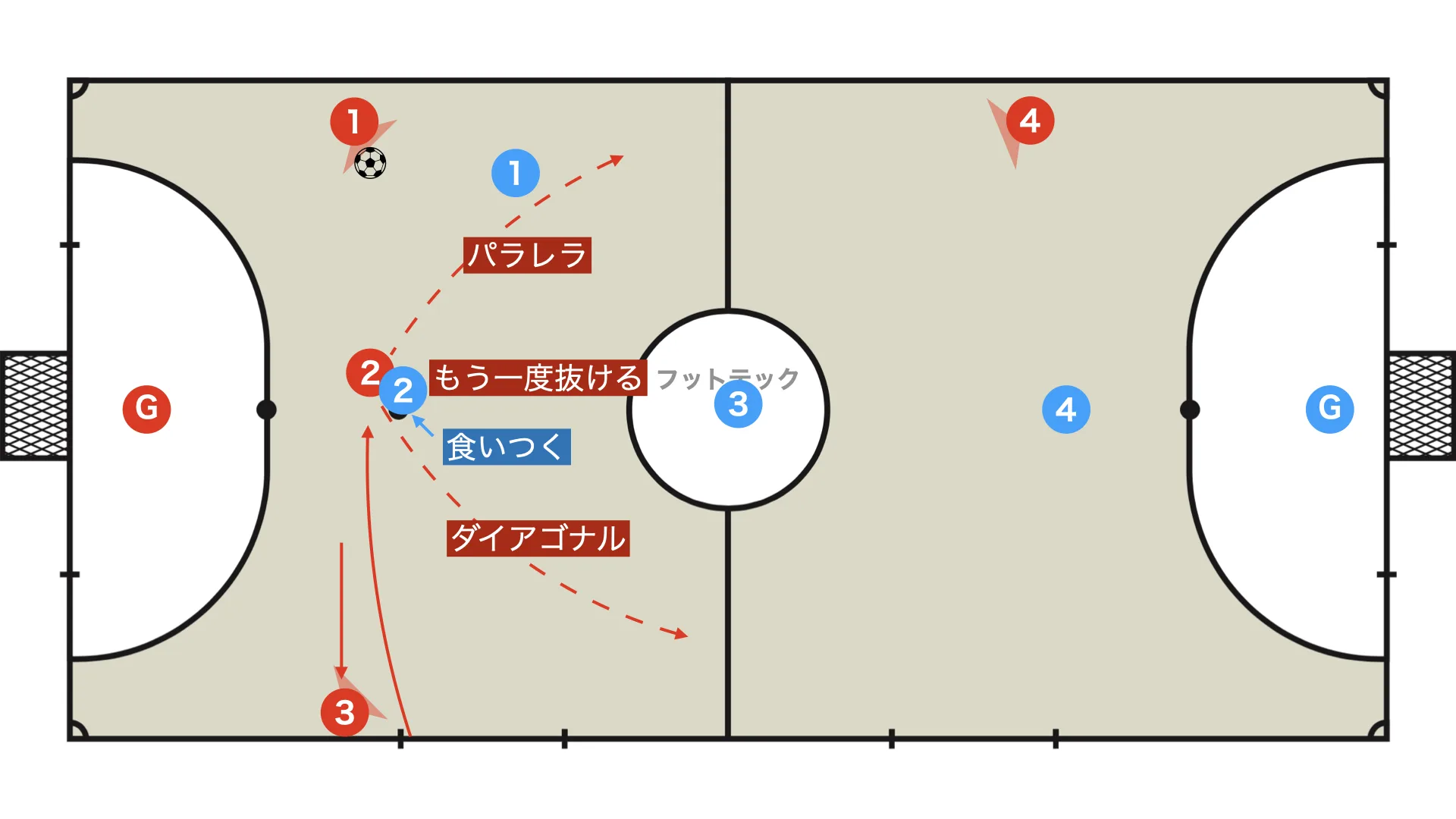
If the 2nd defender bites and the ball holder is in a position to play the ball in behind (that is, not under pressure), the attacker can run in behind.
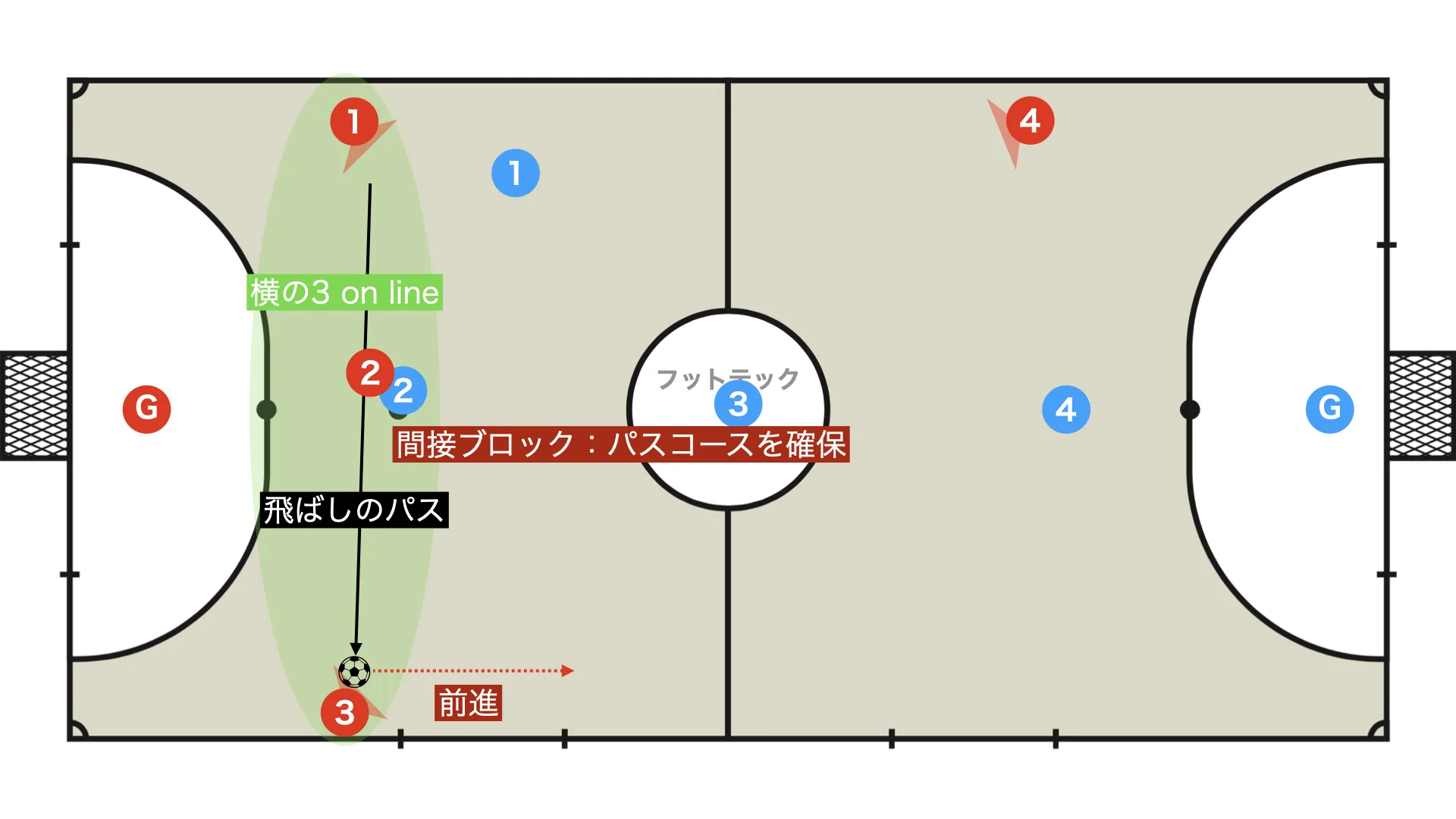
If the 2nd defender bites to the inside, it means the defence is overloaded to one side, so simply switching the ball to the other side lets the team advance with the dribble.
At this point, another option is to secure the passing lane by giving the 2nd defender an indirect block.
関連記事
Do You Actually Know the Difference? Block vs Curtain, plus Indirect Curtain and Indirect Block
A thorough explanation of the difference between blocks and curtains in futsal. This article sorts o…
続きを読む →This article explained the line cut as an off-the-ball individual tactic.
If you are still new to futsal, this may have felt like a slightly difficult concept, but I hope you at least now have a firm grasp of what the term line cut means.
To take your positional attack up a level, it is extremely important to understand the tactical intent of the line cut and embed it within the team.
And if only the player making the line cut understands it, the movement has very little value, so the whole team needs a shared understanding.
I recommend first introducing it through unopposed analytic training and practicing it as a team.
関連記事
The Complete Futsal Glossary
A complete, keep-for-reference glossary covering the tactical terms used in futsal. This essential g…
続きを読む →