The Complete Guide to Quatro (4-0) in Futsal: Purpose, Movement, and Training
Published: 2021.01.12Updated: 2026.05.03
Many players probably feel, "I want to introduce Quatro (4-0), but the rotations are so complex that I do not even know where to start."
Quatro (4-0) is a positional attacking structure that does not place a pivo up front. Instead, all four players move fluidly to break down the opposing defence. It may look complicated, but once you understand the four-lane theory and the core rotation principles, you can approach it systematically.
This article explains Quatro from the ground up, covering its tactical purpose, every major rotation pattern, and even training exercises.
If you want to compare it with other systems as you read, these articles will help as well.
Quatro? Cuatro?
In this context, it is Quatro, not Cuatro.
Quatro (quatro) means "four" in Spanish, and the English word "quarter," meaning one fourth, is also derived from it.
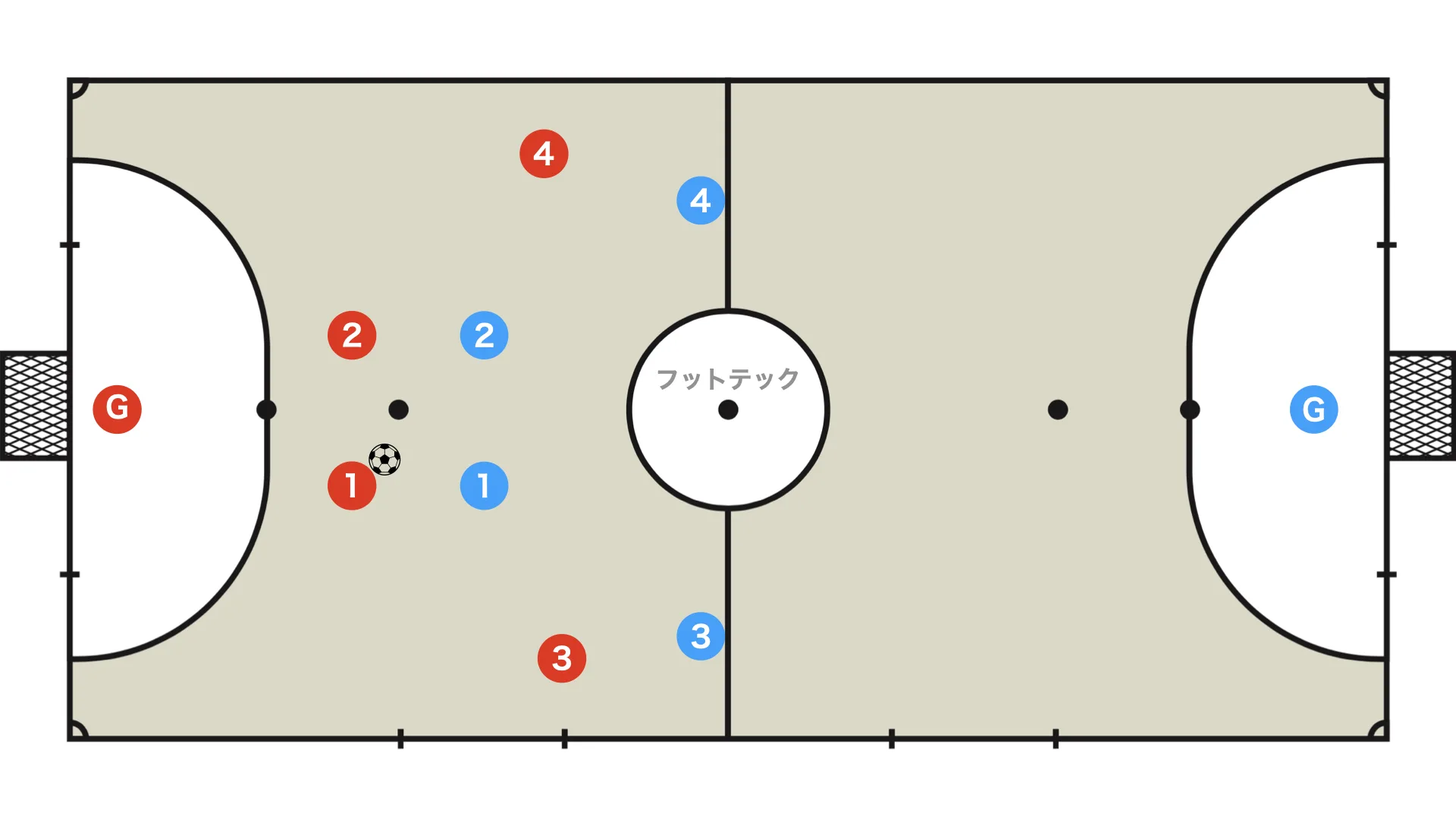
In futsal, Quatro is a formation that places four players in the deeper areas, as shown above.
Its defining feature is that it does not station a field player up front.
Because of that, Quatro offers the following advantages:
- There is a huge amount of space in front, so runs in behind are easier to make successfully
- The fluid movement of all four players can confuse the opposing defenders
At the same time, there is not much space in Quatro inside your own half, so players need fluid movement to solve that problem. That means work rate, technique, and tactical understanding are all essential.
Depending on the team, different formations may be used in different attacking zones, such as 4-0, 2-1-1, and 3-1. Some teams use 4-0 only while playing out under pressure, then change into 3-1 once they cross the halfway line.
Also, some teams adopt Quatro for negative reasons because they do not have a pivo. But even for teams that do have one, a pivo is still valuable in Quatro because receiving with the back to goal in deeper areas expands the team's tactical options.
In short, 4-0 is a structure that advances without a fixed reference point up front, using four-player positional interchange to shift the defence.
In futsal, Quatro includes a wide variety of movements, in other words, many kinds of rotations.
It is difficult to classify every Quatro rotation perfectly, but they can broadly be divided into the following four types:
- 2-player rotation
- 3-player rotation with a fixed fixo (Quatro with an axis)
- 3-player rotation with a fixed side
- 4-player rotation
The balance between these rotation types differs from team to team, but in Quatro, teams aim for goal by mixing these four patterns or repeating them.
This article explains all four in detail.
I mentioned that Quatro rotations can be divided into four major categories, but there is one basic principle shared by all of them.
That principle is the four-lane theory in Quatro.
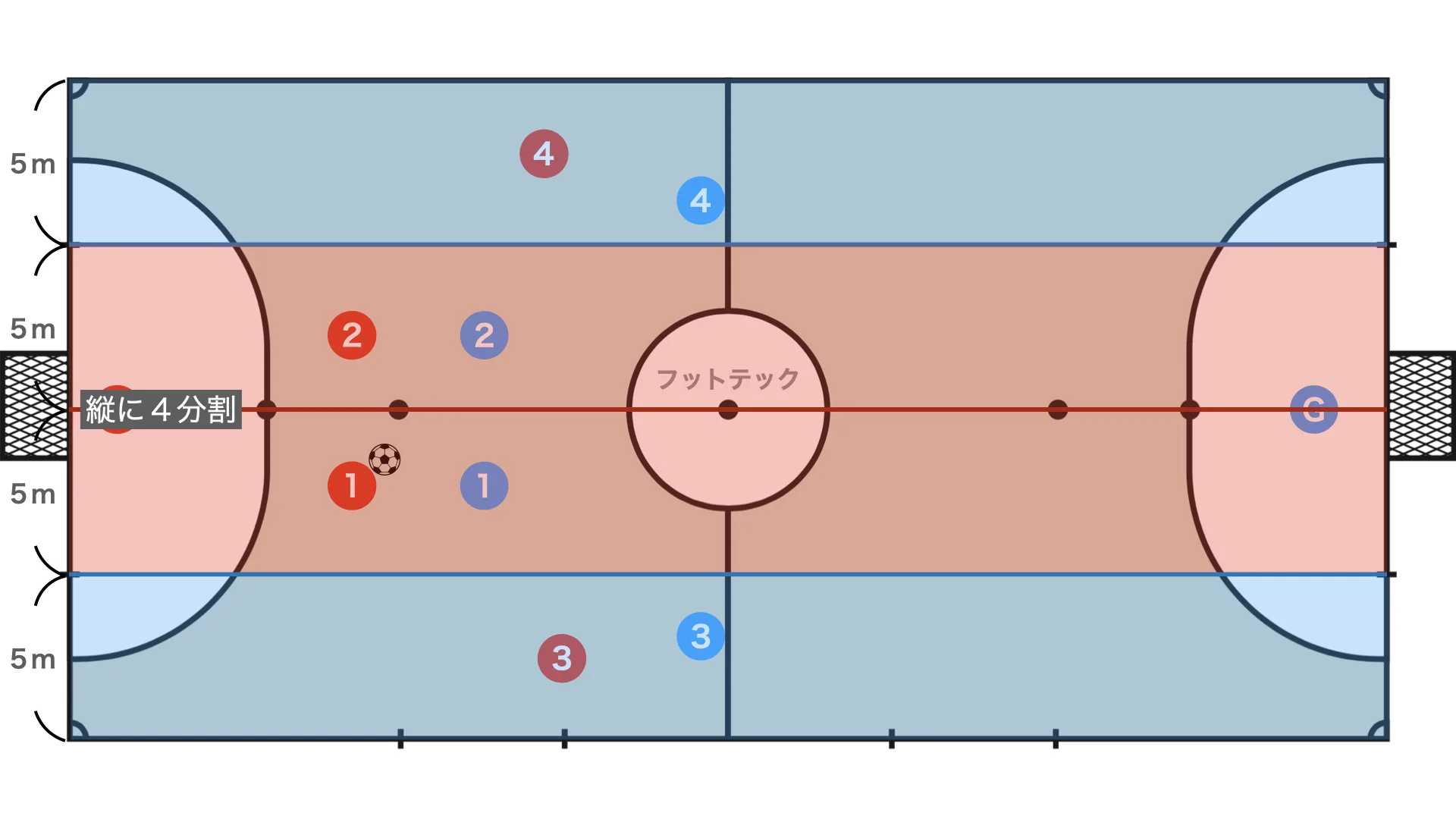
In every Quatro tactic, it is extremely important to think of the pitch as divided into four vertical lanes (5m x 4). The key is to keep one player in each lane so the floor balance is maintained.
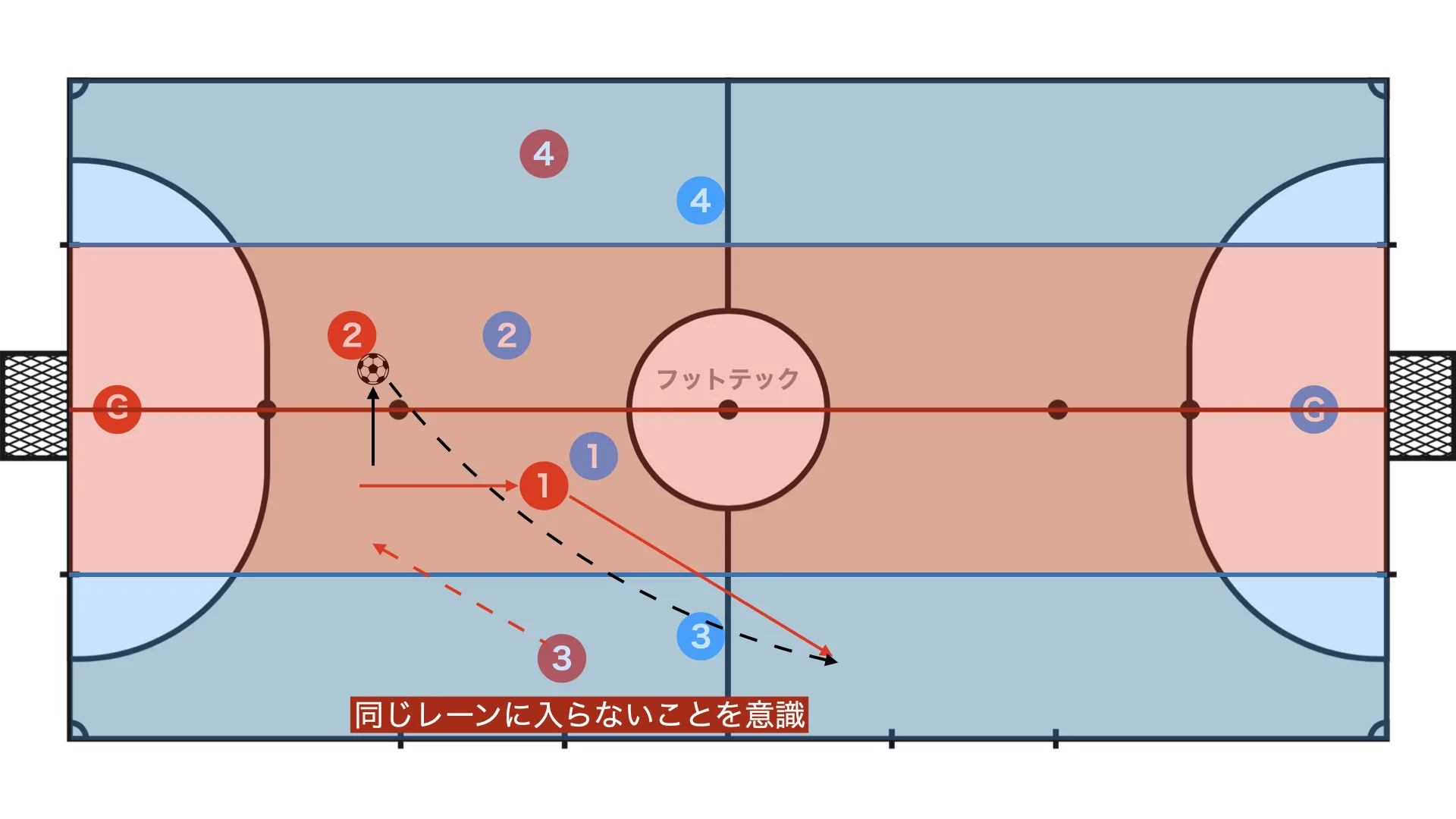
If two players end up in the same lane, one of them should move into a different lane to restore the floor balance. In the diagram above, red no. 1 makes a diagonal run, and red no. 3 recognizes that and slides into the fixo position where red no. 1 had originally been.
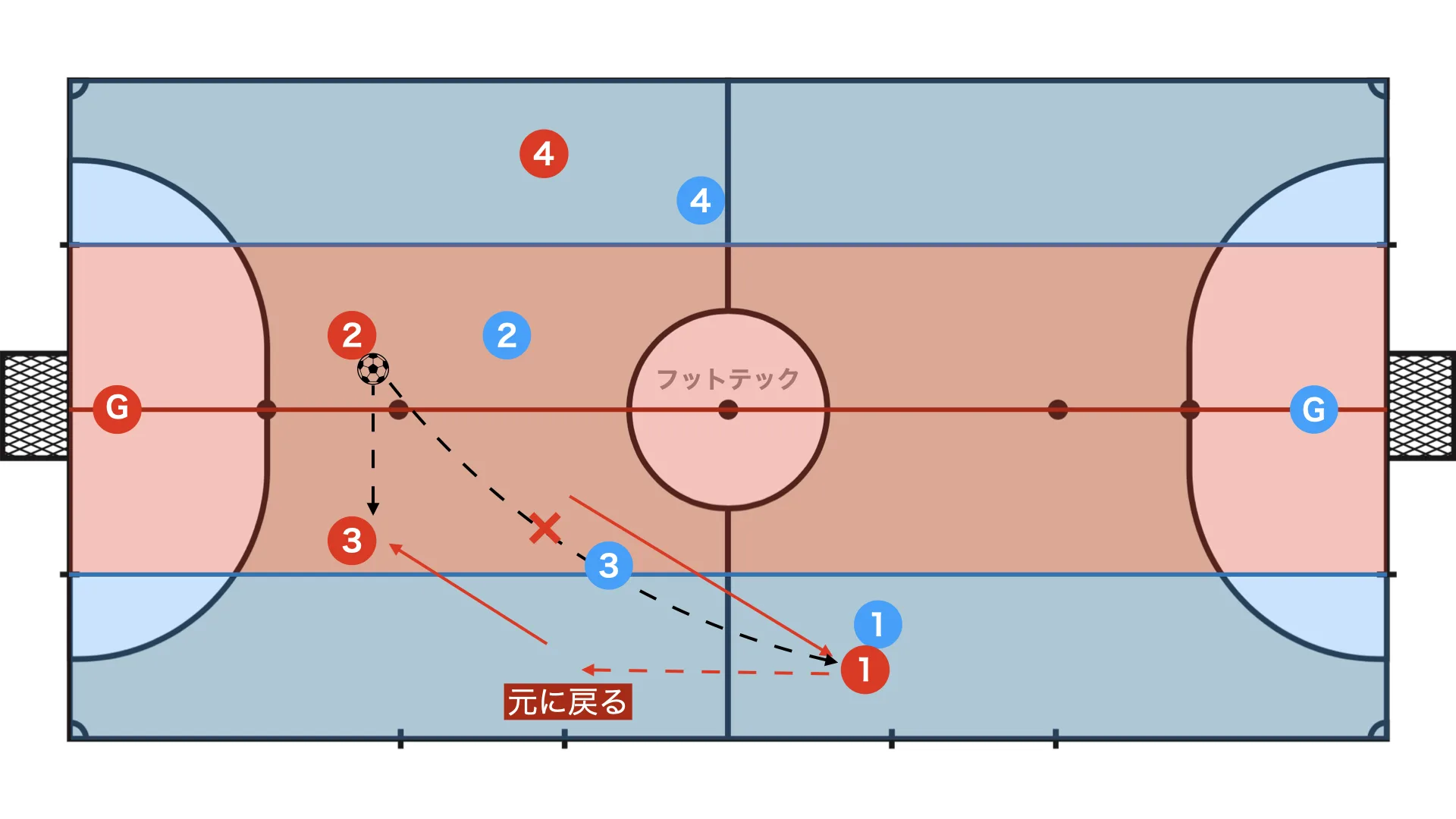
If the pass cannot be played to red no. 1 after the diagonal run, red no. 1 drops back again and returns to the original shape.
関連記事
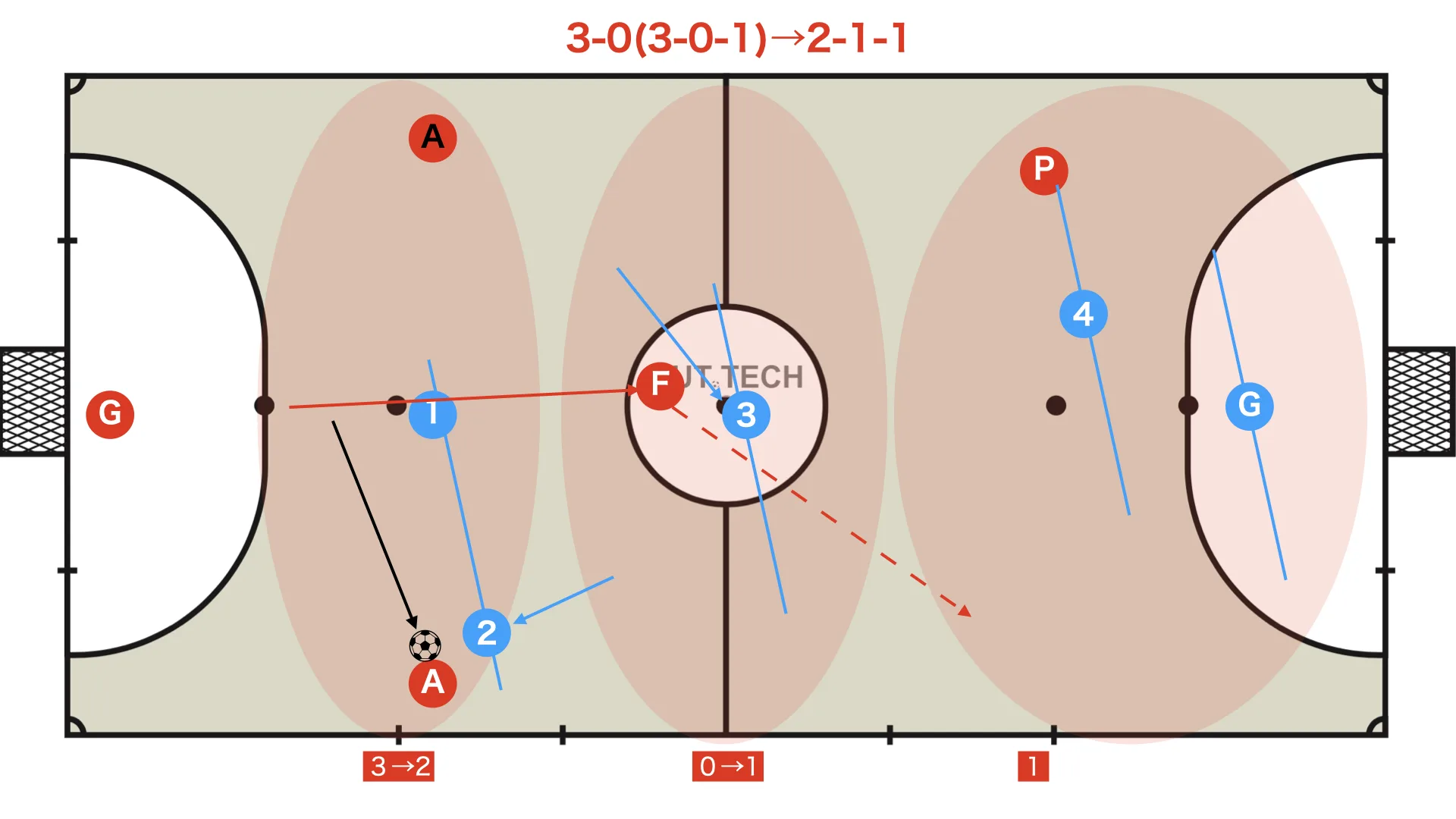
Positional Attack: How to Think About Formations and Rotations
A structured guide to formations and rotations in futsal positional attack. This article explains th…
続きを読む →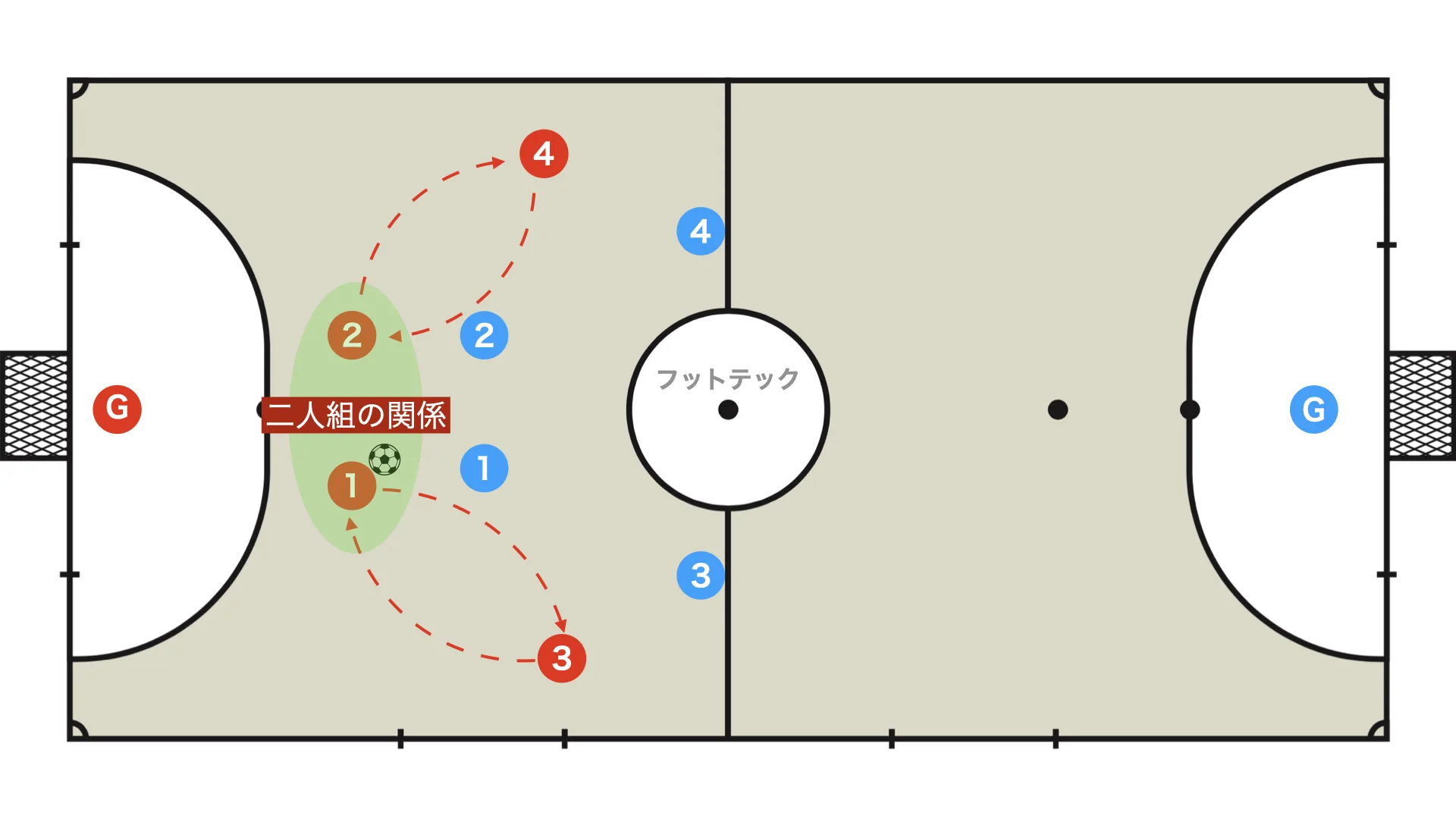
In a 2-player rotation, an ala and a fixo on the same side swap places as shown above, repeatedly creating a two-player relationship between the two fixos.
The aims of the two-player relationship between the two fixos are:
- backdoor (one-two)
- diagonal
- parallel (central parallel)
The diagonal is the same pattern introduced earlier in the basic principles section.
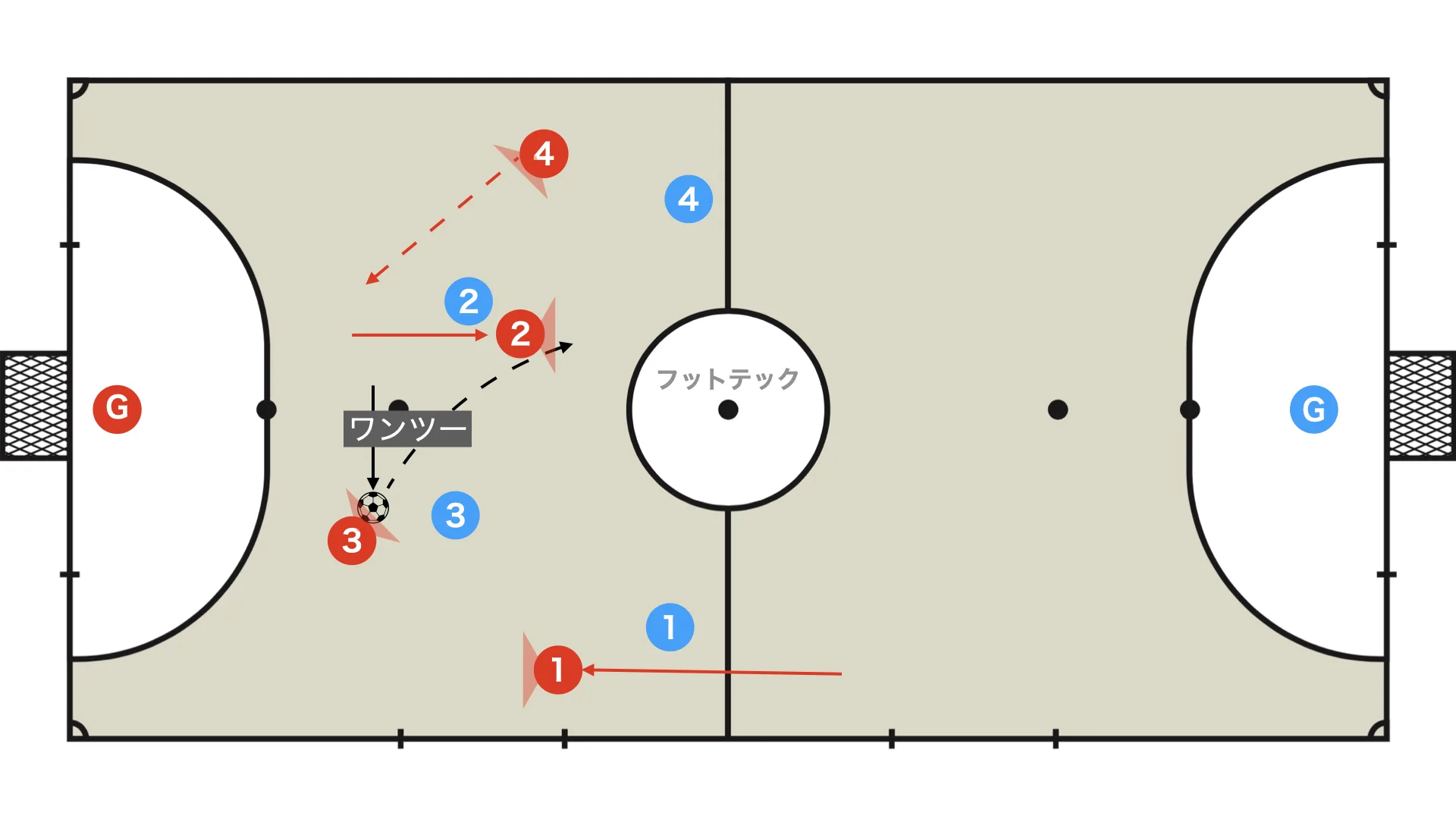
This kind of one-two played through the central lane by the two fixos is called a central one-two.
Among all Quatro rotations, the 2-player rotation is the easiest and most beginner-friendly, so it is excellent as an entry point. However, it has the drawback of being easy for opponents to read, so teams at higher levels almost never use only the 2-player rotation as their Quatro system.
That said, teams do sometimes use it in parts of an attack in combination with other rotations.
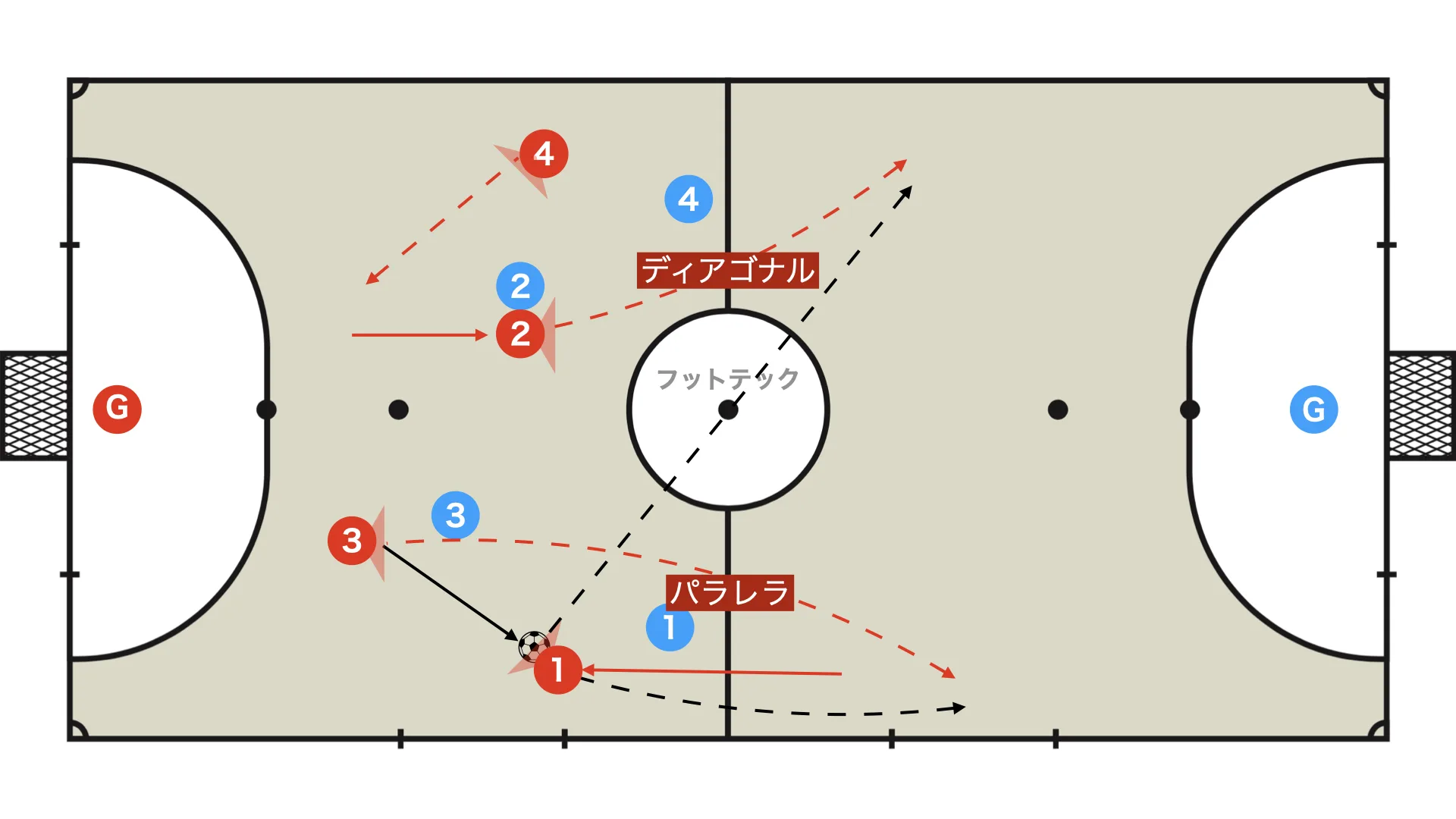
As an attacking option in Quatro, a double run in behind is extremely effective.
That is because it creates two forward passing lanes and makes the opponent's cover defence arrive too late.
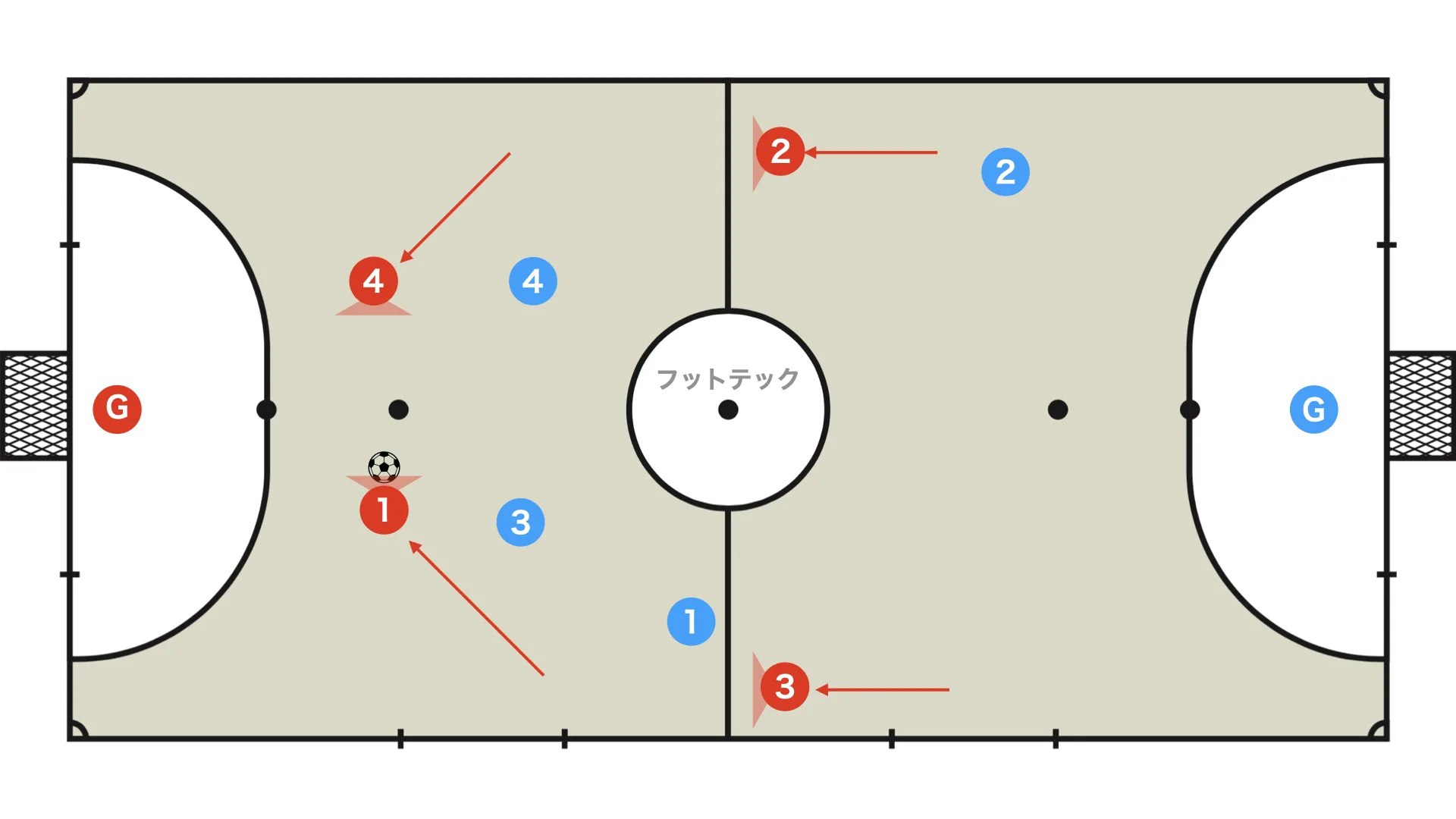
If the pass cannot be played in behind, restore the floor balance and return to the original shape.
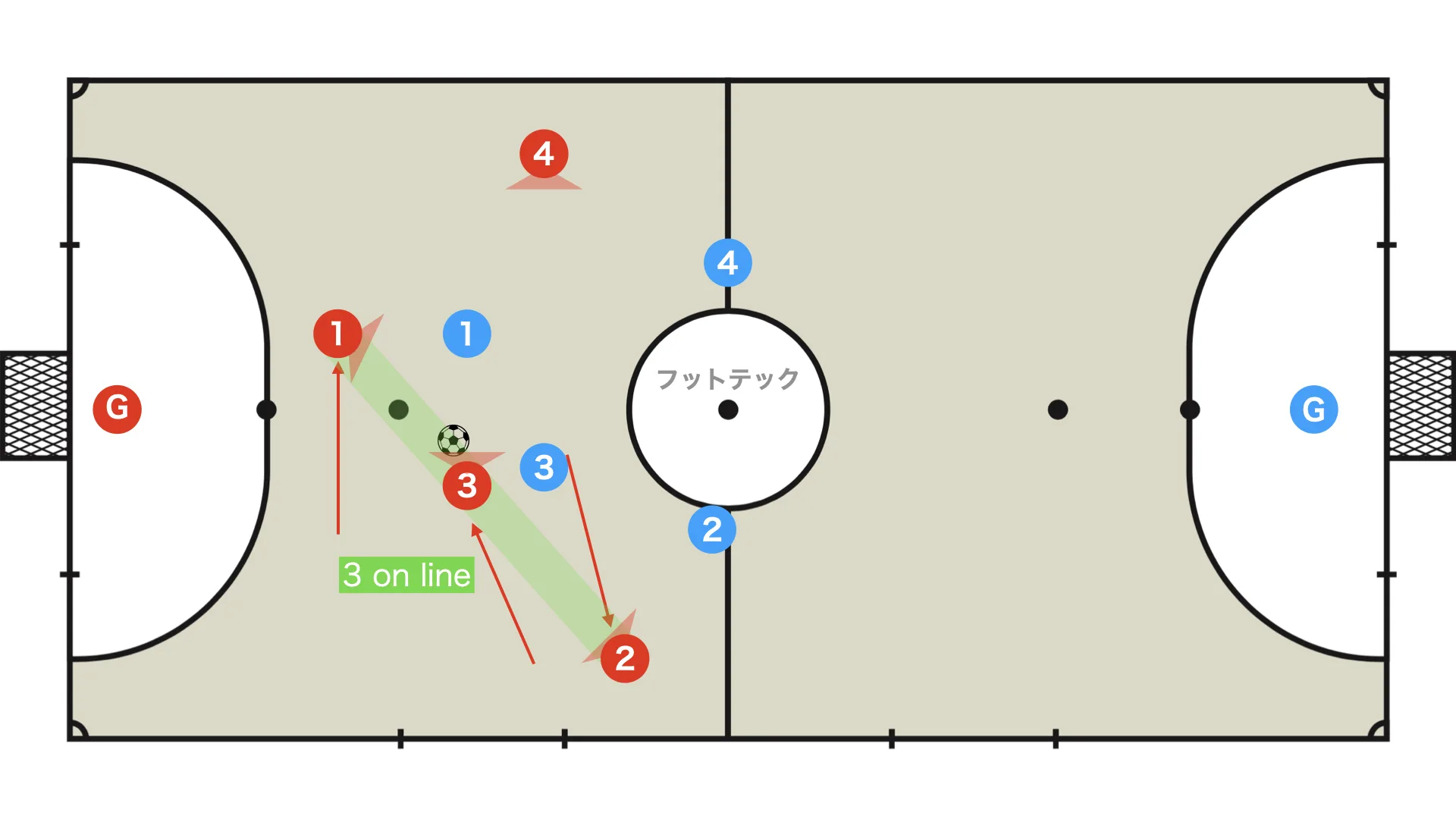
The 3-player rotation is the tactic most heavily used even at the professional level, because it can continuously create many different attacks by forming 3 on line and triangles.
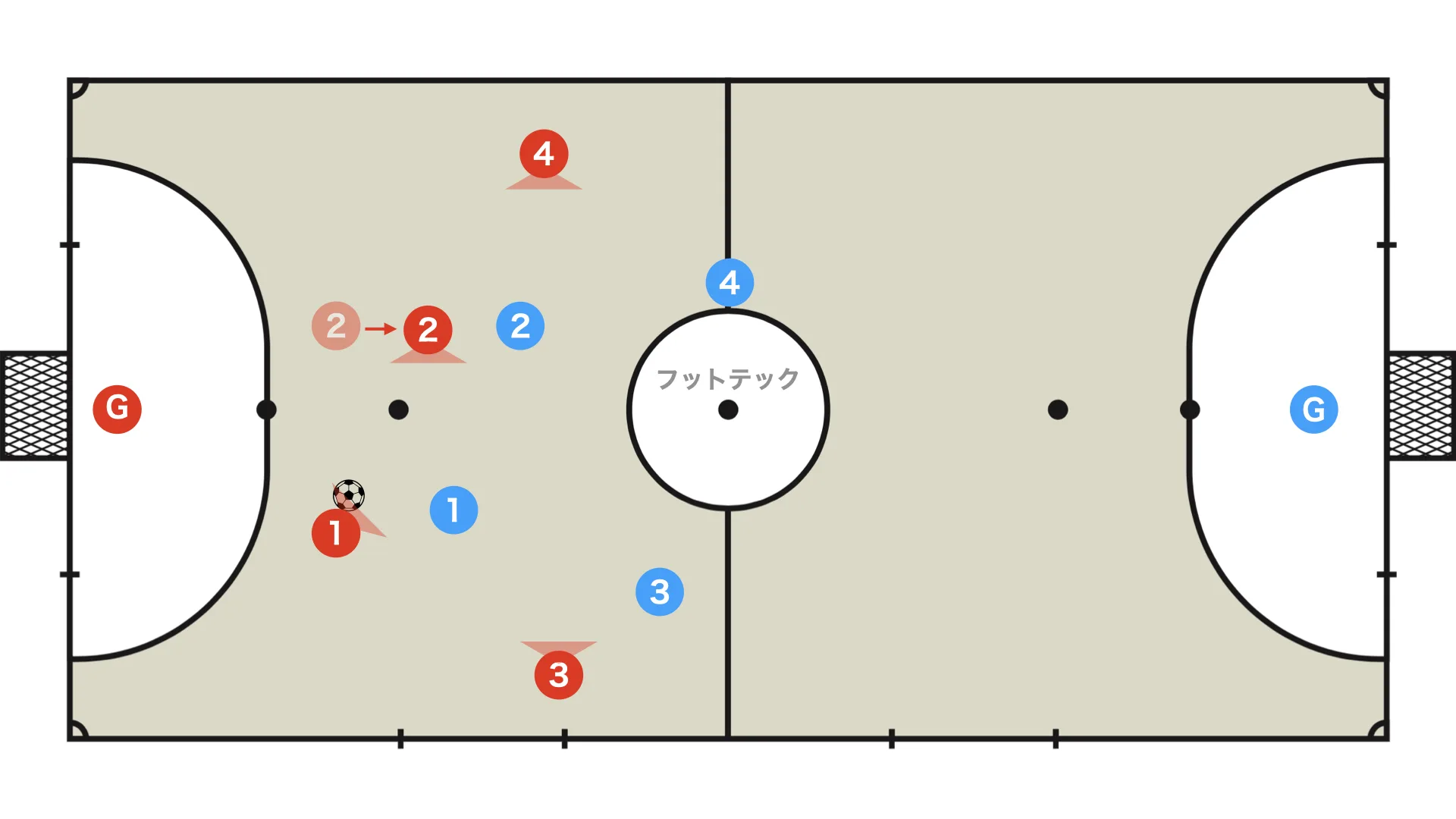
There are mainly two possible starting shapes: the bowl shape, or 3 on line + 1.
If you start from the bowl shape, the idea is ultimately to build 3 on line + 1 as shown above.
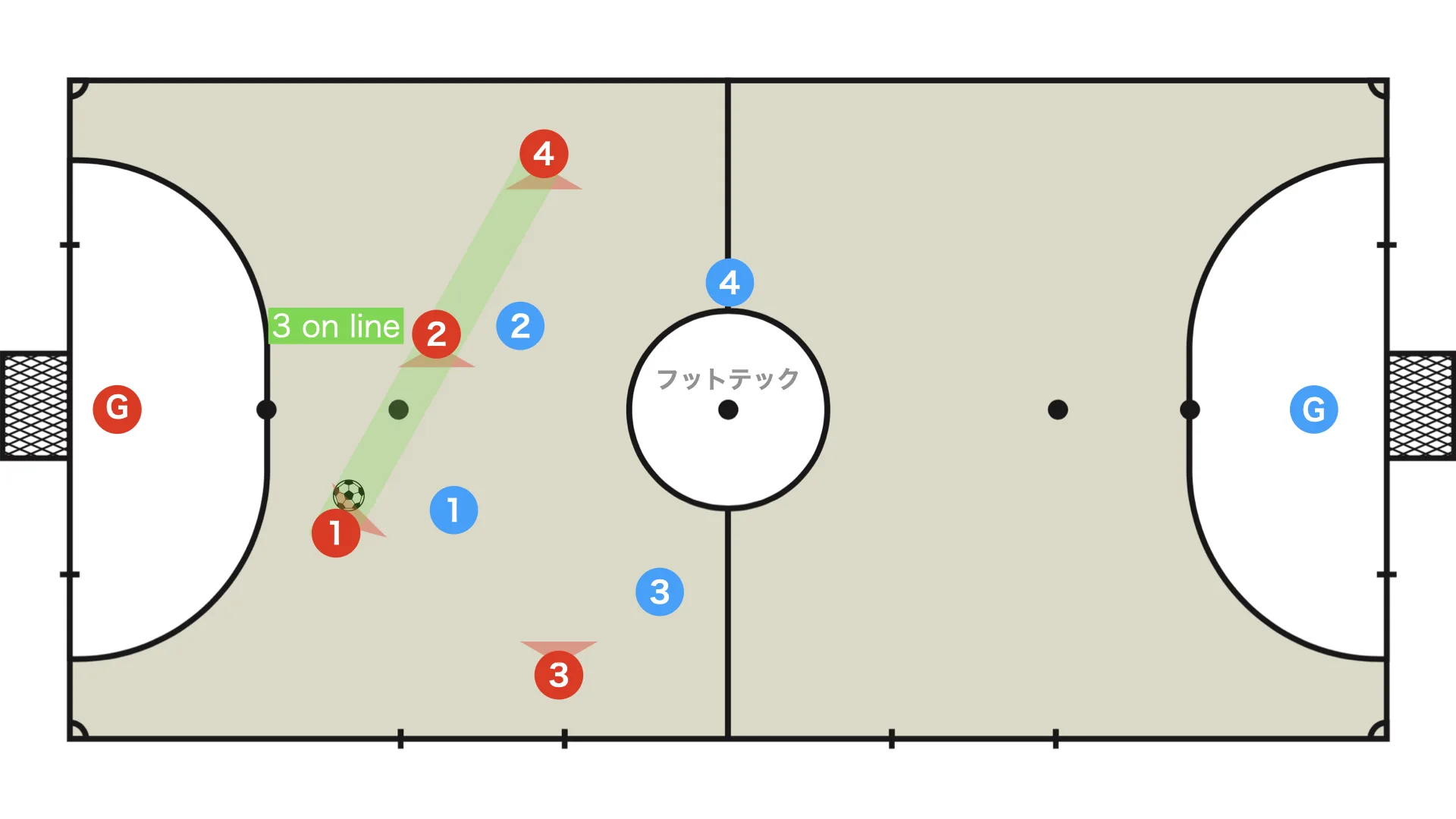
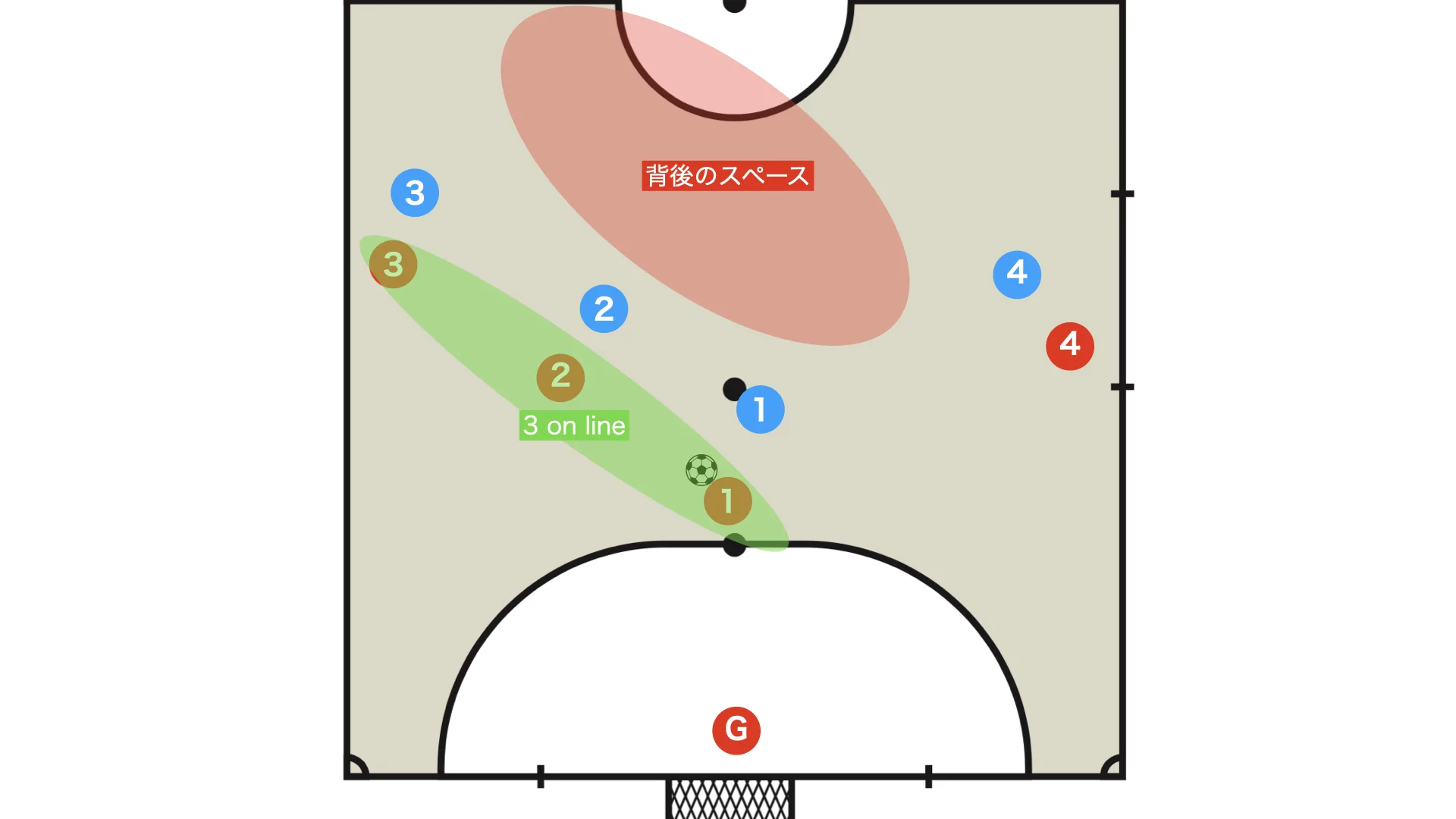
The purpose of 3 on line is to draw the opposing defenders toward it, absorb the multiple defensive lines they have formed, and break them apart.
In this phase, all the usual ways of breaking down a defence from 3 on line become available.
I strongly recommend reading the dedicated article on 3 on line for more detail, but I will cover a few of the representative patterns here.
関連記事
Diagonal 3-on-Line (1-Line) Explained: How to Collapse Multiple Defensive Lines
A detailed explanation of the diagonal 3-on-line in futsal. Learn how this three-player structure pu…
続きを読む →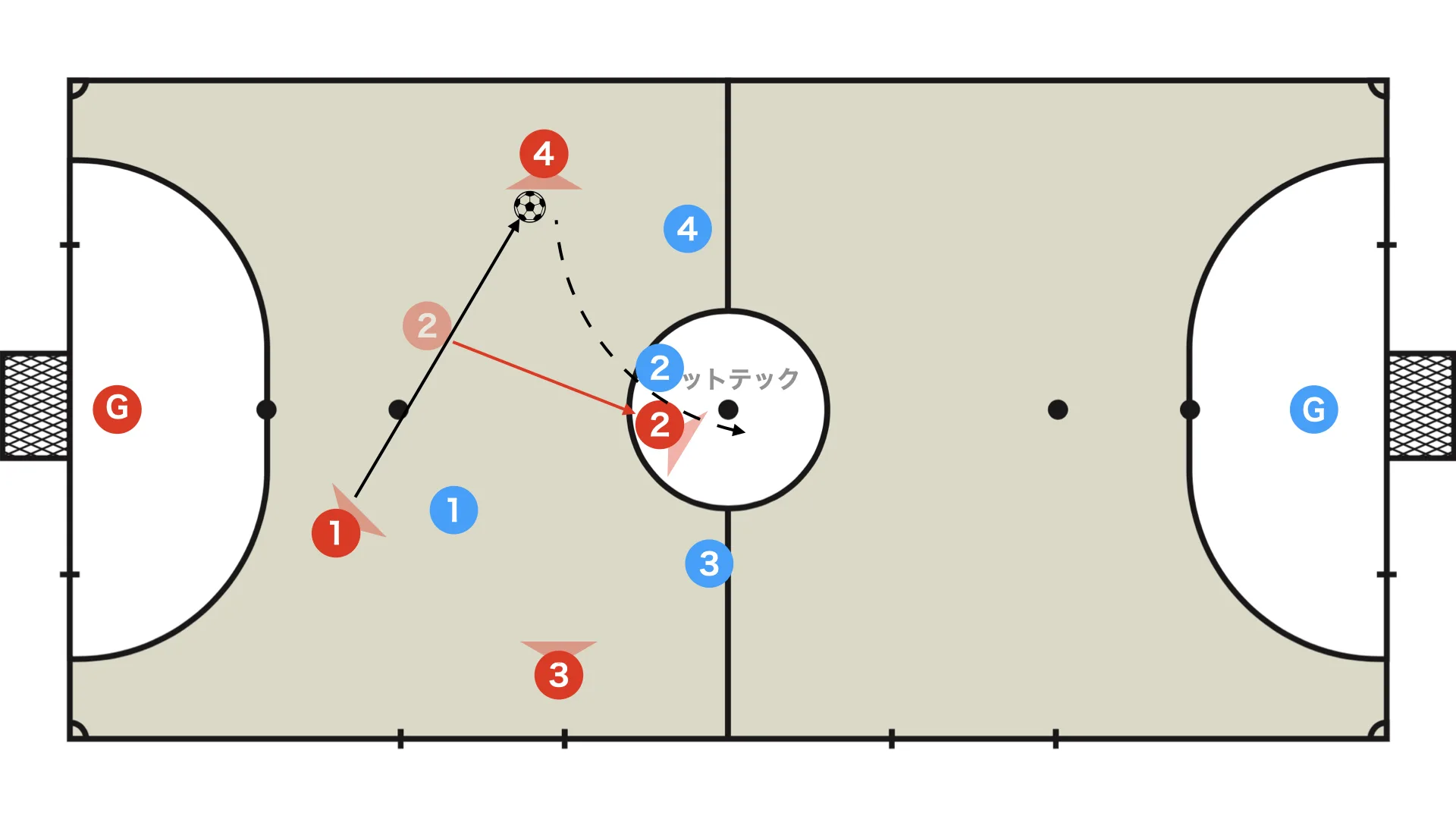
One of the most standard and famous patterns is when the middle player in the 3 on line runs through to become the third man.
At first glance this looks like a very powerful pattern, but it is completely ineffective against teams that defend it by exchanging marks.
Against that type of opponent, I recommend using the backdoor pattern introduced next.
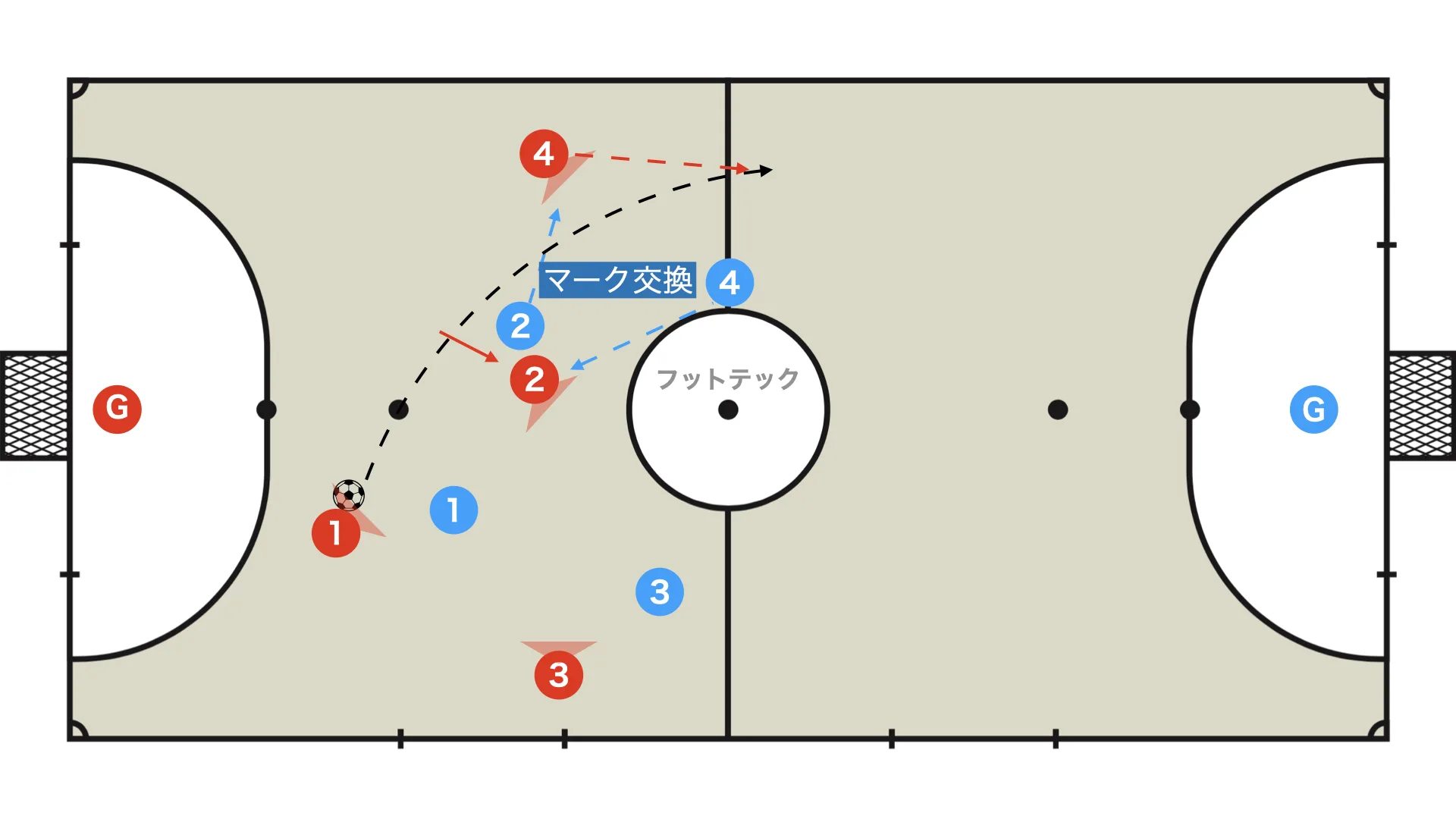
This attacks the space behind the defence by taking advantage of the moment the opponents exchange marks.
It is extremely effective against teams that respond to 3 on line by switching markers.
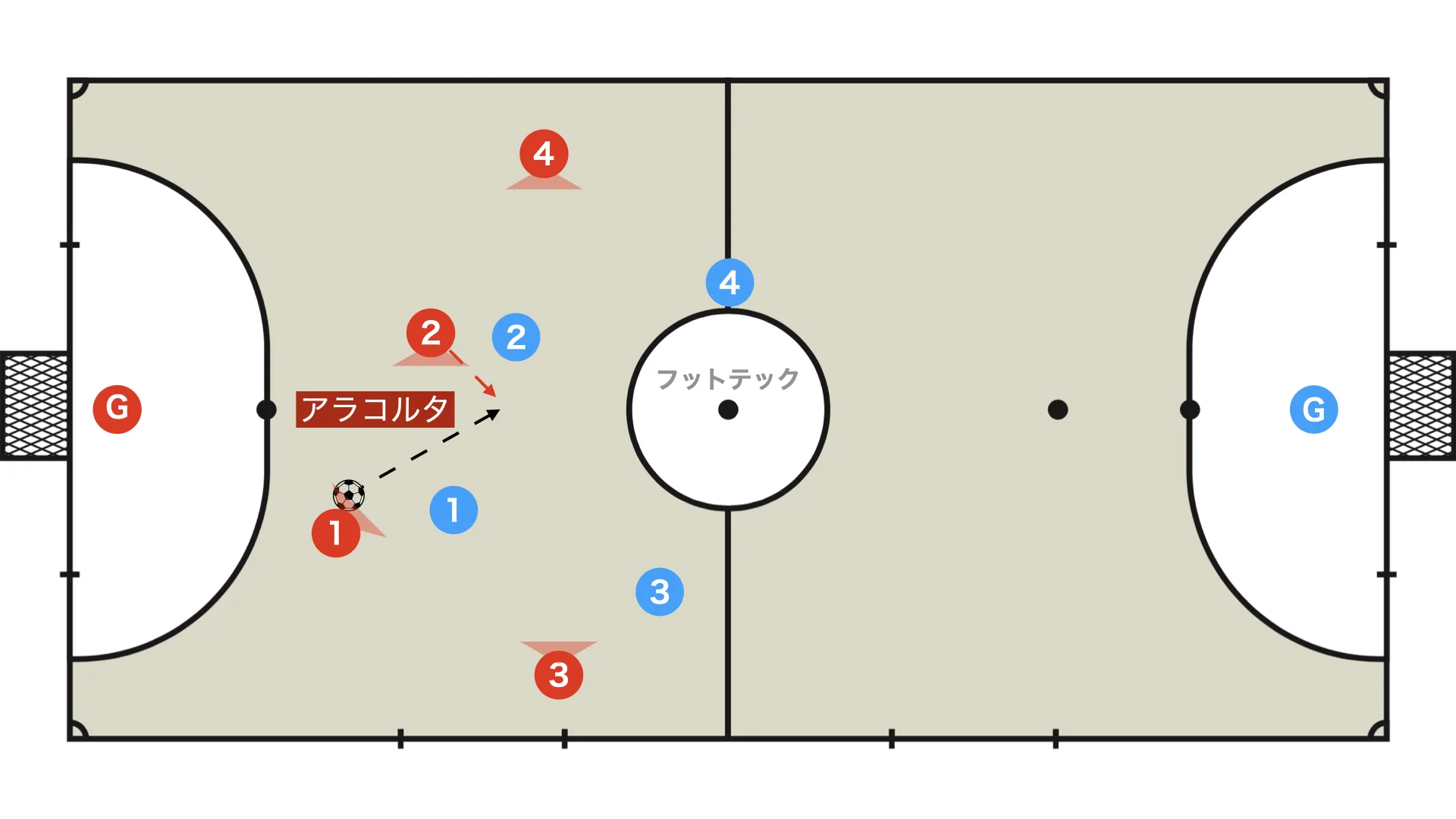
If blue no. 2 tries to intercept the skip pass to red no. 4, the front side opens up, so ala corta becomes effective.
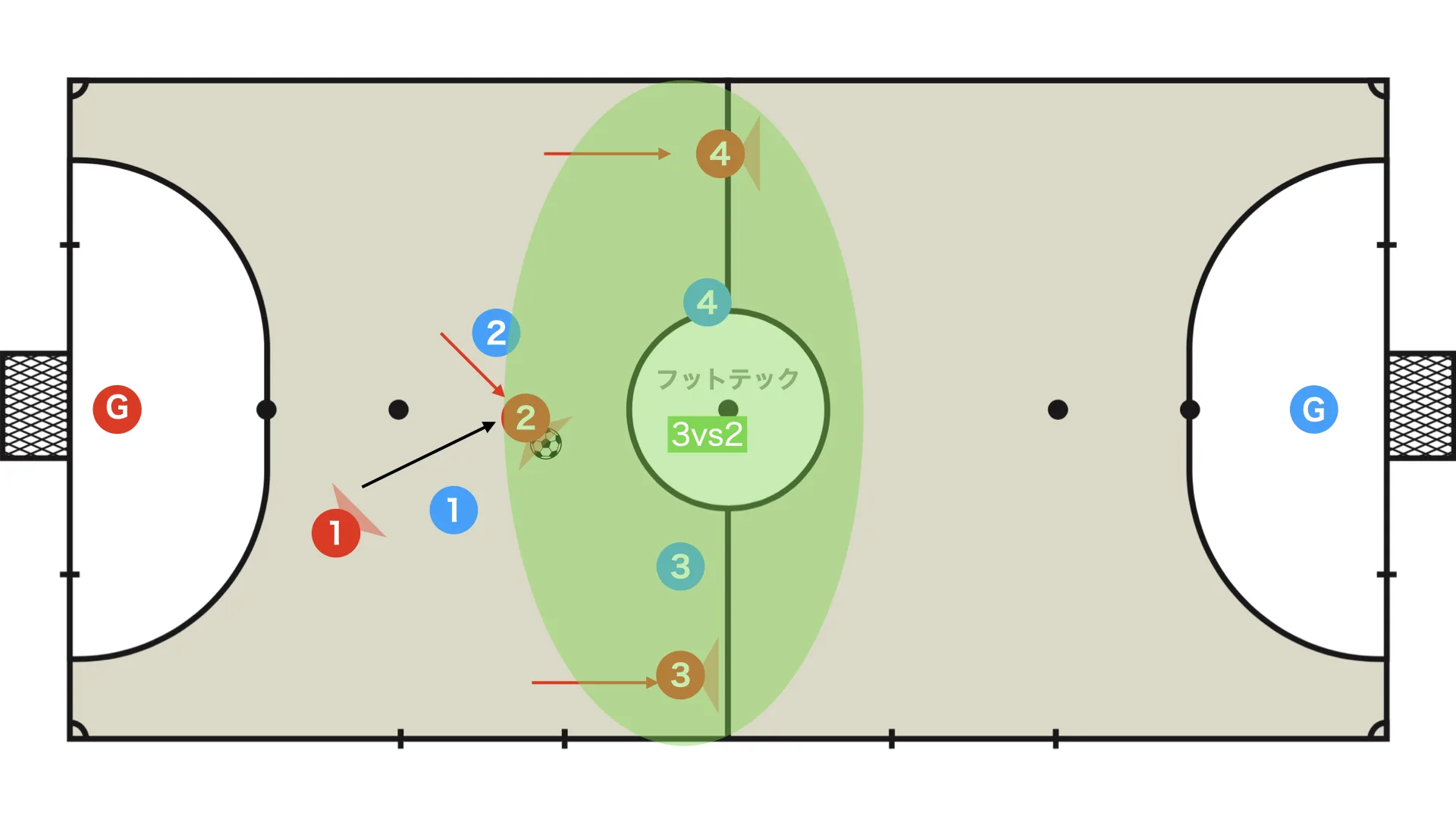
If the receiver can then dribble past the defence after taking the ball on ala corta, the attack can create a 3v2 numerical advantage.
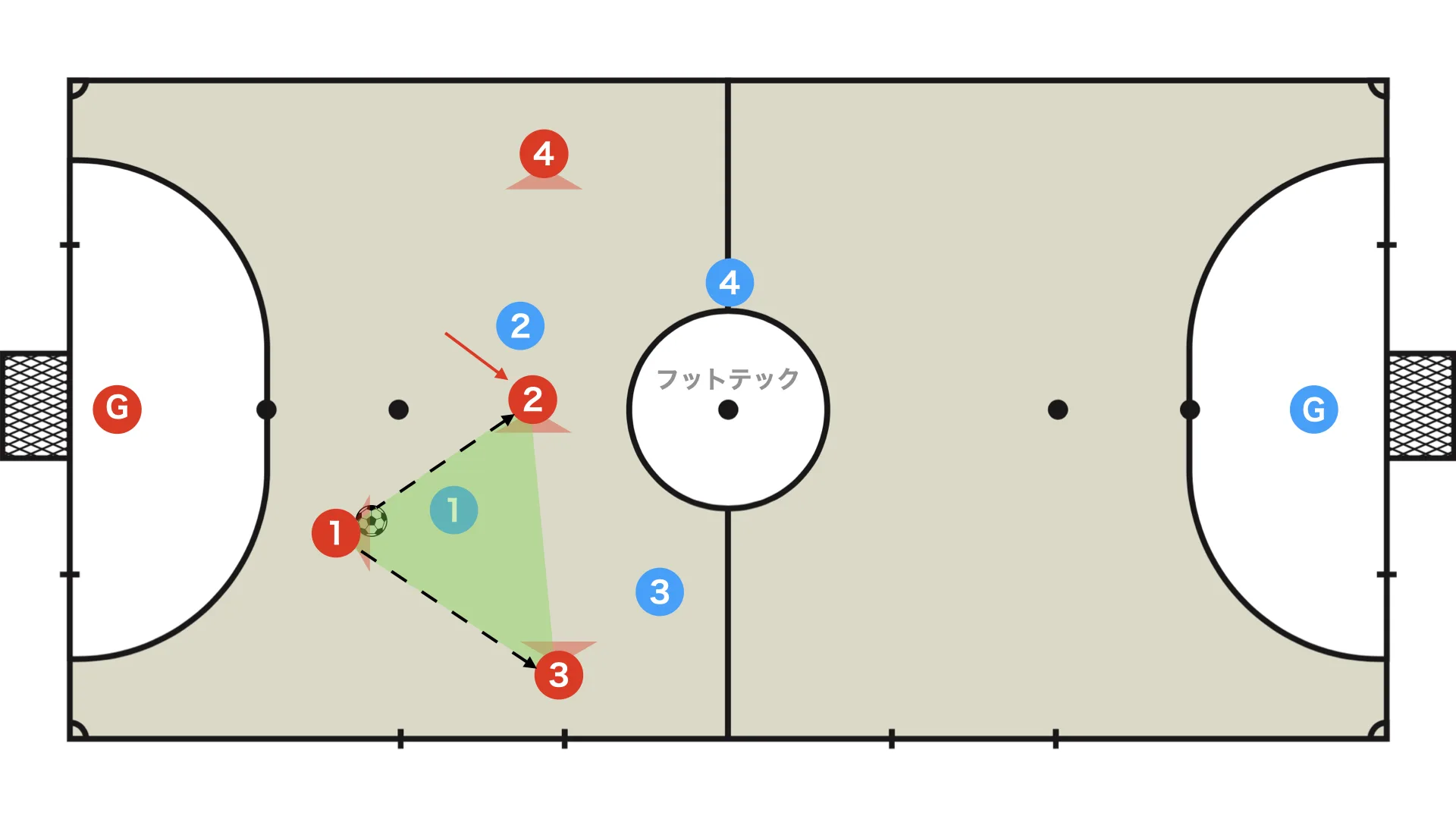
If breaking through from 3 on line is difficult, move the ball to the far side.
Red no. 2, who had been in the intermediate position of the 3 on line, gives horizontal support to red no. 3.
What matters here is that red no. 2 must not support too early and accidentally block the passing lane from red no. 1, the fixo, while forming the triangle properly.
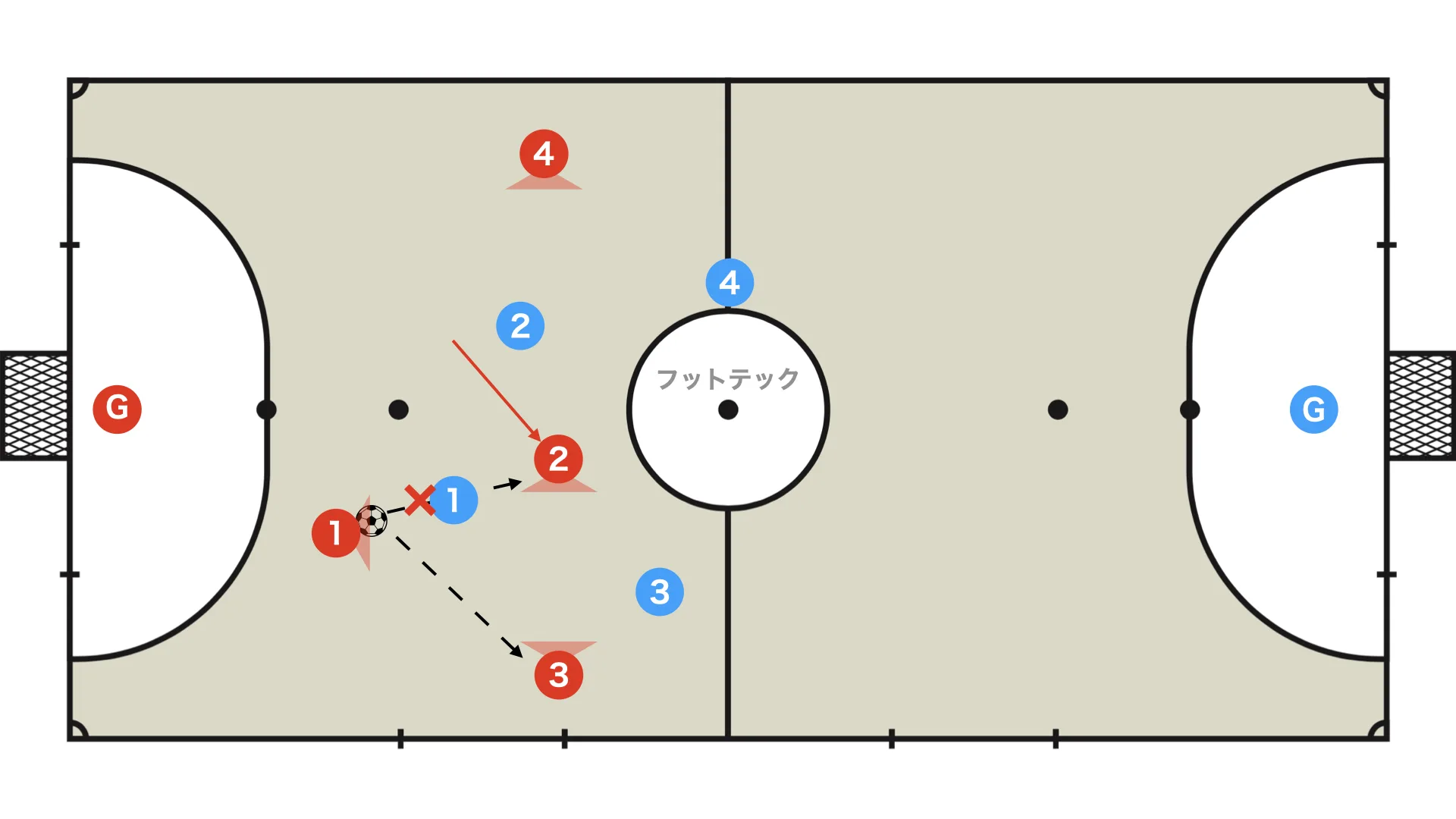
As shown in this diagram, if the passing lane from red no. 1 to red no. 2 disappears before the ball reaches red no. 3, red no. 1 loses an option and may end up trapped.
When switching the ball to the far side and forming a triangle, it is important for red no. 2 to support slowly toward the space between the lines while keeping the passing lane from red no. 1 open, so the passing lanes continue to exist throughout the move.
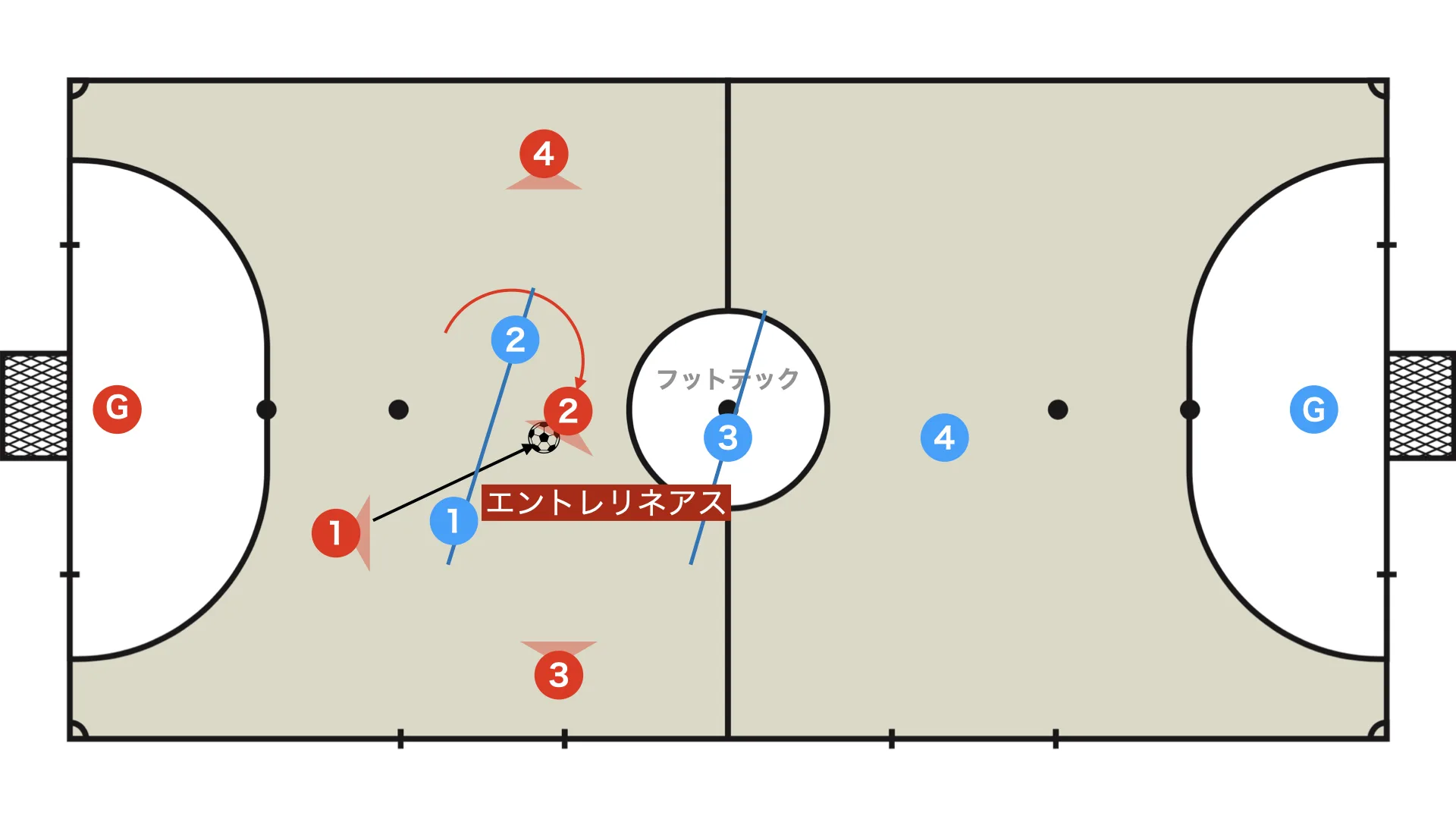
If the opponent is defending in a more zonal way and their reference points for mark exchanges on the first line are clear, it is effective to loop around from behind and use the space between the lines.
After receiving between the lines, the main options are to turn or pass to red no. 3.
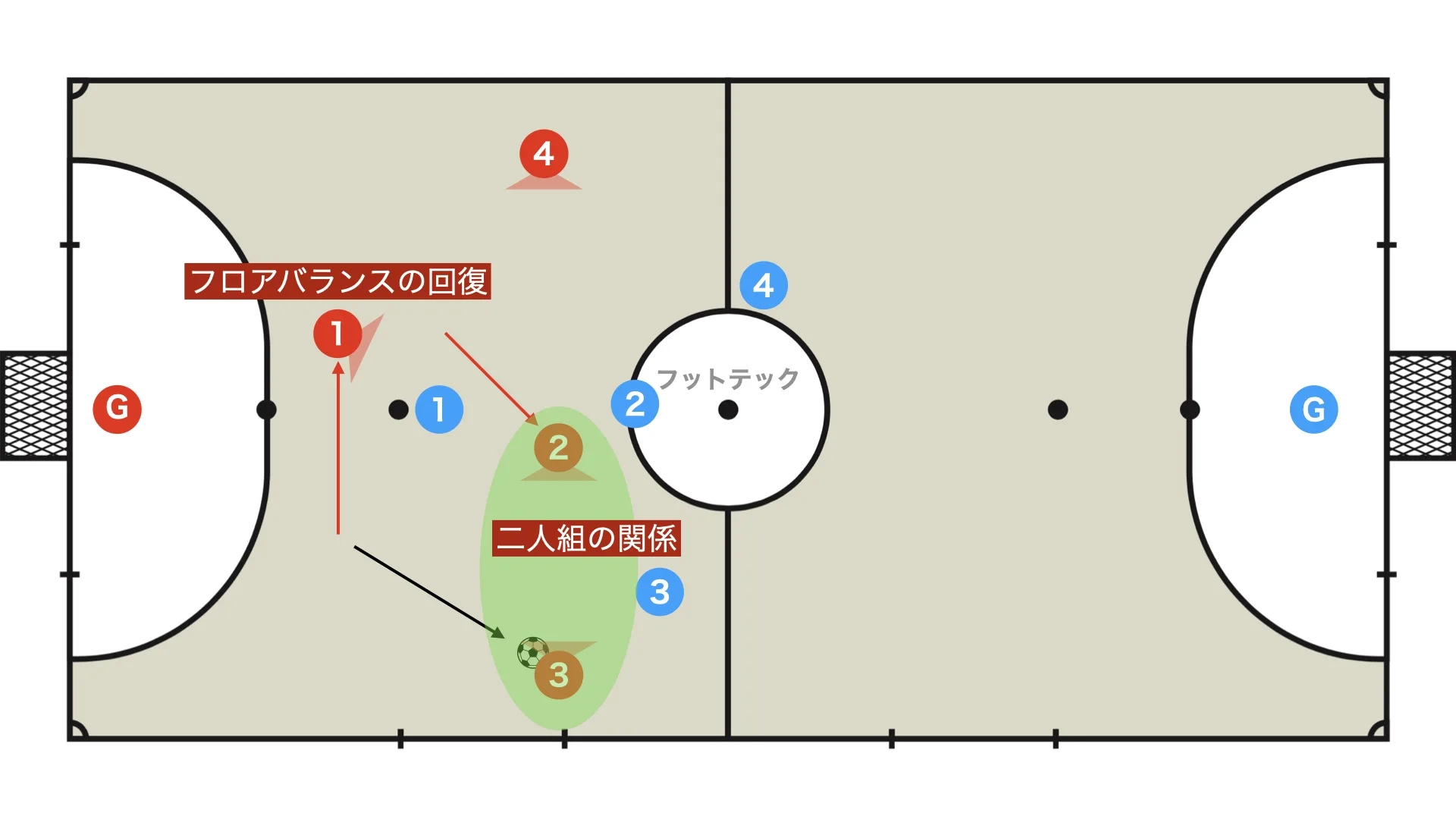
Once the triangle is formed, red no. 1 (the fixo) passes to red no. 2 or red no. 3 and creates a two-player relationship.
The two-player options in this phase are:
- backdoor (one-two)
- parallel
- block or curtain
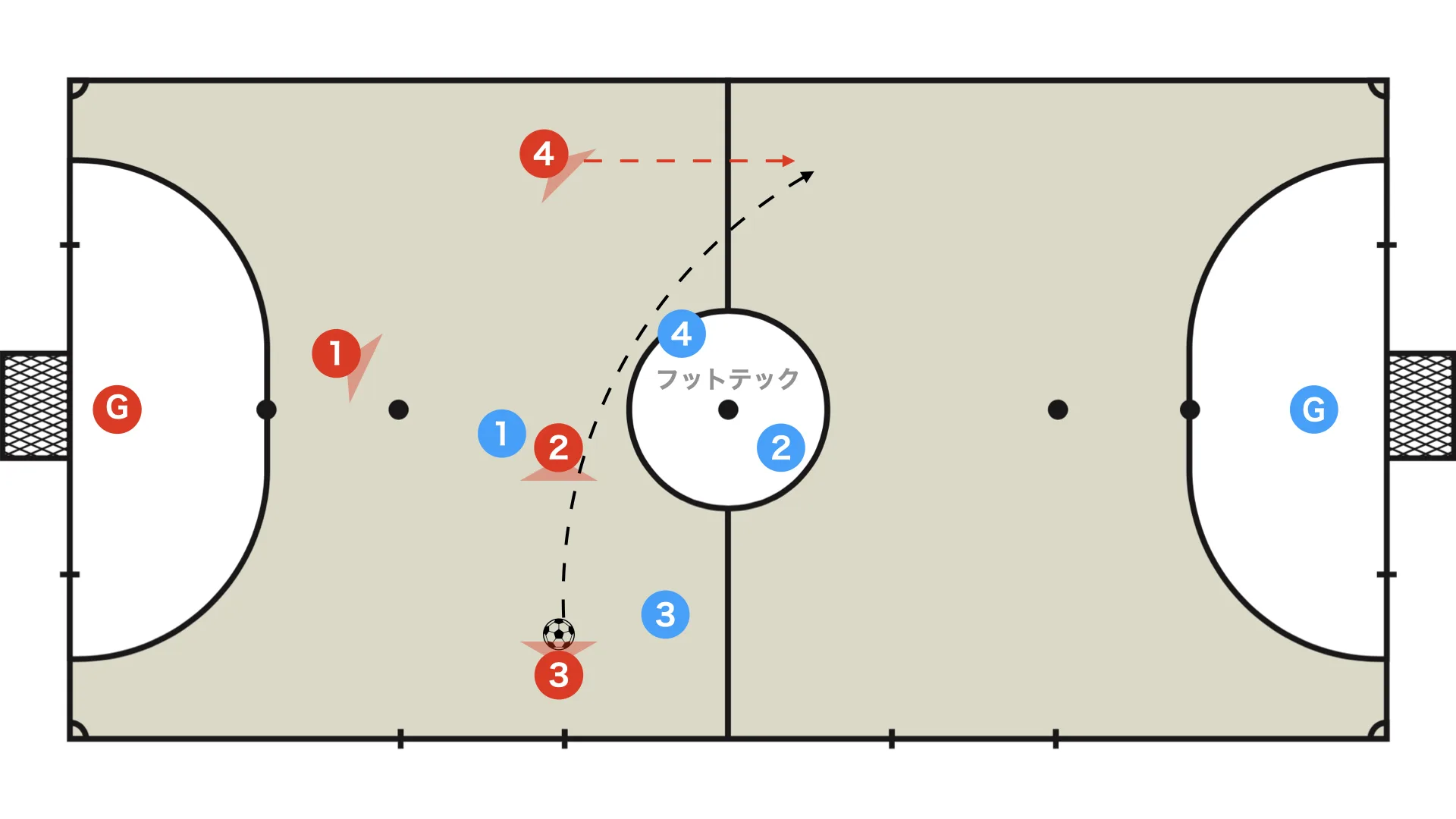
Opposing defenders often focus too much on the triangle and lose track of the far-side ala.
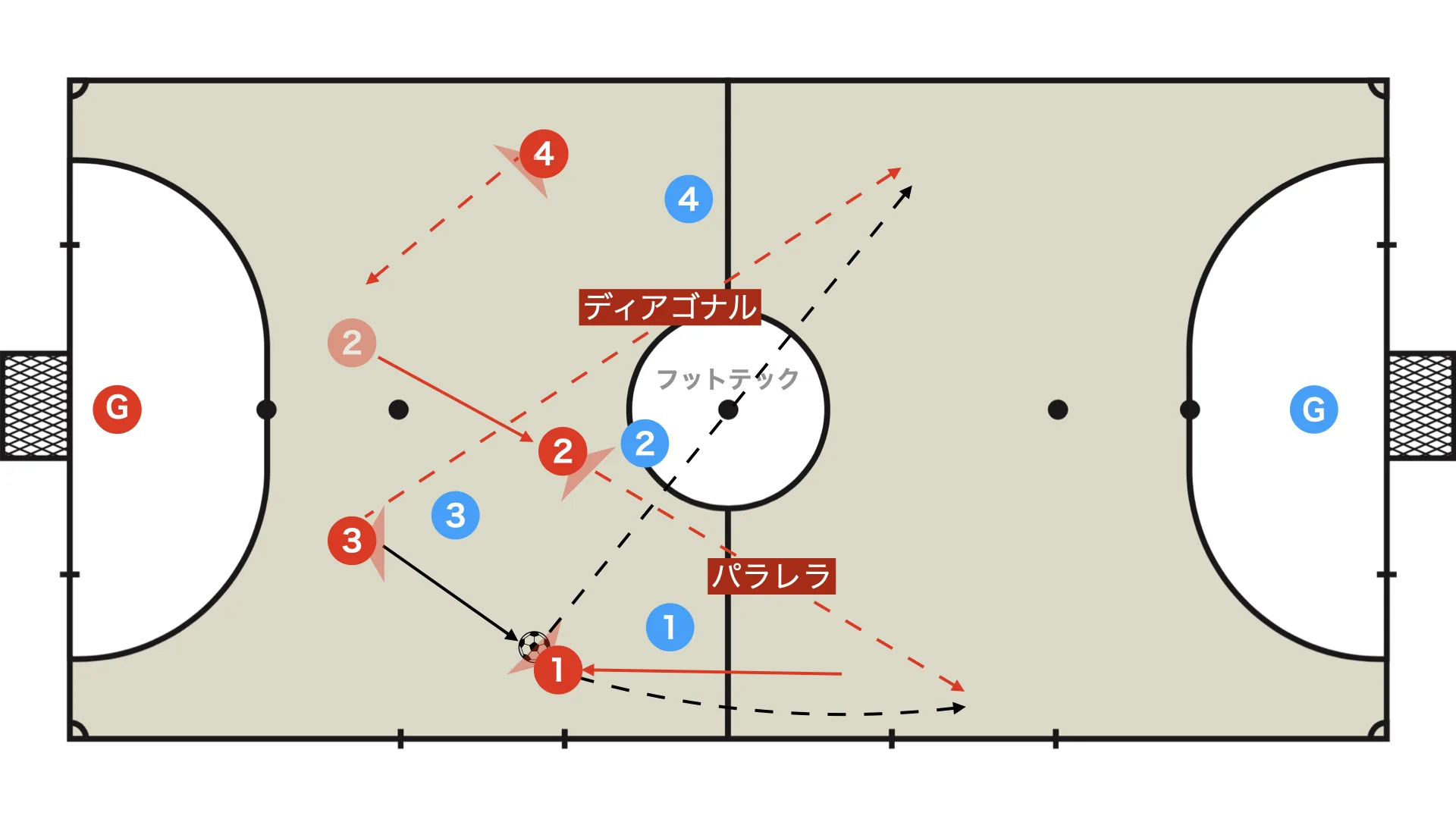
If, in addition to red no. 2's parallel, the fixo acting as the axis also makes a diagonal run, creating a double run in behind, then red no. 4 drops back to become the axis (fixo).
When using the double run, it is best to decide on the in-play signal in advance.
If the attack cannot break through from the two-player relationship, form 3 on line again and repeat the same flow with left and right reversed.
Repeat this rotation endlessly until you succeed in playing through the pressure.
As you can see, red no. 1 remains fixed as the fixo, so this whole sequence can be described as a rotation with a fixed fixo (Quatro with an axis).
Because the fixo remains fixed in this rotation, it is an effective tactic when you want a specific player to stay in the deeper position, and it is the most commonly used pattern at the professional level.
There are two main advantages to keeping a designated player at the back:
- You can place a player with strong close control there, which makes ball circulation smoother
- You can place a strong defender there in preparation for losing the ball
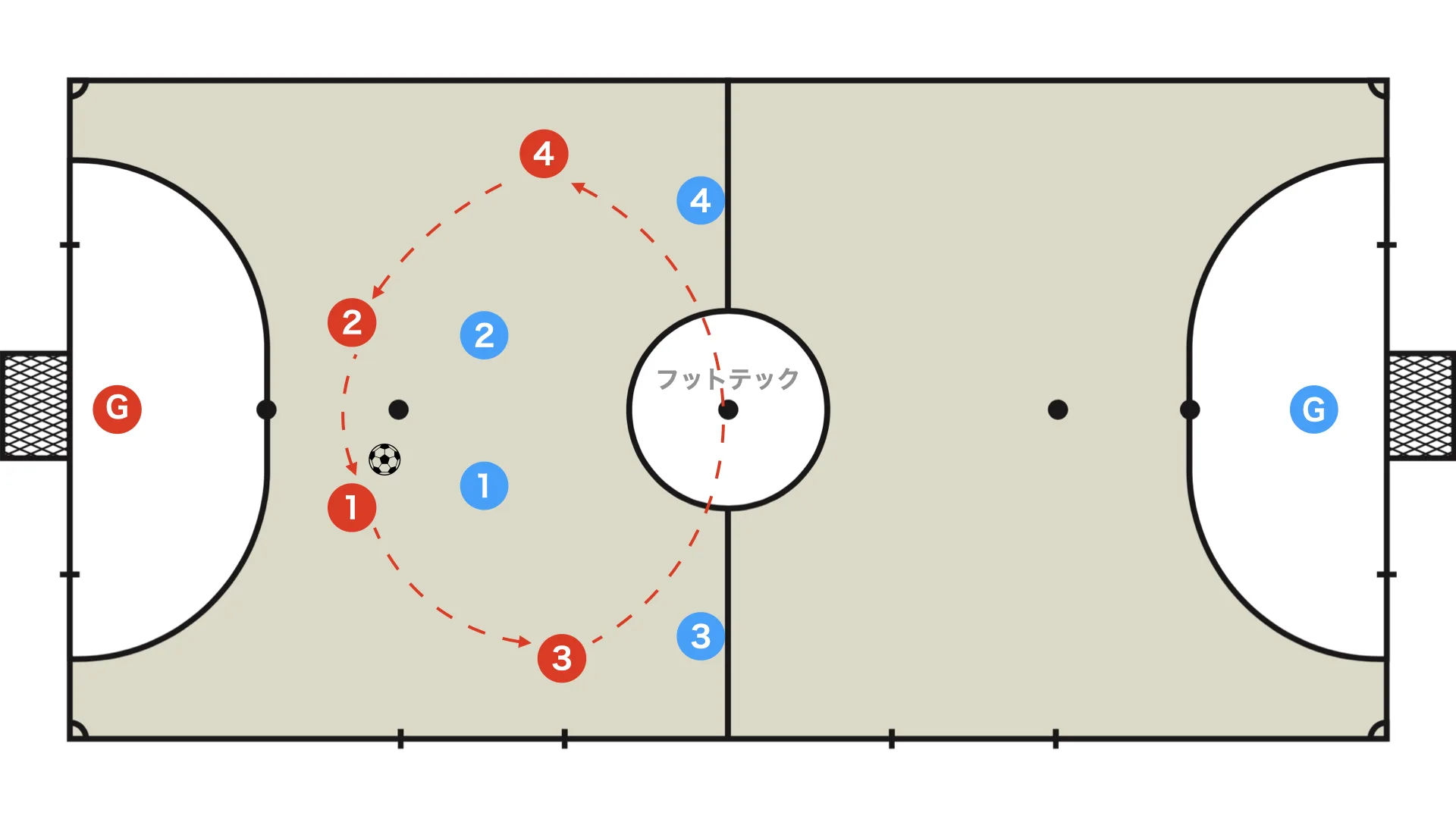
This version of Quatro is a tactic in which all four players rotate continuously in the same direction, creating triangle + 1 shapes over and over.
In Quatro with an axis, one fixo stays fixed, but in this rotation all players can rotate fluidly.
It can be done either clockwise or counterclockwise, but here I will explain only the counterclockwise version.
It is best to decide in advance which direction the team will rotate, taking into account traits such as the players' stronger foot.
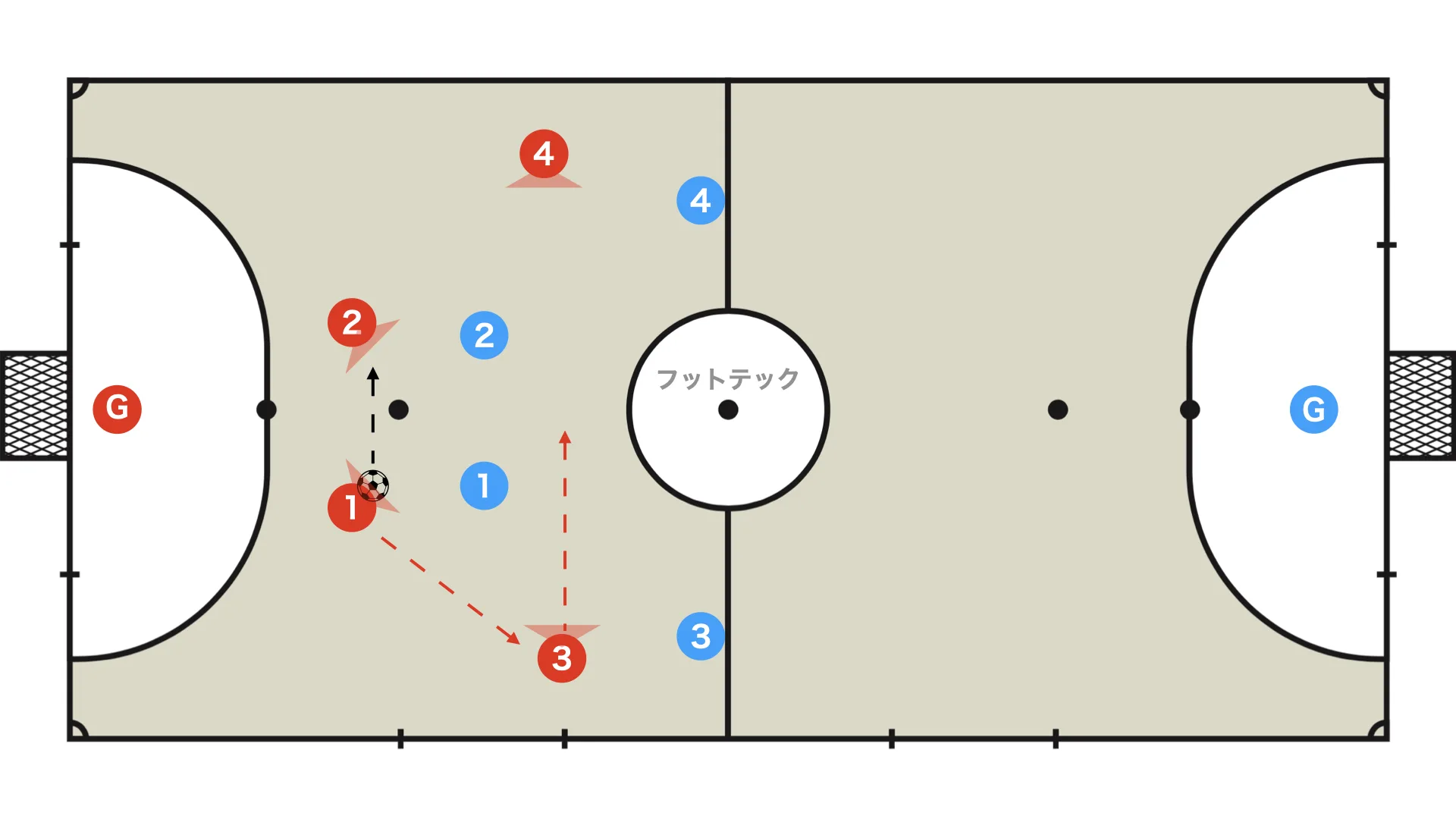
Opening
- Pass the ball from one fixo to the other
- The far-side ala moves between the lines to form the triangle
- The fixo who made the pass (red no. 1) provides width to restore the floor balance
If you place a player between the lines immediately from the initial shape to form the triangle, it becomes easy for the opponent to target it, so it is better to start from the bowl shape.
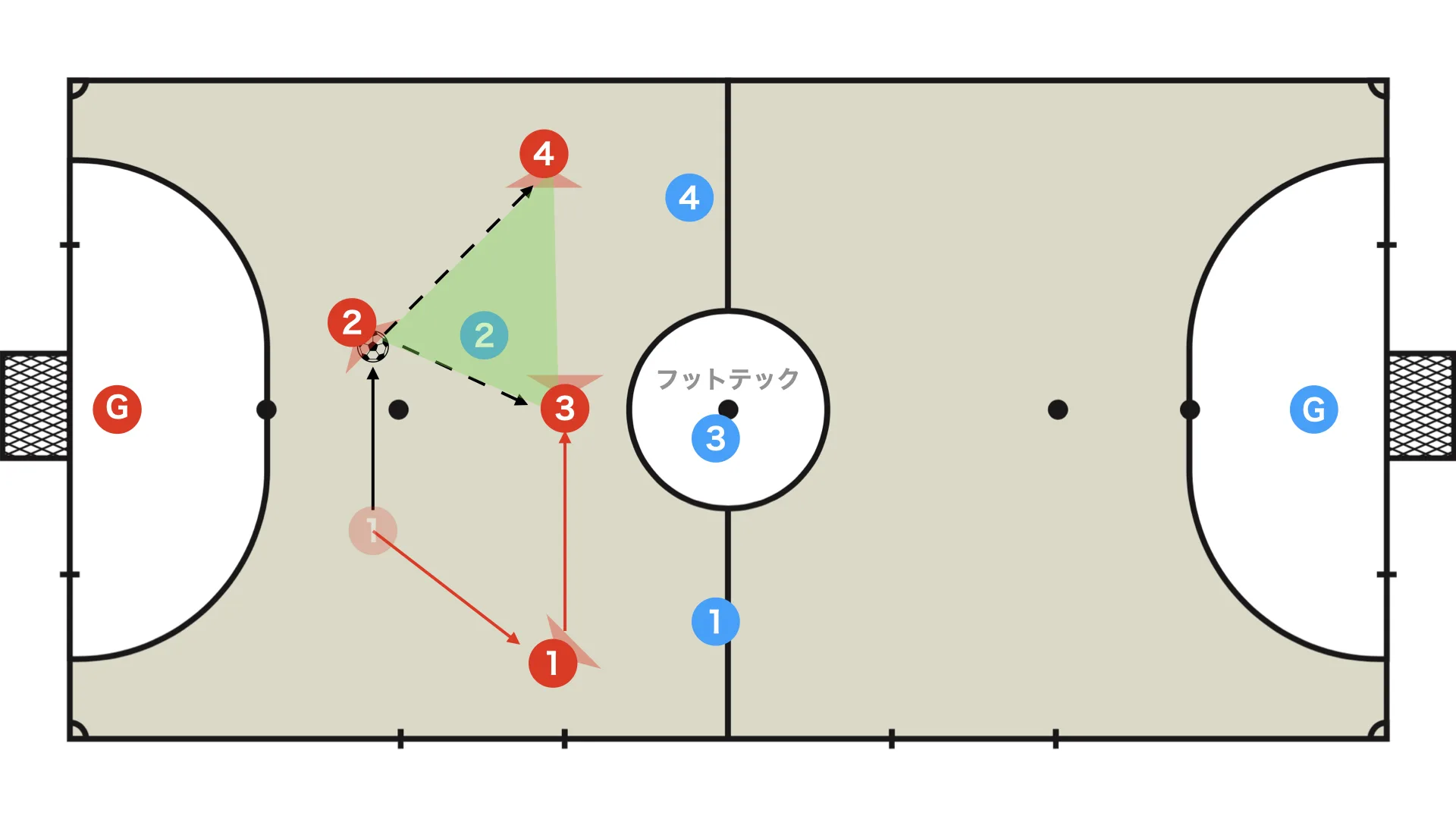
As with Quatro with an axis, the team forms triangle + 1.
The core idea here is exactly the same as in Quatro with an axis.
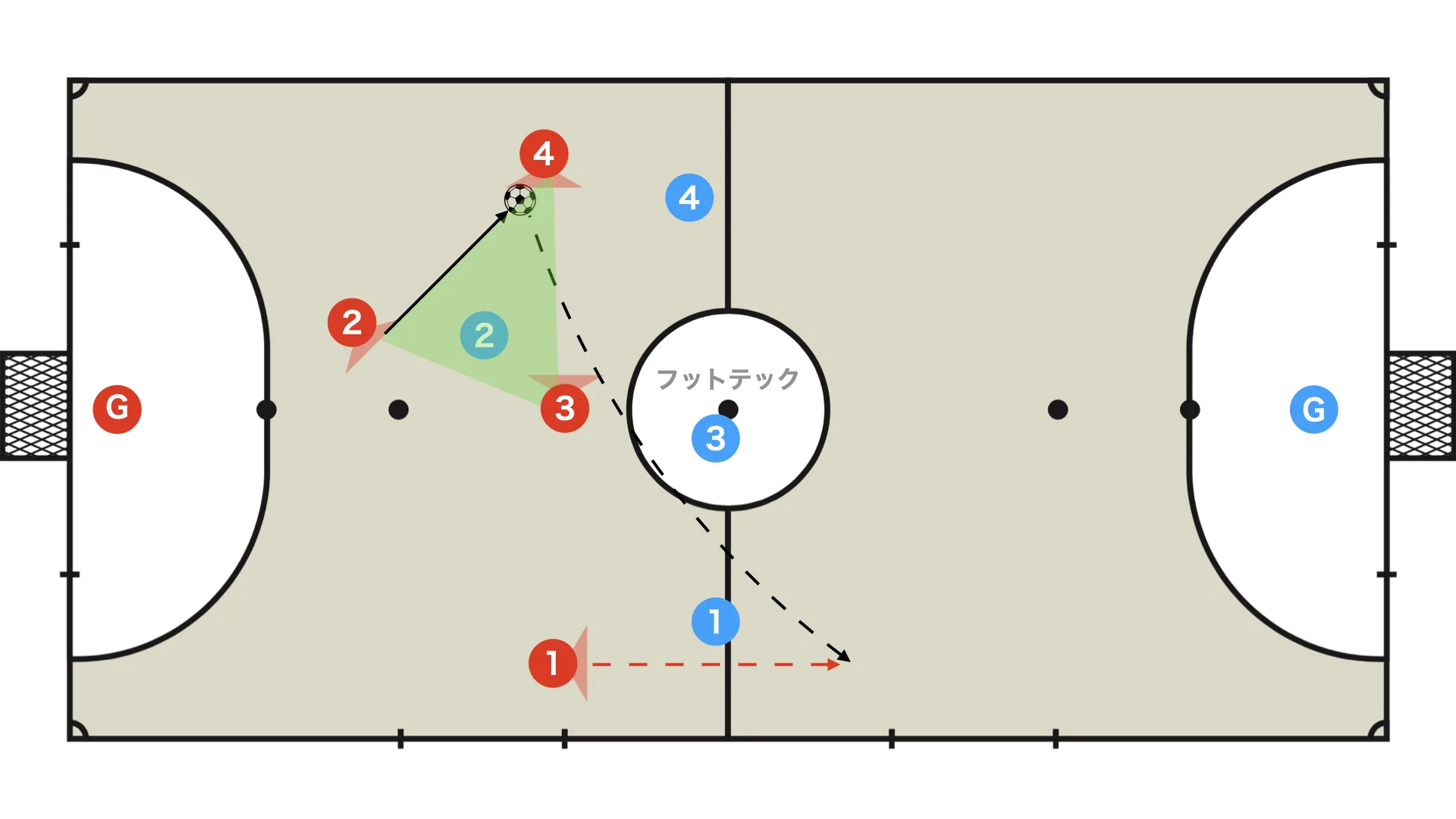
When red no. 1 runs into the space vacated by red no. 3, the far-side ala backdoor becomes effective.
It would not be an exaggeration to say this is the defining feature of 4-player rotation Quatro.
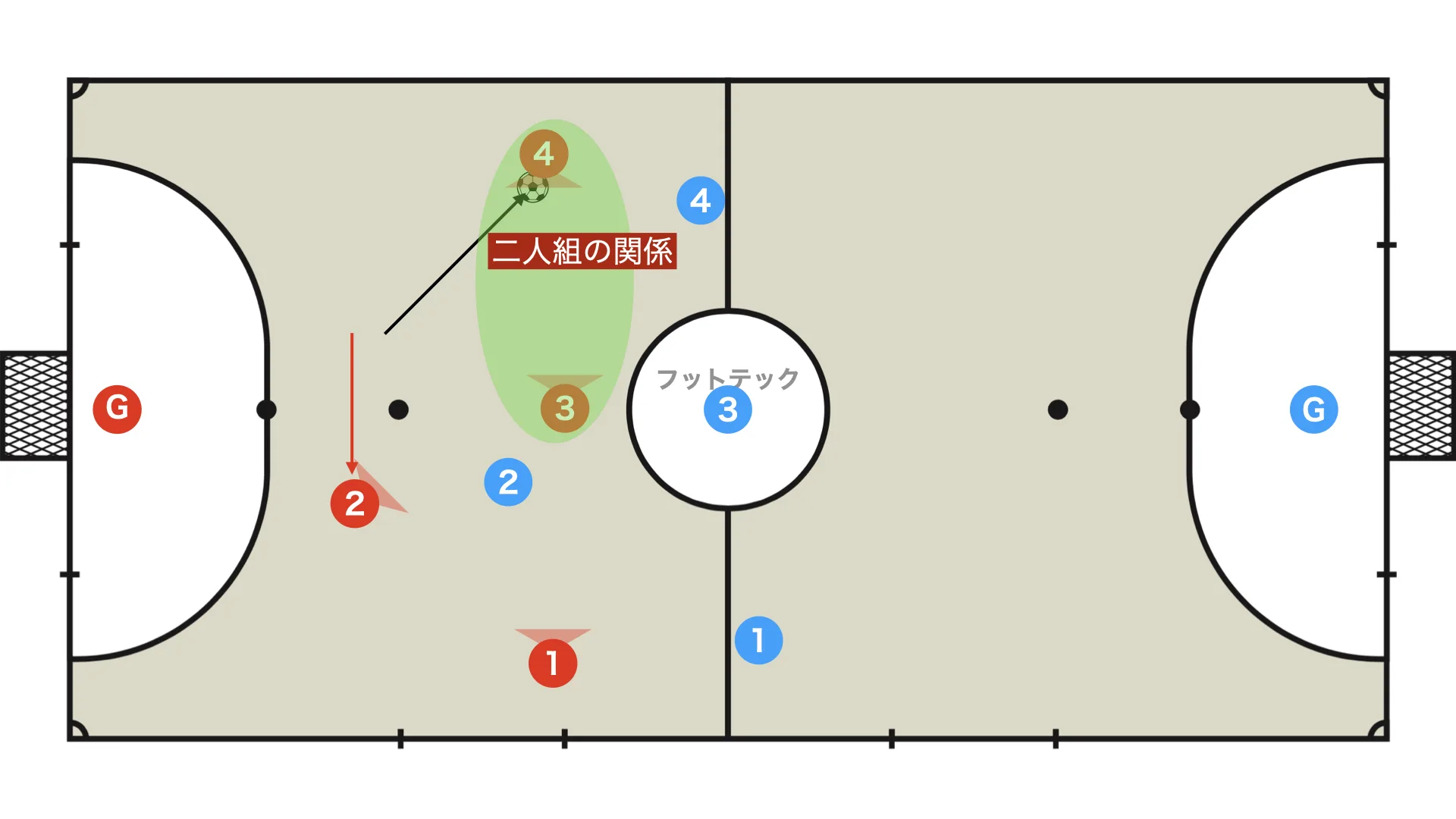
The attack similarly tries to break through via a two-player relationship on the side.
If that does not look promising, red no. 4 dribbles inside, and red no. 3 moves into the side lane (the space where red no. 4 had been) to return to the original shape.
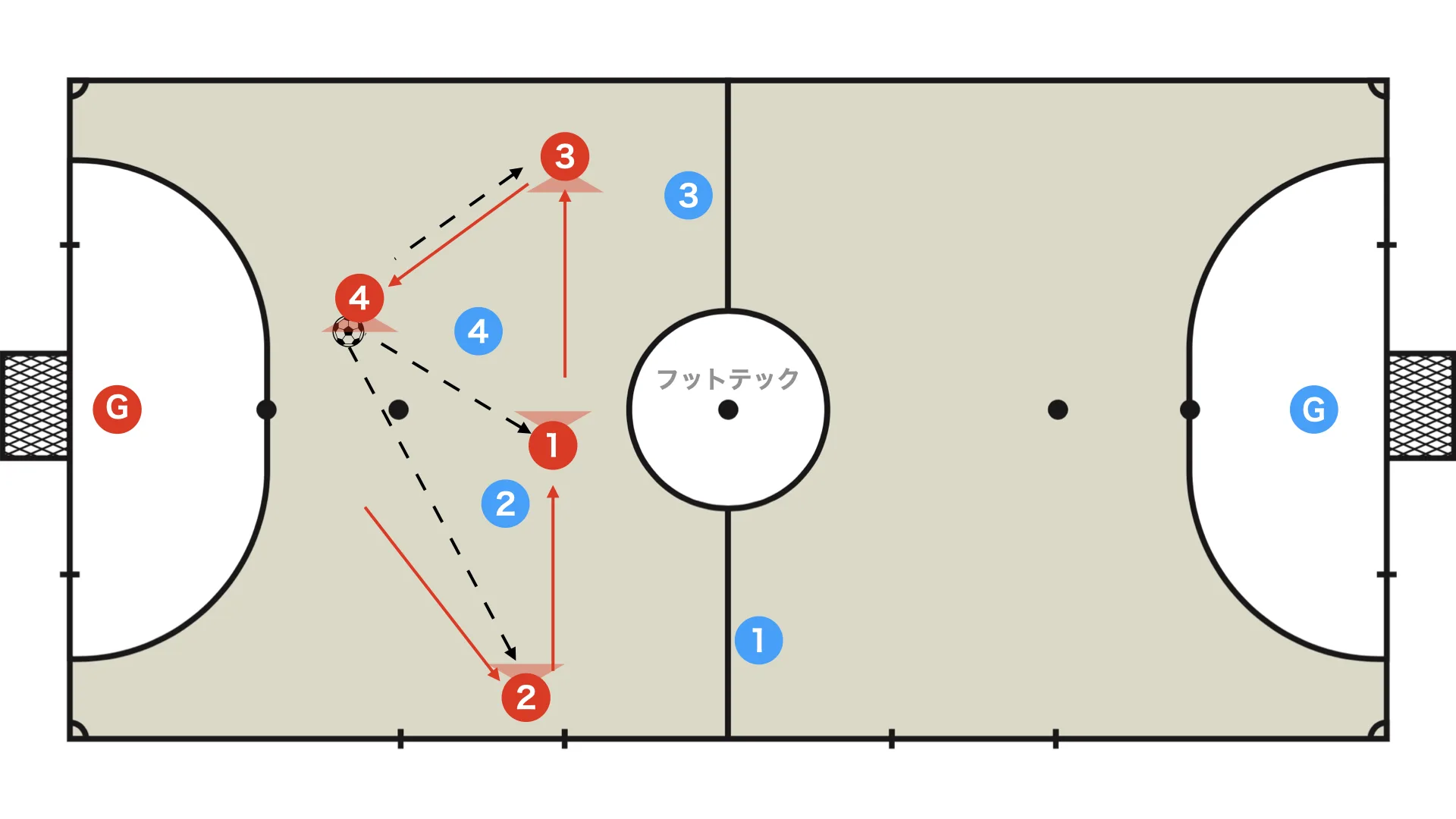
Once the team returns to the original triangle + 1 shape, there are three main options.
This is an effective option against a more zonal opponent.
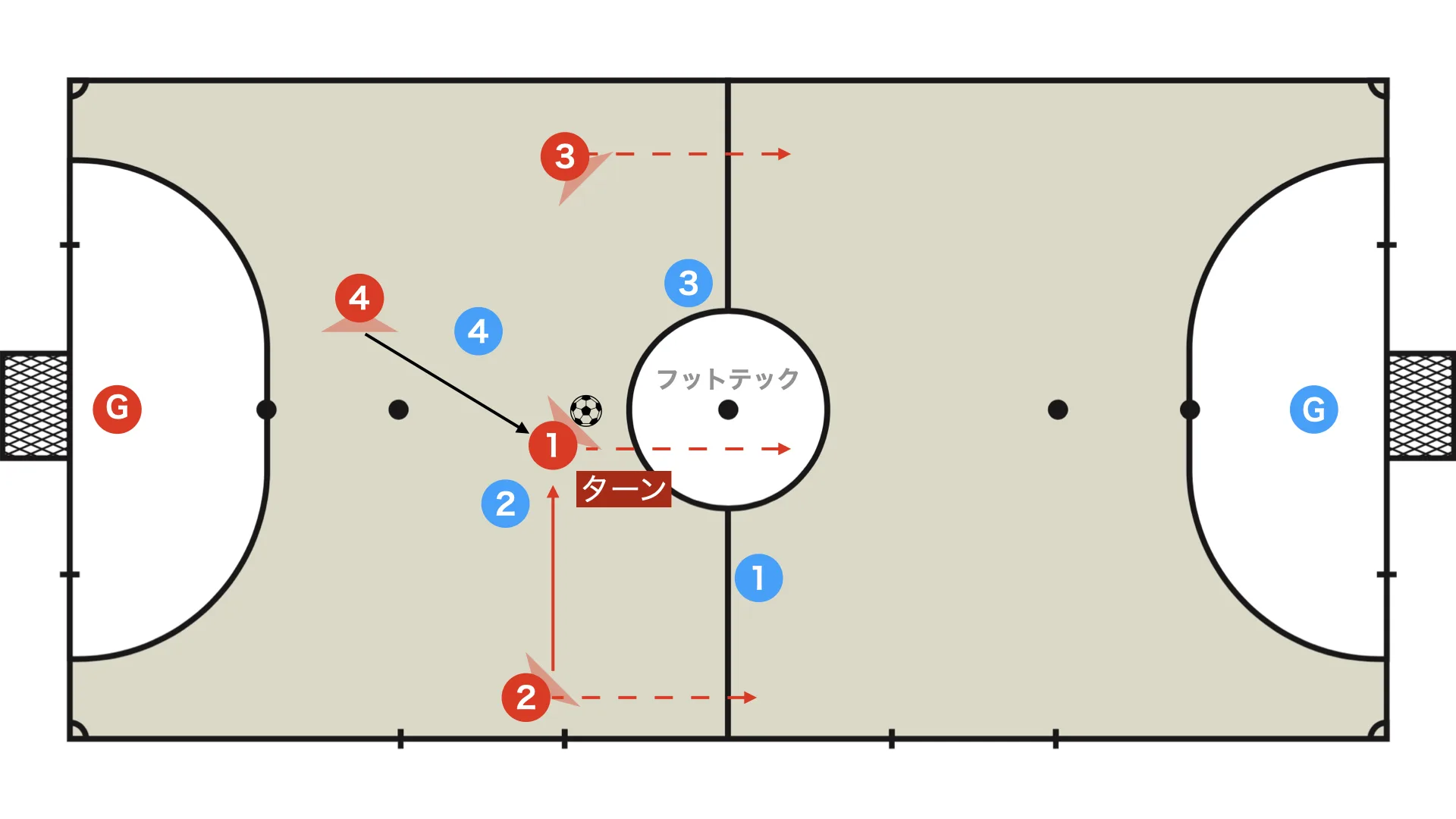
If the player can turn, do it immediately and create a 3v2.
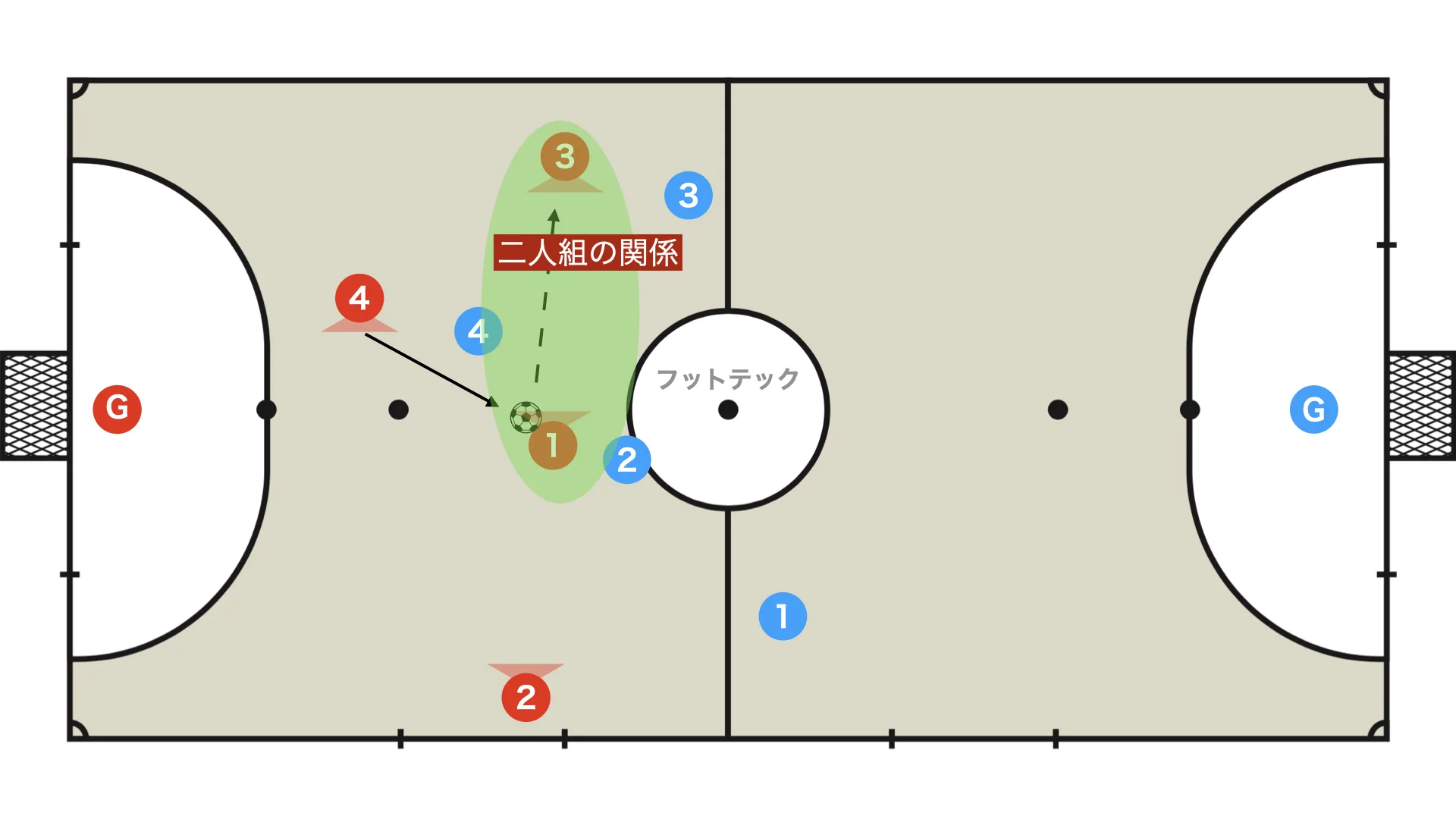
If the player cannot turn, create the two-player relationship again.
(At worst, there is no problem with playing a return pass to red no. 4.)
Given red no. 4's body shape, this is the safest option.
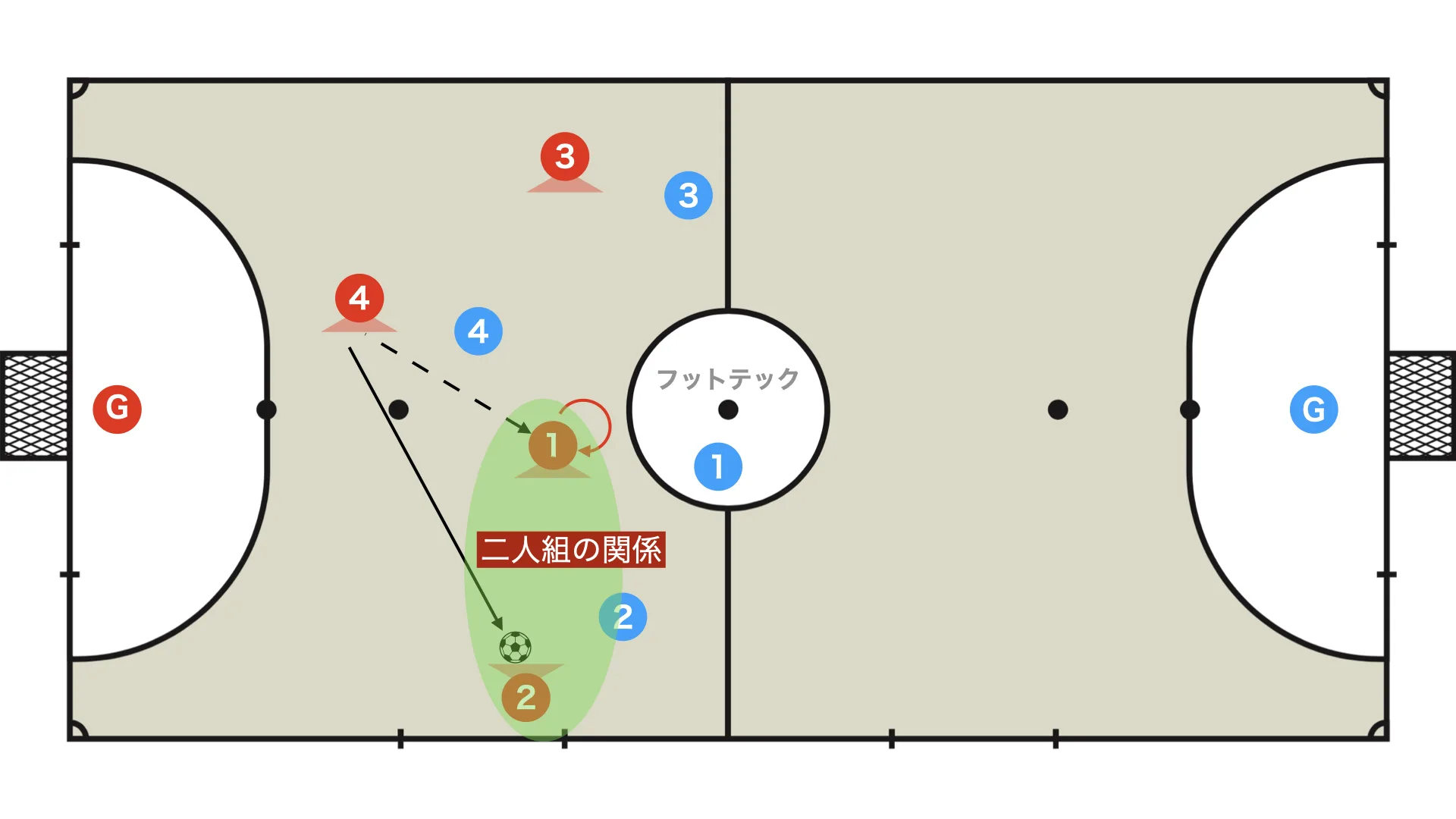
Red no. 2 and red no. 1 create a two-player relationship and try to break through.
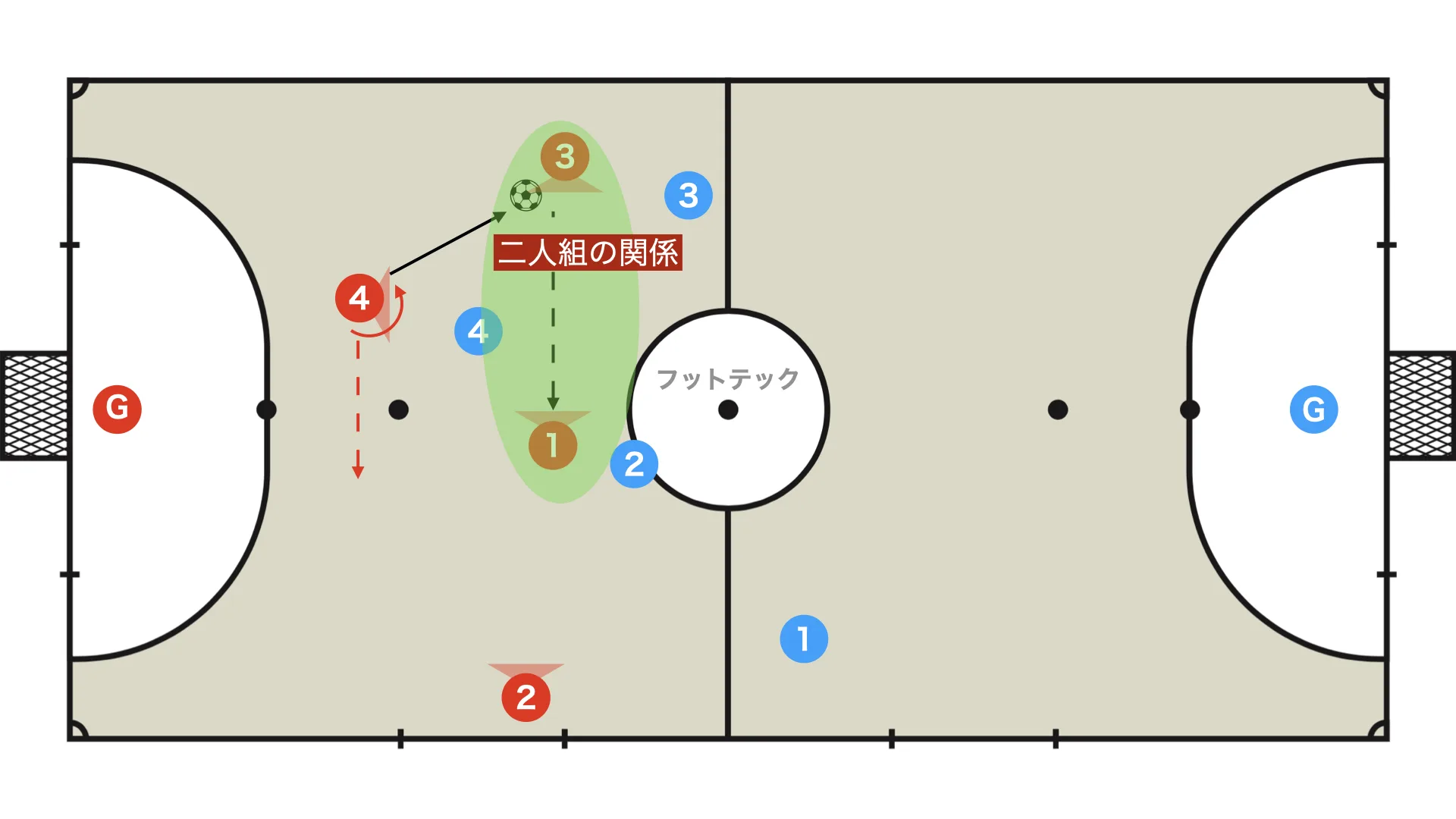
If red no. 4 is dribbling inside on a slightly negative angle, a pisada works effectively.
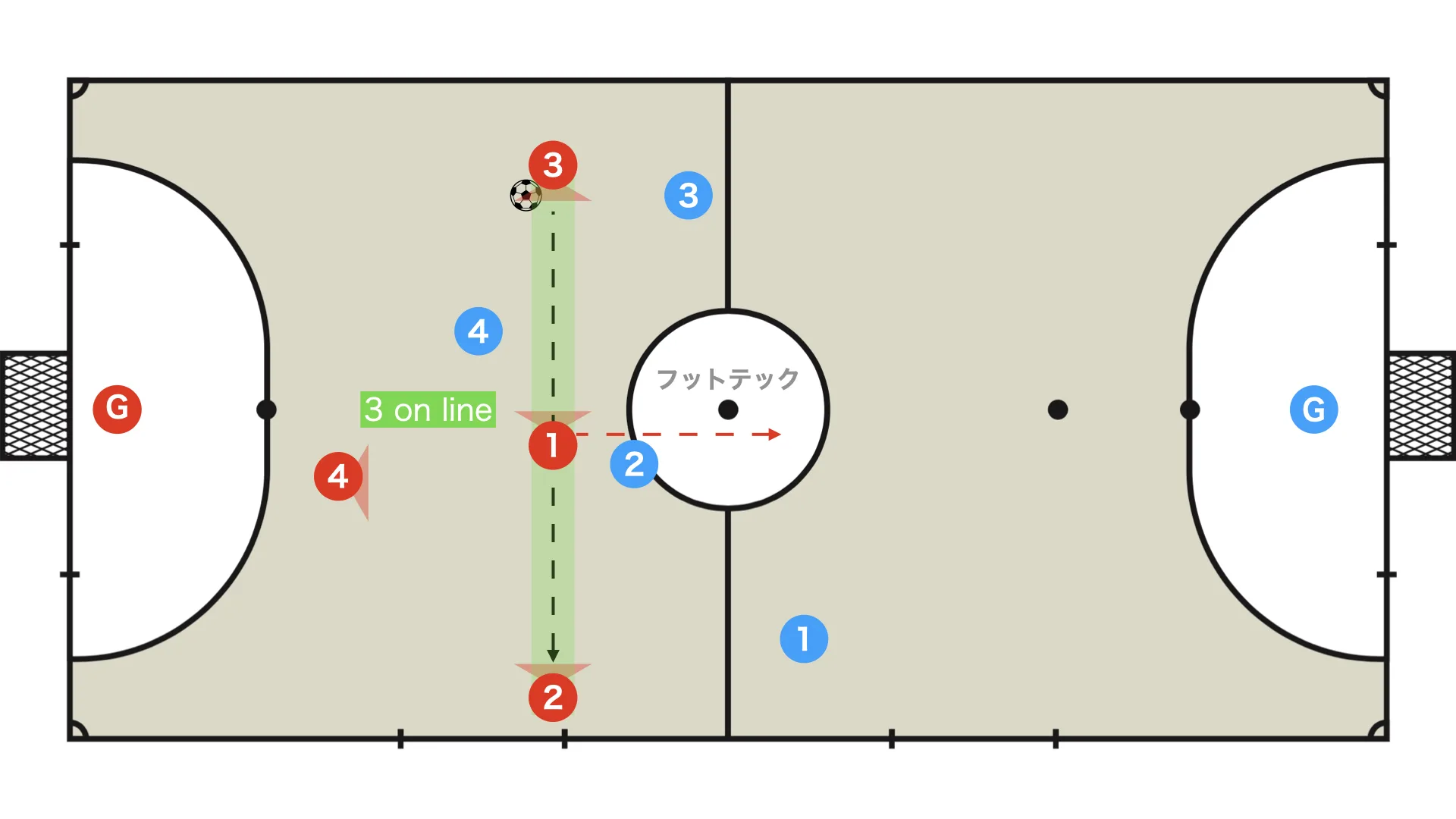
In many cases, including Quatro with an axis, a horizontal 3 on line appears when creating a two-player relationship on the side.
In that case, it is effective for red no. 1 to secure the passing lane behind, let the ball run, and then move through to become the third man.
In Quatro Zero, it is extremely important to think about positional balance while being aware of the four lanes, so it is effective to run a game with the pitch divided by flat markers or similar tools and add restrictions.
- Make sure the four players occupy separate lanes (if two players enter the same lane, one must leave)
- End the sequence if two players stay in the same lane in the team's own half for more than two seconds
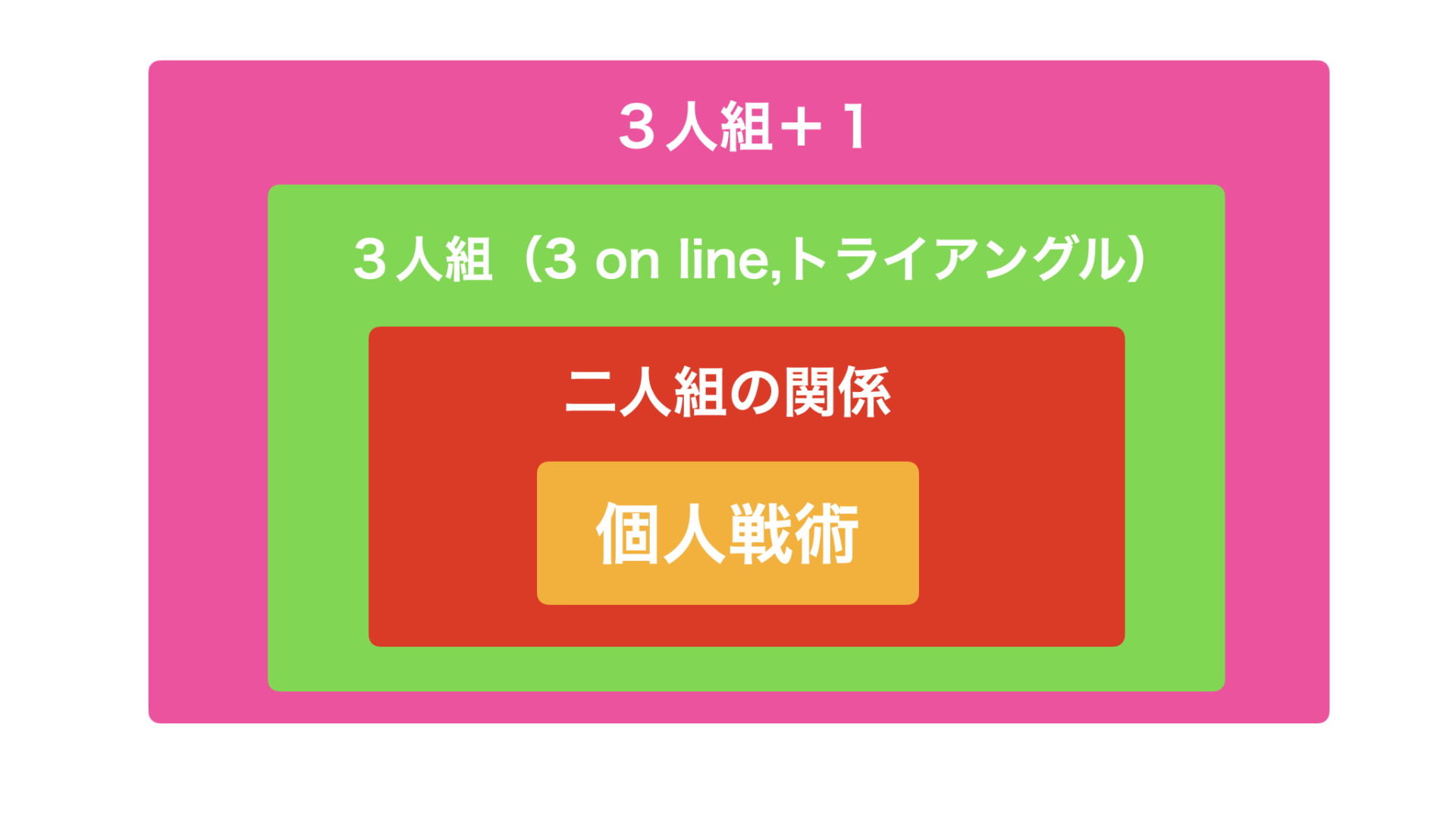
Quatro is a formation made up of four players, so you must never forget that within the larger Quatro structure are 3-player tactics (triangle + 3 on line), and inside those are two-player relationships and individual tactics.
In other words, to build high-quality group tactics, you need to work in the following order:
- Individual tactics
- Two-player relationships
- Three-player relationships (3 on line, triangle)
- Quatro
Once you have a general grasp of Quatro as a whole, it is best to focus first on improving the quality of the basic two-player relationships.
Never neglect the fundamentals, such as individual tactics and two-player relationships.
This time, I explained the main Quatro rotations.
I focused on well-known structured patterns here, but that does not mean these are always the best solution for every team.
Rather than copying them blindly, it is extremely important for each team to think through and share a game model that fits its own players.
I did not cover it here, but there are also Quatro patterns that use a volante, so if you have the time, try thinking about those as well.
Even just watching the F.League after understanding the ideas in this article should change how you see the game and make it much more interesting.
Use what you learned here somewhere and try putting it into practice.
関連記事
Positional Attack: How to Think About Formations and Rotations
A structured guide to formations and rotations in futsal positional attack. This article explains th…
続きを読む →