The Ideal System for Maximizing Individual Ability: The Box Shape (2-2) with Two Pivots
Published: 2021.06.15Updated: 2026.05.03
"We have strong individual players, but we still are not getting the most out of them." For teams that feel that way, the ideal solution is the 2-2 box-shaped formation.
In 2-2, two pivots are placed up front, making it easy to create space between the lines and isolate 1v1 situations. For teams that can secure two strong pivots, this is the shape that most easily creates clear reference points in the front line.
This article explains the tactical purpose of 2-2, along with its advantages, disadvantages, and main rotation patterns, using diagrams.
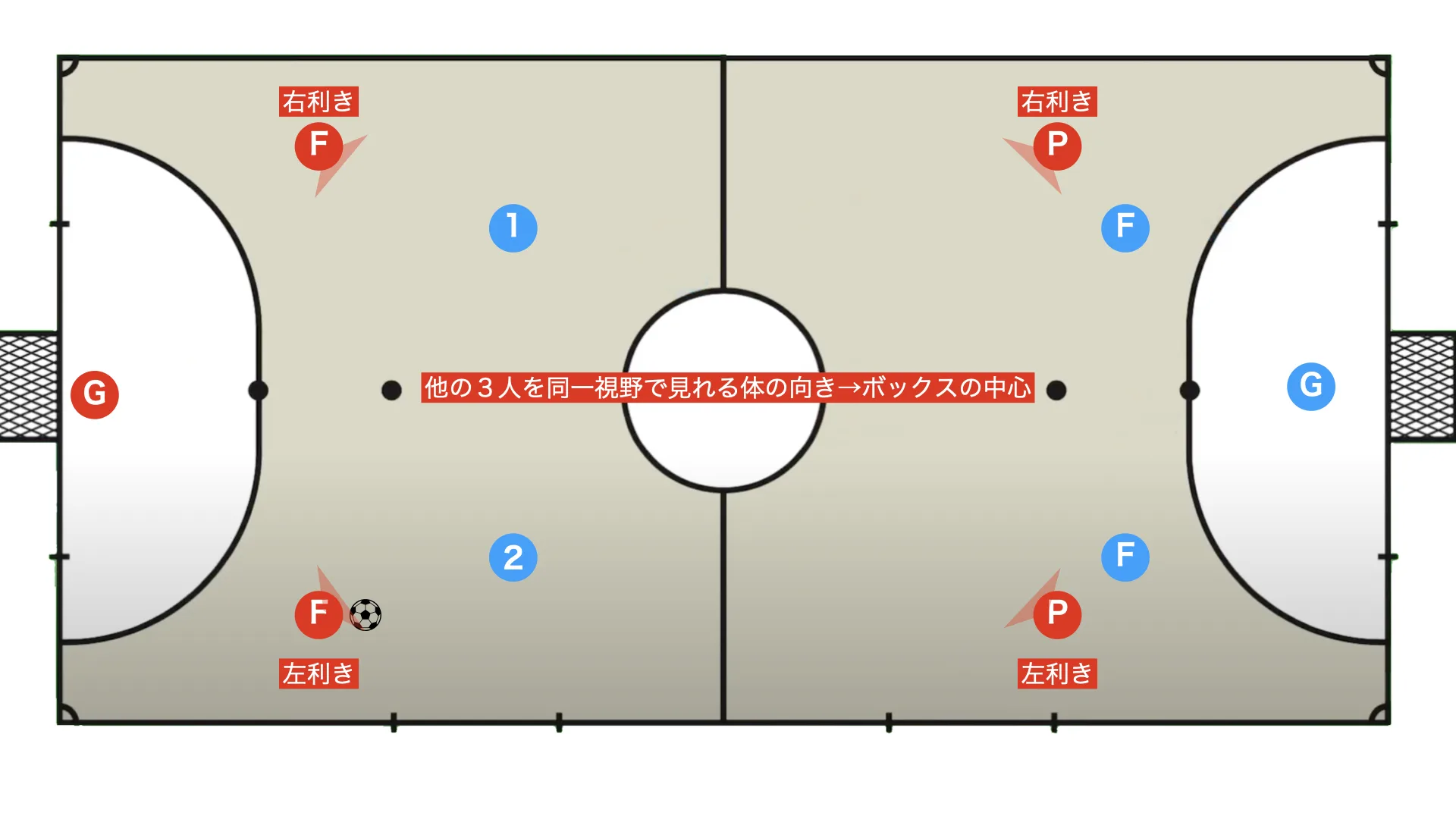
- Place the pivots in front and the fixos (alas) behind
- Position them on the side opposite their stronger foot (right-footed players on the left, left-footed players on the right)
- Face your body so you can see the other three players in one field of view, in other words, toward the center of the box
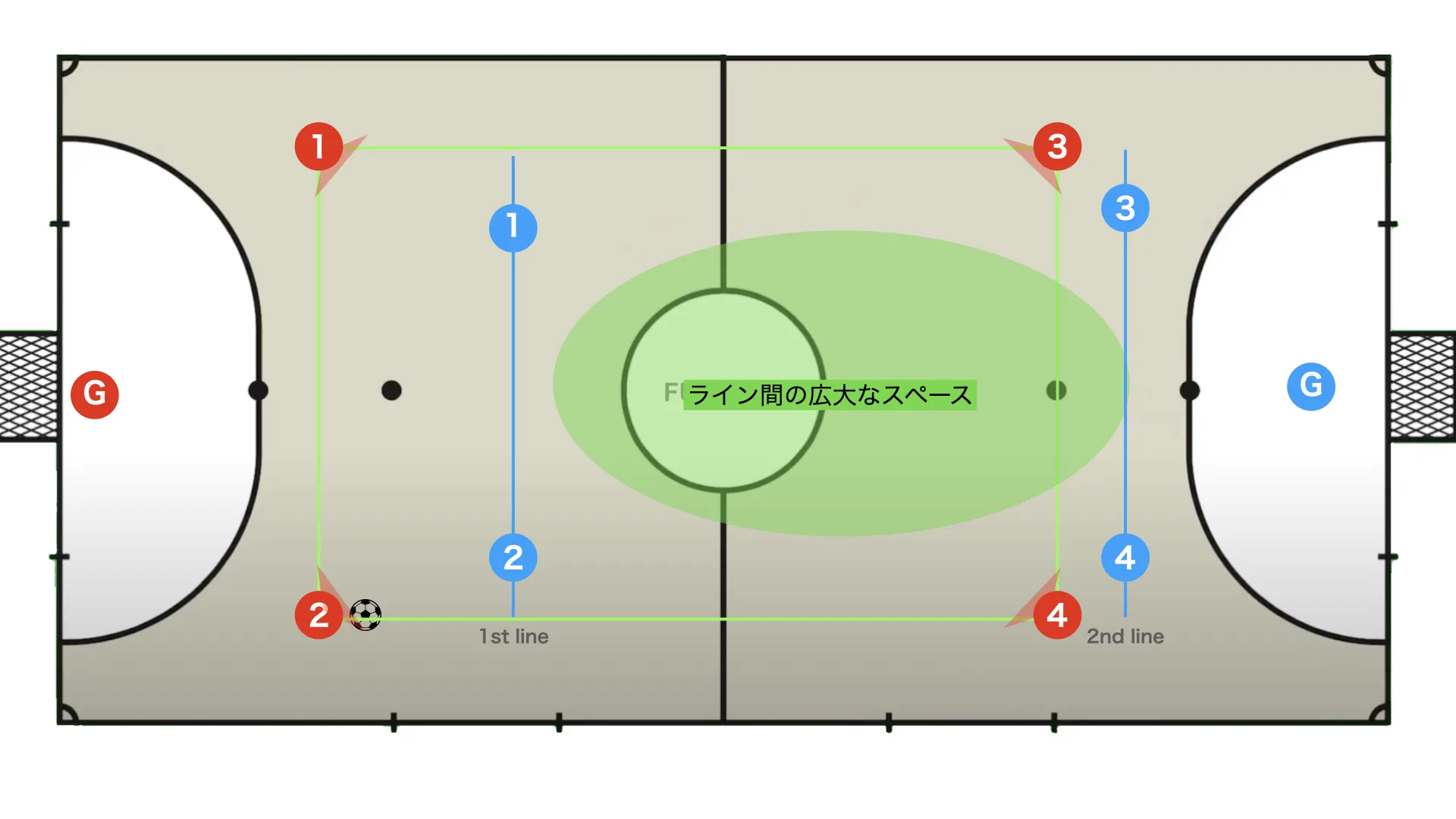
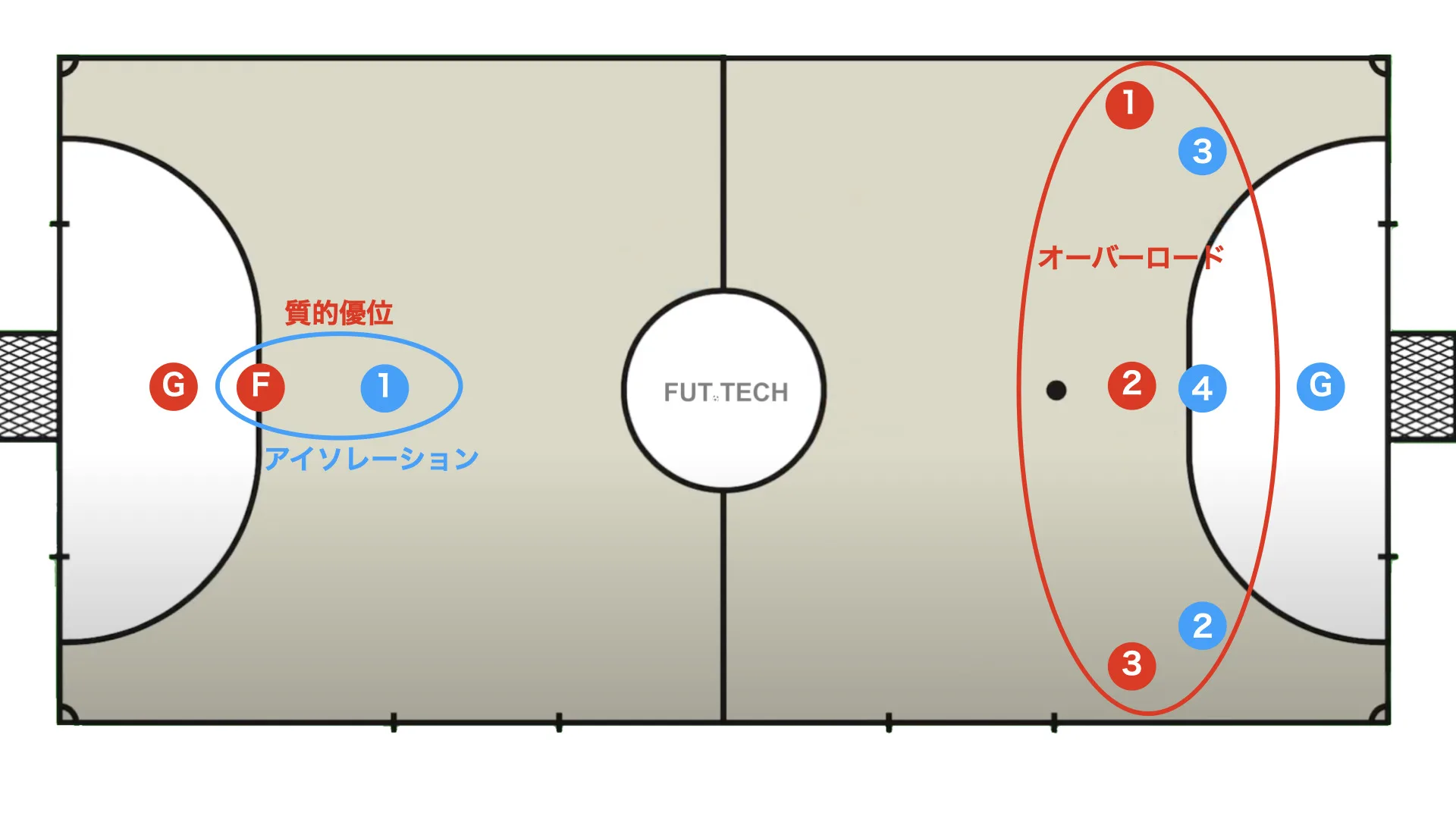
Most teams respond to this shape with something close to man-to-man marking, so as shown above the defending team ends up with two defensive lines (or three if you count the goalkeeper).
The key to this tactic is to make effective use of the space that appears between those lines, in other words, the middle of the box.
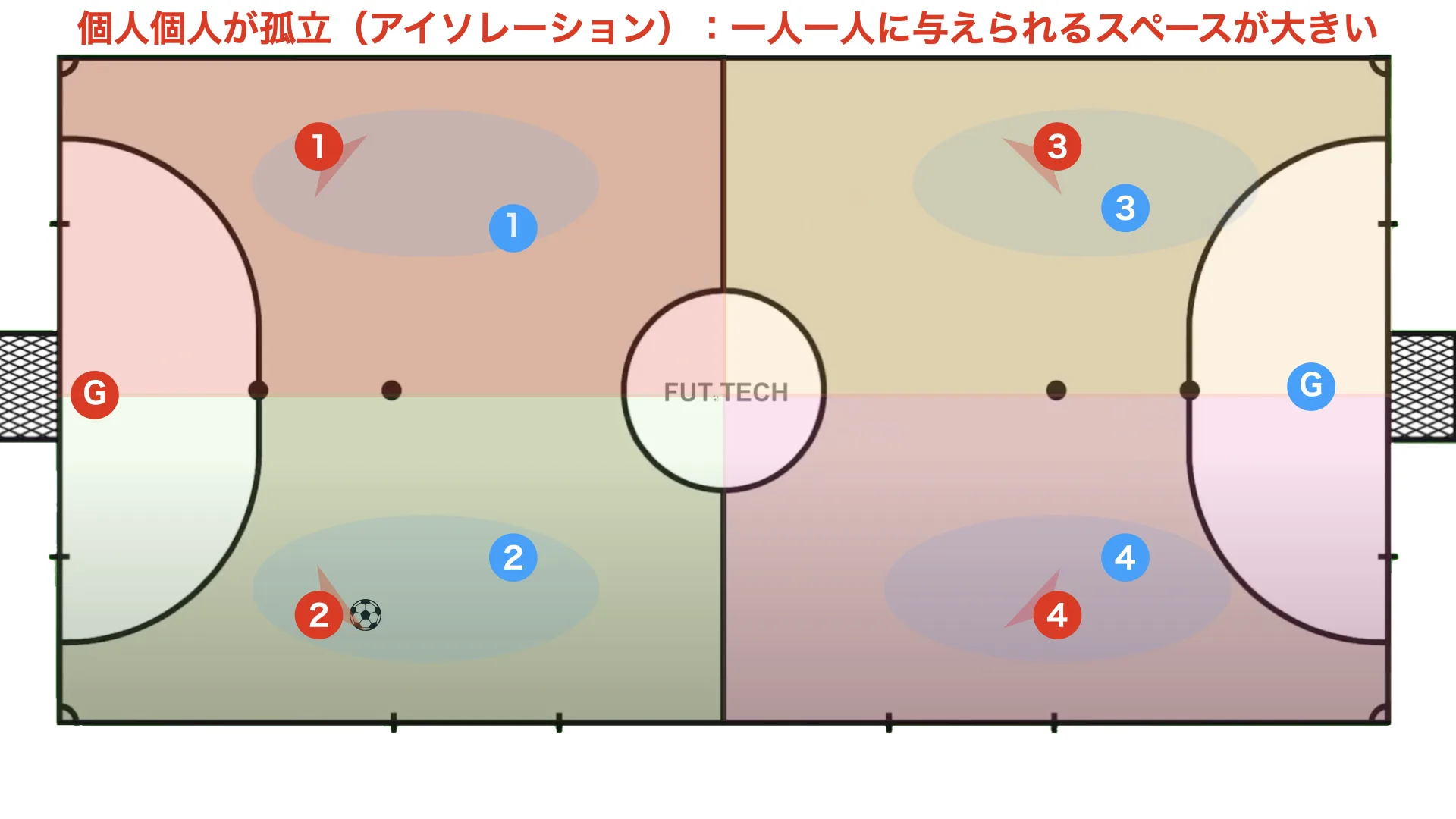
As shown above, one feature of this shape is that the distance between players becomes larger, so each player is given more space.
Because of that, this tactic tends to rely heavily on pure individual ability, which makes it especially suitable for physically strong teams made up of former soccer players.
Supplement
On a small court (for example, 30m x 15m), the distances between players become just right, so this is also worth considering if your team struggles to attack in 4-0 or 3-1 on a small court.
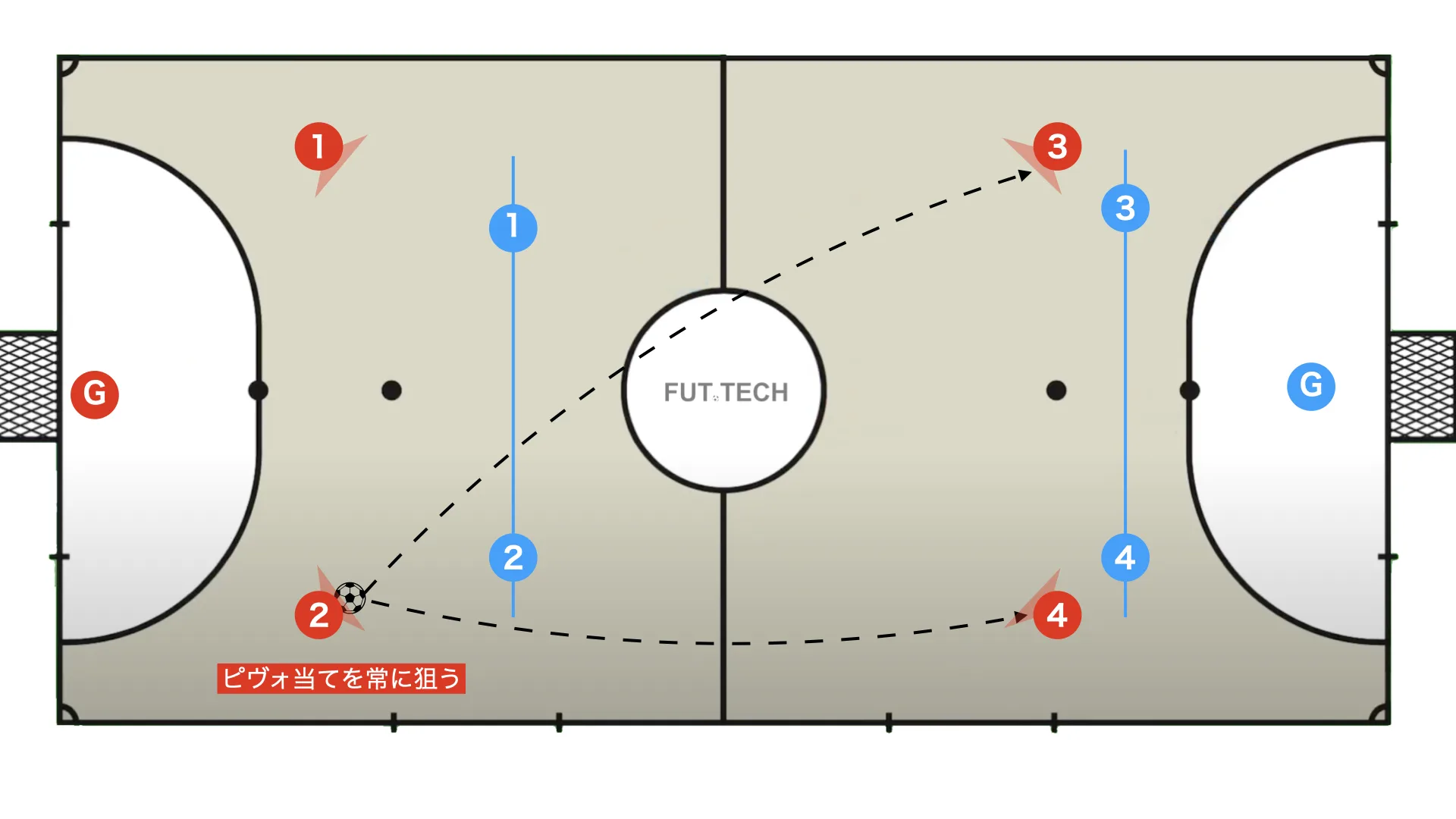
Because there are two pivots, the core of this tactic is that it creates vertical and diagonal passing lanes into the pivot.
The deeper players must always keep their heads up and stay aware of the passing lanes into the pivots.
Attacking priorities
- Play into the pivot
- Horizontal pass
- Back pass to the goalkeeper (if a back pass is available)
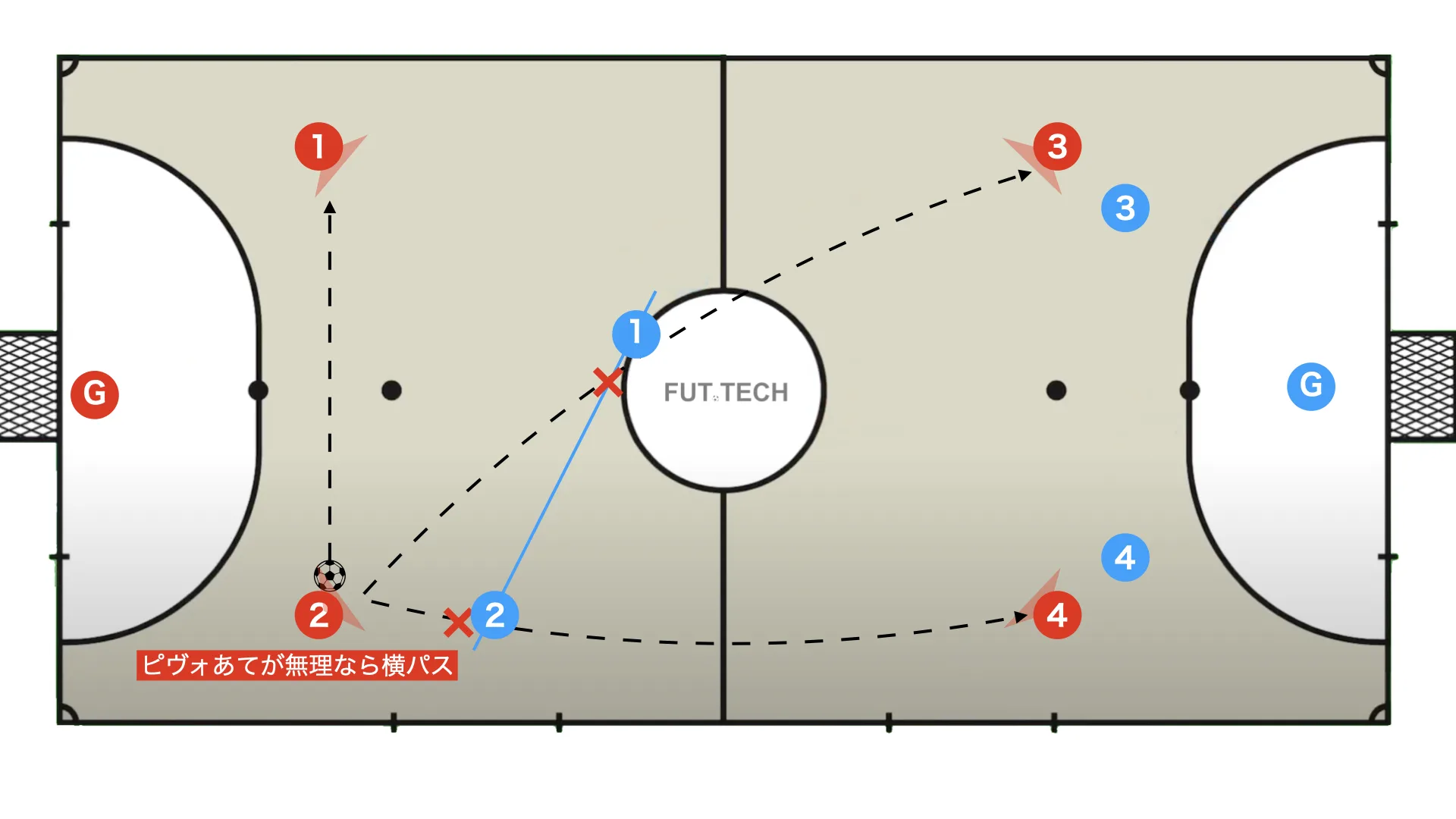
If both the vertical and diagonal lanes into the pivot are blocked, use a horizontal pass to move the opposing defenders.
Defending
When the 1st defender in the front line is not applying pressure to the ball carrier, the 2nd defender in the front line should screen the diagonal passing lane into the pivot. In other words, cut out the skip pass or diagonal pass.
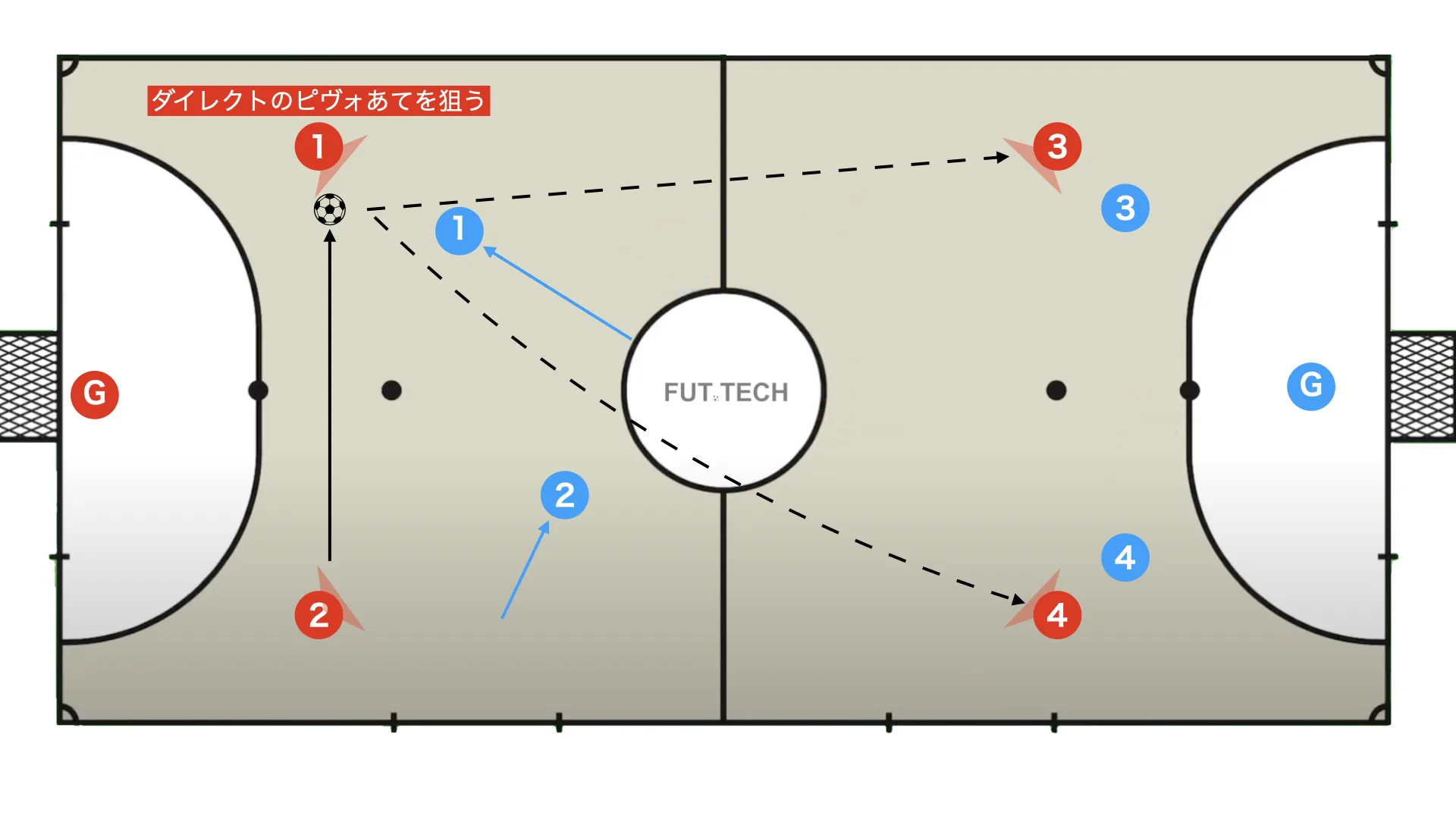
Instead of controlling the horizontal pass first and then looking for a passing lane, check the surrounding situation before receiving and look to play into the pivot first time.
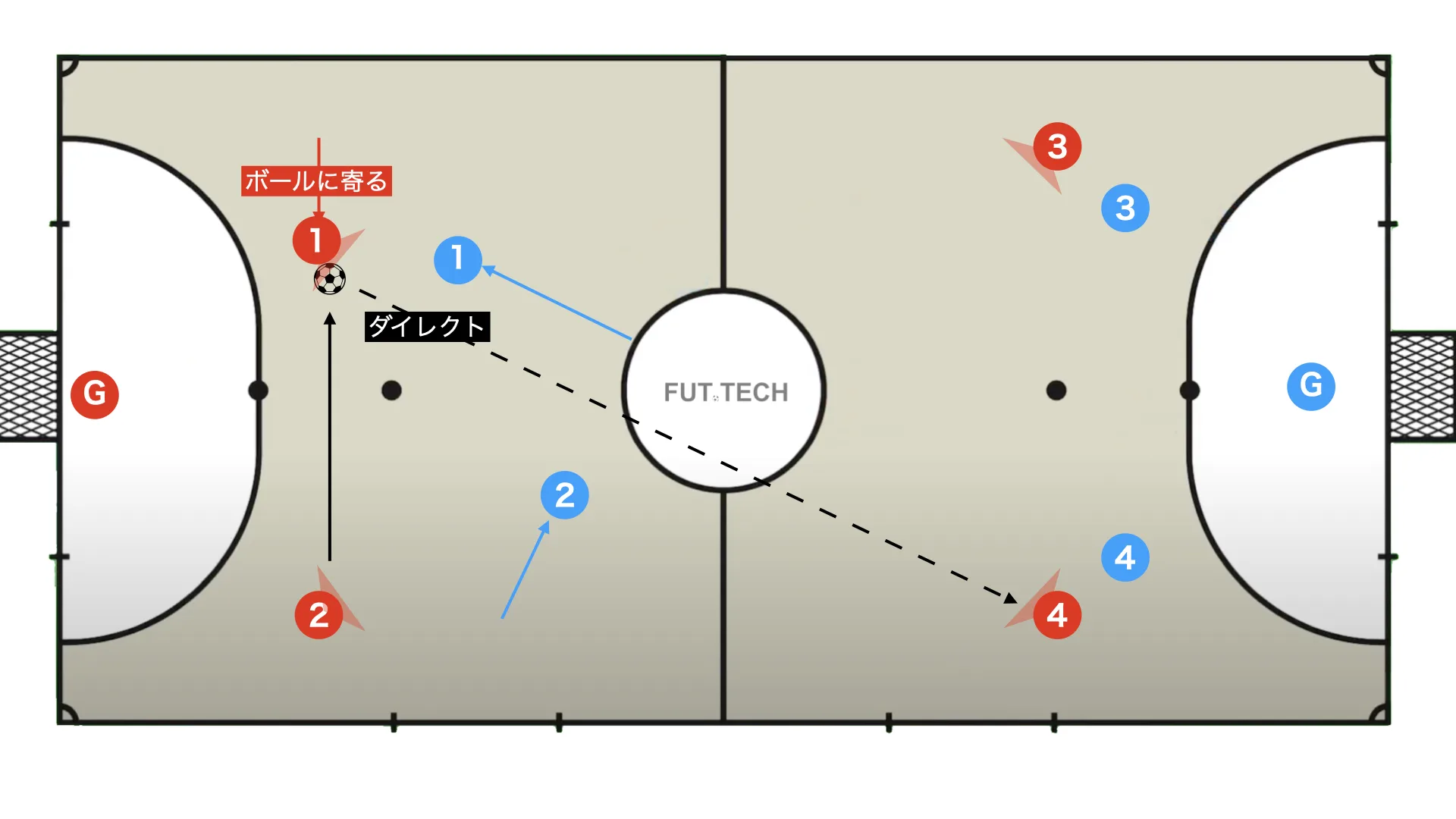
If the opponent is pressing, it is effective to move toward the ball or attack the ball and receive it inside, so you can shake your marker temporarily.
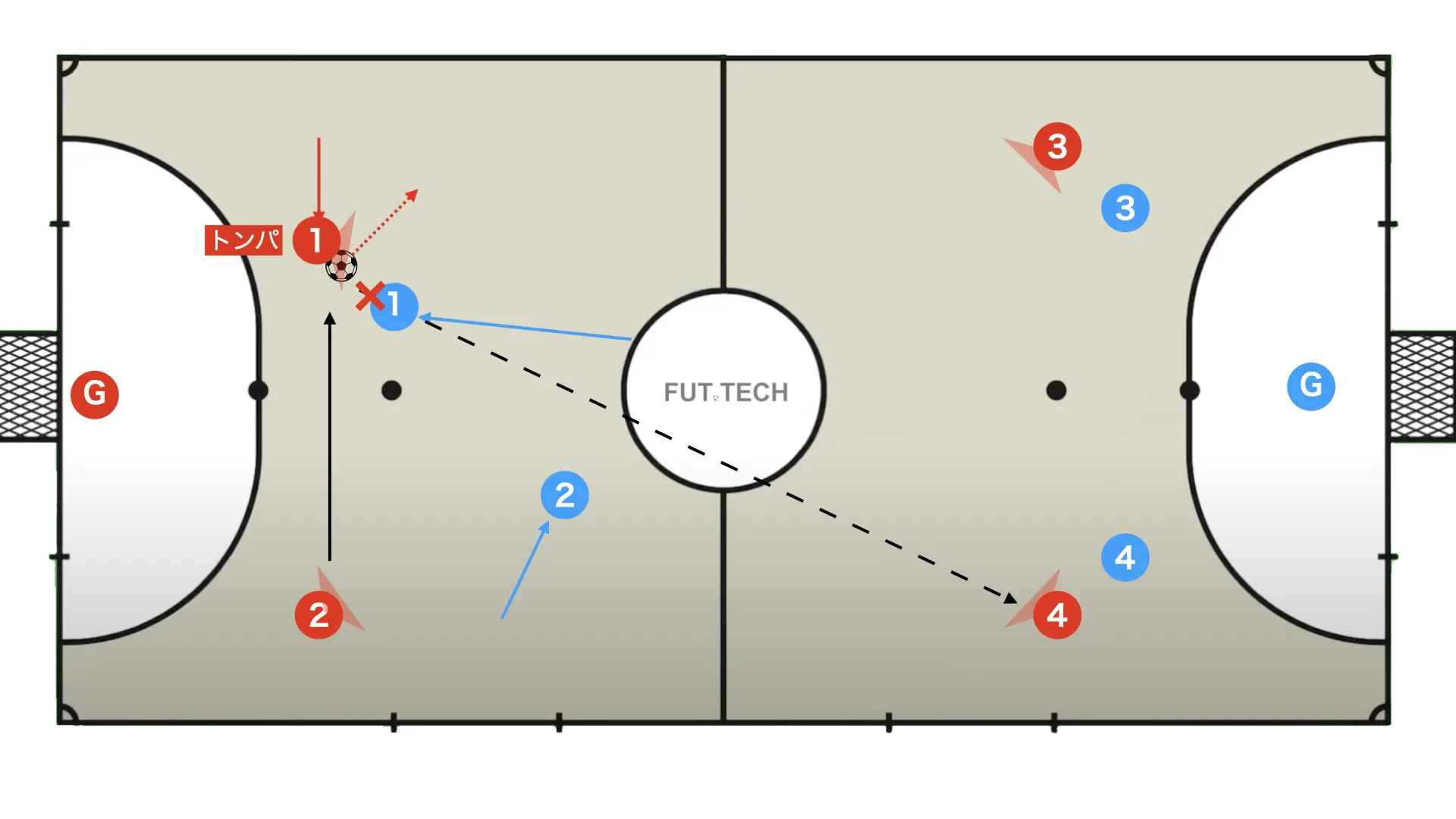
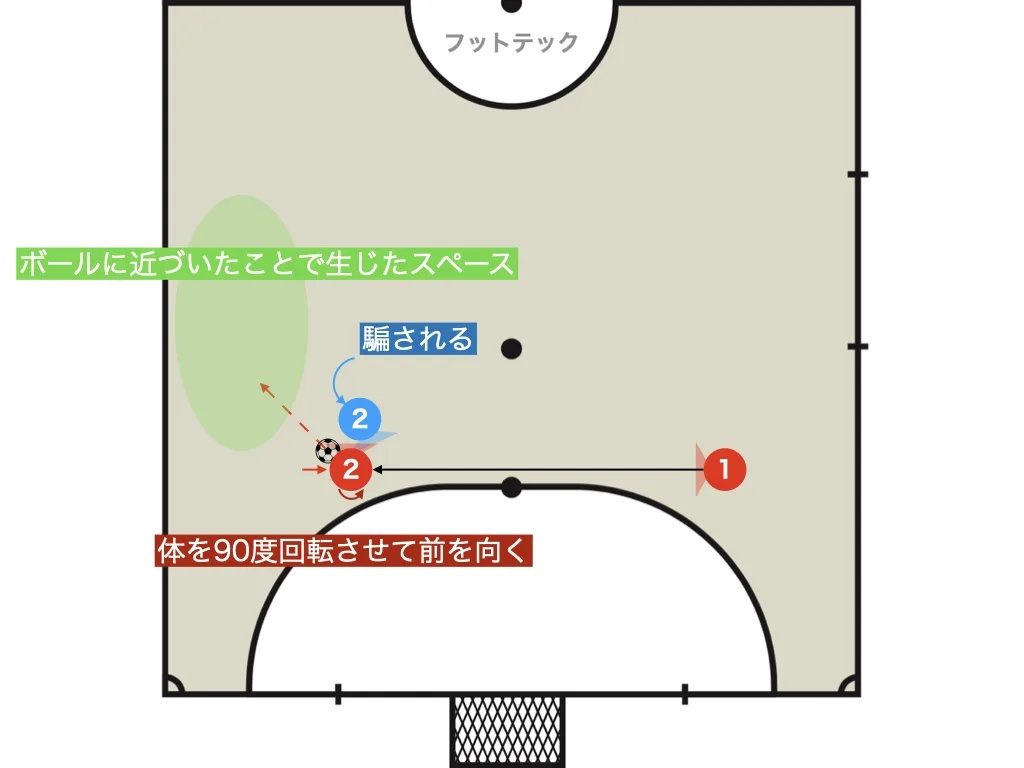
Sometimes the opposing defender anticipates the movement toward the ball and presses slightly inward.
If the opponent jumps inward, use that against them by driving the dribble to the opposite side and leaving the defender behind.
関連記事
What Is Tonpa (Contrapie) in Futsal? How to Do It and When to Use It Instead of Inward Dribbling
A beginner-friendly explanation of what tonpa (contrapie) is in futsal, how to do it, and when to ch…
続きを読む →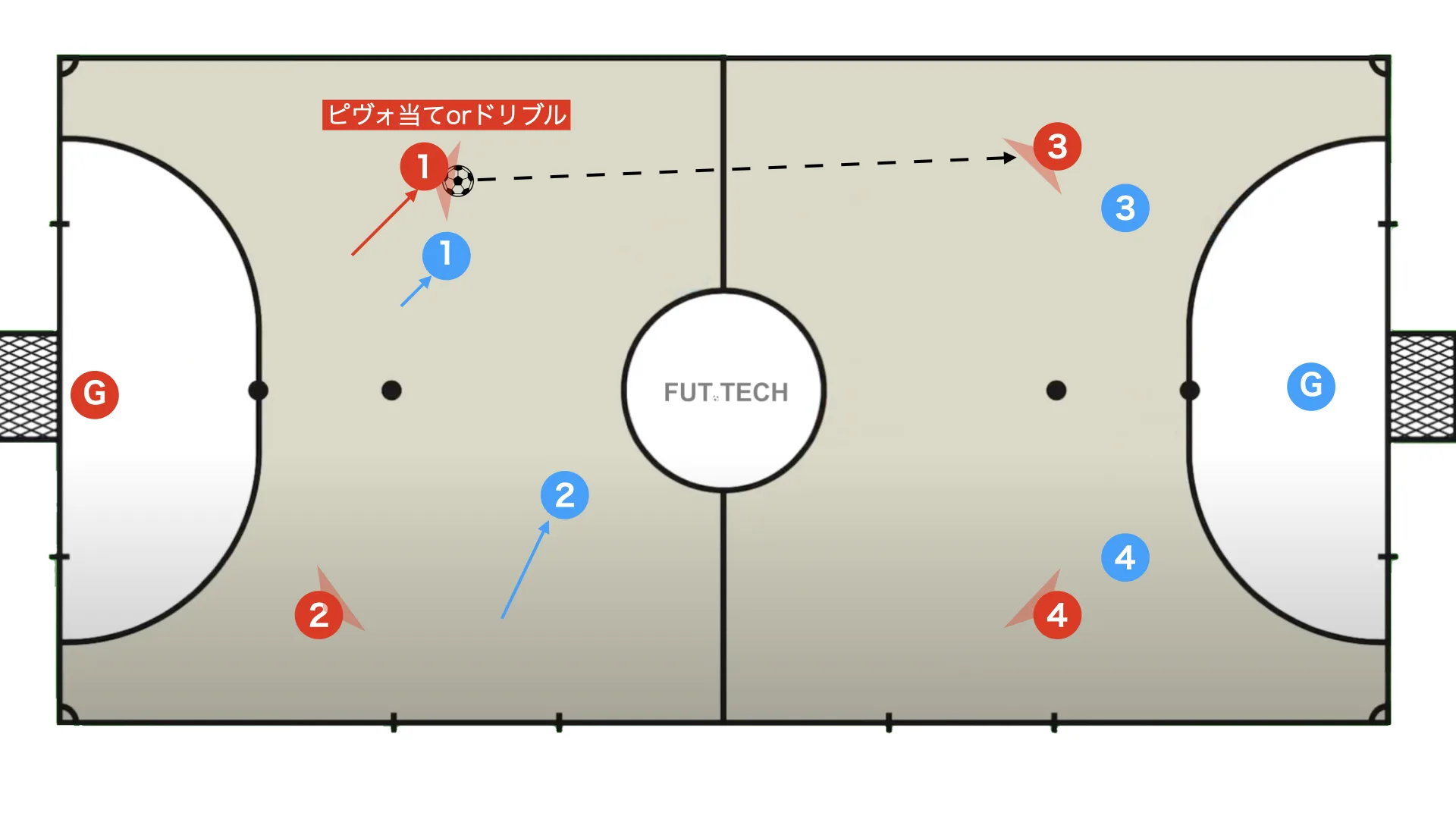
After using a tonpa, the ideal outcome is usually to carry the ball forward and create a 3v2 in the front line. But if the opponent defender (blue no. 1) recovers in time, the safer option is to play into the pivot quickly.
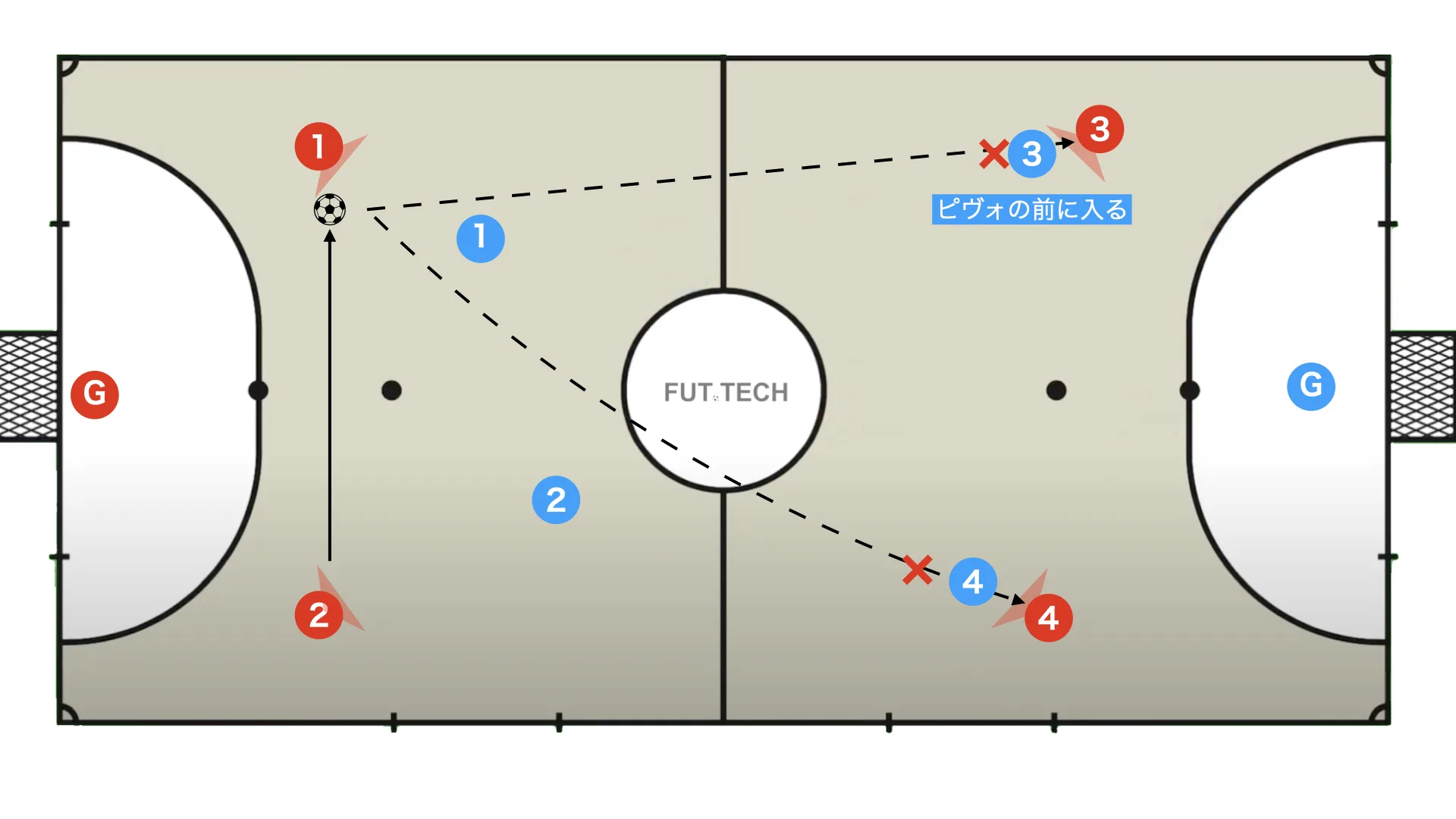
As a basic rule when defending against a pivot, the fixo positions in front of the pivot in advance and screens the passing lane.
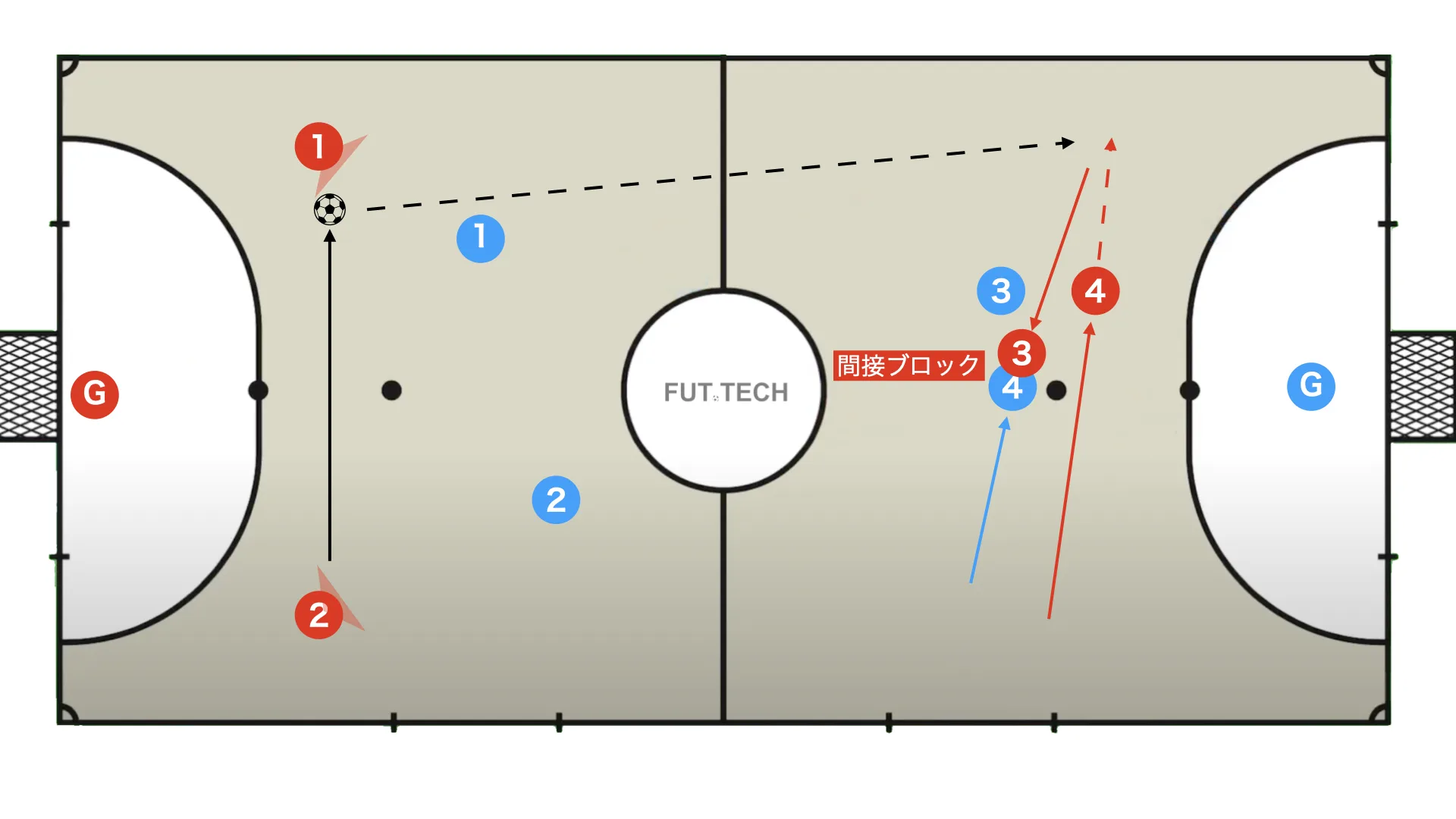
If the opposing fixo steps in front and removes the passing lane into the pivot, it is effective for the two pivots to switch positions.
That can confuse the opposing markers and allow one of them to receive the ball free.
It is even more effective if one pivot indirectly blocks the other player's marker at that moment, deliberately provoking a mark exchange.
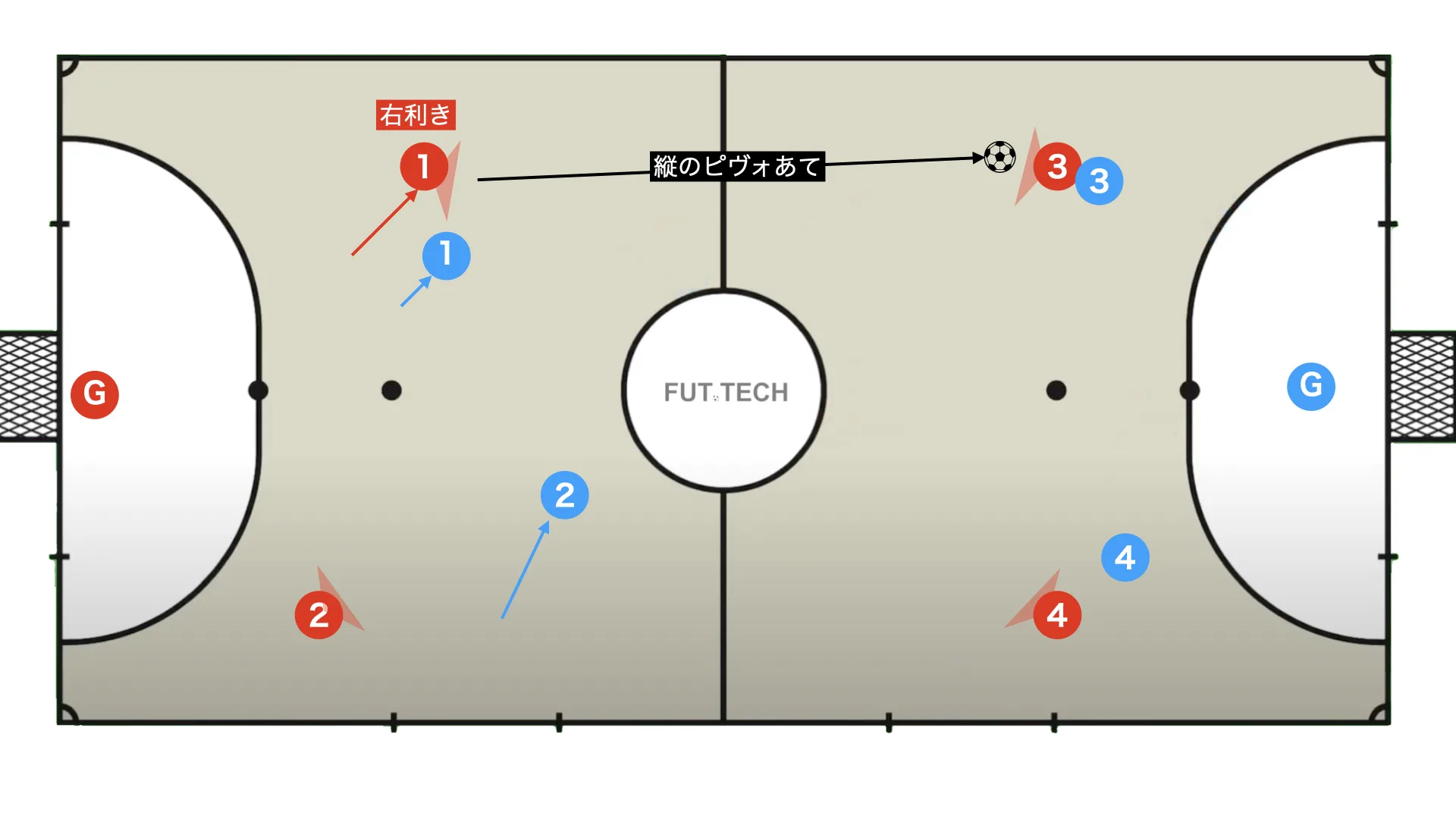
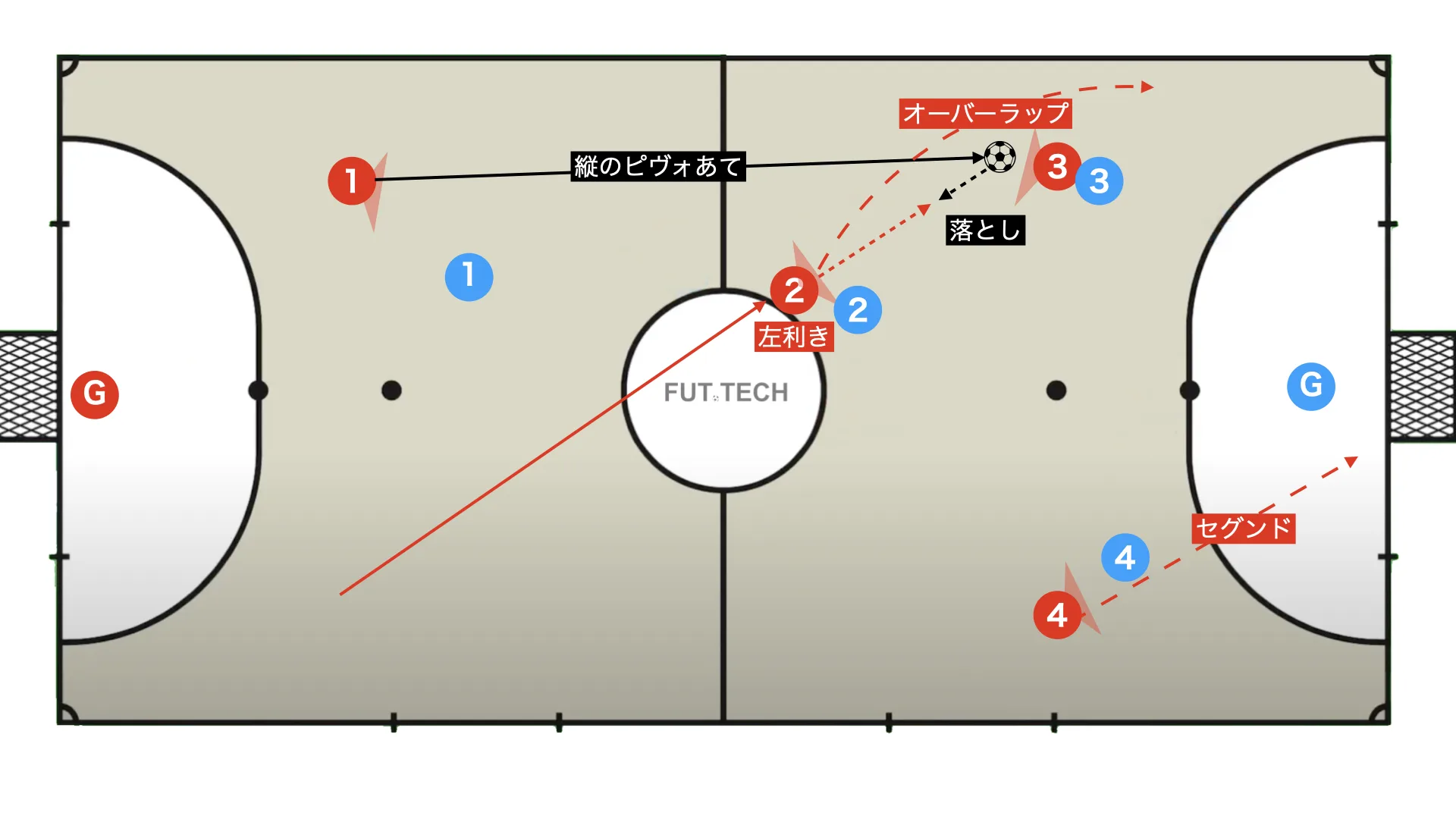
Here I will explain the full sequence after a vertical pass into the pivot, from support around the pivot to the finish.
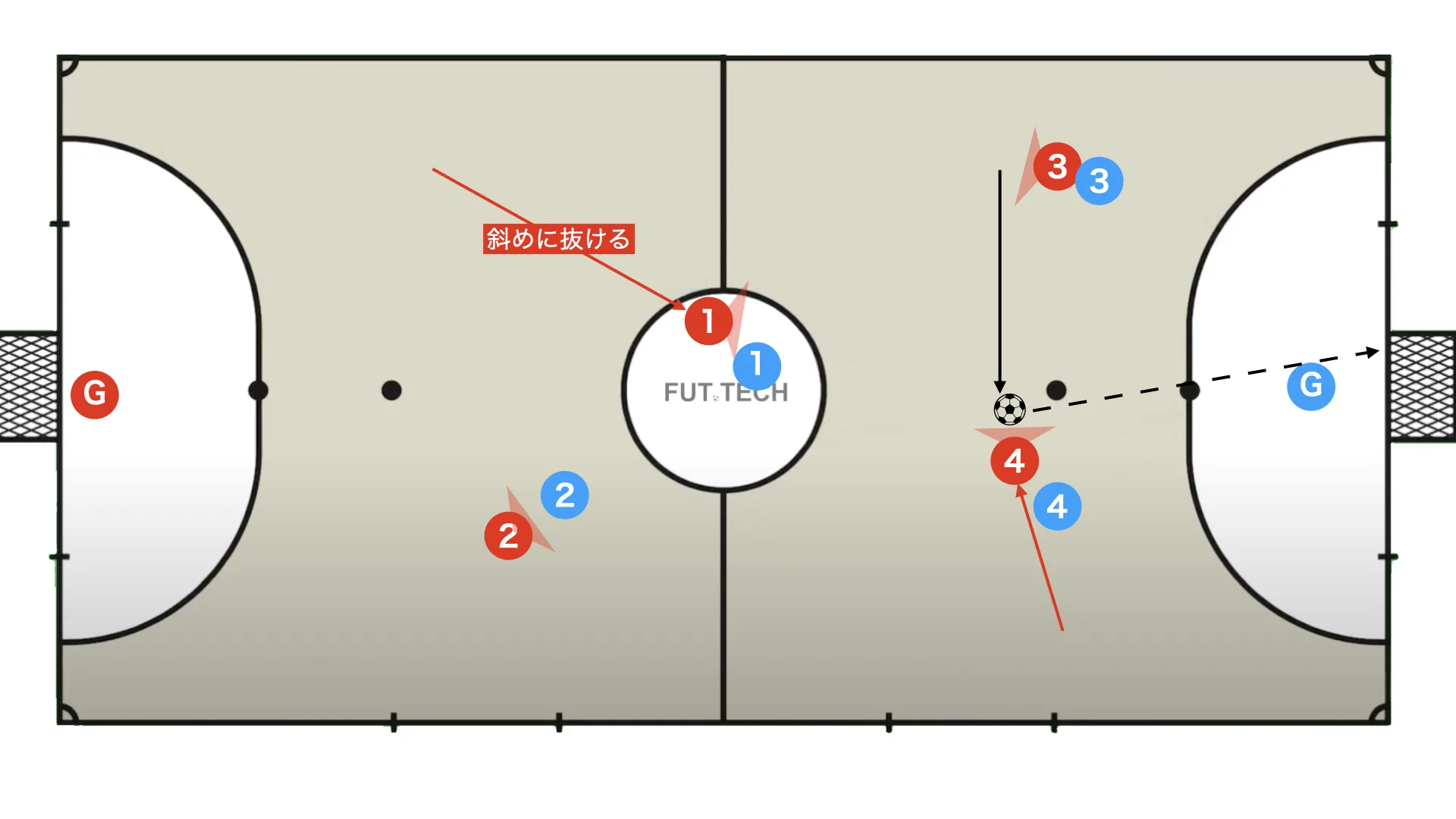
As shown above, after playing into the pivot, always keep in mind the simple option of using the other pivot to finish quickly (within two touches).
After a vertical pass into the pivot, the basic idea is that the two players closest to the ball get involved, so the player who passed into the pivot should make a diagonal run.
This is based on the same logic as the three-player L pattern that uses a pivot.
L
In other words, the attack is completed by the player who made the diagonal run and the two pivots.
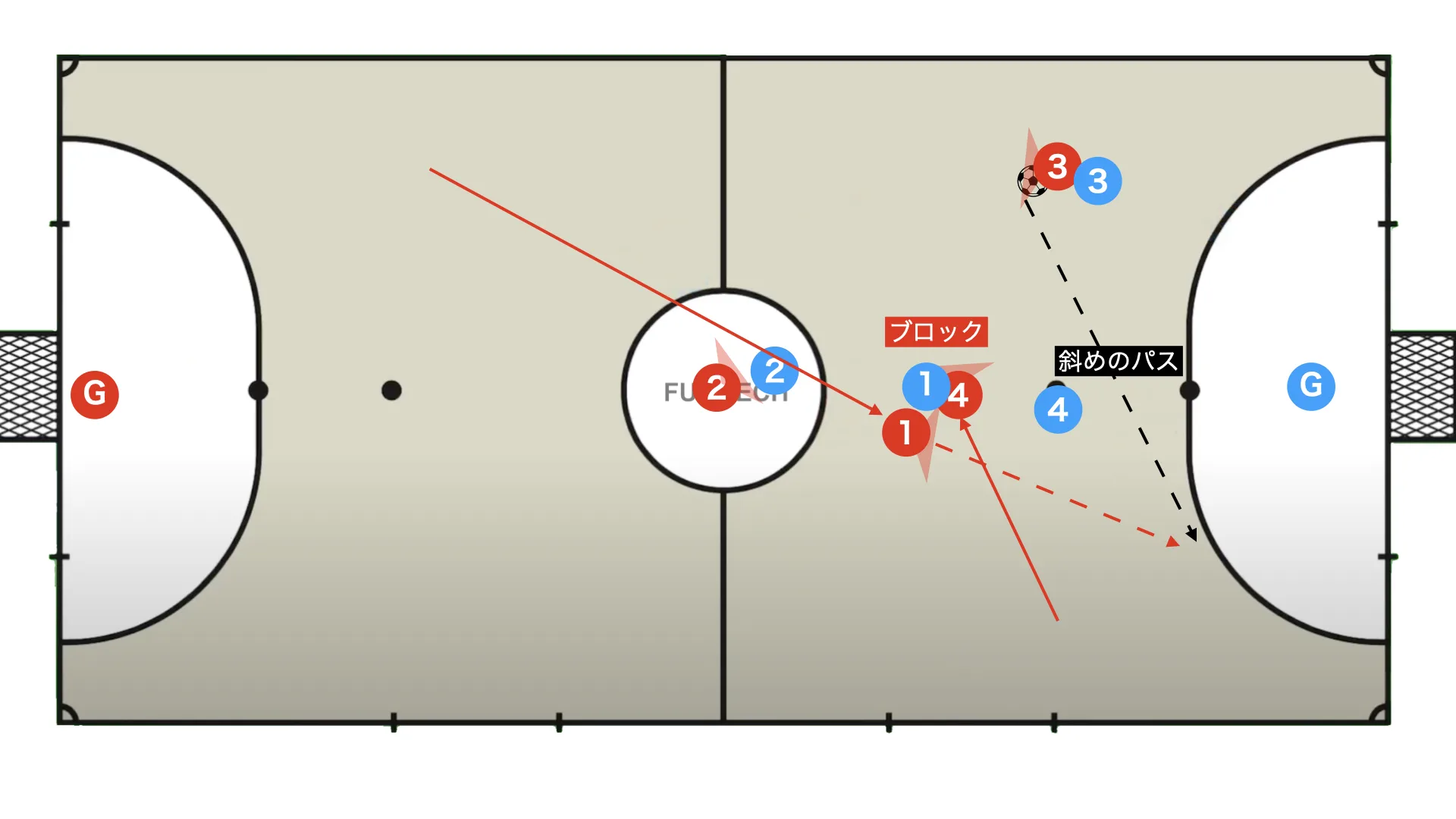
In the example above, after the pivot pass, the pivot indirectly blocks the marker of red no. 1, who made the run, and the team looks for the diagonal pass.
This can confuse the opposing markers and make it easier to receive the ball free.
Conversely, it is also extremely effective for the runner to indirectly block the marker of the pivot (red no. 4) so the pivot can shoot free.
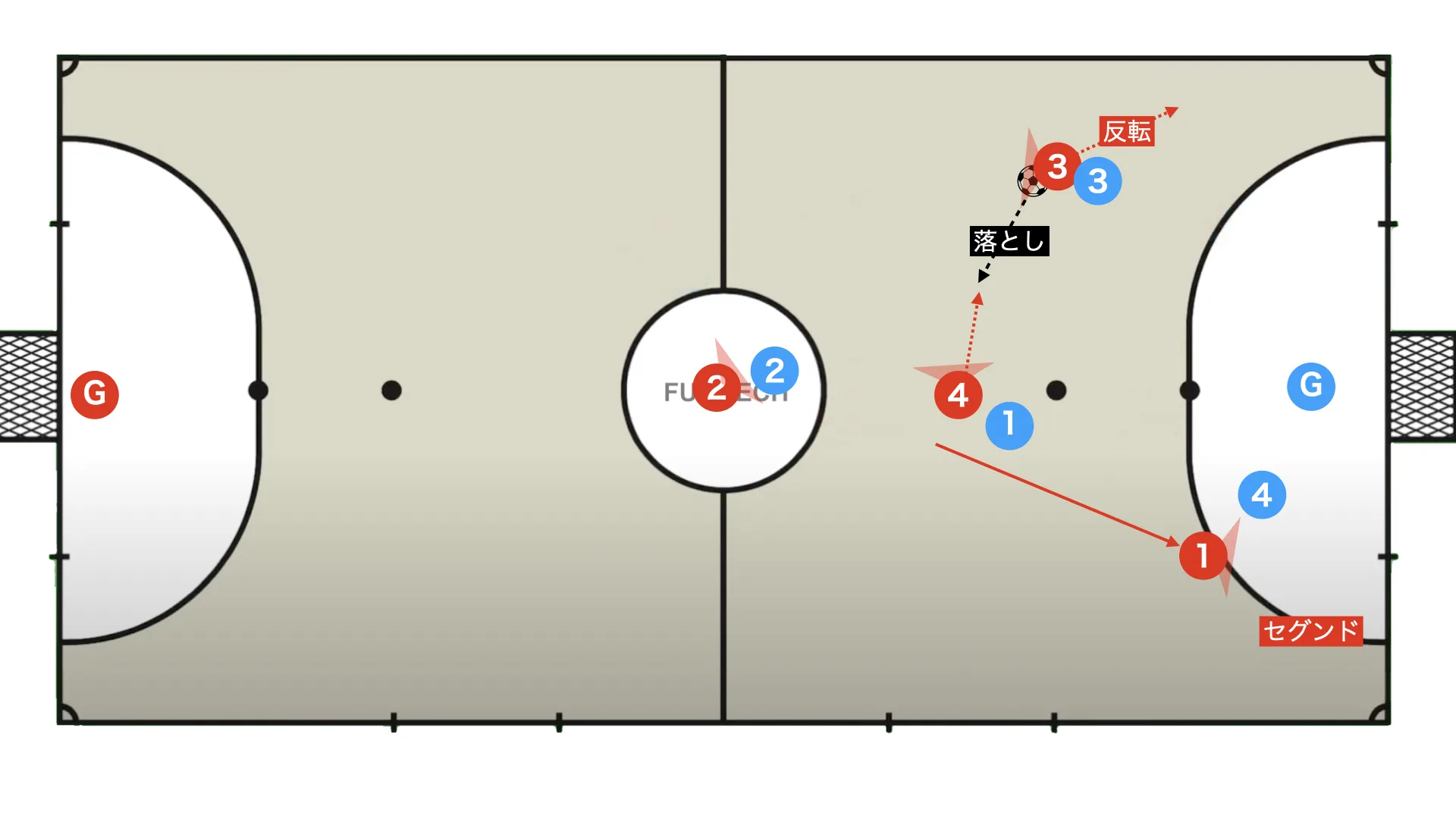
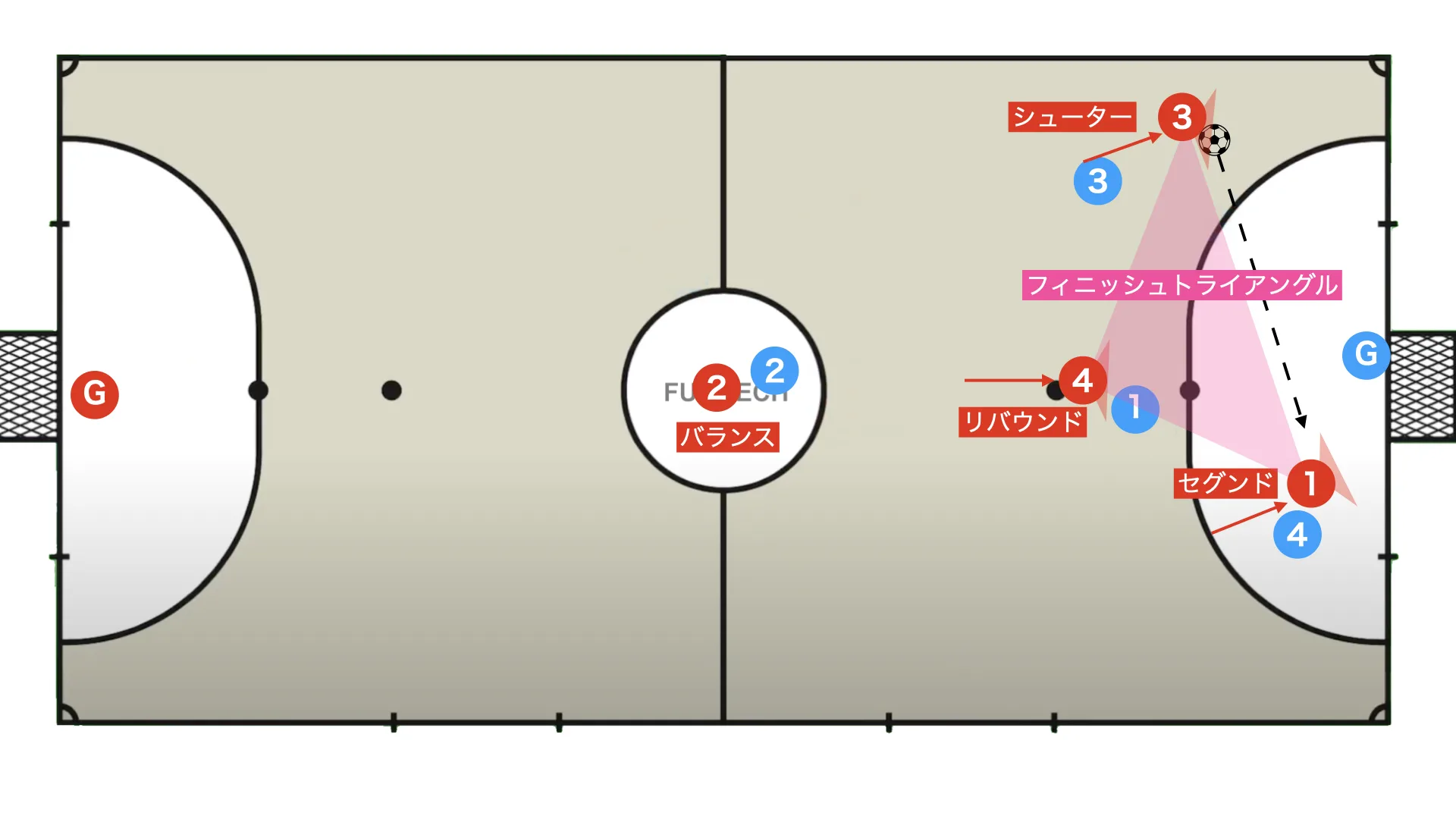
The pivot should not only look to use teammates, but also always keep the option of turning, using it as part of the duel.
If the pivot turns, create a finishing triangle. If the pivot turns vertically but has no shooting angle, simply look for the segundo.
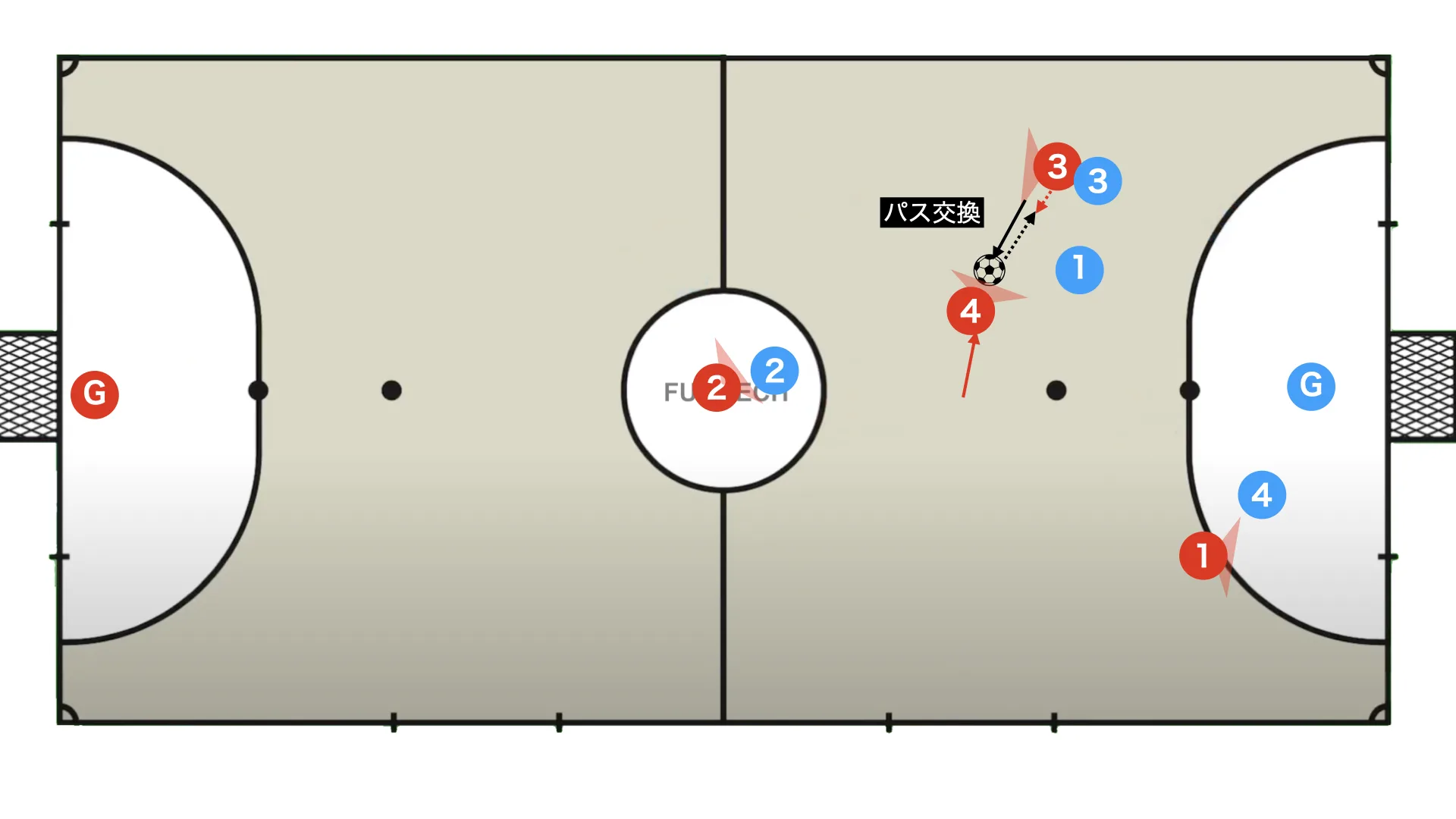
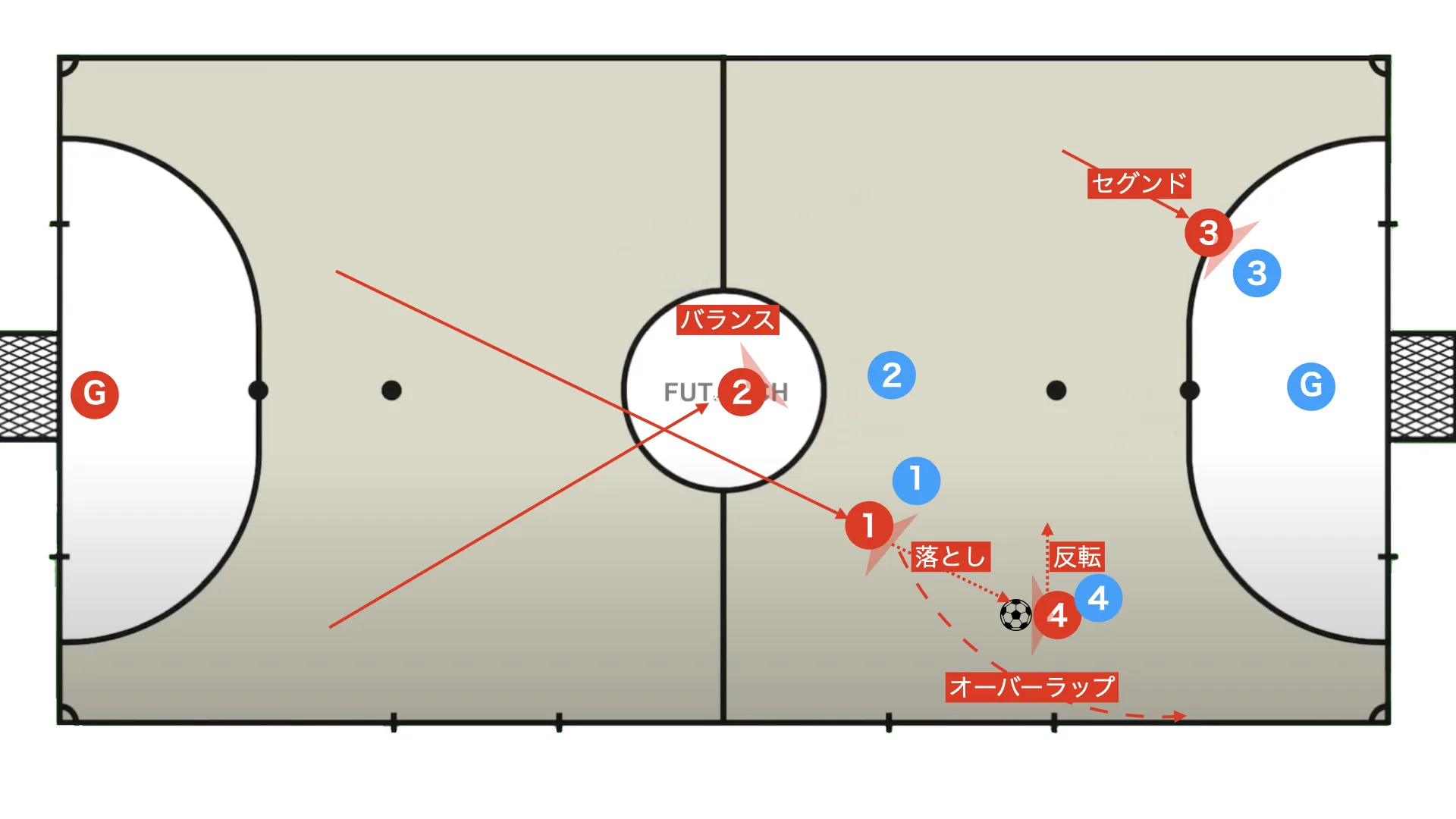
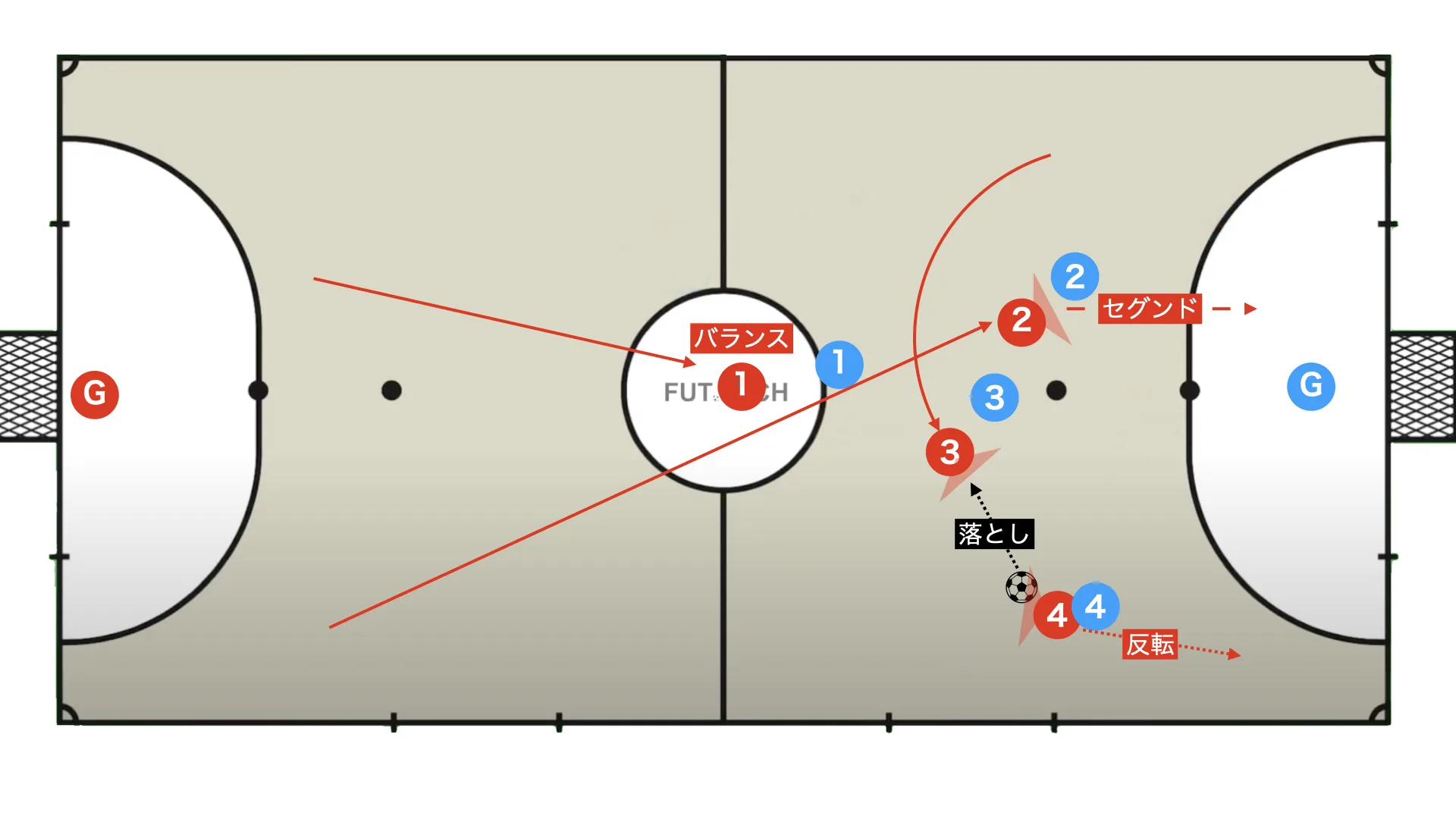
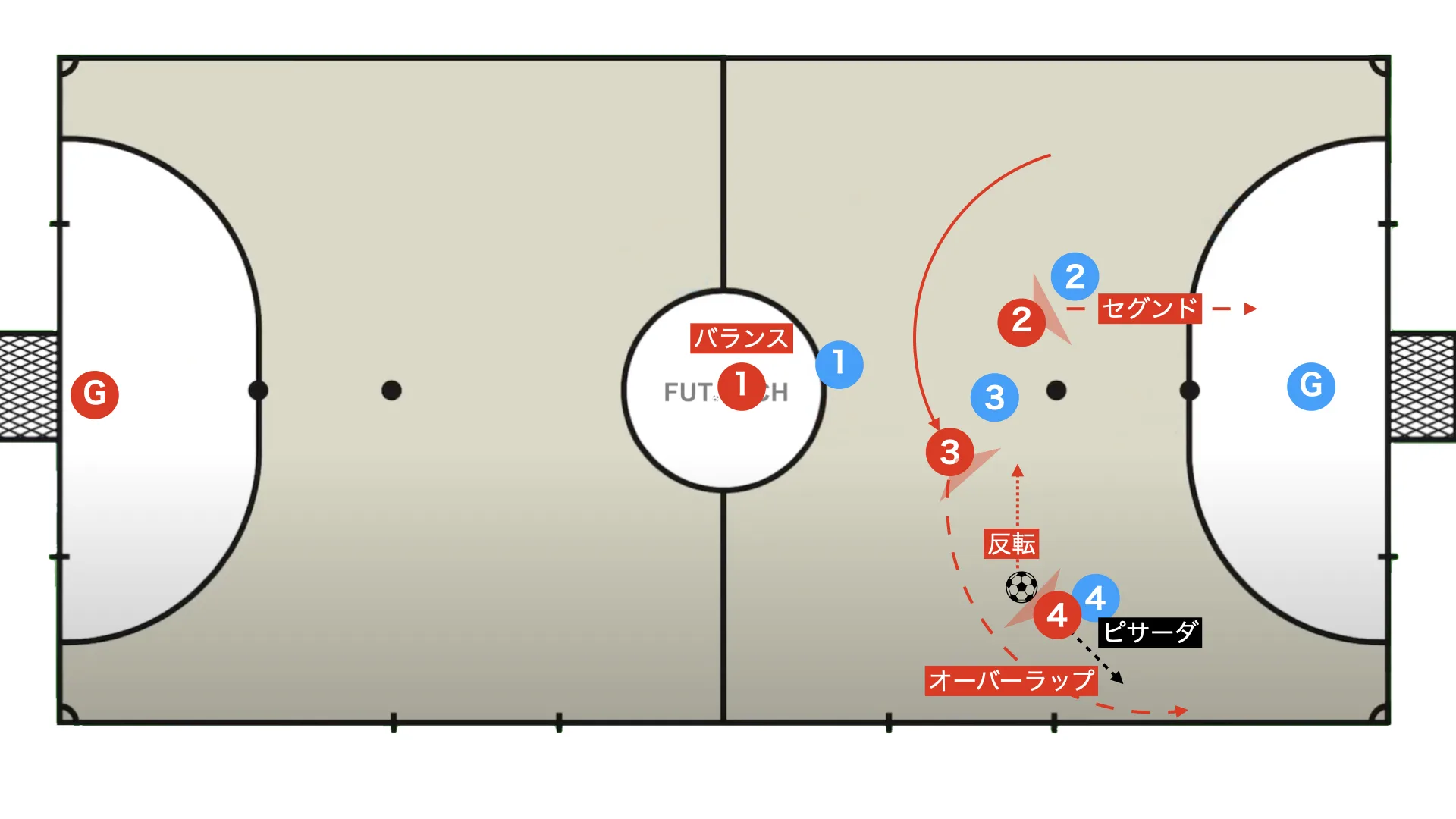
This is a tricky play, but if you switch the ball as if exchanging passes with the sole, it can really confuse the defender.
- Red no. 3 lays it off to red no. 4 with the sole
- Red no. 4 uses a shooting feint, then passes back to red no. 3 with the sole and overlaps around red no. 3
- Red no. 4 either turns inside or uses a pisada (making use of the overlapping red no. 4)
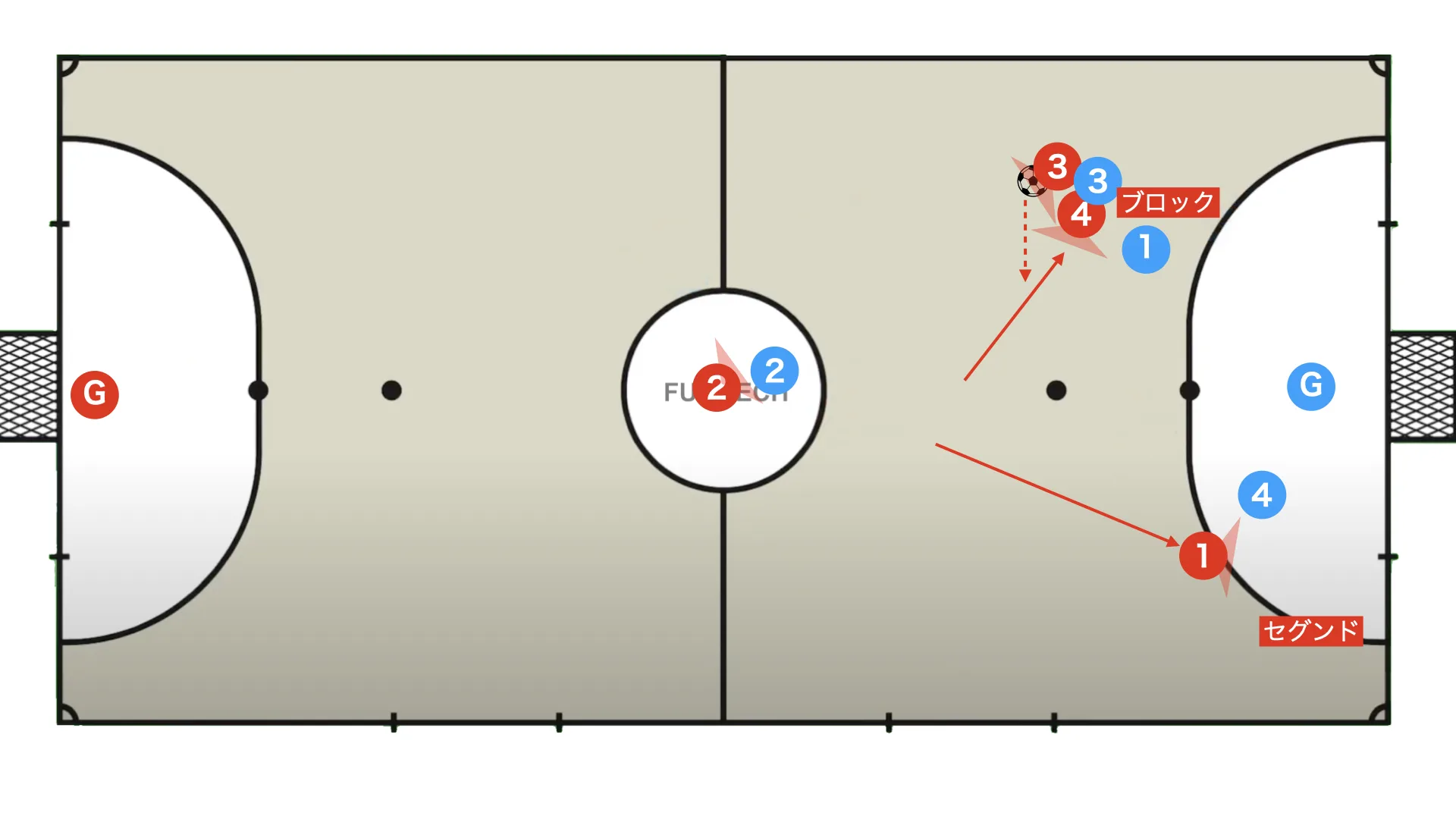
By blocking the pivot's marker from the side, you can help the pivot turn.
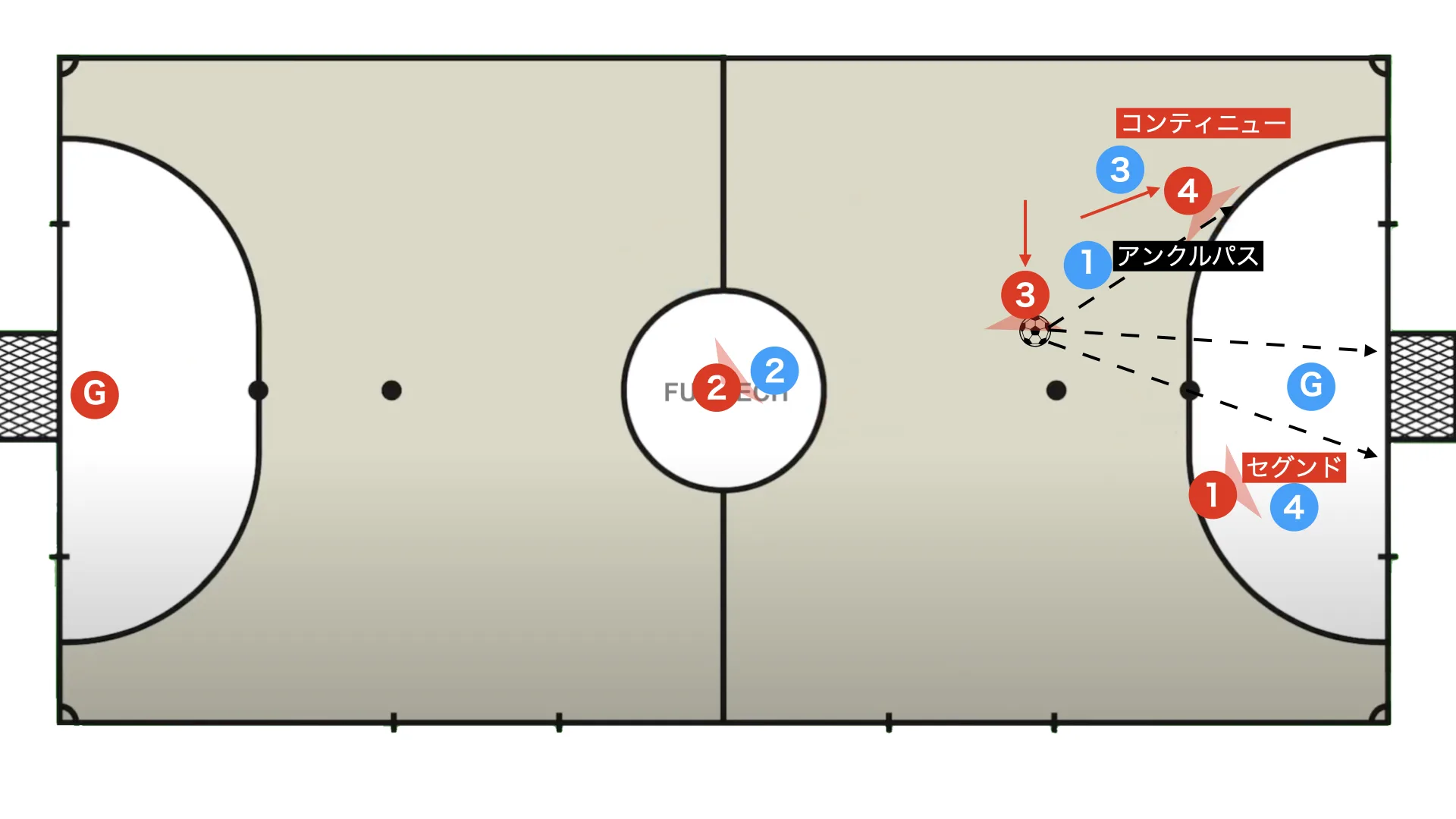
After making the block, red no. 4 should continue the movement, receive again if possible, and prepare for any loose ball.
I will omit the detailed explanation because it overlaps with earlier patterns, but there are also patterns where the player far from the ball becomes involved around the pivot.
The drawback is that it takes more time to reach the finish, but in some teams this option is better because of factors such as the players' stronger feet, so it is best to decide these patterns in advance.
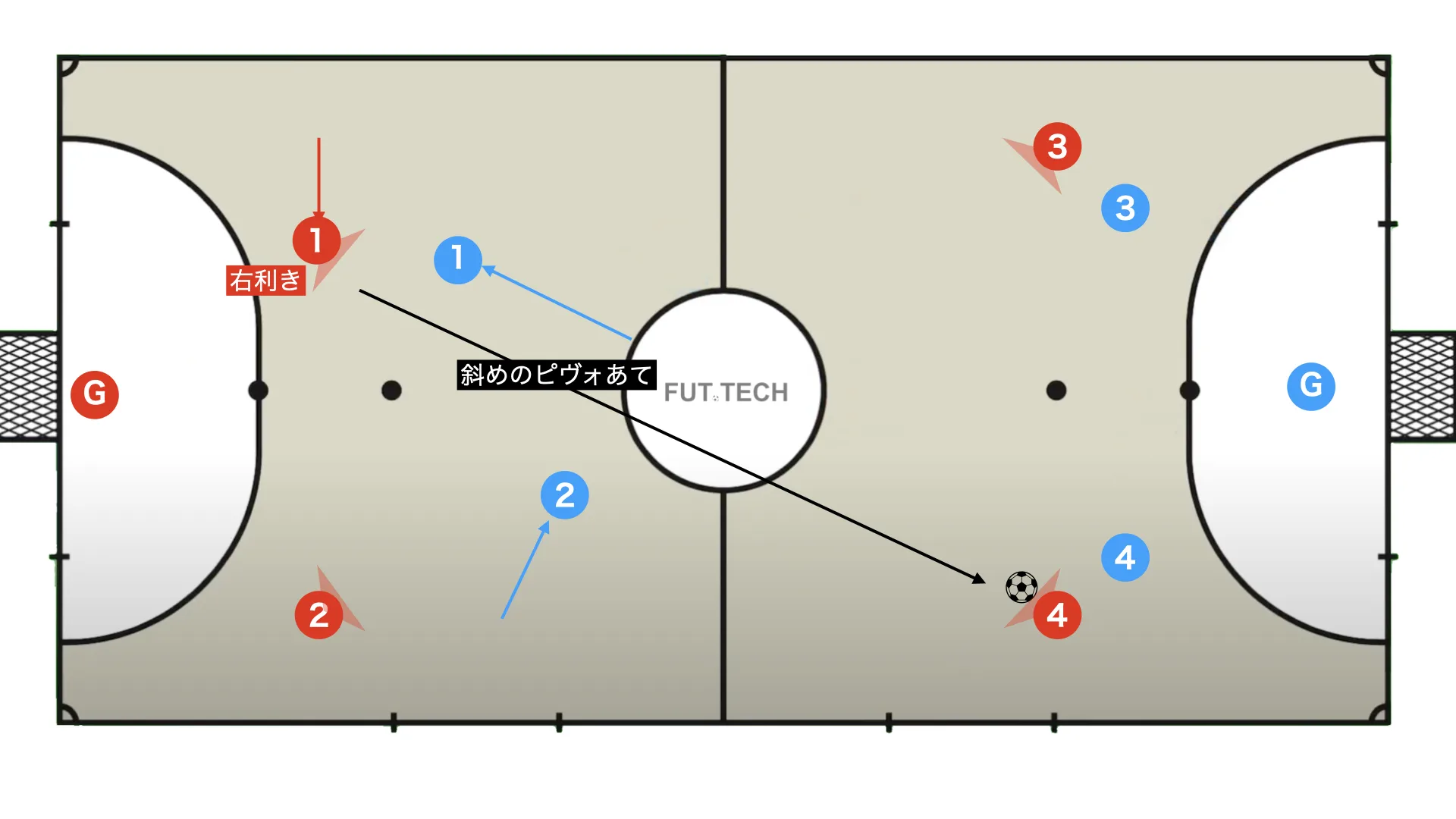
When the nearby fixo (red no. 2) makes the diagonal run, the pattern overlaps with the attack explained in the section on the vertical pivot pass, so I will skip the detailed explanation here.
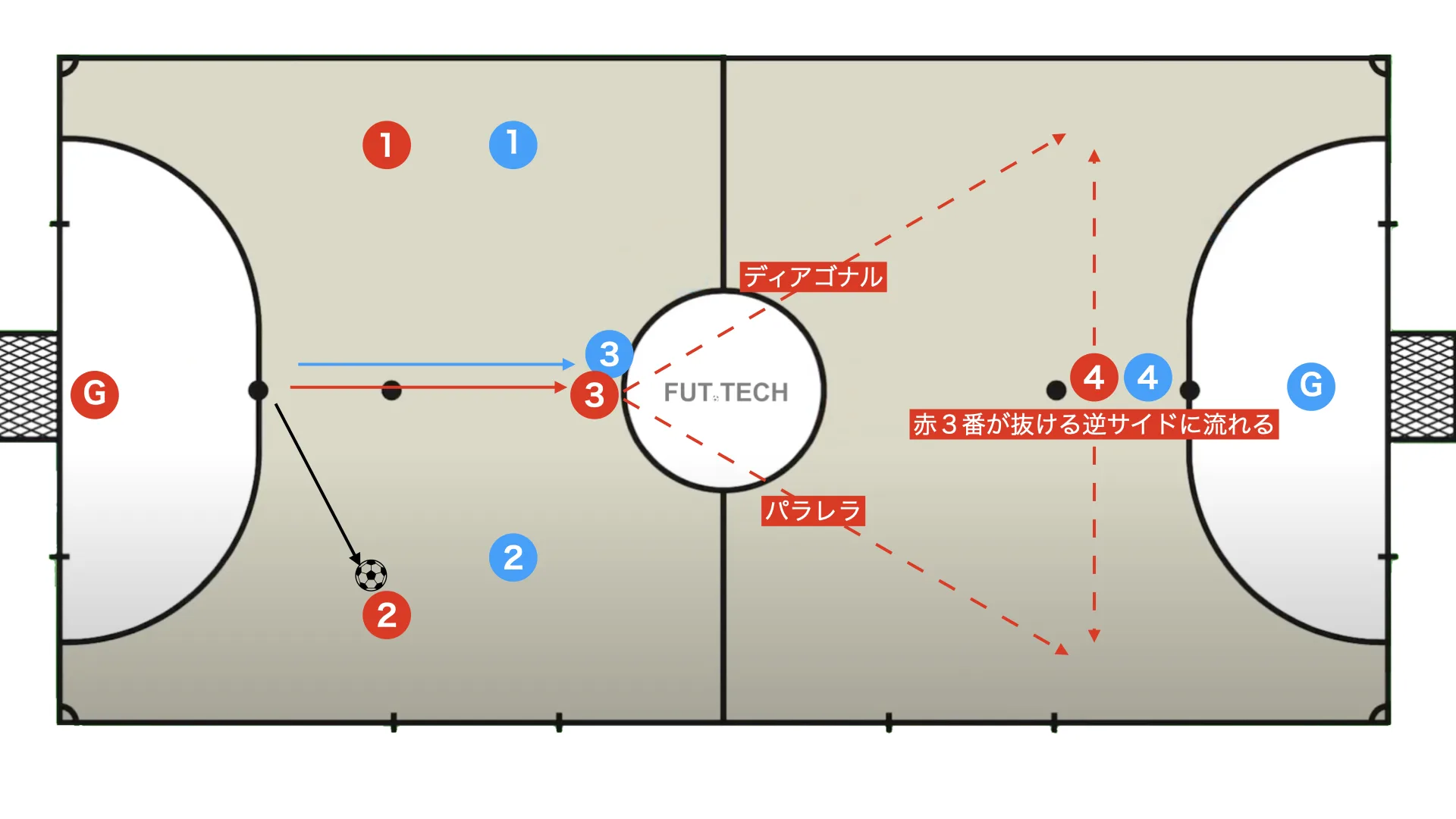
In a 3-1 phase, if one of the deeper players runs to the side opposite the pivot, the shape becomes 2-2.
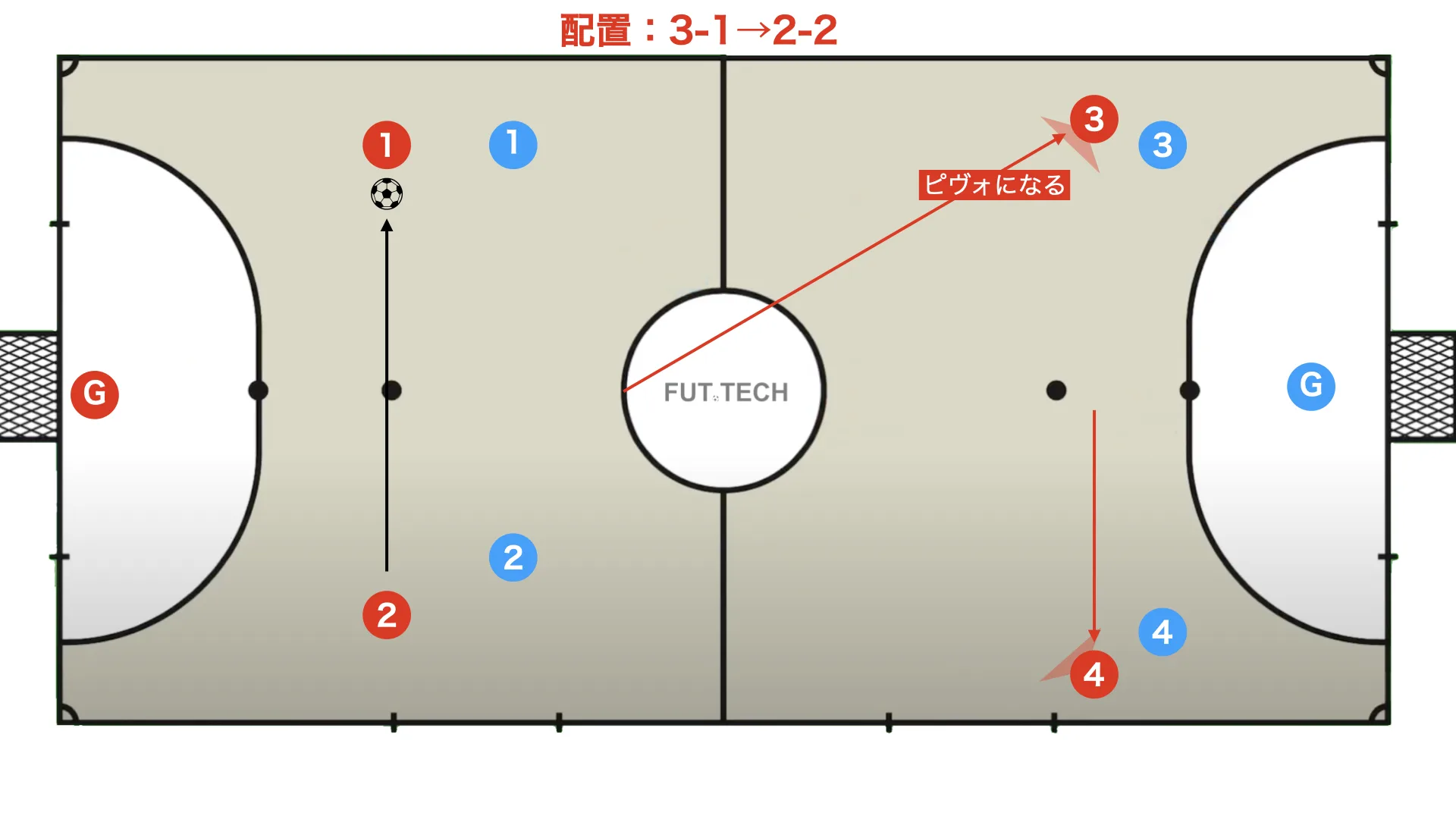
Also, if the player who made the run becomes the pivot (pivoting), the team can shift into exactly the same 2-2 system explained in this article.
Conversely, if one of the front two drops back into the first line again, the team can return to 3-1.
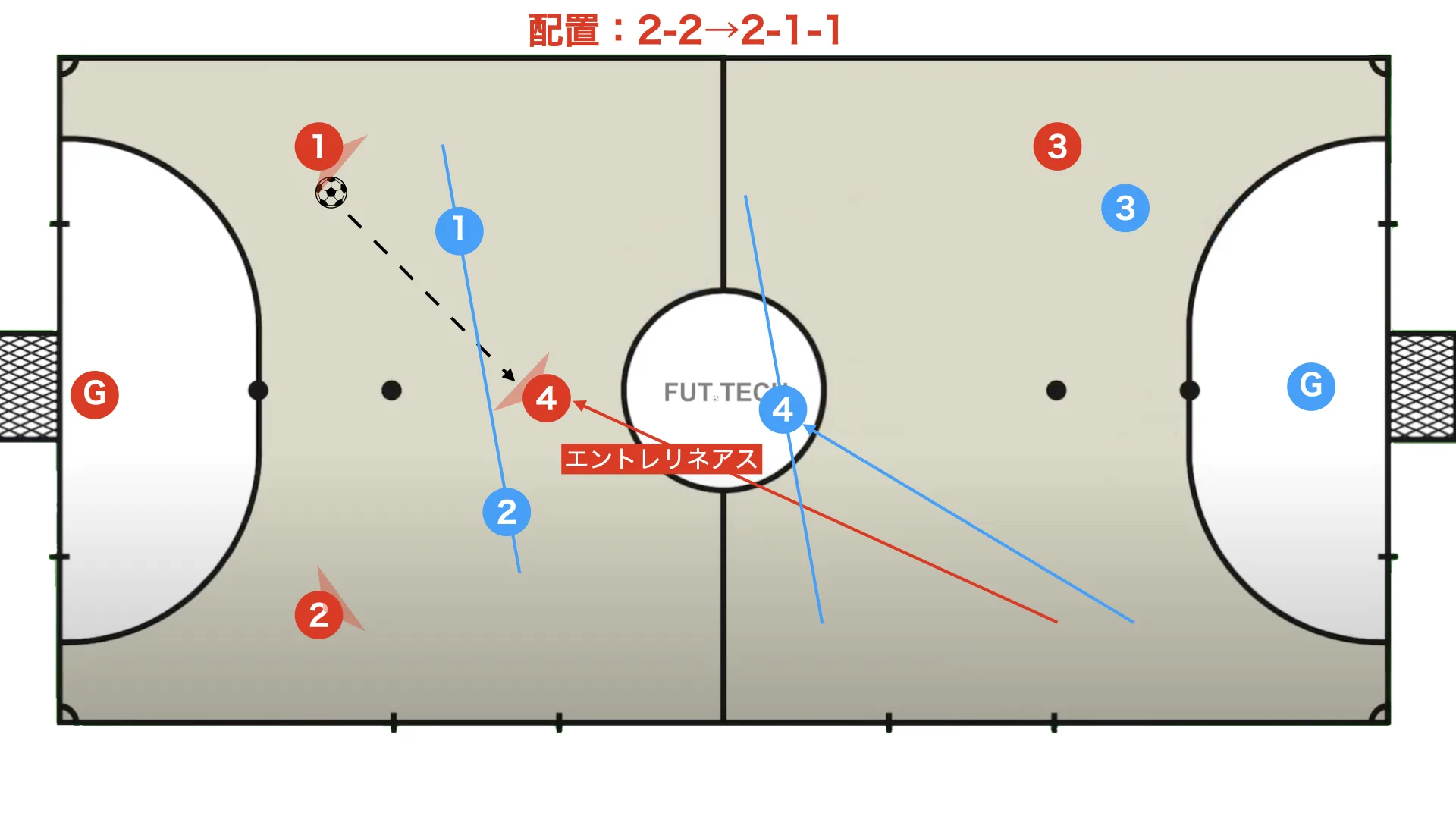
When it is difficult to play into the pivot, or when the pivot cannot hold the ball up in the front line, one player can drop into the space between the lines and the shape can shift into 2-1-1.
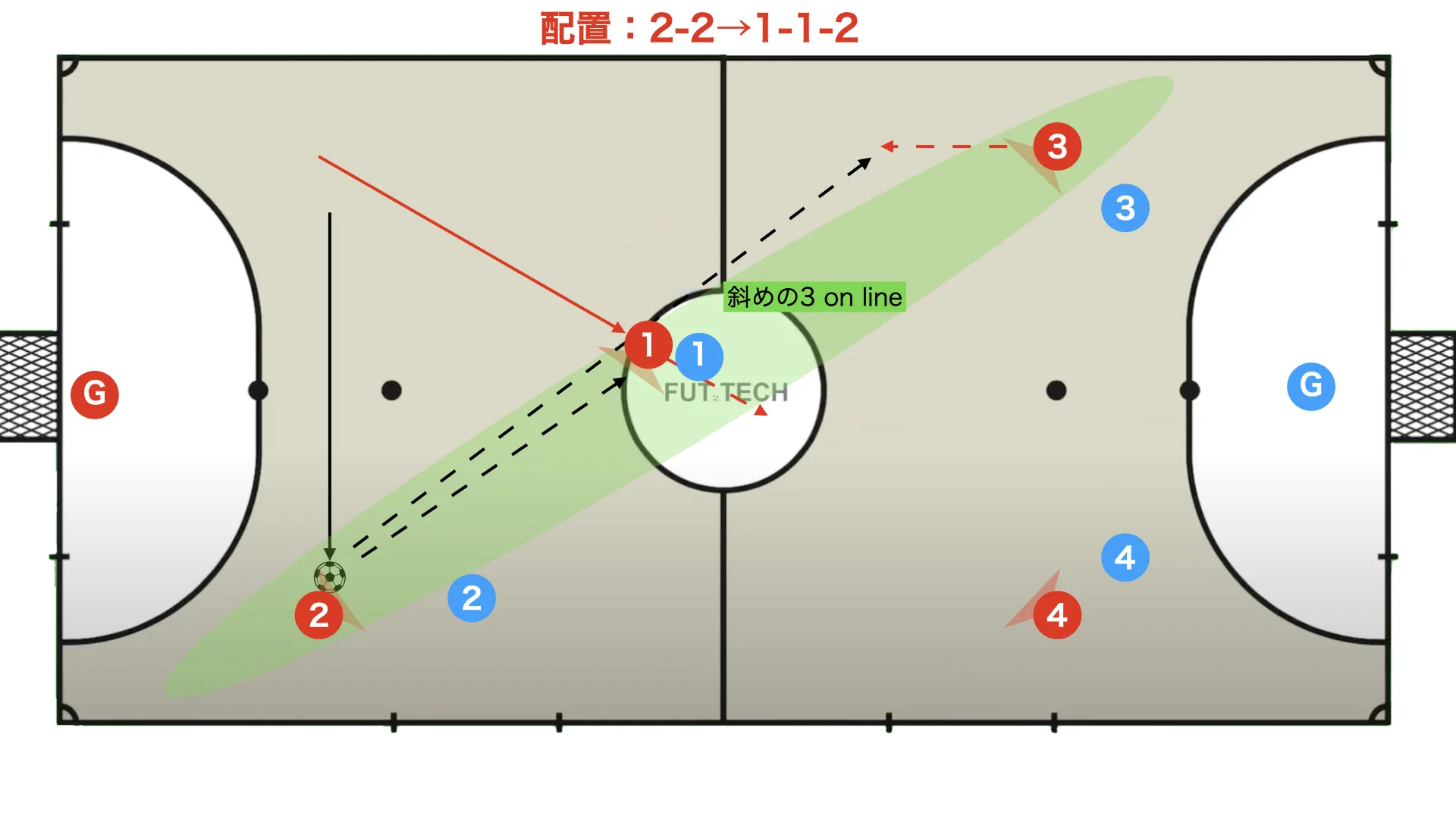
If the fixo without the ball moves up into the second line, the team can create a 1-1-2 shape.
This 1-1-2 may not be a familiar term, but quite a few teams use it without really thinking of it that way.
The advantage of this shape is that after playing into the pivot, the team can reach the finish with relatively little time and effort.
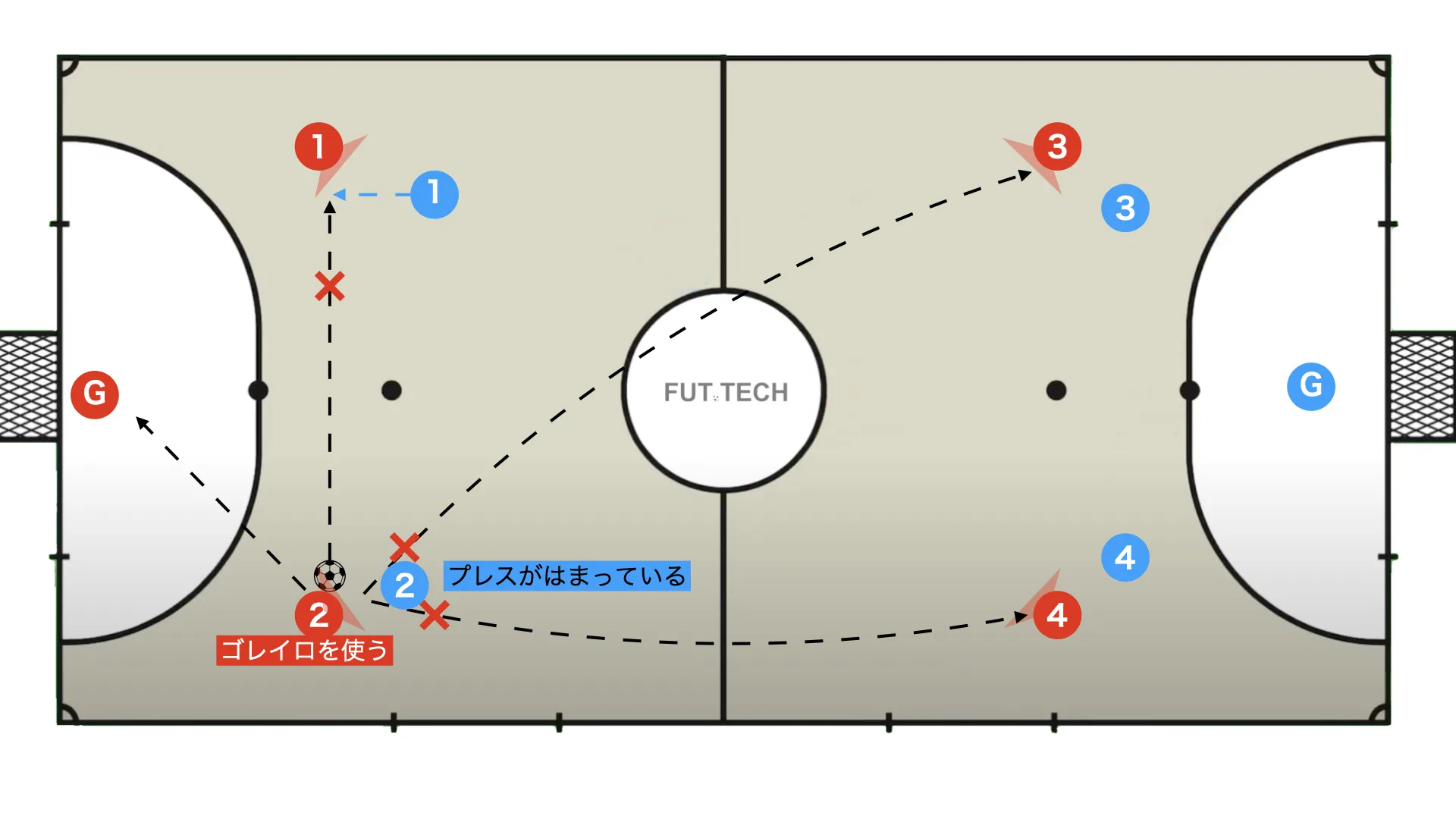
When the opponent's press looks like the diagram above, use the goalkeeper decisively. (If a back pass is not available, clearing it safely is the sensible option.)
Defending
If the 1st defender (blue no. 2) is pressing the ball and both passing lanes into the pivots are cut out, blue no. 1 should not screen the pivot lane. Instead, blue no. 1 should screen the remaining passing lane, in other words the horizontal pass lane to red no. 1.
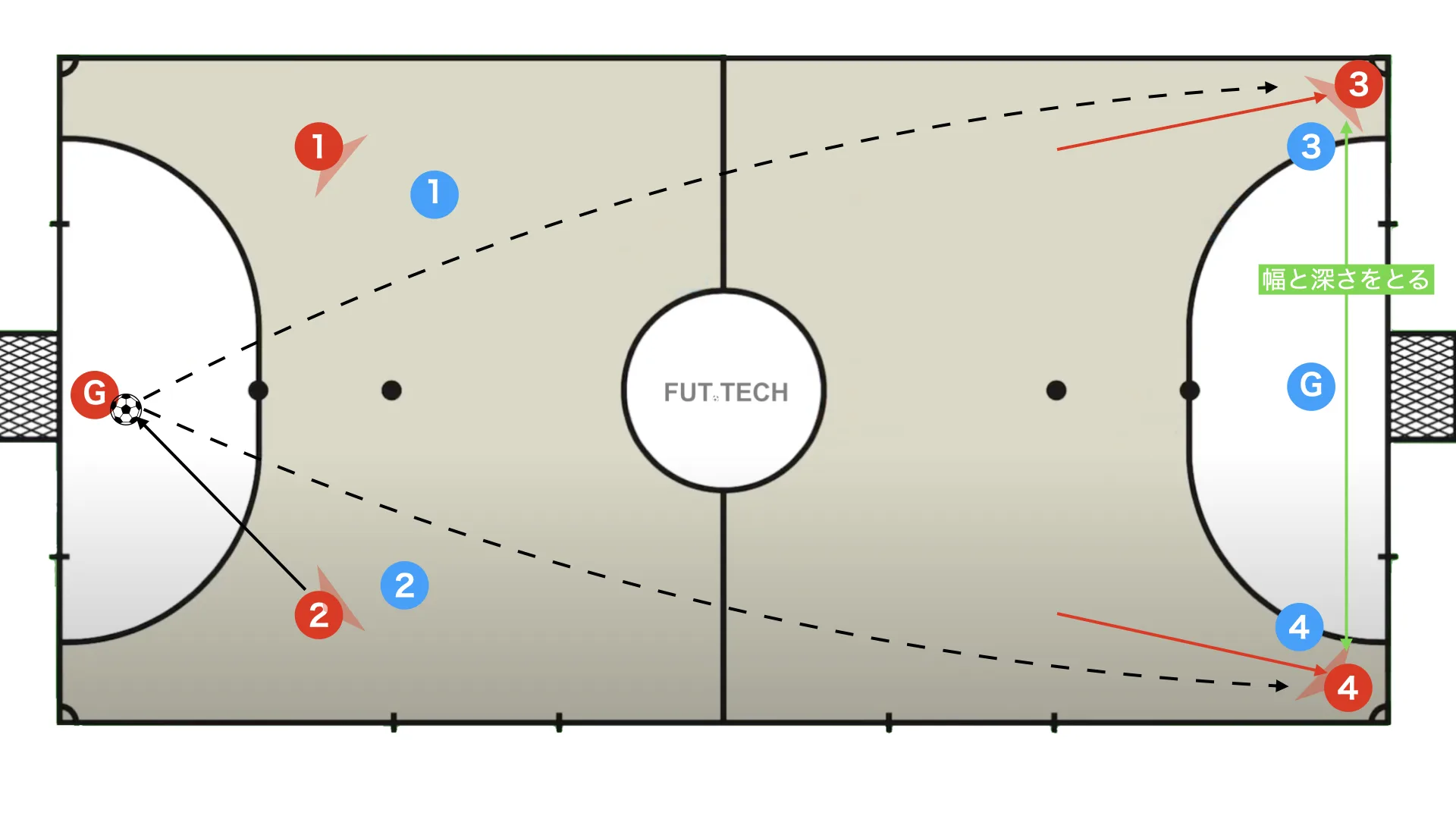
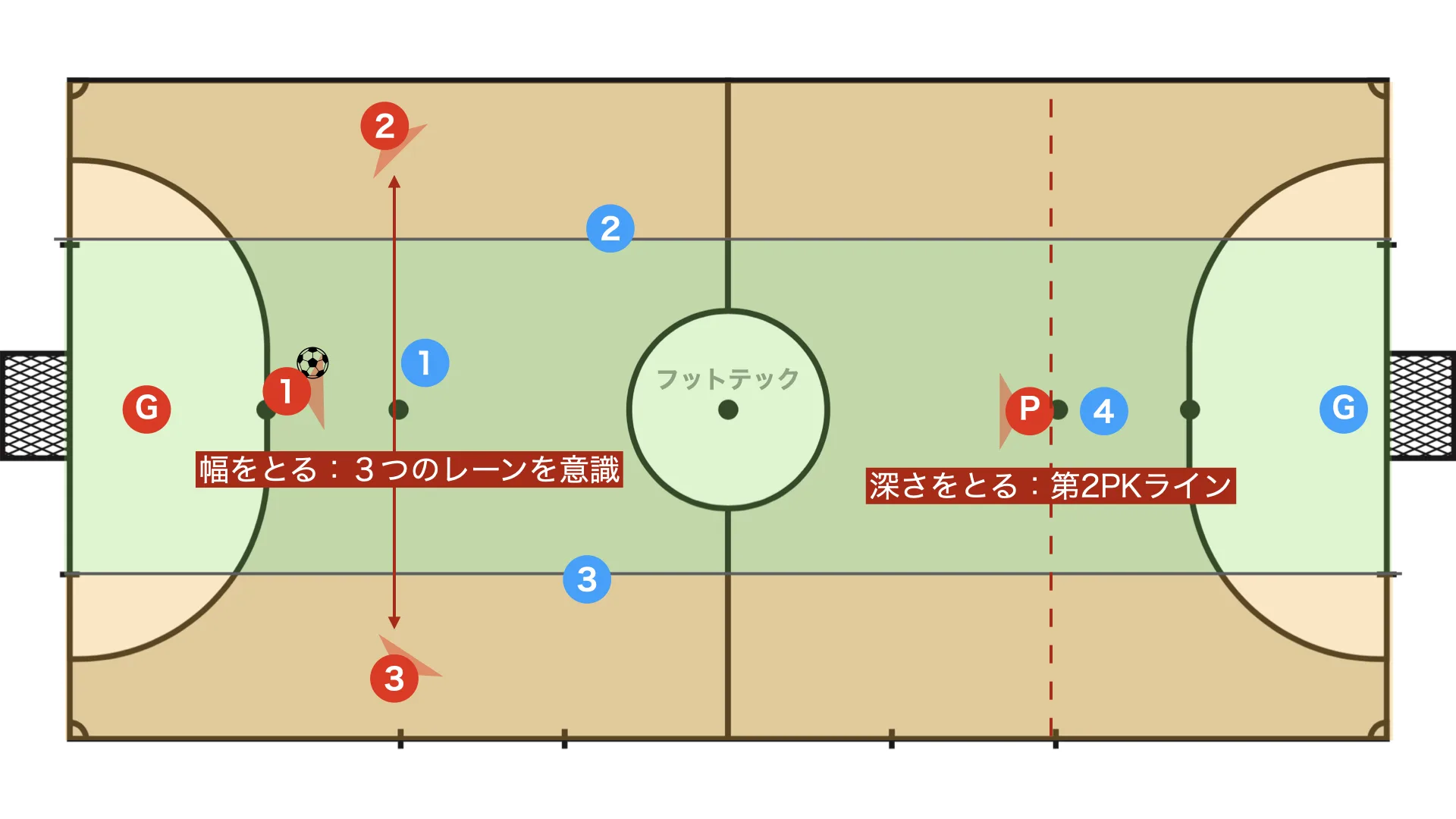
The two pivots in the front line should provide width and depth.
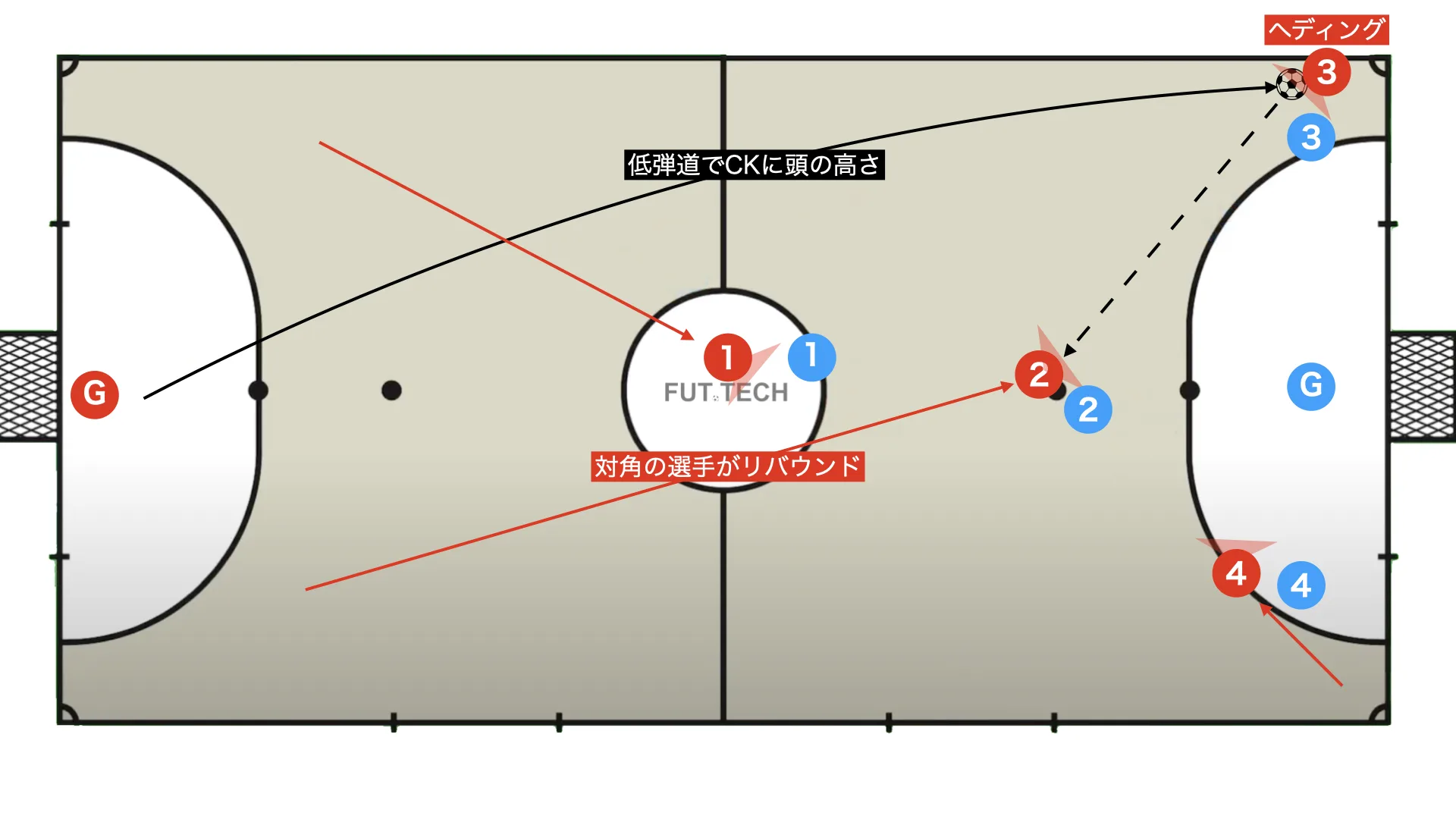
- The goalkeeper drives a low ball toward the head of one of the pivots
- The diagonal player (the fixo) takes up a rebound position, taking into account stronger foot and body orientation
- The other fixo takes up the balance (cover) position
- The pivot heads the ball back toward the rebound position, making sure the goalkeeper cannot claim it
What did you think?
This system is simple and easy to understand structurally, but it does require a certain level of individual ability.
That is why it tends to be especially effective for temporary teams with many players who come from soccer.
Also, if you consider how teams often drift into this shape without realizing it, either by one player running out of 3-1 or by two players running out of 4-0, organizing your understanding of this shape once should deepen your overall understanding of positional attack.
It is an interesting system to try as a team, so give it a real go.
関連記事
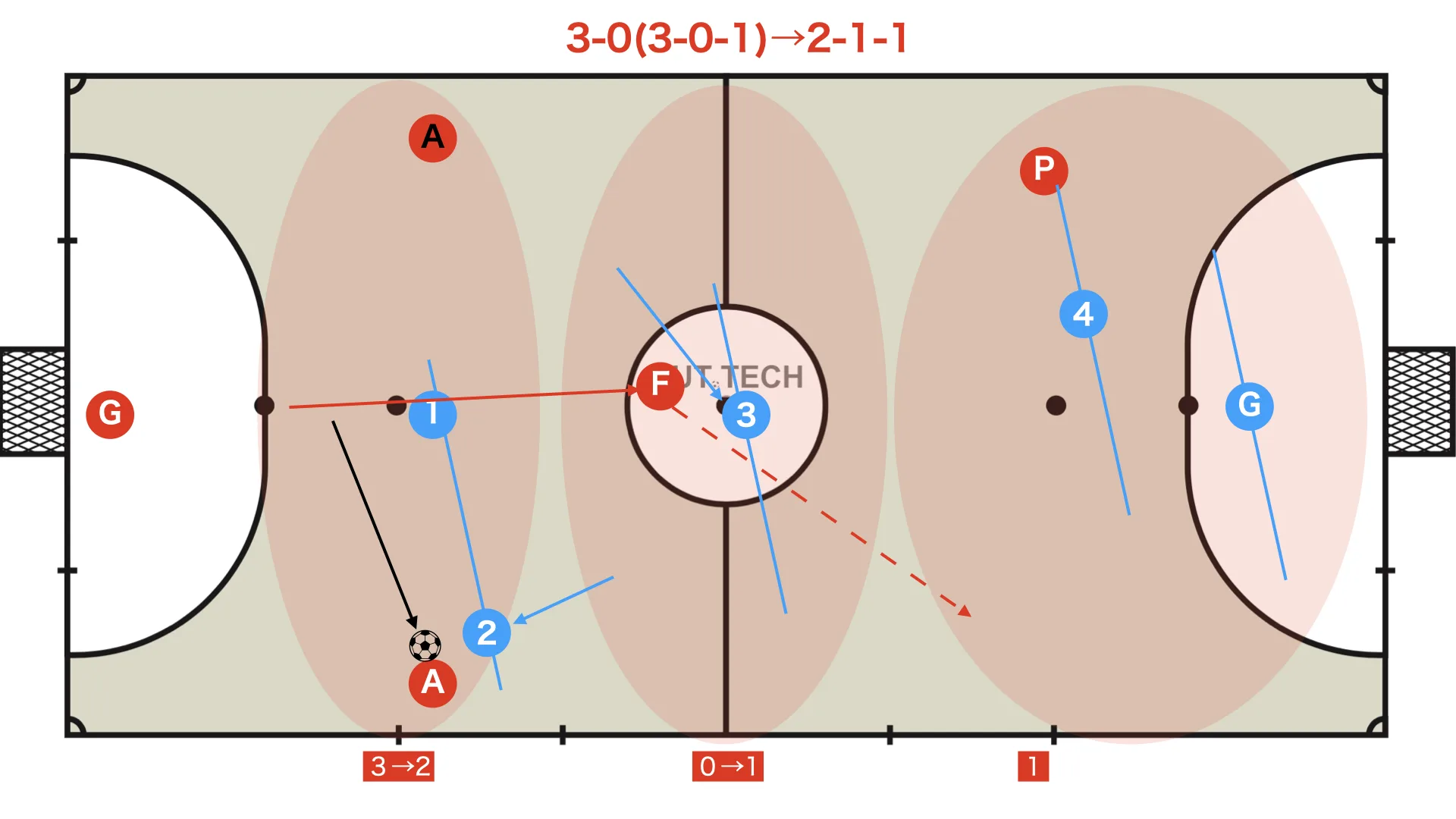
Positional Attack: How to Think About Formations and Rotations
A structured guide to formations and rotations in futsal positional attack. This article explains th…
続きを読む →